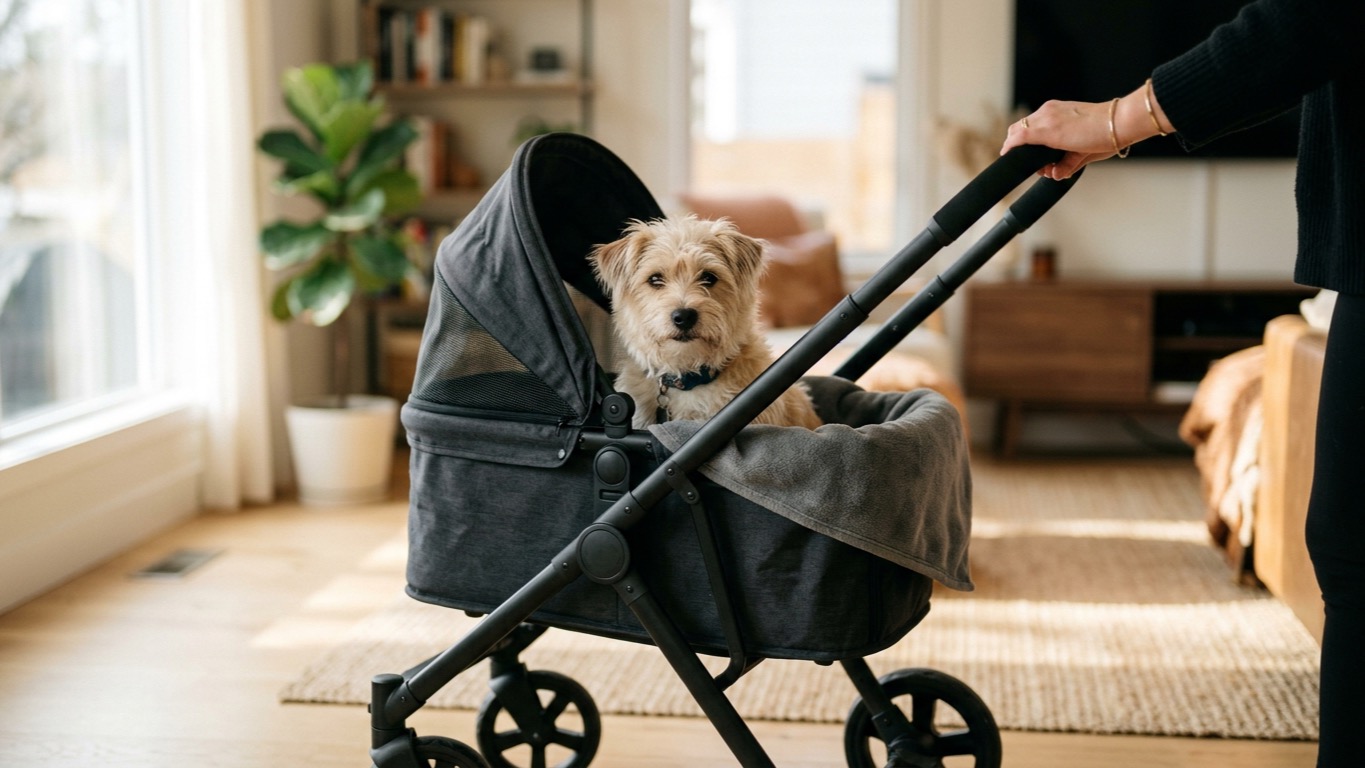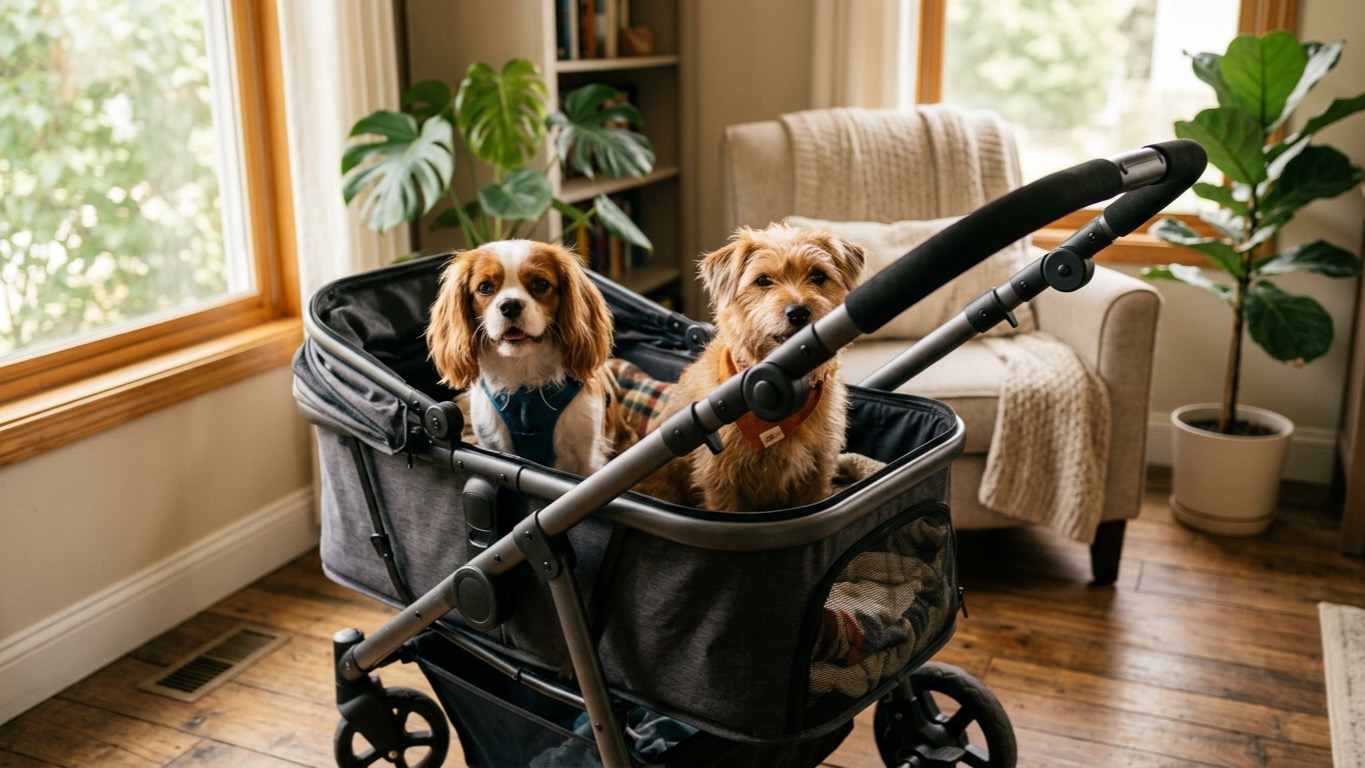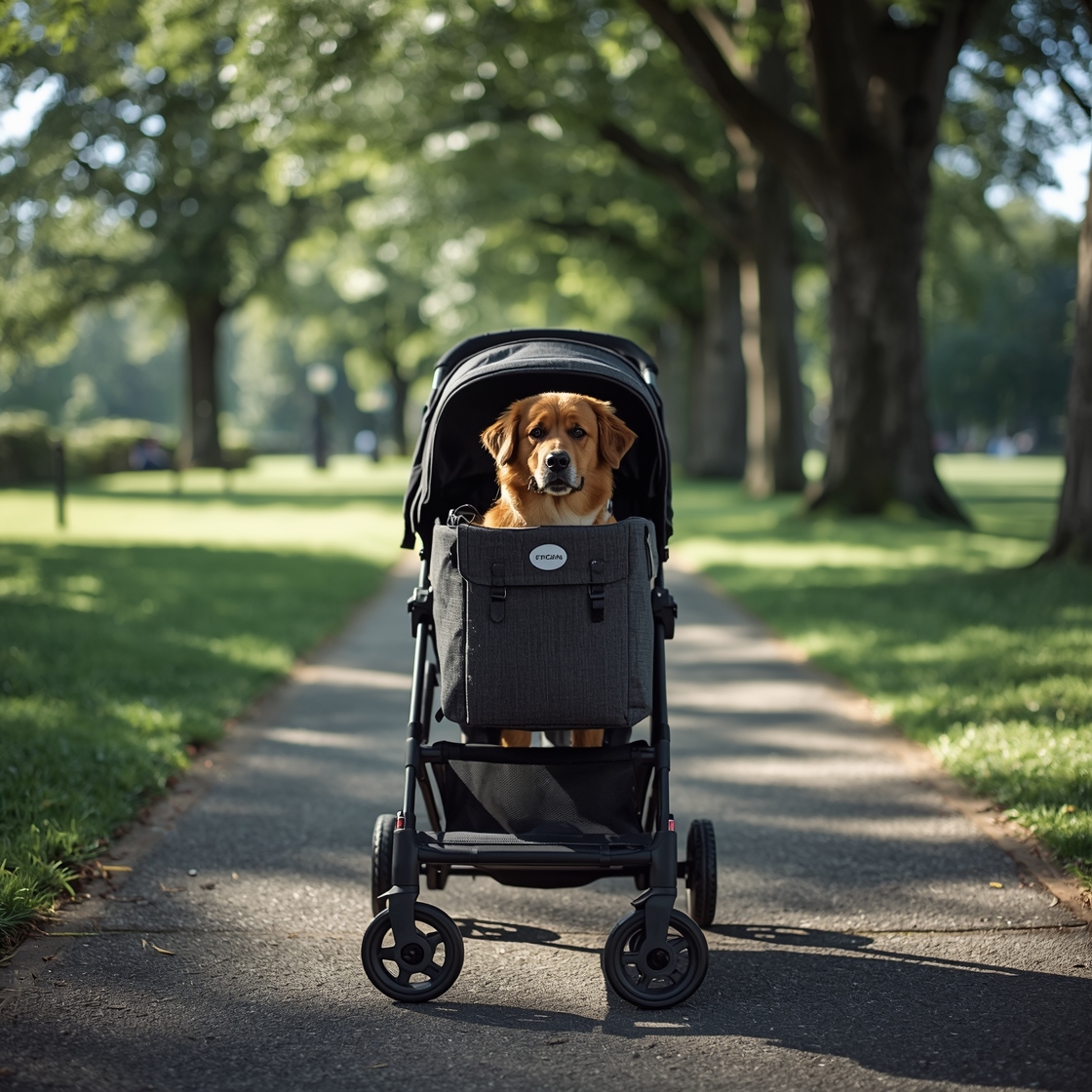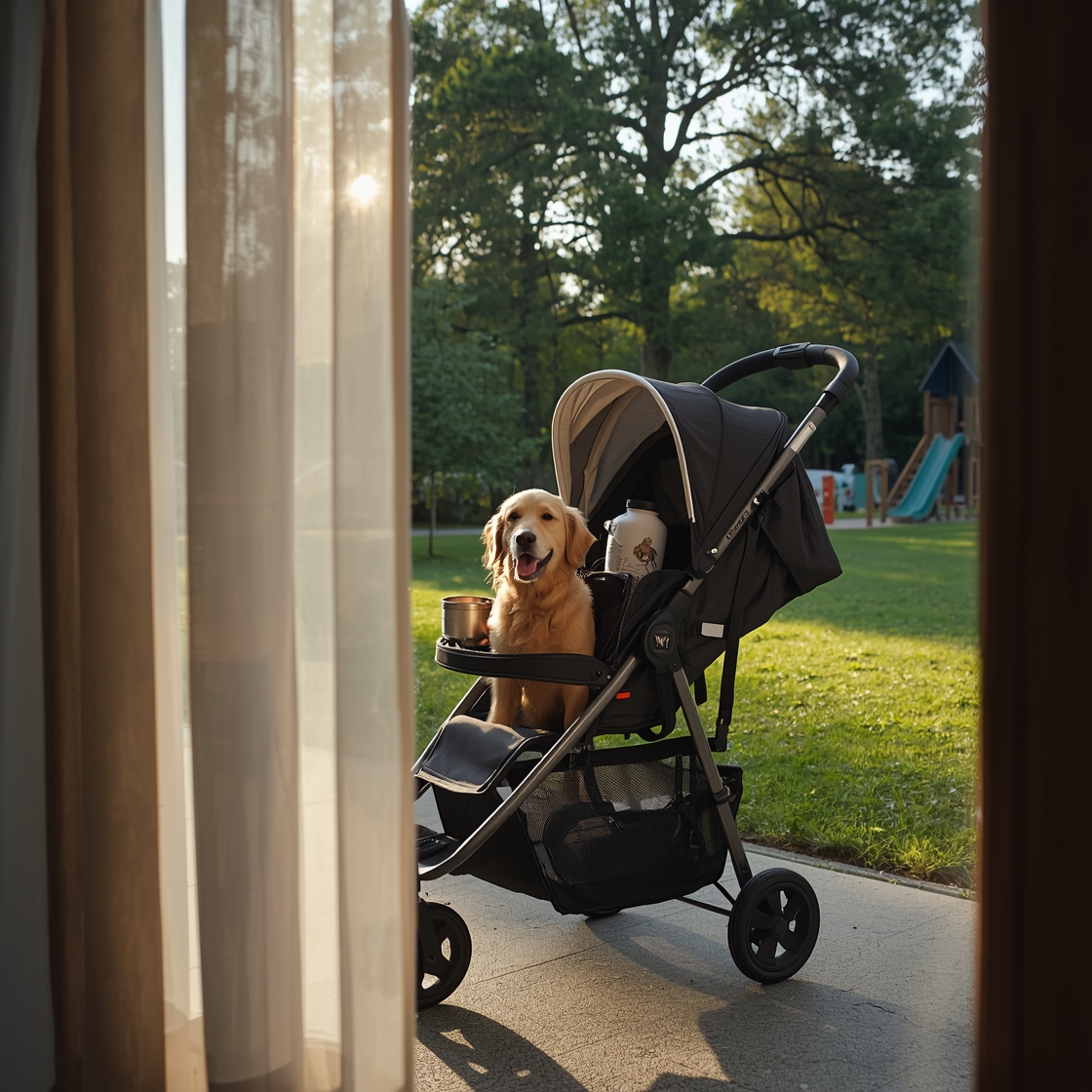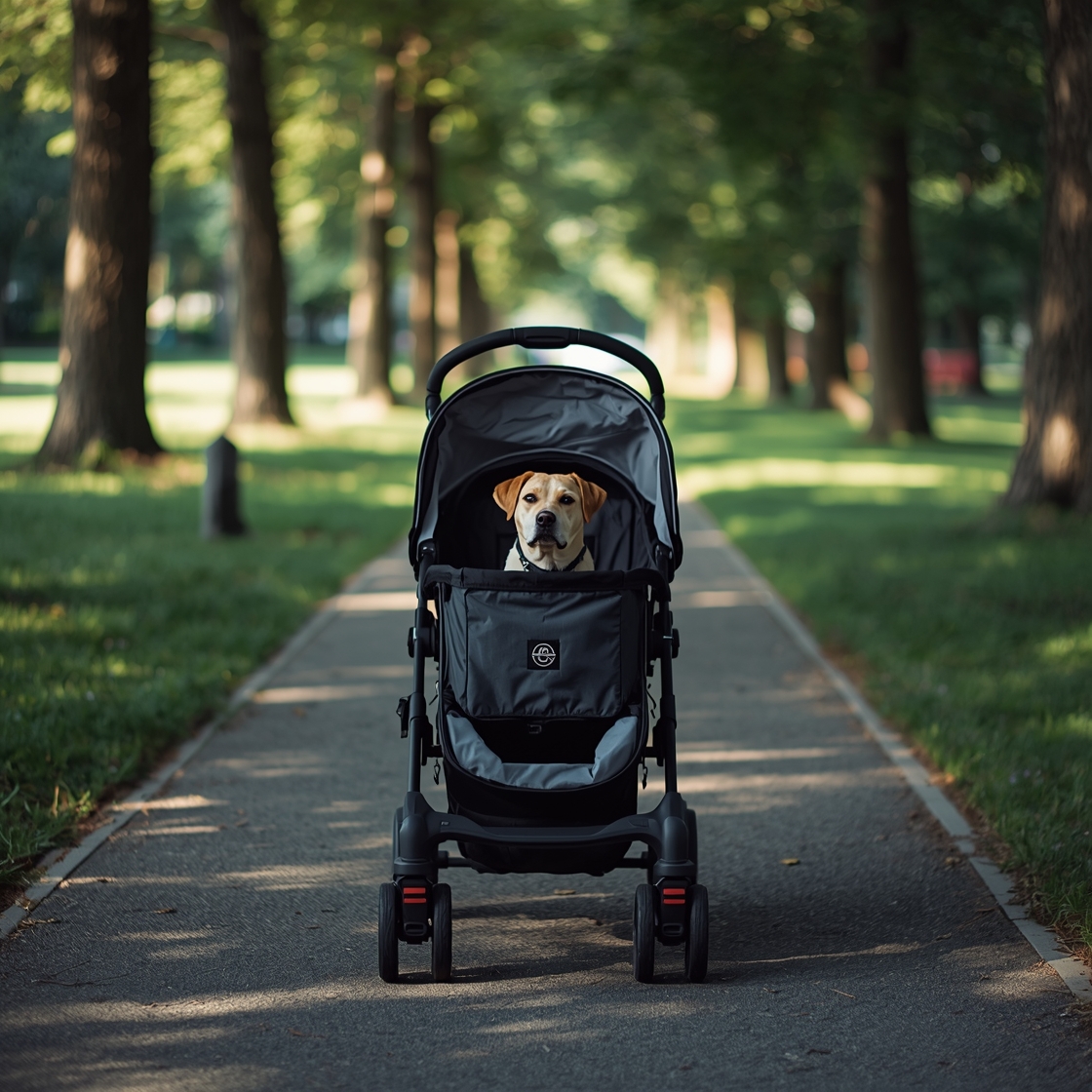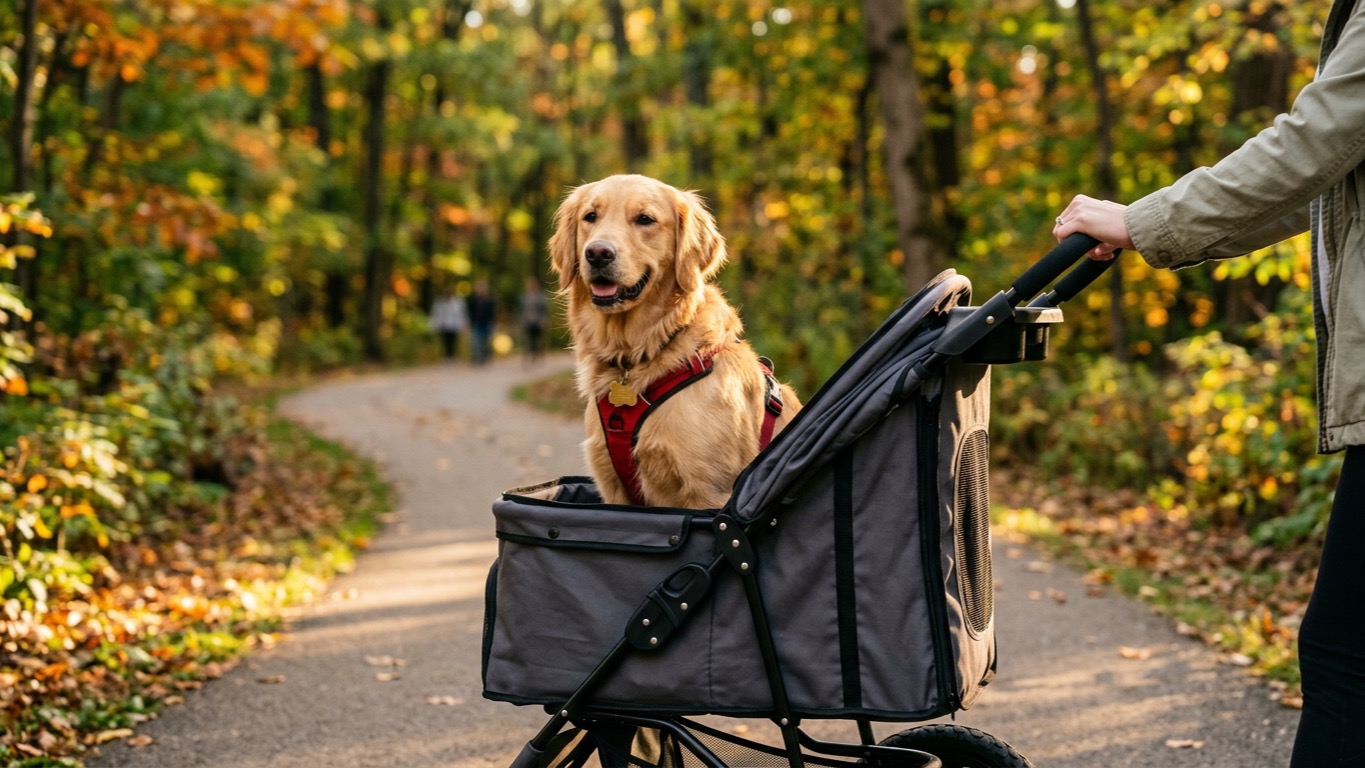
A dog jogging stroller is defined by three hardware facts, not by the word "jogger" in the title: a front wheel that locks or is fixed, tires large enough to roll over a sidewalk expansion joint without deflecting, and a hand brake you can reach at speed. On the we sorted 7 shortlisted frames into three classes. True jogger-class frames sit at $248.76–$299.99 (median $274.38). Mid all-rounders run $149.99–$180.49. Light city three-wheelers start at $44.99. That is a 6.7× spread across frames that all appear under the same search term — and the cheapest ones are not slower versions of the expensive ones, they are a different product doing a different job.
If you searched for a dog jogging stroller and the results looked interchangeable, that is the core problem in this category. Marketplace listings use "jogger," "jogging," and "all-terrain" as keywords rather than as specifications. A $45 three-wheel frame with a permanently swiveling front caster and 8-inch plastic wheels will appear next to a $300 frame with a lockable 12-inch front wheel and a proper brake, and the photographs look similar enough that most buyers never notice the difference until the first run.
The difference matters at exactly one moment: when you accelerate past a walking pace and the front caster starts to shimmy. A swiveling caster is a feature at 2 mph and a hazard at 6 mph. Everything below is organized around telling those two products apart before you buy.
The 30-Second Verdict
- If you actually run: Pet Gear No-Zip AT3 ($248.76) or PETIQUE Trailblazer Jogger ($299.99). These are the only two frames here built for jogging cadence.
- If you walk briskly and want one good frame: the $149.99–$180.49 mid band — Zoosky, Bicystar, or PawHut.
- If you need a light frame for errands and vet trips: MoNiBloom at $44.99 or ROODO at $96.98. Do not run with these.
- The single spec that decides it: can the front wheel be locked straight? If no, it is not a jogging stroller regardless of the listing title.
- The second spec: is there a hand brake on the handlebar? A foot-operated parking brake is not the same thing.
Proprietary Tables
Built from published listing specifications for the seven frames on this page, plus the desk's standing classification rules for wheeled pet transport. These are shopping heuristics, not engineering certifications.
Table 1 — Price bands for dog jogging stroller classes
| Class | Price range | Page examples | Count | Intended surface |
|---|---|---|---|---|
| Light city 3-wheel | $44.99–$96.98 | MoNiBloom, ROODO | 2 | Smooth sidewalk, short trots |
| Mid all-rounder | $149.99–$180.49 | Zoosky, Bicystar, PawHut | 3 | Mixed paths, brisk walking |
| Jogger / all-terrain | $248.76–$299.99 | Pet Gear AT3, PETIQUE Trailblazer | 2 | Sustained running cadence |
Desk stat: Jogger-class median on this page is $274.38; city-class median is $70.99; page-wide median is $149.99 and the mean is $167.31. The gap between the city median and the jogger median is $203.39 — that is the real cost of the lockable front wheel, the larger tires, and the brake.
Table 2 — Feature gate: what earns the "jogging" label
| Feature | Jogger pass | City-only | Why it matters at speed |
|---|---|---|---|
| Front wheel | Fixed or lockable straight | Always-swivel caster | Swivel shimmies above roughly 5 mph |
| Tire diameter | 10 in or larger, air or dense foam | 6–8 in hard plastic | Small wheels stop dead on lips and joints |
| Brake | Hand brake at the grip | Foot parking brake only, or none | You cannot reach a foot brake mid-stride |
| Wheelbase | Long, low center of gravity | Short and tall | Short wheelbase tips on camber |
| Frame material | Steel or heavier-gauge aluminium | Thin-wall tube | Flex becomes wobble under load |
| Rated pet weight | Honest margin above your dog | Optimistic round numbers | Frames fail at the axle first |
Table 3 — Dog weight versus stroller duty
| Dog weight | Desk recommendation | Frame class | Notes |
|---|---|---|---|
| Under 20 lb | Light 3-wheel is adequate for walking | City | Still tether the harness inside |
| 20–35 lb | Mid all-rounder minimum | Mid | Check cabin height for a seated dog |
| 35–50 lb | Mid or jogger, verify axle rating | Mid / jogger | Many "large" listing photos show empty cabins |
| 50–70 lb | Jogger-class frame only | Jogger | Confirm the rating is per-frame, not per-wheel |
| 70 lb+ | Wagon or wheeled cart instead | Neither | Stroller cabins run out of floor before weight |
Table 4 — Cadence and surface matrix
| Your pace | Surface | Minimum class | Front wheel setting |
|---|---|---|---|
| Walking, 3 mph | Sidewalk | City | Swivel unlocked |
| Brisk walk, 4 mph | Sidewalk and packed path | City or mid | Swivel unlocked |
| Slow jog, 5 mph | Smooth asphalt | Mid at minimum | Locked straight |
| Steady run, 6–7 mph | Asphalt or track | Jogger | Locked straight |
| Trail, any pace | Gravel, root, camber | Jogger with air tires | Locked straight |
| Any pace, downhill | Any | Jogger with hand brake | Locked straight |
Table 5 — Pre-run checklist (60 seconds, every time)
| Check | Pass | Fail | Action |
|---|---|---|---|
| Front wheel lock engaged | Clicks and holds | Rotates under hand pressure | Do not run |
| Tire pressure or foam integrity | Firm, no flat spot | Squashy or cracked | Inflate or replace |
| Fold latch seated | Audible click both sides | One side soft | Re-seat before loading dog |
| Hand brake travel | Bites before the grip | Pulls to the bar | Adjust cable |
| Internal tether clipped | To harness, short | To collar, or loose | Re-clip to harness |
| Wrist strap on | Around your wrist | Dangling | Put it on |
| Cabin free of hazards | No loose toys or cords | Anything that can be swallowed | Remove |
Table 6 — Maintenance calendar
| Interval | Task | Why |
|---|---|---|
| Every run | Wipe grit off the front fork | Grit is what kills the swivel bearing |
| Weekly | Check tire pressure on air tires | Under-inflation causes pull |
| Monthly | Torque axle nuts and handlebar bolts | Vibration loosens everything |
| Monthly | Inspect welds at the fork crown | The first failure point on used frames |
| Quarterly | Lubricate brake cable and fold hinges | Sticky brakes are late brakes |
| Seasonally | Wash the cabin liner | Hair and grit abrade the mesh |
How We Ranked These Frames
We list the two genuine jogger-class frames first because the search term is "dog jogging stroller" and the honest answer is that only two products here satisfy the feature gate in Table 2. After that we descend by capability rather than by price, ending with the light city frames that are excellent at what they do and dangerous at what they are marketed for.
For each product we read the published specifications, checked the front wheel type and brake configuration against the gate, and noted recurring themes in public owner commentary.
Top Picks: Dog Jogging Stroller — Reviewed Products
1. Pet Gear No-Zip AT3 Pet Stroller for Cats/Dogs
Best for: the owner who runs three or more times a week and wants the no-zip entry system.
At $248.76 this is the less expensive of the two true jogger-class frames here, and the distinguishing feature is in the name. The no-zip system replaces the zippered cabin entry with a latch-and-lift mechanism, which sounds like a convenience feature and is actually a safety one: zippers on pet strollers fail by splitting behind the slider, and a split zipper on a moving frame is how dogs exit unexpectedly. Removing the zipper removes the failure mode.
The AT3 designation points at all-terrain intent — larger wheels, a longer wheelbase, and a front wheel that can be set straight for running. That combination is what keeps the frame tracking instead of wandering when you are pushing one-handed at a steady cadence. The cabin is generously sized for a medium dog to sit up rather than lie flat, which matters more than owners expect; a dog that cannot see out spends the run trying to stand.
The trade-offs are weight and folded footprint. Jogger-class frames are heavy, and this one does not disappear into a hatchback the way the ROODO does. If you drive to your running route, factor the lift into the decision.
Pros: No-zip entry removes the most common cabin failure; genuine all-terrain wheel package; cabin height suits a seated medium dog; the cheaper of the two real joggers here.
Cons: Heavy; large folded; $248.76 is a serious commitment if you only walk.
2. PETIQUE Trailblazer Jogger
Best for: trail use and the owner who wants the most jogger-committed frame on the page.
At $299.99 this is the most expensive item here and the one whose entire product identity is running. "Trailblazer" and "Jogger" in the same name is not subtle, and the specification set follows through: this is the frame you buy when your route includes gravel, packed dirt, and camber rather than clean municipal sidewalk.
The case for spending the extra $51 over the AT3 comes down to surface. On asphalt, the two frames are closer than the price gap suggests. On anything loose or uneven, larger and softer tires stop transmitting every impact into the cabin, and a dog that is not being shaken will settle instead of bracing. Owners describing trail use consistently report that the difference is in the dog's behavior, not the push effort.
Where it is the wrong choice: apartment storage and short errands. This is a committed piece of equipment. If it lives in a hallway and you use it twice a month, you have bought $300 of frame to do $90 of work.
Pros: Most capable frame here on loose or uneven surfaces; jogger geometry throughout; cabin insulation from impact keeps dogs settled.
Cons: Highest price on the page; bulkiest to store; overspecified for pure sidewalk use.
3. PawHut 3 Wheels Pet Stroller
Best for: the top of the mid band — brisk walking, occasional slow jogging, and a budget that stops short of $200.
At $180.49 the PawHut sits closest to jogger territory without paying jogger prices, and that position makes it the most interesting compromise on this page. Three wheels, a reasonable wheelbase, and a frame substantial enough that it does not flex noticeably under a medium dog. For someone who walks fast and breaks into a jog for a block or two, this is defensible.
What you should verify before assuming it is a dog jogging stroller in the strict sense is the front wheel behaviour. Mid-band frames vary: some ship with a genuine lock, some with a detent that holds at walking speed and releases under load, and some with nothing at all. The listing photograph will not tell you. Look for the words "lockable front wheel" in the specification block, and if they are absent, treat the frame as a fast-walking stroller.
PawHut generally publishes fuller dimensional data than the cheaper listings in this category, which makes it easier to check cabin length against a dog that likes to lie down rather than sit.
Pros: Strongest frame in the mid band; good published dimensional data; comfortable at brisk-walk pace.
Cons: Front wheel lock must be verified per revision; $180.49 is close enough to the AT3 that real runners should stretch; heavier than the light city frames without jogger capability.
4. Zoosky Medium Dog Stroller for Large Dogs
Best for: larger dogs that need cabin floor area more than they need speed.
At $149.99 the Zoosky is priced identically to the Bicystar, and the two split cleanly on what they optimize. Zoosky puts the money into cabin volume — the listing is explicit about medium and large dogs — while the Bicystar puts it into folding and portability.
Cabin floor is the specification most owners of larger dogs get wrong. A 45 lb dog does not need a taller cabin, it needs a longer one, because a dog that size will lie down within about ten minutes regardless of how interesting the walk is. If the floor is shorter than the dog's sternum-to-tail-base length, the dog curls, and a curled 45 lb dog in a stroller raises the center of gravity and makes the frame twitchier on camber.
Read the "for large dogs" phrasing carefully against the published weight rating rather than the title. Across this category, marketing size language and rated capacity frequently disagree, and the rating is the number that describes the axle.
Pros: Best cabin floor area in the mid band; explicit large-dog positioning; sensible price for the size.
Cons: Verify the rating against the title claim; not a jogging frame; higher loaded center of gravity than the jogger-class options.
5. Bicystar Foldable Dog Stroller for Small Medium Dogs & Cats
Best for: apartment dwellers and anyone who transports the frame in a car more often than they push it.
Also $149.99, the Bicystar spends its budget on the fold. That is a legitimate trade and an underrated one — the most common reason a pet stroller stops being used is not that it broke, it is that getting it out of the closet became annoying. A frame that folds in one motion and stands on its own gets used; a frame that requires two hands and a knee does not.
The dual small-and-medium positioning, plus cats, tells you the cabin is sized conservatively. This is the right frame for a 20 lb dog and the wrong frame for a 45 lb one. It is also a reasonable choice for a multi-species household, where a cat that needs a vet trip and a small dog that needs a mobility assist can share one purchase.
It is not a dog jogging stroller. The fold mechanism that makes it convenient is the same mechanism that introduces play into the frame, and play at 6 mph is wobble.
Pros: Best fold on the page; self-standing when collapsed; genuinely multi-species; same price as the Zoosky with a different strength.
Cons: Cabin is small for medium-plus dogs; fold joints add flex; not suitable for running.
6. ROODO 3 Wheel Pet Stroller Best Lightweight Foldable Compact Portable
Best for: travel, small dogs, and errands where the frame spends more time folded than rolling.
At $96.98 the ROODO occupies the gap between the $45 entry frames and the $150 mid band, and it justifies the position with build quality rather than capability. Everything in the product name is about portability, and the frame delivers on that: light enough to carry up stairs with one hand, compact enough for a car trunk with groceries still in it.
For a senior small dog that walks for ten minutes and then needs a ride, this is close to the ideal purchase. The dog gets a comfortable cabin, you get a frame you will actually bring along, and nobody is pretending it is athletic equipment.
The reason it is not in jogger contention is structural. Lightweight means thin-wall tubing, thin-wall tubing means flex, and the three-wheel geometry with a swiveling front caster means that flex expresses as a front-end wander as soon as you pick up pace. That is fine at walking speed and unpleasant above it.
Pros: Excellent portability-to-quality ratio; comfortable for small and senior dogs; fits a car trunk without negotiation.
Cons: Frame flex rules out running; small cabin; the "Best" in the listing title is marketing, not a finding.
7. MoNiBloom 3 Wheels Pet Stroller
Best for: the lowest-cost way to find out whether your dog will tolerate a stroller at all.
At $44.99 this is the cheapest frame on the page by $51.99, and the most useful way to think about it is as a trial. A meaningful share of dogs simply refuse a stroller cabin — they will not settle, they try to stand, they bark at the mesh. Discovering that on a $45 frame is a much better outcome than discovering it on a $300 one.
Within its band it is a competent walking stroller. Three wheels, a basic cabin, a canopy, and a storage basket. For a small dog on smooth sidewalk at conversational pace, there is nothing wrong with it.
The clear warning: the listing will appear in searches for a dog jogging stroller and it does not belong there. Small hard wheels, an unlocked front caster, and no hand brake is the exact configuration that fails at running speed. Use it for walking, and if the dog settles well and you find yourself wanting to run, treat the $44.99 as the cost of a well-informed upgrade.
Pros: Lowest cost entry by a wide margin; perfectly adequate for slow sidewalk walking; a smart way to test a dog's tolerance before spending real money.
Cons: Small hard wheels stop on sidewalk lips; no lockable front wheel; no hand brake; not a jogging stroller in any sense.
Comparison at a Glance
Browse more: See dog jogging stroller on Amazon →
Dog Jogging Stroller Versus Folding Pet Stroller
These are two product categories wearing similar photographs, and the distinction is worth internalizing because it saves both money and returns.
A folding pet stroller optimizes for the moments the dog is not in it: how small it packs, how light it is to carry, how quickly it opens. Every design decision that improves those numbers — thinner tubing, smaller wheels, more hinges — subtracts from stability under speed.
A dog jogging stroller optimizes for the moments the dog is in it and moving fast: a long wheelbase that resists tipping, a locked front wheel that tracks straight, tires large enough that a two-centimetre lip in the pavement is absorbed rather than transmitted, and a brake you can use without breaking stride. Every one of those decisions makes the frame heavier and bulkier folded.
You cannot buy both in one frame at any price, and the marketplace listings that claim otherwise are usually folding strollers with "jogger" added to the title. Decide which set of moments matters more in your week, then buy for those.
The Front Wheel Question, Explained Properly
A swiveling front caster works because the wheel trails behind its pivot axis. At walking speed, small steering inputs let the caster settle into a stable trailing position. Above roughly 5 mph, the caster can enter a self-reinforcing oscillation — the classic shopping-trolley shimmy — where each correction feeds the next. On a shopping trolley it is annoying. On a frame carrying a dog, with a human running behind it, it is a control loss.
Locking the wheel straight removes the pivot from the equation entirely. The frame now steers by leaning and by the rear wheels, exactly like a running stroller for children, and it tracks in a straight line without input. This is why the lock is the single non-negotiable feature and why the desk treats its absence as disqualifying regardless of what the title says.
Two practical notes. First, a lock that engages by friction rather than by a pin will slip; look for a pin or a positive detent. Second, always unlock before tight low-speed manoeuvring, because a locked front wheel on a three-wheel frame turns badly and you will scrub the tire.
Teaching the Cabin: A Five-Session Ladder
Dogs do not automatically understand a stroller. Build it up rather than lifting a confused dog into a moving frame.
| Session | Setup | Duration | Success signal |
|---|---|---|---|
| 1 | Frame stationary, brake on, cabin open, treats inside | 3 min | Dog enters voluntarily |
| 2 | Dog in cabin, frame stationary, you seated alongside | 5 min | Dog lies down |
| 3 | Slow push indoors or in a driveway | 5 min | Dog stays down through turns |
| 4 | Walking pace outdoors, quiet street | 10 min | No attempt to stand |
| 5 | Target pace on your normal route | 15–20 min | Dog settles within the first minute |
If the dog stands persistently at session 3, the cabin is probably too short or the view is blocked. Both are fixable — a longer cabin or a rolled-back canopy — and neither is solved by going faster.
Tether Rules Inside the Cabin
Every cabin tether should clip to a harness, never a collar. A collar tether on a moving frame concentrates any sudden force on the neck; a harness tether spreads it across the chest. Keep the tether short enough that the dog cannot get a leg over the cabin wall and long enough that it can turn around and lie down.
The tether is a fallback, not a containment system. It exists so that a dog that gets its head out during a fumbled zip does not reach the ground. The primary containment is a closed cabin and, on the AT3, a latch rather than a zipper.
Route Planning for Running With a Frame
- Scout the route on foot first. Curb cuts, bollard spacing, and gate widths decide whether a route is passable long before hills do.
- Prefer wide shared paths over narrow sidewalks. You are wider and less manoeuvrable than a runner, and passing etiquette matters more.
- Announce passes with your voice, early. A frame appearing at a pedestrian's shoulder without warning startles people.
- Treat painted crosswalk markings as low-grip. Wet paint is measurably slicker than wet asphalt; brake before it, not on it.
- Plan downhills. A loaded frame accelerates faster than you expect, and this is the specific scenario the hand brake exists for.
- Wear the wrist strap. If you trip, the frame stays with you. This is the cheapest safety feature in the category and the most frequently ignored.
Heat, Airflow, and When to Leave the Frame Home
A stroller cabin is an enclosed space with limited airflow, and a dog sitting still inside one on a warm day is not cooling itself the way a walking dog does. Mesh panel area is the specification that governs this and almost no listing quantifies it, so judge from the photographs: you want mesh on at least three sides, and a canopy that can be rolled back rather than one that is fixed.
For flat-faced breeds the margin is narrower still, and the desk's position is that heat questions belong with your veterinarian rather than with a gear guide. What we will say as a shopping matter: if your primary use case is warm-weather running with a brachycephalic dog, the right answer may be a different activity rather than a different frame.
Frequently Asked Questions
What is the difference between a dog jogging stroller and a regular pet stroller?
A dog jogging stroller has a front wheel that locks straight, tires large enough to roll over pavement joints without deflecting, a longer wheelbase for stability, and a hand brake at the grip. A regular pet stroller has a permanently swiveling front caster, small hard wheels, and at most a foot-operated parking brake. The first is designed for sustained speed; the second is designed to fold small. Listing titles use "jogger" as a keyword, so check the specification block rather than the name.
Can large dogs use a dog jogging stroller?
Yes, but verify the rated capacity rather than the marketing language, and check cabin floor length rather than height. A large dog will lie down within about ten minutes, and if the floor is shorter than the dog's body it will curl, raising the center of gravity. On this page the jogger-class frames and the Zoosky are the realistic options above 35 lb; above 70 lb, a wheeled wagon is usually the better tool.
Are three wheels required for a dog jogging stroller?
Three wheels is the dominant jogger configuration because a single front wheel gives a longer effective wheelbase and less rolling resistance than two. But the count is not the specification that matters — the lock is. A three-wheel frame with an unlockable swivel caster is a city stroller. A four-wheel frame with locked front wheels is closer to jogger-capable than the three-wheeler is.
How early can a puppy ride in a dog jogging stroller?
A stroller is not exercise, so the usual growth-plate cautions about running do not apply to a puppy riding in a cabin — a stroller is one of the few ways to take a young dog on a long outing without asking its joints to do the work. What we will not do is name an age, because vaccination status, socialization plans, and the individual dog all matter and those are conversations for your veterinarian.
Do I need a brake on a dog jogging stroller?
If you run, yes, and specifically a hand brake. A foot-operated parking brake holds a stationary frame and is useless at speed because you cannot reach it mid-stride. A hand brake at the grip lets you scrub speed on a downhill, which is the single situation where a loaded frame most often gets away from a runner. Frames without one are walking strollers.
What tires should a dog jogging stroller have?
Larger diameter beats every other tire consideration, because wheel diameter is what determines whether a pavement lip is rolled over or hit. Air tires ride best and require pressure maintenance; dense foam tires are close behind and never go flat. Small hard plastic wheels — the standard on sub-$100 frames — are the specific component that makes cheap frames unsuitable for running.
Can brachycephalic dogs use a dog jogging stroller?
Mechanically nothing prevents it, and a stroller can be a good way for a flat-faced dog to join a long walk without over-exerting. The airflow question in an enclosed cabin on a warm day is real, though, and it is a health question rather than a gear one. Prioritize maximum mesh area and a roll-back canopy, and take the specifics to your veterinarian.
Is a second-hand jogger frame a good deal?
It can be, with one inspection point that matters more than the rest: look closely at the welds around the front fork crown and the axle mounts. Fatigue cracks start there, and a frame that has been run hard shows them before it shows anything else. Also check that the front wheel lock still engages positively — a worn detent that slips is the most common defect on used jogger frames.
Sources and Method
The these canine jog listings is compiled from published Amazon listing specifications for the seven frames on this page, captured in August 2026, together with the desk's standing classification rules for wheeled pet transport. Price bands, medians, the $167.31 mean, and the 6.7× spread are calculated directly from the listed prices in the comparison table. The cadence and surface matrix reflects general wheeled-vehicle handling principles applied to this product class; it is a shopping heuristic, not a measured result.
Nothing here has been reviewed or endorsed by a veterinarian. Prices, specifications, and front-wheel hardware change between listing revisions; verify on the live listing before purchase.