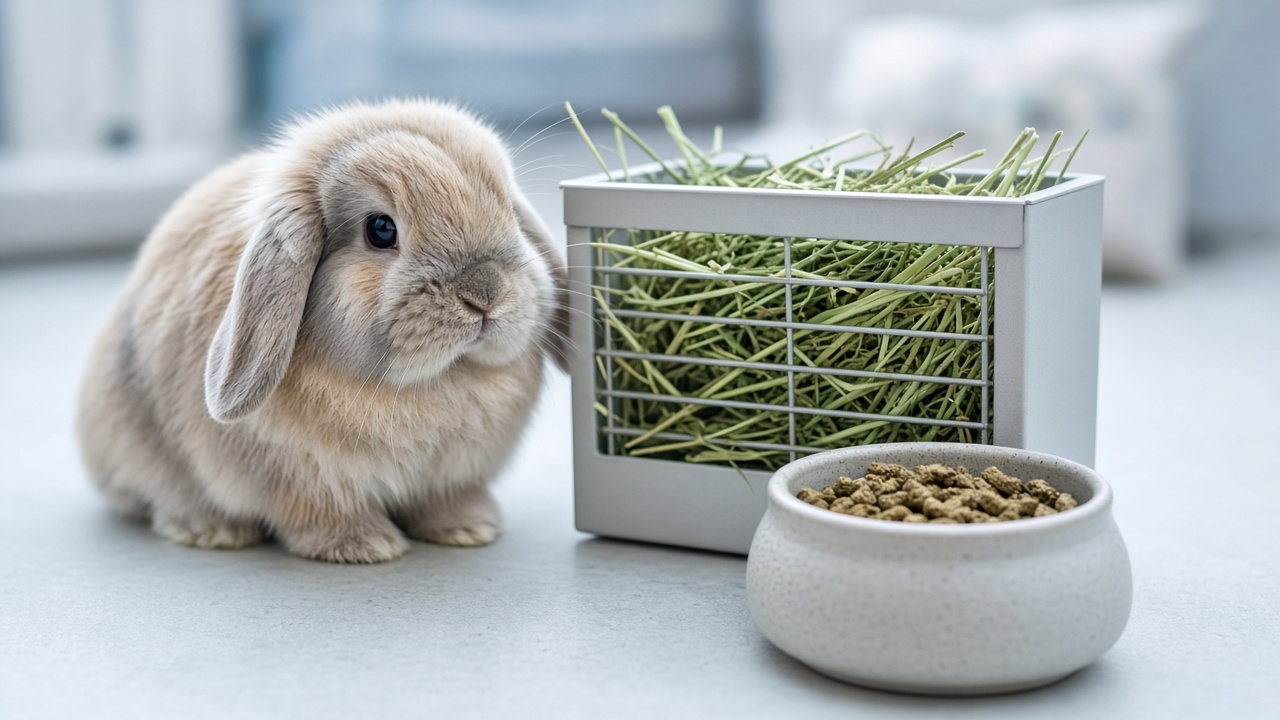
Quick answer: Pair a hanging hay rack with a separate pellet bowl. A combo bin such as the Kaytee Hay & Food Bin Feeder fits a tight cage. One open dish cannot keep hay unlimited and clean.
Most adult rabbits need a hay rack kept full all day and a separate bowl for about 1/4 cup of pellets per 5 pounds. This page is a published-spec comparison of currently sold hay racks and bowls. We did not weigh leftover hay, time chew-through, or run cage trials.
Hay is the main meal. Pellets are a measured side. The feeder has to match that split.
The Two-Fixture Rule we used
Our research team analyzed current maker pages, not store rankings. We used one selection rule and kept it.
A product entered this article only if the maker page listed a fixture that keeps feed off bedding. That fixture could be a hang hook, a lock, or a heavy bowl. The same page also had to print at least one number in inches, ounces, or days.
We left out timed automatic dispensers. We left out hay sold as feed. We left out racks marketed only for birds.
That is why a chew-safe wood forager sits next to a metal rack. Both keep hay off the floor.
Top 7 Rabbit feeder
The picks below are the 7 rabbit feeders on sale right now, listed with what each suits best and an honest drawback. Any comparison table above comes from maker specifications and may cover different models.
1. Maxcheck 2 Pcs Rabbit Feeder for Cages
Best for: Two-cage pellet hopper keepers
Maxcheck’s two-pack is a pair of cage hoppers, not a hay rack. Maker pages for this line list a lidded metal box with side hooks, and owners keep a spare while one is washed. Owners also report pellets can swell and clog in humid weather.
Pros: Two feeders in one pack; Hooks onto wire cages Cons: Pellets clog when damp
2. 4 Pack Rabbit Feeder for Cages Small Animal Dispenser
Best for: Four-cage rescue barn keepers
This four-pack is the volume buy on the list. Listings in this class sell hang-on dispensers for several small-animal cages. Owners who run more than one hutch like the extras, but each cage still needs a separate hay station.
Pros: Four dispensers per order; Suits several cages Cons: Still no hay station
3. Pet Lodge® Small Animal Feeder with Lid and Sifter Bottom | Outdoor
Best for: Outdoor wire hutch keepers
Pet Lodge lists this as an outdoor gravity feeder with a lid and a sifter bottom. The maker page says the mesh drops pellet dust so fines do not sit and mold. Owners report the steel box holds up outside, though the wire hooks can feel loose.
Pros: Lid keeps feed covered; Sifter drops pellet dust Cons: Hooks can feel loose
4. Rabbit Supplies with Bowl & Hay Feeder
Best for: Tight indoor hay-bowl combos
This is the only hay-plus-bowl fixture on the list. The listing shows a small upper rack over a lower bowl that locks onto cage wire. Owners like the one-hole install in a tight cage, and they also report determined chewers work the body loose.
Pros: Hay rack plus bowl; Locks onto cage wire Cons: Small hay pocket overall
5. Maxcheck Large Metal Rabbit Feeder for Cages with Mesh Bottom
Best for: Large rabbits needing extra hopper
Maxcheck’s large metal unit is the bigger hopper in this set. The listing names a mesh bottom, so dust and rain can fall through instead of sitting on pellets. Owners like the extra volume, but a large gravity box makes it easy to leave too many pellets in reach.
Pros: Large metal hopper; Mesh bottom sheds debris Cons: Easy to overfill pellets
6. Hanging Automatic Food Dispenser
Best for: Weekend pellet top-off owners
This hanging dispenser is a gravity food hopper. It is not a hay rack, and it is not a timed feeder. Owners like skipping a midday scoop, and they also report the chute can jam if pellets swell.
Pros: Hangs off cage floor; Gravity refills the bowl Cons: Chute can jam
7. GPY Automatic Hanging Gravity Pet Feeder and Water Dispenser Set
Best for: Cage food-and-water pairing
GPY sells this as a hanging gravity feeder paired with a water dispenser. One order covers both bowls so the cage floor stays clearer. Owners like the set price, though they also report siphon waterers leak when the hang does not match the bars.
Pros: Feeder and waterer together; Budget hanging pair Cons: Waterers can leak
Comparison: Rabbit feeder at a Glance
Want to browse every option? See the full range of rabbit feeder on Amazon →
Why hay and pellets cannot share one open dish
The House Rabbit Society states that hay should comprise 85 percent of an adult rabbit’s diet. Vegetables are listed at 10 percent. Pellets are listed at 5 percent.
The Merck Veterinary Manual’s July 2026 diet chapter puts grass hay at about 85–90 percent. It then adds a smaller pellet ration that contains 15–20 percent crude fiber.
Those pages disagree slightly on vegetables. They agree that hay stays unlimited and pellets stay measured.
The Merck Veterinary Manual lists about 1/4 cup of timothy-based pellets per 5 pounds of body weight per day. It lists about 1 cup of fresh vegetables per 2 pounds of body weight per day.
The House Rabbit Society lists 1–2 cups of vegetables for every 4 pounds of body weight. It also asks for pellets with 18 percent minimum fiber. That is a label number, not a bowl size.
Susan Brown, quoted on the House Rabbit Society diet page, warns against uncontrolled pellet feeding. She ties that pattern to obesity, heart and liver disease, chronic diarrhea, and kidney disease.
A wide open dish invites that pattern. The rabbit finishes the easy pellets and leaves the hay.
A hay rack or forager reverses the order. The rabbit has to pull fiber first. The pellet bowl then holds only the day’s scoop.
AAFCO’s nutritional-labeling page requires four guarantees on a pet food label. Those are minimum crude protein, minimum crude fat, maximum crude fiber, and maximum moisture. Crude names the lab method, not the quality of the hay.
A feeder does not change those label rules. It only decides whether the rabbit can reach the hay.
Five current feeders compared by listed attributes
The table below uses only attributes printed on each maker’s product page. There is no rank column. There is no price column.
Our research team compared the four maker pages that publish a number. Listed longest dimensions ran from 4.25 inches on the Prevue 3500 to 9.25 inches on the Ware 00714.
| Model | Maker-listed size | Material | Mount or use | Listed role or capacity |
|---|---|---|---|---|
| Kaytee Hay & Food Bin Feeder With Quick Locks | 5.75 in × 6 in × 7 in; 1.05 lb | Plastic and wood composite | Carabiner hang plus quick lock | Separate hay bin and food bin |
| Ware Hay Rack 00714 | 9.25 in W × 4.75 in D × 6.25 in H | Powder-coated metal | Hangs on a cage | Hay only; waste-reduction claim |
| Ware Eye Bowl Medium 13116 | 4.50 in × 4.50 in × 3.50 in | Dolomite | Floor bowl | Holds up to 13 oz |
| Prevue Metal Bin Feeder 3500 | 4 1/4 in L × 3 7/8 in W × 7 1/8 in H | Powder-coated metal | Inside or outside cage hooks | Up to a 5-day supply; pellets or timothy hay |
| Oxbow Enriched Life Apple Stick Hay Feeder | Size not listed on Oxbow’s product page | Apple sticks and untreated wood | Attaches to the habitat | Enrichment hay chew |
Kaytee’s page also prints an “actual size” of 5.75 inches long, 5.75 inches wide, and 7 inches high. That is one-quarter inch narrower than the 6-inch width on the same page.
We report both figures as printed.
Oxbow’s page lists apple sticks, untreated wood, and food-safe colors. It does not list an assembled length. We did not borrow a box size from a retailer.
Hanging racks and chew-safe hay holders
The Ware Hay Rack 00714 is the simple metal option in this set. Ware lists it as all-metal and powder coated. It hangs on a cage.
Ware’s page says it reduces food waste and helps keep the cage clean.
A powder-coated rack belongs on the outside of wire bars when the rabbit cannot get a foot stuck. Fill from the top. Pull empty stems daily.
The Oxbow Enriched Life Apple Stick Hay Feeder is the opposite tool. Oxbow says it is made with apple sticks and untreated wood. It attaches to the habitat.
Treat that feeder as a chew station, not as the only hay source. A rabbit that finishes the sticks still needs a full day’s grass hay somewhere else. Oxbow’s own copy tells owners to offer a variety of Enriched Life items daily.
The Kaytee Hay & Food Bin Feeder With Quick Locks splits the job. Kaytee lists a hay compartment and a separate food compartment. The bin hangs with carabiner clips.
A quick lock holds it in place.
Kaytee lists the unit weight at 1.05 pounds. That is light enough for most wire cages. Check the lock after the first day.
Prevue’s Metal Bin Feeder 3500 can hold timothy hay or pellets. Prevue lists a mesh trough that lets pellet dust sift out. Movable hooks hold the bin inside or outside the cage.
Prevue lists a 5-day supply. That claim is useful for pellets. It is a poor target for hay.
If the rabbit lives in a pen, hang the rack at chest height. If the rabbit free-roams, keep one hay station in the litter area and one in the rest area.
The House Rabbit Society still wants unlimited fresh hay each day. Two stations beat one empty rack.
Pellet bowls and gravity bins
Pellets need a bowl that does not tip. They do not need a buffet.
The Ware Eye Bowl Medium 13116 is a floor bowl. Ware lists dolomite, a chew-proof design, and a capacity of up to 13 oz. The listed footprint is 4.50 inches by 4.50 inches by 3.50 inches.
Thirteen ounces is far larger than the Merck Veterinary Manual’s 1/4-cup pellet ration per 5 pounds. Use the bowl as a stable dish. Do not fill it to the rim.
A 5-pound rabbit, on that Merck figure, gets about 1/4 cup of pellets. The House Rabbit Society treats pellets as 5 percent of the diet, not as free-choice feed.
The Prevue Metal Bin Feeder 3500 is a gravity bin, not a bowl. Prevue lists 4 1/4 inches long, 3 7/8 inches wide, and 7 1/8 inches high. The model number is 3500.
The UPC on Prevue’s page is 048081035009.
A gravity bin shines when the rabbit flings a light dish. It fails when the owner treats a 5-day pellet load as a set-and-forget meal.
Measure the day’s scoop into the trough. Leave the hopper empty if the rabbit is overweight.
Kaytee’s combo bin can hold pellets in the food side. Keep that side small. Use the hay side as the main volume.
The House Rabbit Society’s 85 percent hay split is the check. If the pellet pocket looks fuller than the hay pocket, the bin is loaded backward.
Do not copy a slow feeder dog bowl pattern onto hay. A dog bowl that meters kibble can slow a gulp.
A rabbit that cannot pull hay all day loses the fiber the Merck Veterinary Manual ties to gut health.
Hay should stay free-choice. Pellets should stay measured. Those are opposite jobs.
Where to put the feeder and how often to refill
Place hay where the rabbit already lingers. Many rabbits eat hay while they use the litter box. A rack above that box keeps stems off wet litter.
Keep pellets away from the litter box. Urine on pellets wastes the day’s ration. It also hides a drop in appetite.
Refill hay at least twice a day. Empty the rack when stems turn dusty or damp.
The House Rabbit Society asks for large, unlimited amounts of fresh hay daily. Yesterday’s crushed pile does not meet that line.
Wash a bowl daily. Wash a plastic or metal bin whenever pellet dust cakes the corners.
Prevue tells owners to wipe the 3500 with a damp soft cloth and dry it thoroughly. That is a cleaning step, not a sterilization claim.
Hay dust also lands in the coat. A daily hay session is a grooming session whether you planned one or not.
Keep a rabbit grooming kit next to the rack if the rabbit sheds into the feeder.
Long-coated breeds drop more hair into hay. Follow a calm step-by-step rabbit grooming routine instead of fishing mats out of the rack.
Hair in hay is a reason to groom. It is not a reason to switch to pellets.
Watch the rabbit’s stool when you change a feeder. Small, dry pellets should stay frequent. A sudden stop in eating is a clinic problem, not a new rack problem.
Water belongs in its own bottle or heavy crock. Do not park a water bowl under a hay rack. Wet hay spoils fast.
FAQ
Do rabbits need a hay rack, or can hay sit on the floor?
Hay on a clean floor still counts as hay. The House Rabbit Society wants large, unlimited amounts each day. A rack helps when the floor is wet, dusty, or shared with litter.
Use a rack when hay would otherwise be soiled. Use a floor pile only on a dry, wiped surface.
Can hay and pellets go in the same bowl?
They can, and that is the usual mistake. The House Rabbit Society puts pellets at 5 percent of the adult diet. A mixed bowl lets the rabbit sort for pellets and leave the hay.
Keep a rack or forager for hay. Keep a bowl or bin for the day’s pellet scoop.
How much hay should the feeder hold?
Enough that the rabbit never hits an empty rack between your refills. The House Rabbit Society’s 85 percent hay figure is a diet share, not a hopper size.
Fill the Ware Hay Rack 00714 or the Kaytee hay compartment until stems stay reachable. Top up twice a day rather than packing a week of hay that goes stale.
Is a wooden hay feeder safe if the rabbit chews it?
Oxbow’s Apple Stick Hay Feeder is sold as a chew. The page lists apple sticks, untreated wood, and food-safe colors.
Replace it when the frame splits or a sharp edge appears. Keep a metal rack or a bin as the all-day source.
What size bowl do pellets need?
Size the bowl to the scoop, not to the rabbit’s head. The Merck Veterinary Manual lists about 1/4 cup of timothy-based pellets per 5 pounds of body weight per day.
Ware lists the Medium Eye Bowl at 13 oz. That bowl is stable. Put in the measured scoop and leave the rest empty.
How often should I clean a rabbit feeder?
Wash the pellet bowl every day. Empty damp or dusty hay whenever you see it.
Prevue’s care line for the Metal Bin Feeder 3500 is a damp cloth and a full dry. A dirty feeder hides a drop in intake.
Is a gravity bin enough as the only feeder?
No. Prevue lists the 3500 for either food pellets or timothy hay and claims up to a 5-day supply.
Hay still needs a second, larger station if you use that bin for pellets. The Merck Veterinary Manual’s 85–90 percent hay share will not fit in a 4 1/4-inch-long hopper.