
Quick answer: Keep a domestic kit with its mother through week 6. Offer alfalfa hay, uniform alfalfa pellets, and water once eyes open around day 10. Hand-feed formula only if the doe is truly gone, using the House Rabbit Society amounts below.
Domestic baby rabbits wean at about 6 weeks and need alfalfa hay plus alfalfa pellets, not pellet-only bowls.
This page is a week-by-week desk brief from House Rabbit Society sheets, the Merck Veterinary Manual, and maker labels. We did not hand-rear a litter, run feeding trials, or weigh kits in a clinic.
The Published Age-and-Analysis Rule
Our research team used one selection rule. A junior pellet entered this brief only if the maker page listed both a growth age window and a guaranteed analysis.
We left out muesli mixes, seed-and-fruit blends, and adult-only timothy formulas. We also left out any bag whose maker page we could not read.
The timeline covers domestic house rabbits from birth through the first alfalfa-to-timothy switch. It does not cover wild cottontail release or meat-rabbitry weans.
Why the first weeks are a fiber problem
A baby rabbit is not a small adult. The Merck Veterinary Manual states that rabbits need about 85–90% grass hay, plus pellets with 15–20% crude fiber.
The same Merck page says low-fiber diets raise the chance of severe digestive illness, especially in young rabbits. That is why this brief tracks hay before toys or treats.
The House Rabbit Society sets a bar for the pellet itself. Its diet page says a good pellet should hold 18% minimum fiber.
The U.S. Food and Drug Administration requires pet-food labels to list ingredients from most to least, by weight. We used those listed weights to compare the four bags below.
Week 0 through week 2: nest, milk, and closed eyes
Domestic does usually nurse once, often at night. The House Rabbit Society says you should not assume the mother is gone just because you never see a feeding.
Check the kits in the morning. Warm bodies and round bellies mean the doe is doing the work.
The House Rabbit Society nest note is concrete. Use a box with clean towels and keep the nest dark. Do not add extra heat if the room already sits at 65 to 70°F, because excess heat can kill.
Eyes open at about 10 days of age on the House Rabbit Society orphan page. Until then, a true orphan still needs help to urinate and defecate.
Stroke the anal area with a warm, moist cotton ball after each feeding. Keep that up for the first 10 days, or until the eyes open. You are copying the doe’s licking.
Hand-feeding is a last resort. The House Rabbit Society names overfeeding as a leading cause of death in these youngsters, through fatal intestinal disease.
If the doe is truly gone, that page starts feeding with a 3 cc syringe or an eyedropper. Feed only with the bunny sitting upright. Point the syringe toward the side of the mouth so extra formula does not enter the lungs.
Domestic kits with closed eyes are fed 2–3 times per day on that sheet. The House Rabbit Society ties bloat to feedings that come too often.
For a kit that will be about 5 lb as an adult, the House Rabbit Society lists daily formula totals, then splits them. Newborns get up to 5 cc of kitten milk replacer or goat milk.
At 1–2 weeks the daily total rises to 10–15 cc. At 2–3 weeks it rises again, to 26–30 cc.
Those numbers are daily totals, not single-syringe shots. Divide the daily amount into the stated feedings.
A wild baby belongs with a licensed rehabilitator.
Week 3 through week 6: first solids and a slow wean
The House Rabbit Society says you may introduce solids as soon as the eyes are open. For domestic kits that means plain alfalfa pellets, alfalfa hay, oat hay, and timothy hay.
Fresh greens stay off the domestic orphan list at this stage. The House Rabbit Society says to avoid them for these youngsters.
Water belongs nearby once solids appear. A heavy crock is harder to tip than a light bowl. Check a sipper bottle every day, because it can clog.
Domestic rabbits are weaned at about 6 weeks on the House Rabbit Society orphan page. That is the line this brief uses for a house kit.
The House Rabbit Society diet page lines up with that timing. Its “Baby Rabbit Diet” window is 3–7 weeks, with unlimited alfalfa and unlimited alfalfa-based pellets.
Do not pull the largest kit at day 21 because it looks bold. Early separation is a gut risk, not a maturity badge.
If you change pellet brands, follow the maker’s mix. Oxbow Animal Health publishes a four-week shift for Essentials Young Rabbit Food: week 1 at 3:1, week 2 at 2:2, week 3 at 1:3, then the new bag alone.
Supreme Petfoods tells U.S. buyers of Science Selective Junior Rabbit to change over 10–14 days. Kaytee’s juvenile page uses a 7–10 day mix.
A sudden swap can stall a gut that just learned hay. Slow is the point.
Week 7 through week 12: the teenage bowl
The House Rabbit Society calls 7 weeks to 7 months the teenage diet. Unlimited alfalfa and unlimited alfalfa-based pellets continue.
Greens start later than most people think. The House Rabbit Society says to begin 1/2 oz of new greens at 12 weeks of age.
Wash those greens. Because of Rabbit Hemorrhagic Disease Virus Type-2, the House Rabbit Society recommends washing all vegetables for at least two minutes in a bowl. Change the water several times.
Leafy greens should make up about 75% of the fresh portion on that diet page. Non-leafy vegetables stay at about 1 tablespoon per 2 lb of body weight per day.
Fruit is not a baby food. The House Rabbit Society caps fruit at about 1 teaspoon per 2 lb of body weight per day, and only as a later treat.
Keep the enclosure indoors. The nest box can go once the kits hop, eat hay, and hold heat on their own.
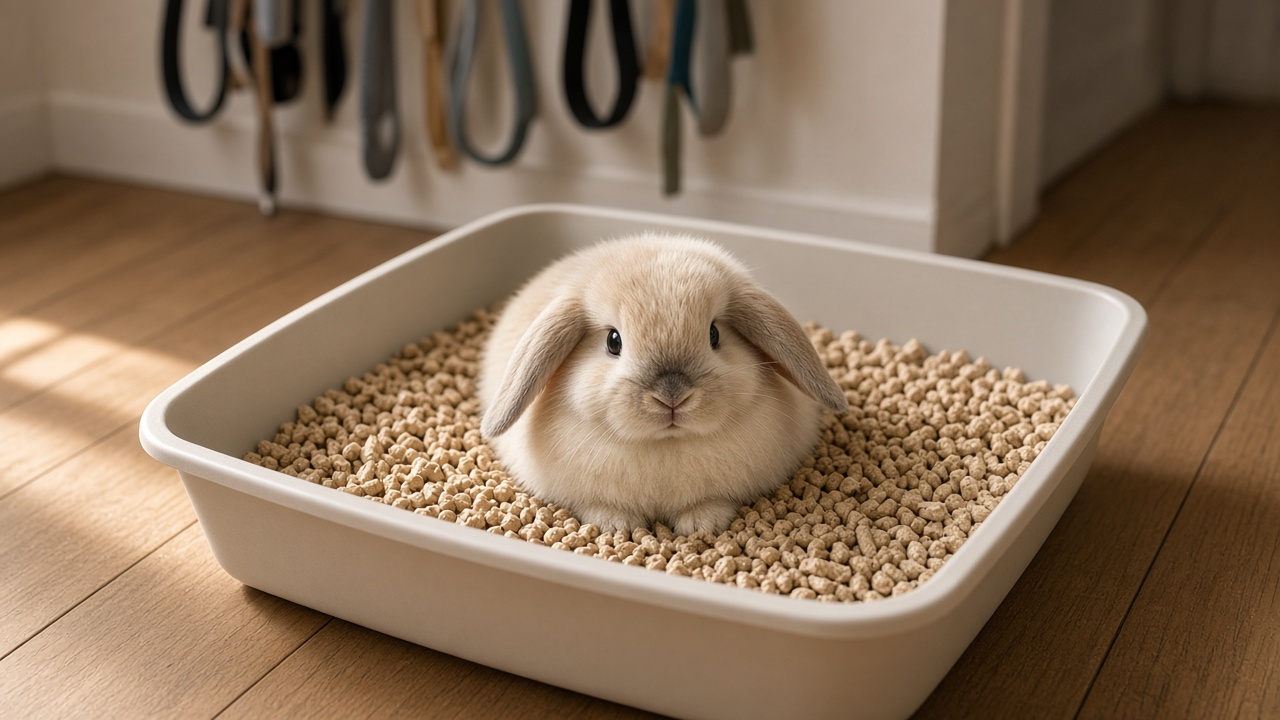
Litter training can start when they leave the nest. Put hay in the box. Kits often eat and pass in the same spot.
Coat care matters once the kit is fully furred and hopping. Use the method in our how to groom a rabbit guide.
Keep tools simple. Our rabbit grooming kit review covers a small slicker and a fine comb.
Watch droppings every day. A quiet gut and no fecal pellets is an emergency.
What four junior labels actually publish
Our research team analyzed the published specs on four maker pages. We compared age windows, first ingredients, and guaranteed analyses. We did not open bags or run lab assays.
Listed minimum crude protein ran from 15.0% on Oxbow Essentials Young Rabbit Food and Science Selective Junior Rabbit to 18% on Small Pet Select Young Rabbit Food Pellet. Kaytee Forti-Diet Pro Health Nourish+Protect Juvenile Rabbit Food sits between them at 16.5% minimum protein.
Calcium maxima were not the same list. Oxbow lists 0.60–1.10%. Small Pet Select lists 1.0–1.5%. Supreme’s U.S. guarantee lists 0.5–1.4%.
Kaytee’s juvenile page we read does not list calcium.
| Product | Maker age window | Crude protein (min) | Crude fiber | Calcium | First ingredient on label |
|---|---|---|---|---|---|
| Oxbow Essentials Young Rabbit Food | Growing, under one year | 15.00% | 22.00% min, 25.00% max | 0.60% min, 1.10% max | Alfalfa Meal |
| Small Pet Select Young Rabbit Food Pellet | About 4–7 weeks through 7 months to 1 year | 18% | 17% min, 19% max | 1.0% min, 1.5% max | Suncured Alfalfa |
| Science Selective Junior Rabbit | Junior rabbits up to 20 weeks+ | 15.0% | 16.0% min, 22.0% max | 0.5% min, 1.4% max | Alfalfa meal pellets |
| Kaytee Forti-Diet Pro Health Nourish+Protect Juvenile Rabbit Food | Juvenile rabbits | 16.5% | 22.0% max | Not listed on the maker page we read | Sun-cured Alfalfa Meal |
Oxbow Animal Health also lists vitamin A at 10,000 IU/kg and vitamin E at 190 IU/kg. Its growing line is unlimited pellets plus unlimited grass hay.
Small Pet Select pairs its pellet with unlimited alfalfa hay. It tells buyers to introduce vegetables slowly at about 12 weeks, which matches the House Rabbit Society green start.
Supreme Petfoods’ U.S. page for Science Selective Junior Rabbit gives 40–50 g per kg of body weight per day. It also lists vitamin A at 10,000 IU/kg and a 4.4 lb pack.
Kaytee publishes portion cups on that juvenile page. Small breeds get 1/4 to 1/2 cup, or 30 g to 60 g. Large breeds get 1/2 to 1 cup, or 60 g to 120 g.
Kaytee also lists Total Bacillus Species at 120,000 CFU/g. That is a label fact, not proof a kit will eat the bag.
Pick one uniform pellet and stay on it through the wean. For the later adult switch, use our best rabbit pellets brief.
From alfalfa growth food to an adult bowl
The Merck Veterinary Manual says young growing rabbits can eat alfalfa hay and alfalfa-based pellets. Switch them gradually to timothy-based foods as they approach 1 year old.
The House Rabbit Society splits that year. From 7 months to 1 year it lists unlimited grass hay, 1/2 cup timothy pellets, and 1 cup of greens.
Adult house rabbits on that page get 1/4 cup of pellets per 6 lb of body weight per day. The Merck pet-owner diet page uses a nearby adult figure: about 1/4 cup of timothy pellets per 5 lb per day.
Those adult cups are not week-4 portions. Growing kits on the House Rabbit Society baby and teenage sheets still get unlimited alfalfa pellets.
Do not cut pellets to an adult cup at week 8 just to “keep them lean.” Growth and lactation are why young formulas exist.
Oxbow’s young bag is also the maker’s pregnant and nursing bag. Small Pet Select and Supreme say the same on their junior pages.
If a kit stops eating, treat that as urgent. Rabbits cannot skip meals the way a dog can.
FAQ
How often does a mother rabbit feed her babies?
The House Rabbit Society says domestic and wild mothers usually feed once, often in the middle of the night. Empty-looking nests in daylight are normal, not proof of neglect.
Warm kits with round bellies in the morning mean the doe fed. Cold, wrinkled, or noisy kits need help the same day.
When do baby rabbits open their eyes?
The House Rabbit Society orphan page says eyes open at about 10 days of age. That is also when it tells you to start hay, pellets, and water for domestic kits.
Closed eyes after that window are a reason to call a rabbit-savvy clinic. Do not pry lids apart at home.
What should a weaned baby rabbit eat every day?
From 3–7 weeks, the House Rabbit Society lists unlimited alfalfa and unlimited alfalfa-based pellets. From 7 weeks to 7 months, that pair stays in the bowl.
Add water that cannot tip. Hold leafy greens until 12 weeks, then start at 1/2 oz.
Can I give a baby rabbit lettuce, carrots, or fruit?
Not in the first weeks. The House Rabbit Society keeps fresh greens off the domestic orphan solid list until eyes are open. It delays measured greens until 12 weeks.
Carrots and fruit are later treats, not staples. Fruit stays at about 1 teaspoon per 2 lb of body weight per day on the House Rabbit Society diet page.
How much formula does an orphaned domestic kit drink?
Use the House Rabbit Society daily totals and split them. Newborns get up to 5 cc a day. Kits 1–2 weeks old get 10–15 cc a day.
At 2–6 weeks the daily band is 26–30 cc, and it may be less for a small breed. Feed 2–3 times a day while eyes are closed.
When do I switch from alfalfa pellets to timothy pellets?
The Merck Veterinary Manual times the alfalfa-to-timothy shift as rabbits approach 1 year old. The House Rabbit Society begins that shift in its 7-month to 1-year “young adult” row.
Use the maker’s mix schedule when you change bags. Oxbow publishes four weeks, Supreme publishes 10–14 days, and Kaytee publishes 7–10 days.
Should a baby rabbit live in an outdoor hutch?
This brief keeps kits indoors. The House Rabbit Society nest sheet already warns that extra heat can be fatal, and outdoor weather swings both ways.
Outdoor hutches also meet predators. A kit belongs in a quiet indoor space until it eats hay on its own.