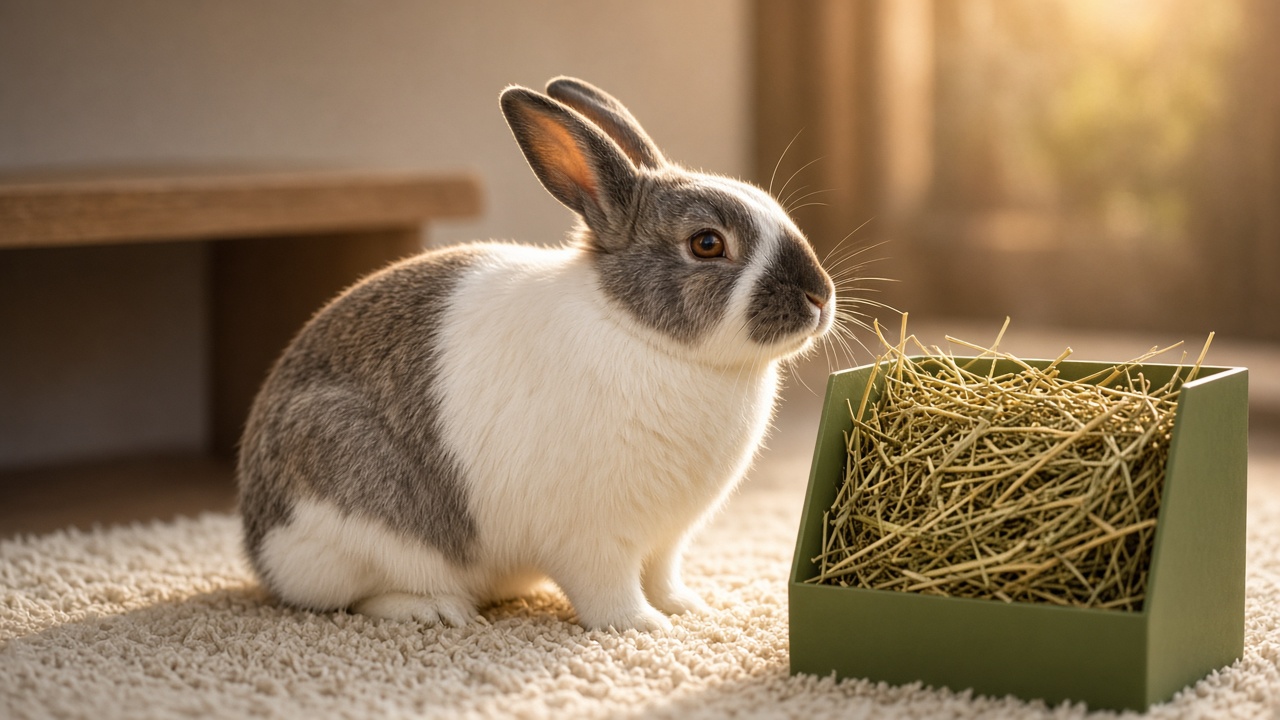
Quick answer: A Californian is a white, dark-pointed commercial rabbit that matures near the ARBA 10.5-pound cap. Keep one indoors in at least a 16-square-foot pen plus daily run time. Feed unlimited grass hay, then a measured timothy pellet.
A Californian is a commercial rabbit whose ARBA-published maximum weight is 10.5 pounds.
This page is a research-desk briefing that compares published breed notes and current adult pellet labels. We did not keep a Californian herd, run feeding trials, or score live temperament.
Our selection rule was narrow. We included only currently sold US adult pellets that publish a full guaranteed analysis and at least 18% crude fiber. We left out seed mixes, muesli blends, treats, alfalfa-only grower feeds, and any pellet that hides its analysis.
What the breed listing actually says
The American Rabbit Breeders Association lists the Californian as a commercial breed. ARBA credits George West of Southern California in the 1920s.
ARBA also calls the “Cal” a competitive commercial rabbit in all 50 states. That is a show-ring note, not a parlor slogan.
The same listing publishes one hard number for the full-size breed. Maximum weight is 10.5 pounds.
ARBA’s recognized-breed list also names a separate Mini Californian. ARBA calls that listing its 53rd recognized rabbit breed, with a published maximum of 6 pounds.
Those two listings are easy to mix up. A 10.5-pound Californian is not a 6-pound mini.
This briefing covers the full-size Californian. We did not write a Mini standard or compare show-point cards.
Size that matches a 10.5-pound body
A Californian is medium-large by house-pet standards. The ARBA maximum of 10.5 pounds is the figure we can check in public print.
Our research team did not weigh live rabbits. We also did not copy unofficial class charts from hobby blogs.
Plan housing and pellet math for an adult near that cap. A rabbit that large needs a full stretch and a hard run each day.
House Rabbit Society says a rest area should be four times the rabbit’s size. It also asks for four or more hours of cardiovascular play.
The same group’s bunny-proofing note sets a 16-square-foot floor for a penned area. That matches the 4-by-4-foot exercise pen it calls an ideal starter setup.
A 10.5-pound Californian will fill a starter cage. Treat that cage as a bedroom, not a home.
If you cannot offer a full room, start with that 16-square-foot pen. Then add daily supervised time outside it.
Temperament in a house, not a hutch
We did not score Californian temperament. We have no kennel notes, no handling trials, and no “good with kids” checklist.
What we can say is structural. ARBA frames the breed as a commercial type used for meat and pelt work. That history means a sturdy body, not a proven parlor personality.
House Rabbit Society treats rabbits as indoor family animals. Its housing page puts them in shared rooms, not isolated sheds.
The same page asks for toys, a hide, and daily play that raises the heart rate. A bored 10-pound rabbit will chew baseboards and cords.
Expect a prey animal’s startle response. Thumps, freezes, and sudden sprints are normal, not a breed defect.
Pair housing is a welfare choice, not a decoration. Two intact rabbits can fight. A bonded pair still needs that 16-square-foot floor as a start, then more room, not less.
Do not buy a Californian as a weekend outdoor hutch pet. House Rabbit Society puts rabbits in shared indoor rooms.
Indoor space that fits the body
House Rabbit Society’s housing page is blunt. A cage is a rest space. It is not the living space.
Any cage, the same page says, should be three to four times the rabbit’s stretched length. The smaller that rest box, the more hours you owe outside it.
A Californian at the 10.5-pound cap is long when fully stretched. Measure the rabbit, then multiply.
Give a cushioned floor, a hide, a hay station, and a roomy litter box. House Rabbit Society lists a heavy water bowl among housing essentials.
Bunny-proof before the first free-roam hour. The same group’s proofing note flags cords, books, carpet edges, and baseboards.
Metal blockers last longer than plastic. That proofing page says determined rabbits chew through plastic fences.
Hay, greens, and the pellets we compared
House Rabbit Society puts unlimited grass hay first for adult rabbits. Timothy, orchard, and oat hays are the grasses it names.
Alfalfa hay, on that same diet page, is for young rabbits and nursing does. It is not the default adult forage for a finished Californian.
Pellets come next, and they stay small. House Rabbit Society’s adult ration is 1/4 cup of pellets per 6 pounds of body weight per day.
A Californian near 9 to 10.5 pounds therefore sits above that 6-pound example. Scale the 1/4-cup rule. Do not pour a free bowl.
House Rabbit Society also wants a minimum of 2 cups of chopped vegetables per 6 pounds of body weight each day. Leafy greens should be about 75% of that fresh portion.
Non-leafy vegetables stay smaller. The same page caps them at about 1 tablespoon per 2 pounds of body weight per day.
Fruit is a treat, not a meal. House Rabbit Society limits fruit to about 1 teaspoon per 2 pounds of body weight per day.
Wash produce. House Rabbit Society asks for at least two minutes in a bowl, with the water changed several times.
A good pellet, that diet page says, should list 18% minimum fiber. Our research team used that 18% floor as the cut for this table.
We compared published specs only. We did not run feeding trials or stool scores.
For a wider pellet shortlist, see our best rabbit pellets briefing.
| Product | First listed ingredient | Crude protein (min) | Crude fiber range | Calcium range | Maker feeding note |
|---|---|---|---|---|---|
| Oxbow Essentials Adult Rabbit Food | Timothy Grass Meal | 14.00% | 25.00–29.00% | 0.35–0.75% | 1/3–1/2 cup daily for an 8–10 lb adult, plus unlimited grass hay |
| Oxbow Garden Select Adult Rabbit Food | Timothy Grass | 12.00% | 22.00–26.00% | 0.35–0.75% | 1/3–1/2 cup daily for an 8–10 lb adult, plus unlimited grass hay |
| Science Selective Adult Rabbit Food | Alfalfa meal pellets | 12.5% | 21.5–28.5% | 0.3–1.2% | 60–70 g (2–2.5 oz) daily in the maker’s 2.5 kg example |
| Small Pet Select Rabbit Food Pellets | Timothy hay | 14% | 25–29% | 0.4–0.6% | 1/4–1/2 cup per 6 lb body weight at 1–5 years |
Three of those four labels lead with timothy or timothy meal. Science Selective’s U.S. page leads with alfalfa meal pellets.
That alfalfa-first listing is a label difference, not a ranking. House Rabbit Society prefers timothy-based pellets for adults.
Oxbow’s Essentials page sets rabbits over 1 year at 1/3 to 1/2 cup daily in the 8–10 pound band. Garden Select uses the same cup range.
Both Oxbow labels also publish a 10-pound-plus line at 3/4 cup daily. A Californian at the 10.5-pound cap sits on that line.
Supreme Petfoods’ U.S. Science Selective page does not publish an 8–10 pound cup chart. It publishes a 2.5 kilogram example at 60–70 grams per day.
A finished Californian is heavier than 2.5 kilograms. Do not copy that 60–70 gram line onto a 10-pound rabbit.
Small Pet Select’s adult line for ages 1–5 years is 1/4 to 1/2 cup per 6 pounds. That matches House Rabbit Society’s low-end adult rule.
Fiber is the other check. Oxbow Essentials lists 25.00% minimum and 29.00% maximum crude fiber.
Garden Select lists 22.00% to 26.00%. Science Selective’s U.S. guarantee is 21.5% to 28.5%.
Small Pet Select lists 25% to 29%. All four clear the 18% floor.
Calcium ranges differ. Both Oxbow adult labels list 0.35% to 0.75%.
Small Pet Select lists 0.4% to 0.6%. Science Selective’s U.S. page lists 0.3% to 1.2%.
Oxbow’s Essentials transition runs four weeks. Garden Select uses a four-week mix as well.
From 7 months to 1 year, House Rabbit Society lists 1/2 cup of timothy pellets and 1 cup of greens. Do not keep a finished Californian on unlimited alfalfa pellets.
Coat care during a commercial molt
A Californian is a short-coated commercial type. It is not a wool breed.
That still means shed cycles. House Rabbit Society’s housing page lists daily brushing as an allergy-control step, preferably outdoors, then a damp-cloth wipe.
A 10-pound body holds more coat than a dwarf. Loose fur that is swallowed can mat in the gut.
Use a soft brush and a metal comb, not a dog rake. For kit options we already logged, see our rabbit grooming kit review.
Work brush, comb, and nails in one sitting. Our step-by-step rabbit grooming guide walks through that order.
We did not time a Californian molt in a live barn. Watch for fresh pigment on the nose, ears, feet, and tail as the coat resets.
Nails grow on soft indoor floors. Check them when you brush.
Do not bathe a healthy rabbit as a routine. Spot-clean soiled fur and keep the litter box dry.
FAQ
How big does a Californian rabbit get?
The American Rabbit Breeders Association publishes a 10.5-pound maximum for the full-size Californian. That is the number we can check on ARBA’s breed listing.
ARBA also lists a Mini Californian as a separate breed with a 6-pound maximum. Do not shop those two as the same animal.
Are Californian rabbits good house pets?
We did not score house manners. ARBA describes a commercial breed used for meat and pelt work.
House Rabbit Society still frames rabbits as indoor family animals that need shared rooms and daily play. A Californian’s size makes a hutch-only plan a poor fit.
How much should a Californian eat each day?
House Rabbit Society wants unlimited grass hay first. Then it publishes 1/4 cup of pellets and at least 2 cups of chopped vegetables per 6 pounds of body weight.
Oxbow’s two adult labels both list 1/3 to 1/2 cup for an 8–10 pound rabbit, plus hay. Scale up if your rabbit sits on the 10.5-pound cap.
Do Californians need a lot of grooming?
They are short-coated, so they are not a daily wool project. They still shed, and a 10-pound rabbit sheds a lot of hair.
House Rabbit Society lists regular brushing in its housing notes. Follow a simple brush-and-nail routine rather than a salon schedule.
What is the difference between a Californian and a Mini Californian?
ARBA lists them as two breeds. The full-size Californian has a 10.5-pound published maximum.
The Mini Californian is ARBA’s 53rd recognized rabbit breed, with a 6-pound published maximum. Markings can look similar, but the weight cap does not.
Can I keep a Californian in a starter pet cage?
House Rabbit Society says a cage is a bedroom, not a home. It wants a penned floor of at least 16 square feet plus daily exercise outside the pen.
A Californian near 10.5 pounds will outgrow a small starter habitat as its only space. Use a pen, a room, or both.
When do I switch a Californian off alfalfa pellets?
House Rabbit Society keeps alfalfa hay and alfalfa-based pellets for babies and nursing does. Its young-adult band, 7 months to 1 year, already moves to grass hay and timothy pellets.
Oxbow’s Garden Select adult label says that food is not for young, pregnant, or nursing rabbits. Read the life-stage line on the bag you actually buy.