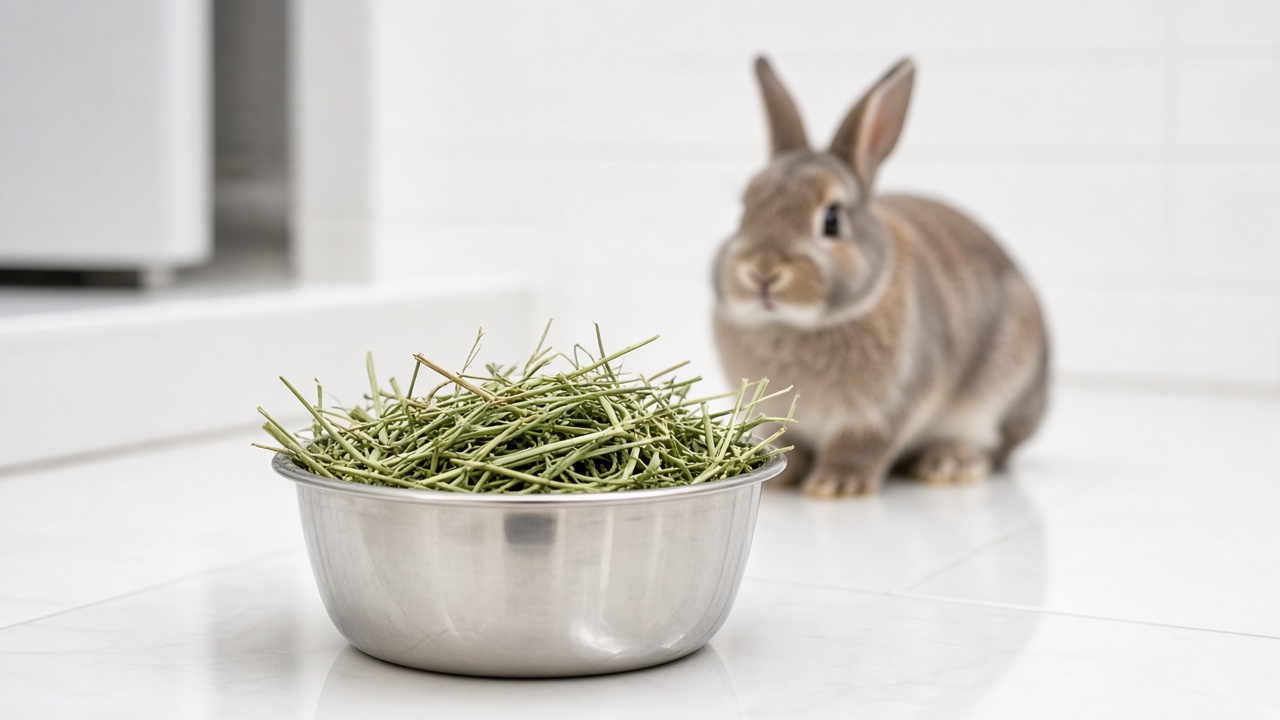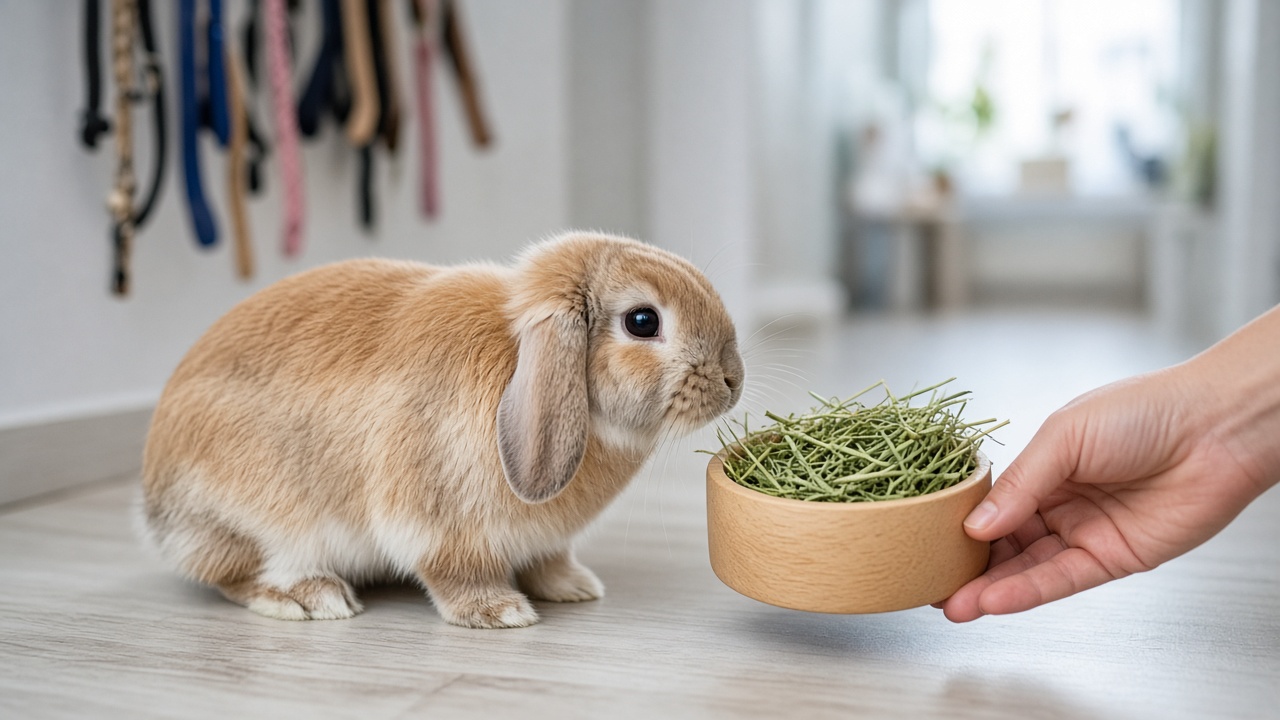
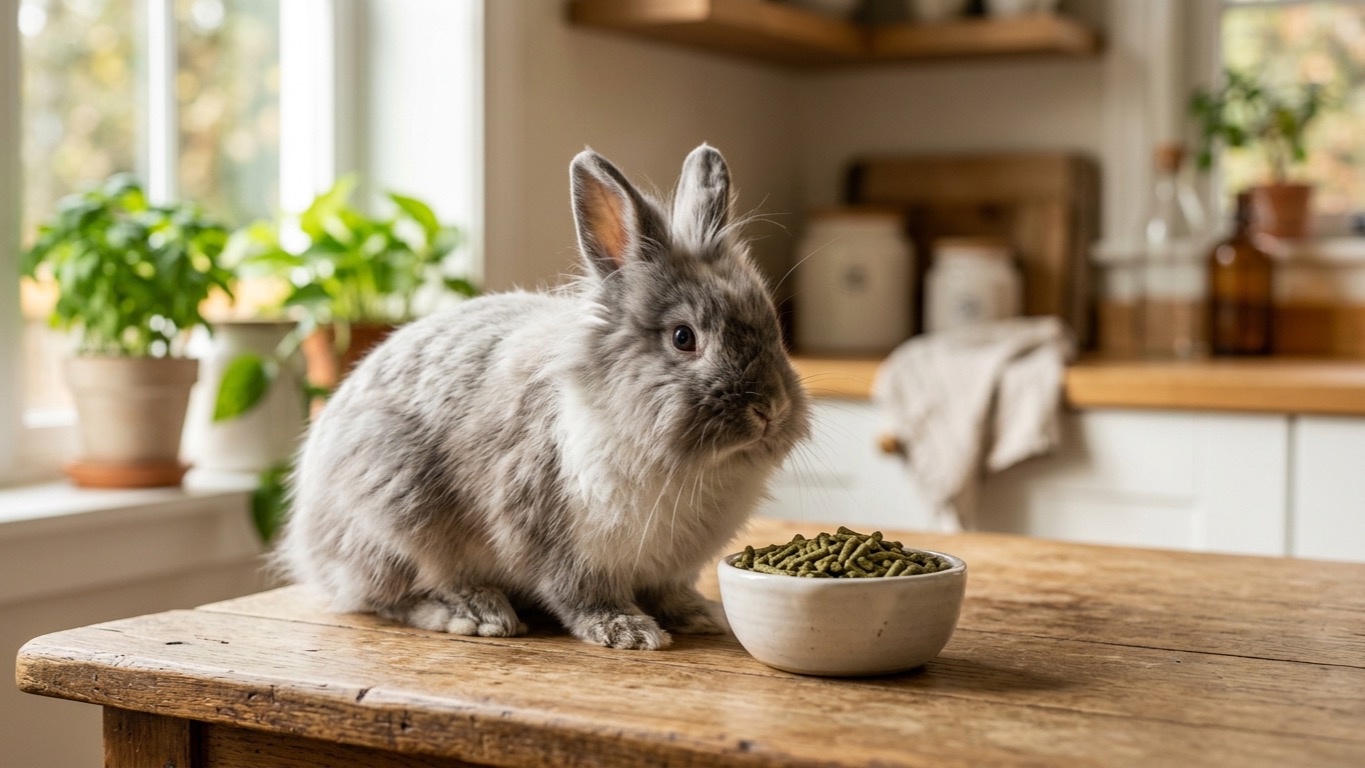
The best rabbit pellets are a plain, high-fiber, timothy-based adult pellet used as a small daily supplement next to unlimited grass hay — not a colorful muesli mix and not the whole diet. The We read the titles and descriptions of 4 SKUs. 3 of 4 titles name timothy (Oxbow Essentials Adult; Small Pet Select Timothy; Kaytee Timothy Complete). 1 of 4 is a “complete nutrition” nameplate (Vitakraft VitaSmart). 0 of 4 replace hay. 0 of 4 are a diagnosis. A muesli bag that looks like breakfast cereal is how selective feeding empties the fun bits and leaves the fiber. House Rabbit Society’s public diet page still frames adult maintenance as unlimited grass hay plus about 1/4 cup pellets per 6 lb of body weight — a starting point your clinician adjusts, not a house scoop we measured.
Buy hay first. Then pick a uniform pellet whose first ingredient and fiber line you can read. Use this URL’s four cards as a label class list, not as a mill tour.
Hero stat (August 2026): four cards, zero listed prices, three timothy nameplates, one “complete” nameplate. We grouped listings by label job, not taste. If the bag in the photo has seeds, corn, or yogurt drops, it fails the HRS “never feed pellets that have fruits, seeds, nuts, corn, or yogurt drops mixed in” line even if the front says complete.
Our guides are reader-supported. This article may contain affiliate links. As an Amazon Associate we may earn a commission if you buy through links, at no extra cost to you.
Related: indoor cages, grooming brushes, lettuce, rabbit names. Appetite stop, no droppings, or a still rabbit is a clinic tonight. We are not that clinic.
What are the best rabbit pellets?
A timothy- or other grass-hay-based pellet with high crude fiber (House Rabbit Society reprints 18% minimum as the quality bar), no mix-ins, fed in a limited cup so the rabbit still empties the hay rack. On this URL: Oxbow Essentials Adult, Small Pet Select Timothy, and Kaytee Timothy Complete are the three titles that at least name timothy. Read the guaranteed analysis on the lot you buy.
Browse the keyword on Amazon →
Quick picks at a glance
- Adult in the title. Timothy class in the brand line. Still a supplement.
- Same job class as Oxbow. Price not on the card.
- “Complete” is a title word. Fiber still has to be on the bag.
- Complete-nutrition marketing. Confirm whether the lot is a plain pellet or a mix. If you see colorful bits, it is the wrong class for an adult staple.
How pellet label listings compare on labels
Four real feeding jobs — then the four tiles this URL actually lists.
| Job | What actually works | Category | Fail if you skip it |
|---|---|---|---|
| Keep the gut moving | Unlimited grass hay (timothy, orchard, oat, meadow) | Off these four cards | Treating any bag as 85% of the diet |
| Adult vitamin / mineral top-up | Limited plain timothy pellet | Oxbow B0017JANQY or Small Pet Select B00ID70IFY as label class | Free-choice pellets that kill hay appetite |
| Budget timothy nameplate | A plain timothy bag you can find locally | Kaytee B00BAQYO00 if the bag is uniform | Assuming “complete” means hay-optional |
| Avoid selective feeding | One shape, one color | Any of the three timothy titles if the bag matches | VitaSmart-class mix-ins |
| Growing / nursing extra calories | Alfalfa-class pellets per a clinician | Not these four adult tiles as a default | Adult alfalfa forever |
| GI emergency | Exam, not a brand swap | None of these cards | Waiting on a new Amazon box |
Before you shop: (1) hay is down before you name a pellet brand, (2) the bag is plain — no seeds, fruit, nuts, corn, yogurt drops, (3) you can read fiber % and first ingredient on this lot, (4) no food + no poop + hunched is a clinic, not a Kaytee vs Oxbow thread. Fail gate 4 and this checklist is how you shop past an emergency.
House Rabbit Society (houserabbit.org/diet) still prints adult maintenance as unlimited grass hay, vegetables by weight, and 1/4 cup pellets per 6 lb. VCA’s public feeding page uses a nearby scoop: about 1/8 to 1/4 cup per 5 lb for adult timothy pellets. MSD Veterinary Manual’s consumer rabbit-diet page uses about 1/4 cup per 5 lb. Those are public starting ranges. They disagree by a few tablespoons. We reprint the spread. We will not pick your scoop.
Why “best rabbit pellets” is a hay worksheet, not a gourmet bag
- Hay first. Long-strand grass hay is the motility and tooth tool. Pellets are the short-fiber multivitamin.
- Age class. Alfalfa pellets and alfalfa hay are for young, nursing, or clinician-directed underweight seniors on HRS’s own age table — not the default healthy adult.
- Uniformity. One pellet shape stops the rabbit from sorting candy from fiber.
- Fiber line. HRS: 18% minimum crude fiber on a “good quality” pellet. If the bag is 12% and loud about “gourmet,” believe the 12%.
- Water. Always. A dry hopper is not a brand problem.
The four Amazon cards sit in a fifth bin: named bags. Useful as a shopping shortlist. $0 of diagnosis.
How this desk scored the four cards (and refused to score gut motility)
We grouped listings by the four attached cards on label honesty:
- Does the title name timothy / adult? Oxbow yes (adult). Small Pet Select yes (timothy). Kaytee yes (timothy). VitaSmart no (complete nutrition).
- Is a price on the card? 0 of 4.
- Shop the live listing photo, not this page’s empty tile.
- Could a muesli lot hide under a “complete” title? Yes — that is why VitaSmart is the caution tile until you see the bag.
Want current bag shopping? Read the lot. Then: browse best rabbit pellets on Amazon →
How these products compare on labels and price
| Tool (this URL) | Card price | — | Honest job |
|---|---|---|---|
| Oxbow Essentials Adult Rabbit Food | not listed | B0017JANQY | Adult timothy-class nameplate |
| Small Pet Select Timothy Rabbit Food | not listed | B00ID70IFY | Timothy-class nameplate |
| Kaytee Timothy Complete Rabbit Food | not listed | B00BAQYO00 | Wide-aisle timothy nameplate |
| Vitakraft VitaSmart Complete Nutrition | not listed | B087J1Q8JB | Read the mix before it is a staple |
Desk kit math: Four cards. Three timothy tokens. One complete-nutrition token. Unit price is dollars per pound on the bag you add to cart, not a number this desk invented. A 5 lb bag at $20 is $4/lb; a 10 lb bag at $28 is $2.80/lb — example arithmetic, not a live quote. Compare weight, not the front badge.
If you already feed a plain oxbow-class adult pellet and hay is disappearing, you do not need Small Pet Select and Kaytee in the same month. One staple. One transition.
The 4 cards on this URL
1. Oxbow Essentials Adult Rabbit Food
Best for: the only card whose title says Adult in the same breath as the best rabbit pellets job.
Adult maintenance nameplate. Oxbow’s own public line describes Essentials Adult as a timothy-forward adult formula. We reprint the class.
Honest drawback: “Adult” does not set your cup. Young rabbits on HRS’s table need a different pellet density. A rabbit who stops eating is not an Oxbow problem. See a clinician.
Check Oxbow Essentials Adult listings →
2. Small Pet Select Timothy Rabbit Food
Best for: the timothy nameplate when you want a second adult-class bag to compare on the label, not on a blog ranking.
Timothy in the title. Same job as Oxbow: limited adult pellet. House Rabbit Society of Chicago’s public diet page lists Small Pet Select among pellets they recommend as plain grass-hay-based options. That is their list, not a house trial.
Honest drawback: “premium” is aisle talk. Freshness is a date and storage problem (cool, dry, sealed).
Check Small Pet Select Timothy listings →
3. Kaytee Timothy Complete Rabbit Food
Best for: the wide-aisle timothy title when the job is plain pellets you can actually find.
Timothy + Complete in the title. Complete is a marketing word. The job is still hay + a limited cup.
Honest drawback: mass-market bags vary by lot and line. Confirm this SKU is not a Forti-Diet-style mix. If the photo shows seeds, walk away.
Check Kaytee Timothy Complete listings →
4. Vitakraft VitaSmart Complete Nutrition Rabbit Food
Best for: the caution tile when you need to see the ingredients before this becomes a staple.
Honest drawback: “vitamin fortified” does not beat hay. Selective feeding is the failure mode.
Check Vitakraft VitaSmart listings →
Pellet worksheet (the part a “complete” badge cannot finish)
Write these in a notes app before you add a 10 lb bag:
- Rabbit: age months, weight, spay/neuter, current hay type.
- Hay reality: is the rack empty every day, or is hay ignored?
- Current pellet: brand, first ingredient, fiber %, daily cup.
- Body condition: can you feel ribs under a light fat cover? A clinician scores this better than a photo.
- Mix-in audit: any colorful bits in the bowl?
- Transition plan: 7–10 days mix if the rabbit is picky — public owner-care theme, not a house trial.
- Stop rule: no eating, no poop, teeth grinding, bloated belly → clinic. Not a new SKU.
This desk will not fill in a brand winner. Those move by lot.
Fiber / protein / calcium desk (public pages, not an assay)
| Source | What it actually says | What we will not add |
|---|---|---|
| House Rabbit Society diet page | 18% min fiber; 1/4 cup pellets / 6 lb adult; no mix-ins; timothy preferred for adults | A house lab % for Oxbow |
| VCA “Feeding Your Rabbit” | 1/8–1/4 cup timothy pellets / 5 lb adult; hay majority | A claim we measured a 5 lb rabbit |
| MSD rabbit diet (consumer) | ~1/4 cup / 5 lb; alfalfa pellets generally not for healthy adults | A calcium ppm we titrated |
| HRS Chicago diet page | 1/8–1/2 cup grass-hay pellets daily for adults; names Oxbow / Small Pet Select among options | An endorsement we paid for |
Worked scoop arithmetic (desk only): a 6 lb adult on the HRS 1/4-cup line is 0.25 cup/day. A 10 lb adult on a straight scale of that line is ~0.42 cup/day. A 5 lb adult on the VCA 1/8–1/4 band is 0.125–0.25 cup/day. If those numbers disagree with your clinician, believe the clinician.
Worked jobs (desk, not a nutritionist)
Job A — 4-month rabbit, still growing. HRS young-adult table is not the adult 1/4 cup / 6 lb line. Alfalfa-class pellets may still be on the table. Oxbow Adult B0017JANQY is the wrong age word until the clinician says switch.
Job B — 2-year healthy indoor rabbit, hay disappears. Pick one timothy nameplate (Oxbow, Small Pet Select, or Kaytee if the bag is plain). Limit the cup. Do not stack all three bags.
Job C — rabbit sorts the bowl and leaves brown pellets. You are feeding a mix. VitaSmart-class tiles are the suspect. Switch to a uniform pellet. Transition 7–10 days.
Job D — you want the “best rabbit pellets” and also unlimited pellets. That is how hay dies. This checklist fails you on purpose.
Job E — guinea pig pellets on sale. Wrong species. Vitamin C fortification and ratios are not a rabbit formula. Do not.
Job F — grain-free badge, 14% fiber. Badge loses. Fiber line wins.
Job G — senior, losing weight. HRS senior line can add alfalfa if underweight. That is a clinician call. Not VitaSmart mix-ins.
Job H — you already own Oxbow Adult. Skip Small Pet Select until the bag is empty. One transition at a time.
Job I — no droppings this morning. Clinic. Not Kaytee.
Job J — lettuce questions. Off these cards. Lettuce guide. Still not pellets.
- We are not exotic veterinarians.
- A still, empty-gut rabbit is a clinic.
Using the best rabbit pellets without displacing hay
Pellets should not be the 85% HRS hay share. If the pellet bowl is empty and the hay is decorative, cut the cup and refresh hay. Store opened bags sealed, cool, dry — MSD’s storage theme, not a house humidity log. Re-read the bag when you reorder after months; formulas move.
Pair housing with diet: a cramped 36-inch hutch does not fix a pellet problem. See indoor cage worksheet.
Transitioning between pellet brands
Mix new with old over seven to ten days if the rabbit is food-sensitive. Watch droppings. Reduced fecal output is a medical clock, not a brand review. Do not change hay, pellets, and housing on the same weekend if you can avoid it — you will not know which variable failed.
FAQ
What are the best rabbit pellets for an adult indoor bunny?
The best rabbit pellets for a healthy adult are a plain timothy (or other grass-hay) pellet at a limited cup, with unlimited grass hay. On this URL that label class is Oxbow Essentials Adult (B0017JANQY), Small Pet Select Timothy (B00ID70IFY), or Kaytee Timothy Complete (B00BAQYO00) if the bag in hand is uniform. VitaSmart (B087J1Q8JB) is the card you read twice.
Can rabbits eat pellets meant for guinea pigs?
No as a plan. Different species, different fortification. Use rabbit-labeled food.
How much should I feed my adult rabbit daily?
Public starting bands: HRS 1/4 cup per 6 lb; VCA 1/8–1/4 cup per 5 lb; MSD ~1/4 cup per 5 lb. Adjust with your veterinarian for body condition and hay intake.
What should I do if my rabbit stops eating?
Treat it as urgent. Rabbits can decline fast when the gut slows. Contact an exotic-capable veterinarian. Do not wait on a Prime delivery.
Are grain-free pellets always better?
No. Fiber %, first ingredient, and mix-ins matter more than the badge.
Should pellets replace hay if the pellet bag says complete?
No. Complete is a label. Hay is the job.
Can I free-feed Oxbow Essentials Adult?
Not as an adult plan on the HRS / VCA pages we cited. Unlimited pellets are for specific life stages those pages name. Ask the clinician.
How do I store the best rabbit pellets?
Cool, dry, sealed. Date the bag. Do not keep a years-old open sack because the brand is famous.
Label math examples (desk arithmetic)
Three timothy titles + one complete title = 4 cards. The complete title is 25% of the tile set and 100% of the mix-in caution.
HRS 0.25 cup / 6 lb vs VCA 0.25 cup / 5 lb — same cup, different body weight. That is why we print both.
Rank by $/lb on checkout.
When to stop shopping and go to a clinic
- No food, no fecal pellets, teeth grinding, collapse, diarrhea, bloated hard belly.
- A pellet brand is not a treatment.
Pay the exam. Fight the bag later.
Sources this desk actually used
- House Rabbit Society — Diet
- House Rabbit Society — food/diet care page
- VCA — Feeding Your Rabbit
- MSD Veterinary Manual — Diet for Rabbits
- House Rabbit Society of Chicago — Diet
If a bag updates a formula, believe the bag.
If you only remember one sentence: the four cards are named bags, not a diet; the best rabbit pellets are a limited timothy-class supplement next to unlimited hay; B0017JANQY / B00ID70IFY / B00BAQYO00 are the timothy nameplates; B087J1Q8JB is the card you inspect for mix-ins; 1/4 cup per 6 lb is HRS’s printed adult start, not a house scoop.