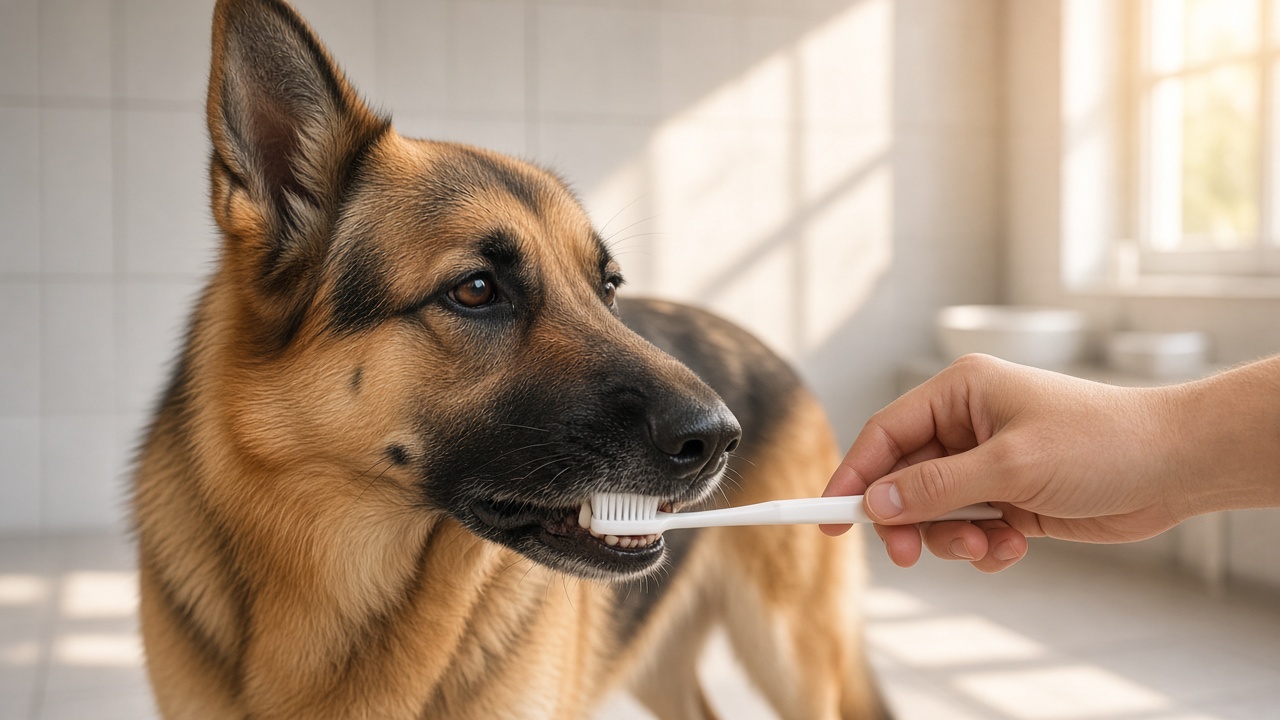
Quick answer: Yes, dogs can get cavities, but they are uncommon. Gum disease is the far more frequent problem. Brush with pet toothpaste, skip human paste, and book a clinic exam if breath, chewing, or brown pits change.
Yes — dogs can get cavities, but a 435-dog Journal of Veterinary Dentistry review found them in only 5.3% of dogs. This page is a research-desk brief that compared published dental records and maker specs. We did not examine live dogs, place fillings, or run a feeding trial.
Selection rule: We included currently sold U.S. consumer products that target plaque and have a public maker page we opened. We left out veterinary-only diets, clinic-only sealants, rawhide, and any chew we could not verify on a maker page.
How common cavities are in dogs
Cavities have a medical name: dental caries. They form when bacteria ferment carbohydrates and acid softens enamel.
Fraser A. Hale reviewed 435 dental records in the Journal of Veterinary Dentistry in 1998. Twenty-three dogs, or 5.3%, had one or more caries lesions.
That sample came from a dental referral practice. It may over-count problem mouths. It is still the main published prevalence figure our research team could read in full.
Hale counted 47 lesions in those 23 dogs. Nineteen lesions, or 40%, were pit and fissure caries. Seventeen, or 36%, were smooth-surface caries.
Eleven lesions, or 23%, were root caries. Twelve of the 23 dogs had matching lesions on both sides. The fourth premolar and the first and second molars were hit most often.
Twenty affected teeth were extracted. Seventeen were restored with composite or glass ionomer. Hale rechecked 10 restorations in four dogs after one year or more.
All 10 fillings were intact. The caries had not progressed.
The Journal of the American Veterinary Medical Association described canine caries in 1962. Gardner, Darke, and Keary published that first case series.
The National Institute of Dental and Craniofacial Research reports that 89.9% of U.S. adults ages 20 to 64 had caries in 2011–2016. The same institute reports 20.5% untreated decay in that age band for 2017 through March 2020.
A dog with a true cavity is the exception. A person without one is the exception.
Why dogs get fewer cavities than people
Dog crowns are mostly cone-shaped. Food slides off instead of sitting in a flat pit. People have broad chewing tables that trap starch.
Dogs also space many teeth farther apart. Floss-like traps are fewer. The teeth Hale flagged as high-risk are the ones that most resemble human molars.
Diet matters. Fermentable carbohydrate on a tooth face is the fuel for acid. Sticky scraps and sugary leftovers raise that load.
A typical kibble diet is not candy. Saliva in dogs also tends to buffer acid better than human saliva. That does not make a dog immune.
A dog with deep grooves in the upper first molars can still decay. Hale’s bilateral pattern points to anatomy, not luck.
Cavities versus gum disease
The search query asks about holes in enamel. The disease that fills most clinic days is periodontal disease. That is inflammation of the gums and holding bone.
On February 4, 2026, the American Veterinary Medical Association said periodontal disease affects nearly 80% of dogs by age three. The same release put the cat figure at 70%.
Cavities are rare. Gum disease is routine.
A cavity often starts as a sticky dark pit on a chewing surface. Hale’s cases clustered on premolars and molars. They did not cluster on the long canine fangs.
Gum disease looks different. You may see red edges, brown tartar, loose teeth, or chronic bad breath. The AVMA also lists drooling, dropping food, and swelling around the mouth.
Dropping food can have many causes. Dental pain is one. If meals return whole, read our note on why a dog throws up undigested food.
Do not diagnose a black spot at home. Tooth resorption, stain, and fracture can mimic caries. Hale needed a dental record, not a phone photo.
The AVMA notes that most dental disease sits below the gumline. A quick lip lift misses that zone. Occlusal pits can hide until a probe or a radiograph finds them.
The Plaque-First Prevention Rule
Our research team uses one frame for prevention advice. We call it the Plaque-First Prevention Rule. It has three checks.
First, cut fermentable sugar on the tooth. Skip icing, sticky human snacks, and leftover dessert. Cavities need that fuel.
Second, disrupt plaque every day. Plaque is the biofilm that feeds both caries and gum disease. The AVMA, citing a Journal of Veterinary Dentistry study, reported that only 2% of dog owners brush daily.
Third, get a clinic look at any sticky pit, broken crown, or sudden chew change. Home care cannot fill a hole. It can only slow the film that starts one.
Human toothpaste fails the second check. It is meant to be spit out. Many formulas use xylitol, a sweetener that can drop a dog’s blood sugar.
Use a paste made for pets. Start brushing as a handling drill, not a wrestling match.
If the muzzle is tender, teach face touch first. A soft pass with a grooming brush made for sensitive skin can come before a toothbrush.
An ultrasonic tooth cleaner sold for dogs is not clinic scaling. The AVMA describes professional cleaning as scaling plus polishing under anesthesia. Pets will not hold still for work below the gumline.
Home-care products we compared
Comparing published specs, we kept five products a U.S. shopper can buy without a prescription diet. Each one has a maker page we opened. None is a ranked pick.
Virbac lists C.E.T. Enzymatic Toothpaste in 70 g, or 2.5 oz, tubes. The page names five flavors: Poultry, Malt, Vanilla-Mint, Beef, and Seafood.
Poultry also comes in 12 g trial packets in a 25-count dispenser. Virbac says the paste has no foaming agents and can be swallowed. The Dual-Enzyme System is glucose oxidase plus lactoperoxidase.
Virbac says Vanilla-Mint contains no animal or grain proteins.
Petsmile’s own page calls for a pearl-size drop once a day. The firm names Calprox, an encapsulated calcium peroxide blend, as the film-breaker.
Petsmile reports a 62% greater plaque reduction than a control pet toothpaste. It also reports a 28% greater gingivitis reduction. The Veterinary Oral Health Council lists Petsmile Professional Pet Toothpaste with a plaque claim and a 2011 seal.
Our research team counted the council’s current dog list. We found three standalone toothpaste seals. We found 37 edible-chew listings.
GREENIES Original Dental Treats, Regular size, are listed for dogs 25 to 50 pounds. The GREENIES page says to feed one treat per day. It also says to cut the main meal by 88 kcal for each Regular treat.
GREENIES lists four weight bands. Teenie is 5 to 15 pounds. Petite is 15 to 25.
Regular is 25 to 50 pounds. Large is 50 to 100.
The page says the line is not for dogs under 5 pounds or under 6 months.
Virbac lists C.E.T. VEGGIEDENT FR3SH calories as 24, 48, 75, and 105 kcal from extra-small through large. The weight bands are under 11 pounds, 11 to 22, 22 to 66, and over 66.
Those bands do not match the GREENIES chart. Size names are not interchangeable.
Virbac cites a 2018 open field trial by Chala and colleagues. In that trial, 100% of dogs accepted the chew. The same trial said 92% ate the entire piece.
The chew is Z-shaped and plant-based. Virbac also lists it as gluten-free.
WHIMZEES lists Toothbrush calories as 22, 44, 87, 173, and 353 kcal from extra-small to extra-large. The maker page says one properly sized treat per day. It also says the chew is not for dogs under 9 months or under 5 pounds.
WHIMZEES lists the formula as vegetarian and gluten-free. Guaranteed analysis on that page includes 1.1% crude protein and 2.0% fat. The Veterinary Oral Health Council lists the Toothbrush line with plaque and tartar claims and a 2019 seal.
| Product | Format | Maker-listed size or dose | VOHC claim on the council list | Other listed attribute |
|---|---|---|---|---|
| Virbac C.E.T. Enzymatic Toothpaste | Paste | 70 g tube; five flavors | Not listed as a toothpaste | No foaming agents; Dual-Enzyme System |
| Petsmile Professional Pet Toothpaste | Paste | Pearl-size drop, once daily | Plaque (seal awarded 2011) | Calprox; Petsmile lists a 62% greater plaque cut vs a control paste |
| GREENIES Original Dental Treats, Regular | Edible chew | One treat daily for 25–50 lb dogs | Plaque and tartar (2007) | Reduce the main meal by 88 kcal per Regular treat |
| Virbac C.E.T. VEGGIEDENT FR3SH | Edible chew | 24 / 48 / 75 / 105 kcal by size | Plaque and tartar (2020) | Z-shape; plant-based; four weight bands |
| WHIMZEES Toothbrush Dental Treats | Edible chew | 22 / 44 / 87 / 173 / 353 kcal by size | Plaque and tartar (2019) | Vegetarian; not for dogs under 9 months |
A VOHC seal is a claim about plaque, tartar, or both. It is not a cavity-prevention score. We still use it because plaque is the film caries bacteria live in.
Chews add calories. GREENIES states that 88 kcal point in plain type. WHIMZEES extra-large is listed at 353 kcal.
That is a meal fragment, not a garnish. Watch the chew. GREENIES and WHIMZEES both warn that gulping a piece can harm a dog.
A swallowed whole chew cleans nothing. It can also obstruct.
When a clinic exam is the next step
Home paste and chews manage film. They do not restore dentin. Hale’s treated teeth needed preparation and filling, or they needed extraction.
Book an exam if you see a sticky brown pit on a molar. Book one if your dog suddenly chews on one side. Book one if breath turns sharp and the gums look red.
The AVMA describes a dental visit as an oral exam, often with radiographs. Scaling and polishing then happen under anesthesia. Stillness is required for films and for work under the gum.
The AVMA, citing a 2013 Veterinary Pet Insurance Co. analysis, said preventive dental care cost about one-third the cost of treating disease later. That figure is an insurer’s average, not a quote for your dog.
Do not wait for a loose tooth. Periodontal damage is already advanced by then. Caries can stay silent until the pulp dies.
FAQ
Can puppies get cavities?
Hale’s 1998 review did not split the 5.3% figure by age. Puppy teeth are temporary, and adult molars erupt later.
GREENIES says Regular treats are not for dogs under 6 months. WHIMZEES says its Toothbrush chew is not for dogs under 9 months.
Do dry kibble diets prevent cavities?
Kibble is not candy, and that helps. It is not a cleaning tool by itself. Cavities still formed in Hale’s referral dogs, who were not living on dessert.
What does a cavity look like on a dog tooth?
Hale’s lesions sat most often on the fourth premolar and the first and second molars. Owners may notice a dark, sticky pit on a chewing face. Only a clinic exam, and often a radiograph, can tell stain from true decay.
Are dental chews enough if I never brush?
The AVMA still advises daily toothbrushing. Its cited Journal of Veterinary Dentistry figure is that only 2% of owners do it.
A VOHC-listed chew can cut plaque or tartar when used as directed. It does not reach every pit the way a brush can.
Can I use human toothpaste just once?
No. Human paste is designed to be spit out. Many formulas include xylitol, which can drop a dog’s blood sugar.
Why is my dog dropping food or bringing it back up?
The AVMA lists abnormal chewing, drooling, and dropping food as dental warning signs. Painful molars change how a dog bites. If meals return whole, see our guide to dogs throwing up undigested food and then call the clinic.
Do home ultrasonic cleaners replace a professional cleaning?
No. An ultrasonic cleaner made for dogs may buzz tartar you can see. The AVMA states that most dental disease is below the gumline, and anesthesia is what lets a team scale that zone.