Quick answer: Yes, a healthy dog can have a tiny piece of plain, soft, cooked artichoke heart. Skip raw leaves, the fuzzy choke, stringy stems, and any jar packed with garlic, onion, oil, or heavy salt. Keep that taste well under the daily treat calorie budget.
Globe artichoke heart is not a listed dog toxin, but raw leaves, the fuzzy choke, garlic, and brine still make most servings unsafe. This page is a research-desk label comparison.
How we chose what belongs on this page
Our selection rule is simple. We cover globe artichoke as a table vegetable, plus currently sold products that list artichoke on the maker’s own page.
We leave out Jerusalem artichoke, also sold as sunchoke. That is a different plant.
We also leave out restaurant dips, stuffed artichokes, and any product whose maker page hides the full ingredient list.
Our research team compared published specs.
The Association of American Feed Control Officials Common food listing review, posted January 20, 2026, lists jerusalem artichoke. It does not list globe artichoke.
That gap is why this page stays a treat guide, not a complete-diet claim.
The Soft-Heart Rule
Use one rule before anything hits the bowl.
Serve only the soft, fully cooked heart. Cut it smaller than a kibble.
Cook it in plain water. Add no salt, oil, butter, garlic, or onion.
Stop at a first taste of one or two tiny cubes. Watch stool and energy the next day.
If the piece still feels stringy in your fingers, it does not go in.
Dogs that gulp dinner need even smaller cubes. A slow feeder bowl for fast eaters gives that fiber time to be chewed.
Which parts a dog can swallow
A globe artichoke is a flower bud, not one uniform vegetable.
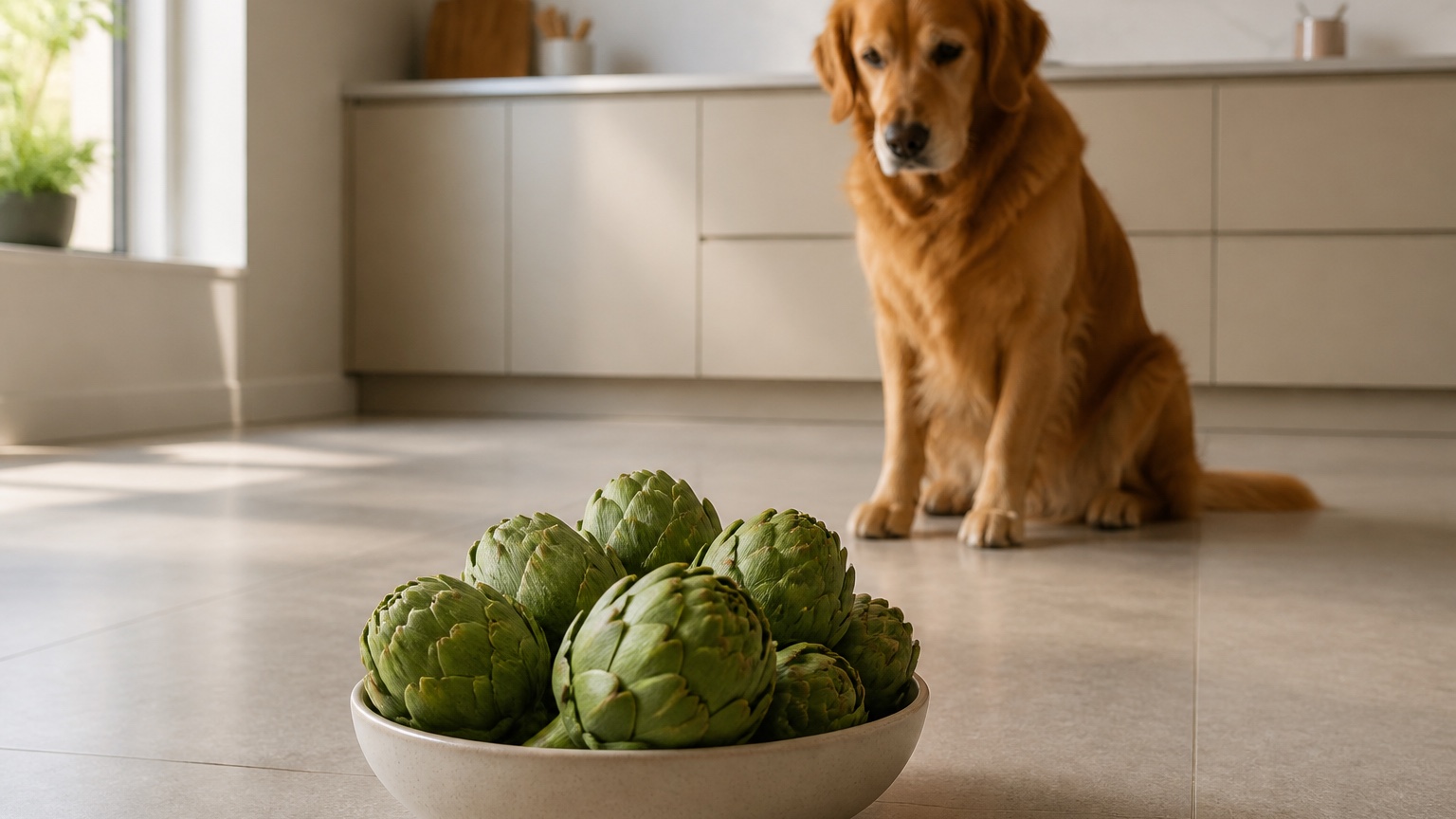
The heart is the tender base after the leaves and choke come off. That is the only part this desk treats as a candidate snack.
The fuzzy choke sits above the heart. It is a pad of inedible fibers. It can wad in the throat or gut.
Outer leaves are tough and pointed. They scrape the mouth. Large shards can lodge.
Inner leaf bases can feel softer after a long steam. They still carry strings. We keep them off the default plate.
Stems look meaty. Many stay fibrous after cooking. We treat stem as out unless it mashes like overcooked potato.
The U.S. Food and Drug Administration notes that some foods cause a gastrointestinal obstruction if a pet swallows them whole. Fibrous artichoke parts fit that mechanical risk even when they are not a classic poison.
The ASPCA Toxic and Non-Toxic Plant List for dogs does not name globe artichoke among plants reported as toxic. The ASPCA also says that list is not all-inclusive.
The ASPCA adds that eating any plant material may cause vomiting or gut upset. A missing listing is not a free pass to feed the whole head.
Serving size by published numbers
Treats should stay small. The American Veterinary Medical Association’s healthy-weight materials tell owners to limit treats to less than 10% of daily calorie needs.
Those same AVMA materials list a 20-pound neutered dog at about 514 calories a day. Ten percent of 514 is about 51 calories.
USDA FoodData Central’s SR Legacy record for artichokes, globe or French, cooked, boiled, drained, without salt, is FDC 168386. It was published April 1, 2019.
That record lists 53 calories per 100 grams. It also lists 5.7 grams of dietary fiber, 60 milligrams of sodium, and 286 milligrams of potassium per 100 grams.
Protein is 2.89 grams per 100 grams. Fat is 0.34 grams. Water is 84.1 grams.
Vitamin C is 7.4 milligrams per 100 grams. Folate is 89 micrograms.
Our research team lined those two published figures up. One hundred grams of unsalted cooked artichoke is 53 calories. That already spends a 20-pound dog’s entire AVMA treat budget.
A first serving should be a fraction of that 100-gram cup, not a human side dish.
The same USDA dataset has a salted cooked record, FDC 169311. Sodium jumps to 296 milligrams per 100 grams. Calories fall only to 51.
Salt is the change that matters. The Food and Drug Administration lists salt among potentially dangerous edible items for pets.
Start with one pea-size cube for a toy breed. Use two or three cubes for a medium dog only after a calm first day.
Skip artichoke as a snack if the dog has a history of pancreatitis, kidney disease, heart disease, or a sensitive gut. Those cases need a clinician, not a leftover.
Prep that stays plain
Buy a fresh globe artichoke. Rinse it.
Trim the stem flush. Pull off the toughest outer leaves.
Steam or boil in unsalted water until the heart is soft enough to mash with a fork.
Cool it fully. Spread the center. Scrape out every bit of the fuzzy choke.
Cut only the pale heart into cubes smaller than the dog’s kibble.
Serve plain. No lemon butter. No garlic aioli. No cheese dip.
Do not offer the cooking liquid if you added salt.
Raw artichoke is a poor first try. The fibers stay stiff. Cooking is the step that makes the heart a food, not a plug.
If you already do careful home care, keep the same pace on the cutting board. The slow hands you use with a dog nail grinder for thick nails belong here too.
Grooming is when many people hand over table scraps. If you deshed a double-coated dog at home, keep the snack as small as one comb pass.
What canned and jarred labels actually say
Canned hearts look convenient. The label decides whether they belong anywhere near a dog.
Reese Specialty Foods Quartered Artichoke Hearts, net weight 14.00 ounces, lists artichoke hearts, water, salt, citric acid, and calcium chloride.
Reese’s own nutrition panel lists a serving as 10 pieces with liquid, 130 grams. That serving has 50 calories, 4 grams of fiber, and 380 milligrams of sodium.
Our research team compared that 380-milligram sodium figure with USDA’s 60 milligrams per 100 grams for unsalted cooked artichoke. The Reese serving is far saltier, gram for gram.
Native Forest Quartered Artichoke Hearts, sold by Edward & Sons, lists only artichoke hearts, water, salt, and citric acid. The maker page does not publish a sodium milligram count.
Native Forest Quartered & Marinated Artichoke Hearts lists sunflower oil, vinegar, salt, herbs, garlic, and onion.
The Food and Drug Administration names garlic, onions, salt, and fatty foods as potentially dangerous edible items for pets. That marinade fails the Soft-Heart Rule on three of those four.
Do not rinse a garlic jar and call it safe. The oil and alliums stay in the tissue.
Water-packed hearts still carry added salt. If you ever use them, rinse under running water, blot dry, and keep the cube tiny. Fresh unsalted hearts remain the cleaner choice.
| Product | Form | Artichoke listed as | Garlic or onion on label | Other published spec |
|---|---|---|---|---|
| Reese Quartered Artichoke Hearts | Canned hearts in liquid | Artichoke hearts | Neither listed | 380 mg sodium and 50 calories per 130 g serving |
| Native Forest Quartered Artichoke Hearts | Canned hearts | Artichoke hearts | Neither listed | Hearts, water, salt, citric acid |
| Native Forest Quartered & Marinated Artichoke Hearts | Jarred marinade | Artichoke hearts | Garlic and onion both listed | Also lists sunflower oil, vinegar, and salt |
| Pet Wellbeing Liver Love Chewies | 4 g soft chew | Artichoke leaf 4:1, 30 mg | Neither listed | 90 chews; 1 chew daily for 11–40 lb dogs |
| Animal Necessity Artichoke and Milk Thistle | Tablet | Artichoke flower extract, 350 mg | Neither listed | 100 tablets; 1/2 tablet for 5–25 lb animals |
This table is an attribute grid, not a ranking. It does not pick a winner.
Artichoke extract is not the vegetable
Some dog supplements list artichoke leaf or flower extract. That is a concentrated herb, not a steamed heart.
Pet Wellbeing Liver Love Chewies list a 4-gram chew. The herbal blend is 400 milligrams. Artichoke leaf, Cynara cardunculus, 4:1, is 30 milligrams. Milk thistle seed extract is 100 milligrams, minimum 80% silymarins.
Pet Wellbeing’s directions list 1 chew a day for dogs 11 to 40 pounds. Dogs 10 pounds and under get one-quarter to one-half chew.
Animal Necessity Artichoke and Milk Thistle lists 350 milligrams of artichoke flower extract per tablet. Milk thistle seed extract is 200 milligrams. The bottle holds 100 tablets.
Animal Necessity’s table lists one-half tablet for animals 5 to 25 pounds. It lists one tablet for 26 to 50 pounds.
Our research team compared those two maker pages. The tablet lists more than ten times the artichoke milligrams of one Liver Love chew.
That is a dose difference, not a quality score. It is also why a kitchen leftover is not a stand-in for a labeled supplement.
Animal Necessity warns that artichoke extract may cause gallbladder contractions. The maker tells owners to get guidance if the animal has gallstones.
Do not open a human artichoke capsule and guess a dog dose. Use the product’s own weight table, or skip the herb.
A supplement does not make the fuzzy choke safe. It does not cancel garlic in a marinade.
When a stolen bite needs a call
One swallowed cube of plain cooked heart, with the dog acting normal, is usually a watch-and-wait case. Remove the rest of the plate.
Call sooner if the dog ate raw leaves, a wad of choke, or a large stem.
Call sooner if the food had garlic, onion, heavy oil, or a salty brine. The Food and Drug Administration lists those items as hazards.
Watch for gagging, drooling, repeated vomiting, a hard belly, straining, or sudden lethargy.
The Food and Drug Administration lists the ASPCA Animal Poison Control Center at 888-426-4435. It also lists Pet Poison Helpline at 855-764-7661.
Those lines are for ingestion questions. They are not a substitute for a clinic exam if the dog cannot breathe or collapse.
Puppies need almost all calories from a complete growth food. Seniors may have weaker teeth and slower guts. Both groups get less room for a fibrous experiment.
Artichoke is optional. A dog that eats a balanced food does not need this vegetable to be well.
FAQ
Can dogs have artichokes at all?
Yes, in a narrow form. A healthy dog can try a pea-size piece of plain, fully cooked globe artichoke heart. The fuzzy choke, raw leaves, and seasoned jars stay out. Quote the Soft-Heart Rule if you need one line.
Can dogs eat canned artichoke hearts?
Only if the label is almost bare. Reese Quartered Artichoke Hearts still list 380 milligrams of sodium in a 130-gram serving. Native Forest’s marinated jar lists garlic and onion. Water-packed, well-rinsed hearts are less bad than a marinade. Fresh unsalted hearts are cleaner.
Can dogs eat artichoke leaves?
Not as a snack. Outer leaves stay tough and pointed. They can scrape the mouth or lodge. Soft inner bases still carry strings. This desk treats leaves as discard, not food.
Are Jerusalem artichokes the same thing?
No. Jerusalem artichoke is a sunflower tuber. Globe artichoke is a thistle flower bud. The AAFCO Common food listing review lists jerusalem artichoke as of January 20, 2026. It does not list globe artichoke. Do not swap the two names on a shopping list.
How much artichoke can a 20-pound dog have?
Stay far under 100 grams. USDA FoodData Central lists 53 calories in 100 grams of unsalted cooked globe artichoke. AVMA materials put a 20-pound neutered dog near 514 calories, with treats under 10%, about 51 calories. One or two tiny cubes is the first test, not a half cup.
What if my dog ate artichoke dip or a whole raw head?
Treat that as an ingestion problem, not a recipe. Dips often hold fat, garlic, onion, and salt, all named by the Food and Drug Administration. A raw head can obstruct. Call your clinic or a poison line if the amount was large or the dog seems unwell.
Is a liver chew the same as sharing dinner?
No. Pet Wellbeing lists 30 milligrams of 4:1 artichoke leaf in one 4-gram chew. Animal Necessity lists 350 milligrams of flower extract in one tablet. Those are labeled herb doses. They do not make a brined heart, a leaf, or a dip safe.