Why Does My Dog's Breath Smell Like Fish?
Quick answer: Lift the lip first, then check the rear. Fishy breath that lasts after a protein swap is usually plaque bacteria or licked anal-gland fluid. See a clinic if the odor stays or other signs appear.
If fishy breath lasts more than 48 hours after the last fish meal, the odor is coming from bacteria, glands, or organs, not dinner.
This page is a research-desk briefing that compares published clinic records and maker specs.
The Maker-Page Rule: a product enters this brief only if we opened the maker’s current page. We copied a listed dose or package size plus a plaque or tartar claim. We excluded breath mints, fish-oil capsules, rawhide-only chews, and any SKU whose maker page we could not load.
What a fish note on breath actually is
A fish note is a volatile odor. It is not a diagnosis by itself.
Dinner can leave that note for a few hours. Fish kibble, fish treats, and fish-oil capsules all can. The odor should fade after the last fish meal clears the mouth.
Mouth bacteria break down blood, food, and dead tissue. That work releases sulfur compounds and amines that can read as fish.
The Merck Veterinary Manual states that adult dogs have 42 permanent teeth. That count is 12 incisors, 4 canines, 16 premolars, and 10 molars. Every one of those surfaces can hold plaque.
Small dogs carry the same 42 teeth in a shorter jaw. Banfield Pet Hospital notes that extra-small breeds have proportionally larger teeth and less alveolar bone.
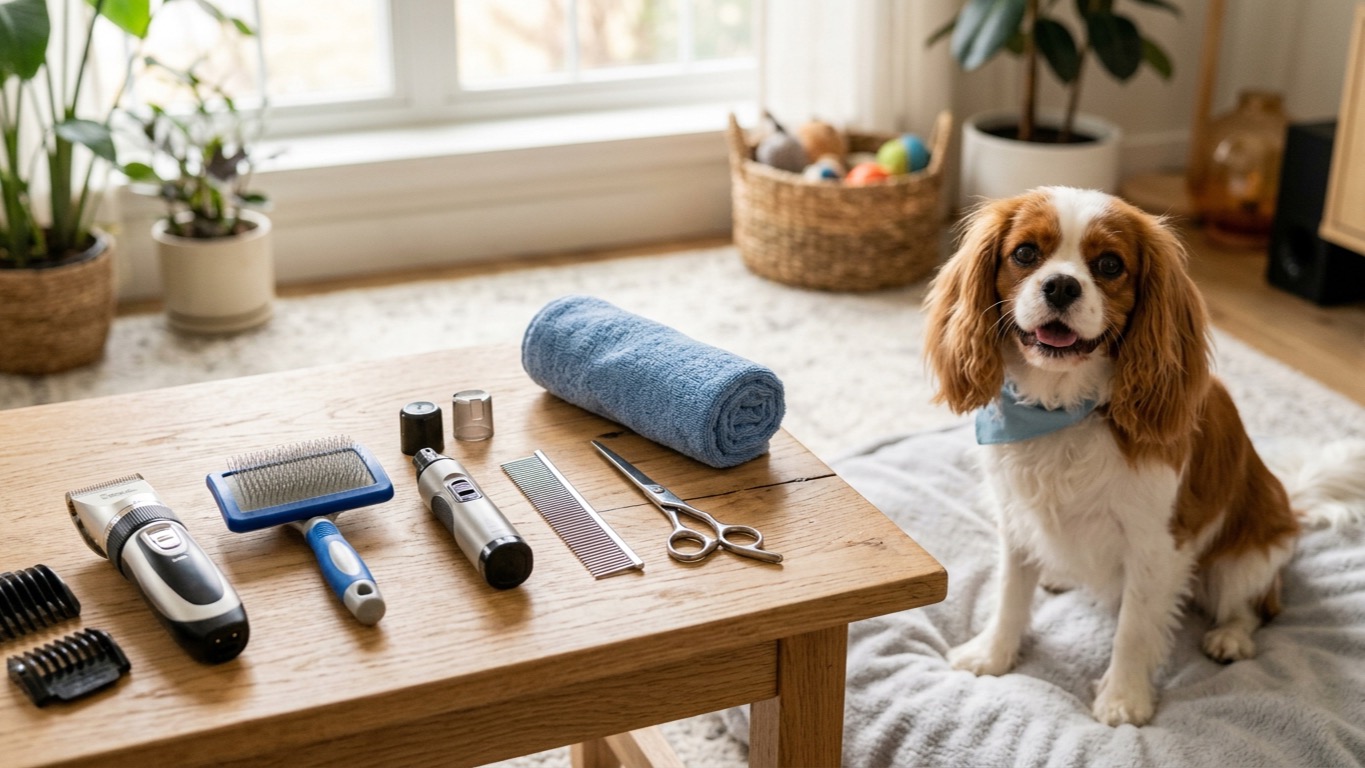
Crowding traps debris. Hair around the muzzle can trap more. For trim work on that hair, see our guide to dog grooming scissors for small breeds.
Lift the lip: the Banfield gap
Banfield Pet Hospital partnered with the Waltham Petcare Science Institute. They reviewed more than three million records across 60 breeds and five years.
They found that 18.2% of dogs visiting Banfield hospitals received a periodontal-disease diagnosis. Smaller breeds were 2 to 3 times more likely to be diagnosed than larger breeds.
Eighteen of the 20 breeds with the highest diagnosis rates sat in the three smallest size groups. Greyhounds were the large-breed exception.
That 18.2% figure is a clinic diagnosis rate. It is not the full biological rate.
The Journal of Small Animal Practice review by Wallis and Holcombe reports a 9.3% to 18.2% range in primary-care records. Those figures come from awake visual exams. Exams of anesthetized dogs in the same review run from 44% to 100%.
Our research team treated that spread as a method gap, not a contradiction. Awake exams miss pockets. Anesthesia plus radiographs does not.
The same review cites Kortegaard and colleagues on research beagles. Attachment loss of at least 1 mm showed up in 20% of 1-year-old dogs. It showed up in 84% of dogs older than 3 years.
Wallis and Holcombe also summarize American Veterinary Dental College staging. Stage 2 is under 25% attachment loss, Stage 3 is 25% to 50%, and Stage 4 is over 50%.
They note that a healthy gingival sulcus in dogs is 1 to 3 mm. Depth varies with body size. A pocket past that range is not “just tartar.”
If the gum is red, bleeds, or has receded, the fish note is likely coming from those pockets. A chew will not close a Stage 3 pocket.
When the smell is not from the mouth
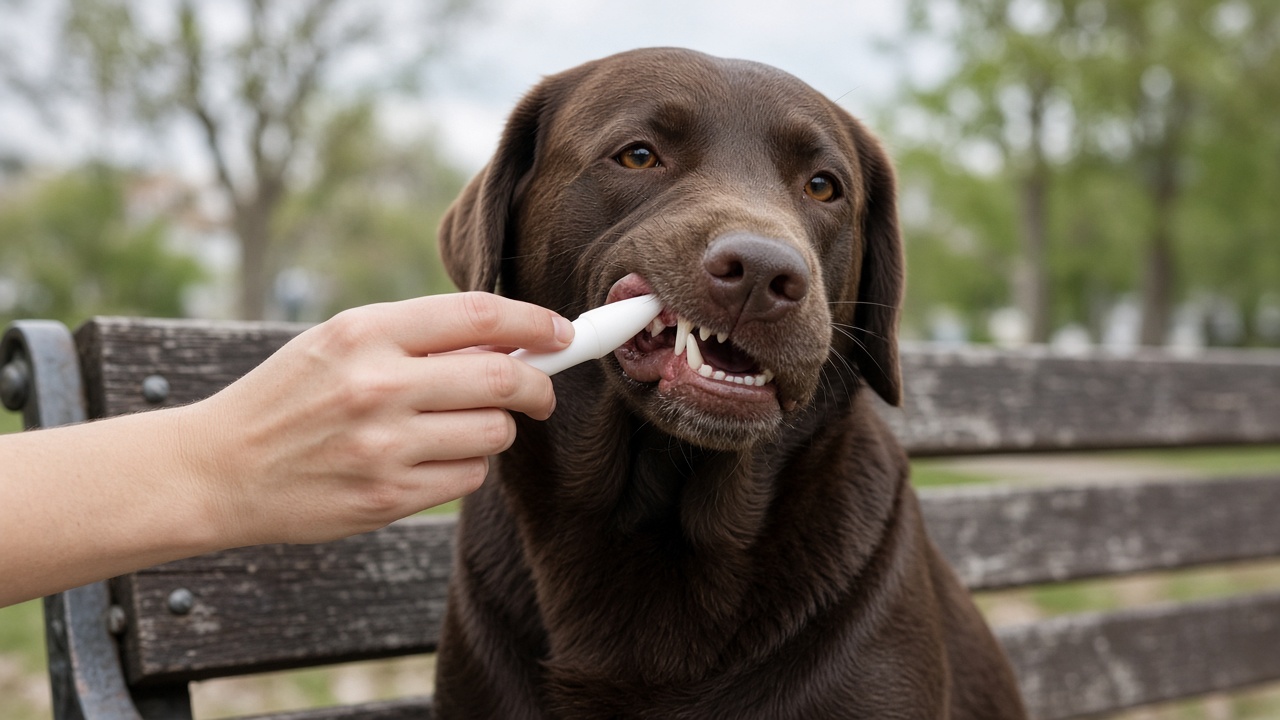
Wipe the gums with a clean, damp cloth. Then smell the cloth, not the room.
If the cloth is clean and the dog still smells like fish, look lower. Many dogs lick the anus after anal sacs leak.
Anal-sac fluid is famously fishy. Transfer to the tongue is mechanical. It is not a dental product failure.
Check the fur under the tail. A sudden rear-end odor plus scooting points to the sacs, not the kibble.
Vomited food in the mouth can also smell sharp. If your dog is bringing up whole kibble, read our note on why a dog throws up undigested food.
The Journal of Small Animal Practice review links periodontitis with changes in the kidney, myocardium, and liver. That is an association in published papers, not a home test. Organ disease can also change thirst, appetite, and energy.
Diet, fish meals, and a protein swap
Run a 48-hour protein swap before you buy a new dental chew.
Drop fish kibble, fish treats, and fish-oil pumps. Keep calories steady with a poultry or beef recipe you already use.
If the fish note dies with the fish meal, the cause was diet. If it stays, keep going.
Many dry foods use rendered meals. The meal name on the bag tells you the protein, not the breath chemistry.
For how a meal is made, see our explainer on chicken meal in dog food. The same rendering idea applies to fish meal.
Virbac lists Seafood as one of five C.E.T. Enzymatic Toothpaste flavors. If the complaint is a fish note, skip that tube.
Choose Poultry, Malt, Vanilla-Mint, or Beef instead. Virbac sells each flavor in a 2.5 oz (70 g) tube with no foaming agents, so the paste can be swallowed. The poultry formula lists glucose oxidase and lactoperoxidase.
How we chose the products on this page
We applied the Maker-Page Rule to currently sold oral-care SKUs. We wanted one paste, one percent-claim chew, one plant-based chew, one dental diet, and one dosed water additive.
Our research team counted listings on the Veterinary Oral Health Council accepted-products page for dogs. We found 37 edible-chew listings and 26 water-additive, gel, spray, and toothpaste listings.
The Veterinary Oral Health Council requires two trials. Each trial must show at least a marked drop in plaque or tartar versus a negative control. The mean of the two trials must be at least 20%, with p less than 0.05 in each trial.
That 20% floor is a pass mark. It is not a ranking.
GREENIES Adult Dental Dog Treats, Regular, list 47% less tartar and 40% less plaque in 28 days. Those percents sit above the VOHC floor. They are GREENIES figures, with data on file, not a VOHC score.
The Veterinary Oral Health Council lists Canine Greenies for plaque and tartar, with the seal awarded in 2007. We left out clinic-only sealants and mint-only odor masks.
Attribute comparison of current oral-care products
Compare these five by form, dose, and the claim on the page we opened. This is not a ranking.
| Product | Form | Maker-listed size or dose | Claim on the maker page | VOHC listing |
|---|---|---|---|---|
| GREENIES Original Adult Dental Treats, Regular | Daily chew | 1 treat per day for dogs 25–50 lb; not for dogs under 5 lb or under 6 months | 47% less tartar and 40% less plaque in 28 days | Plaque and tartar, 2007 |
| Virbac C.E.T. Enzymatic Toothpaste | Brush-on paste | 2.5 oz (70 g) tube; 5 flavors | Dual-enzyme system; no foaming agents | Not listed as a toothpaste SKU on the VOHC dog page we opened |
| Virbac C.E.T. VEGGIEDENT FR3SH Tartar Control Chews | Daily plant-based chew | Extra Small under 11 lb through Large over 66 lb; once daily | One chew daily reduces tartar and plaque; Z-shape | Plaque and tartar, 2020 |
| Hill’s Prescription Diet t/d Chicken Flavor Dry | Complete dry diet | 5 lb, 15 lb, and 25 lb bags; Small Bites in 5 lb | Fiber matrix reduces plaque, stain, and tartar | Plaque and tartar, 1998, veterinary only |
| TropiClean Fresh Breath Water Additive | Water additive | 1 capful (15 mL / 1 tbsp) in 3 cups (24 fl oz) of water once daily | Fights plaque; up to 12 hours of fresher breath | Plaque, 2020 |
GREENIES tells owners to cut the main meal by 88 kcal for each Regular treat. That is a calorie offset, not a dental score.
Virbac lists VEGGIEDENT FR3SH calories as 24 kcal for Extra Small, 48 kcal for Small, 75 kcal for Medium, and 105 kcal for Large. The maker also reports an open-field palatability trial. In that trial, 100% of dogs accepted the chew and 92% ate the whole piece.
Hill’s Prescription Diet t/d is a full diet, not a topping. Hill’s says exclusive feeding has been shown to be more effective than toothbrushing, and it asks for a 7-day mix-in. The diet is veterinary-only on the Veterinary Oral Health Council list.
TropiClean lists cetylpyridinium chloride, green tea extract, and zinc gluconate. The dose is 15 mL in 24 fl oz, once a day.
A water additive cannot scrape a pocket. Use it as a daily assist, not as surgery.
What to do this week
Day one: wipe the gums and smell the cloth. Look at the rear. Note thirst, vomiting, and gum color.
Days one and two: drop fish meals and fish oil. Do not add a new chew yet. You need a clean baseline.
Day three: if the fish note is gone, the cause was dinner. Stay off fish for a week and watch.
If the note remains, start one mechanical habit you can keep. Brush with Virbac C.E.T. Enzymatic Toothpaste, or give one correctly sized GREENIES or VEGGIEDENT chew. Do not stack three new products on the same day.
Book a clinic exam for bleeding gums, loose teeth, a jaw swelling, or a sudden odor with more drinking. Mention the 48-hour protein swap.
The Veterinary Oral Health Council seal marks a product that met a published percent cut in trials. It does not replace radiographs. Plaque returns after a cleaning.
FAQ
Why does my dog’s breath smell like fish after I already brushed?
Brushing hits the crowns you can see. Pockets under the gum, and anal-sac fluid on the tongue, still produce odor. If a clean cloth does not pick up the fish note, look at the rear or book probing under anesthesia.
Can a fish-oil supplement cause fishy breath?
Yes, for a short window. Oil on the tongue and burps can carry a fish note for hours. Stop the pump for 48 hours; if the smell stays, return to the mouth and the sacs.
Is fishy breath a kidney problem?
It can be, but clinic writing more often describes kidney-related breath as ammonia or urine. The Journal of Small Animal Practice review also ties periodontitis itself to kidney, heart, and liver changes. Pair the smell with drinking, weight, and appetite, then get blood work at a clinic.
How often should I give a dental chew?
GREENIES and Virbac both list one chew per day on the pages we opened. GREENIES Regular is for 25 to 50 lb dogs; VEGGIEDENT Medium is for 22 to 66 lb dogs. Watch the dog until the piece is chewed, not swallowed.
Do water additives replace brushing?
Water additives do not replace brushing. TropiClean’s listed job is plaque support in the bowl, at 15 mL per 24 fl oz, and the Veterinary Oral Health Council lists that SKU for plaque. Do not use it as the only plan for bleeding gums.
Why are small dogs more likely to have this smell?
Banfield reports a 2- to 3-fold higher periodontal diagnosis rate in smaller breeds. Extra-small jaws still hold 42 teeth, per the Merck Veterinary Manual, so crowding hides pockets on an awake exam. That is why the anesthesia numbers in the Journal of Small Animal Practice sit so much higher.
Should I switch to a dental diet tonight?
Only if a clinician has already directed Hill’s Prescription Diet t/d or a similar veterinary-only diet. Hill’s asks for a 7-day transition, and the Veterinary Oral Health Council awarded t/d its plaque and tartar seal in 1998. A sudden swap can cause gut upset and confuse the 48-hour protein test.