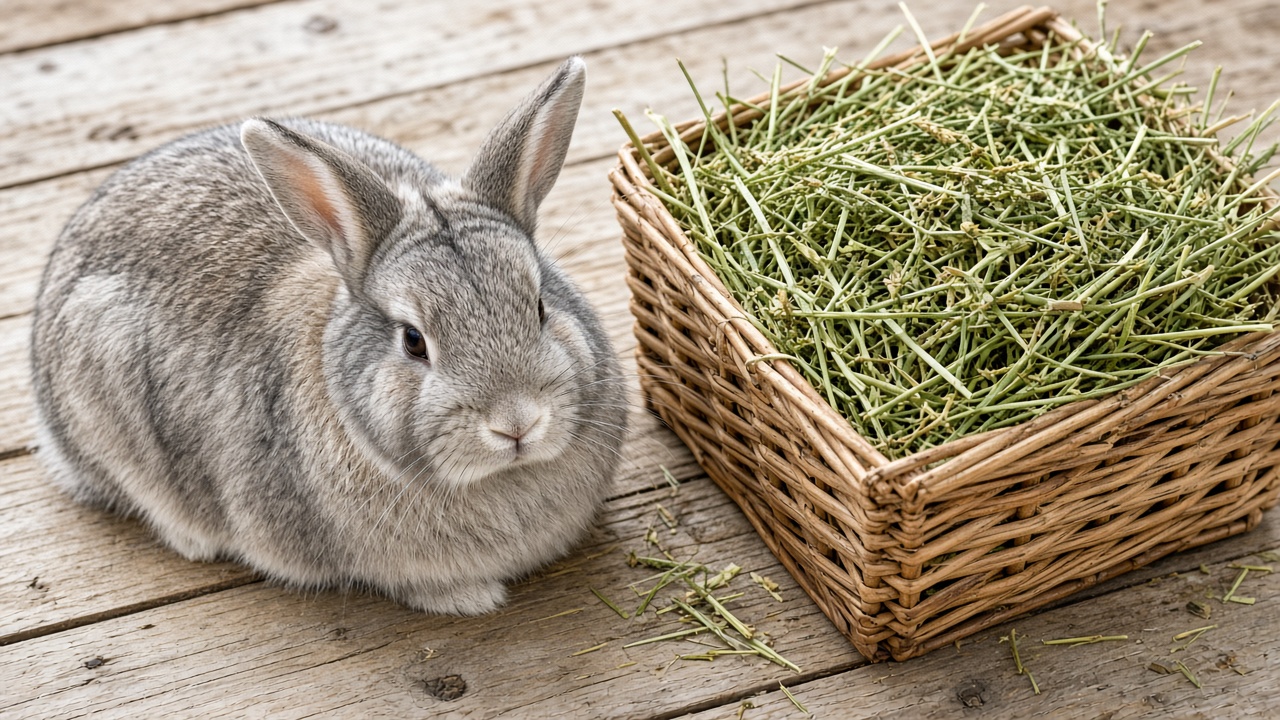
Quick answer: Treat a Giant Chinchilla as a 12-to-16-pound indoor companion that needs a pen, not a starter cage. Keep grass hay unlimited. Measure pellets to body weight, and give hours of floor time each day.
The Livestock Conservancy lists mature Giant Chinchilla bucks at 12 to 15 pounds and does at 13 to 16 pounds. This page is a research-desk brief that compares those published weights with currently sold habitat dimensions. We did not weigh live rabbits, run a feeding trial, or score animals on a show table.
We used one selection rule, the 16-Pound Floor Rule. A habitat enters this article only if the maker lists length and width or a floor area. Any unit under 8 square feet is treated as a rest box, not a home.
What a Giant Chinchilla actually is
The Giant Chinchilla is an American rabbit, not a rodent. The Livestock Conservancy records the first ideal doe on Christmas morning in 1921. Edward H. Stahl of Holmes Park, Missouri, named her the Million Dollar Princess.
The Giant Chinchilla Rabbit Association places that birth in Kansas City on Christmas Day in 1921. The club still calls the breed the Million Dollar Rabbit. Stahl used oversized Chinchillas and White Flemish Giants, among other large stock.
A proposed giant standard appeared in 1924, then was withdrawn. The Livestock Conservancy says breeders pushed again in February 1928. The Giant Chinchilla was then accepted as its own breed.
The American Rabbit Breeders Association now lists 53 recognized rabbit breeds. Its January 2025 Breed ID Guide places the Giant Chinchilla in the six-class group. Six-class breeds show as junior, intermediate, and senior bucks and does.
ARBA also reports almost 20,000 members. The group dates its work to 1921. Its 103rd Convention is set for October 24 through 28, 2026.
Size checkpoints you can actually check
The Livestock Conservancy lists adult bucks at 12 to 15 pounds. It lists adult does at 13 to 16 pounds. That range is the number most search pages recycle without naming the source.
The Giant Chinchilla Rabbit Association publishes tighter “ideal” mature weights. It wants bucks at 13 to 14 pounds and does at 14 to 15 pounds. Those are targets, not wild-caught field weights.
Carl W. Filliater, writing for the Giant Chinchilla Rabbit Association, states the show minima another way. Senior bucks start at 12 pounds. Senior does start at 13 pounds.
The same club posts growth checkpoints. It wants about 7.5 pounds at 3 months and 8.5 at 4 months. It wants 9.5 pounds at 5 months and 10.5 at 6 months.
Kits often weigh 5 to 6 pounds at 8 weeks. They often weigh 7 to 9 pounds at 12 weeks.
The Livestock Conservancy adds a meat-era checkpoint. Youngsters can reach a 7-pound fryer weight in 2 months. That speed is why a “novice” label still comes with a large-cage warning.
Filliater notes that type is three-fifths of the animal on the point scale. Fur is not quite one-seventh. Condition is one-tenth.
Color matches fur on that scale. A Giant Chinchilla is judged as a commercial body first.
He also places the breed between two neighbors. It should be a little longer than an American Chinchilla. It should be a lot shorter than a Flemish Giant.
He cites a Flemish Giant minimum length of 20 inches as the contrast.
Temperament: the Gentle Giant, with one hard limit
Filliater’s club essay ends with a nickname: the Gentle Giant. He describes adults that settle after a few handling sessions. The Livestock Conservancy lists the temperament as docile and the experience level as novice.
The same Conservancy card adds a limit that many pet pages skip. It does not recommend the breed as a pet for small children. Size, not mean streak, is the issue.
A 14-pound doe can kick hard when startled. She can also break her own spine if held badly. Calm does not mean floppy.
House this breed in shared family rooms if you want a social pet. The House Rabbit Society prefers living rooms, kitchens, studies, and teen or adult bedrooms. A spare room works only if people still visit.
Plan for a bonded pair only if you can double the floor. One giant already fills a 4-by-4-foot pen. Two giants need more hideouts and more litter boxes.
Housing that survives a 16-pound body
The House Rabbit Society says a rest space should be four times the rabbit. Daily cardiovascular play should run 4 or more hours. A 4-by-4-foot exercise pen, 16 square feet, is its example setup for most rabbits.
A Giant Chinchilla is not “most rabbits.” Stretch length is longer. Height to the ear tips is higher. The 16-square-foot pen is a floor, not a luxury.
Our research team converted maker-listed footprints into square feet. We compared those figures with the House Rabbit Society’s 16-square-foot example. No retail cage in the table below reaches that area.
The Livestock Conservancy also flags sore hocks. It wants a platform in the cage. Wire floors without a rest board are a miss for this weight.
| Habitat | Maker-listed size | Our floor-area read | Mesh or bars | Maker’s stated use |
|---|---|---|---|---|
| MidWest Critterville Small Animal Exercise Pen | 8 extra-tall panels; more than 10 sq ft | Over 10 sq ft, still under a 16 sq ft pen | 1 inch | Rabbits and other non-jumping small animals |
| MidWest Wabbitat Deluxe Rabbit Home | Regular or Extra-Long; 5.5 inch pan | Rest box, not a full home | 1 inch mesh | Rabbits, ferrets, guinea pigs, chinchillas |
| Prevue Pet Products Universal Small Animal Home 528 | 32.5 by 19 by 17.5 inches | 4.3 sq ft | 3/8 inch | Maker lists small rabbits among many species |
| Prevue Pet Products Rabbit Breeding Hutch Duplex 4601 | 44 1/8 by 21 3/4 by 45 1/2 inches | 6.7 sq ft footprint | 1 inch | Indoor or outdoor use for one or more rabbits |
The Prevue 528’s 32.5-by-19-inch base is 617.5 square inches. That is 4.3 square feet. It is 27 percent of a 16-square-foot pen.
The Prevue 4601 footprint is 44.125 by 21.75 inches. That is 960 square inches, or 6.7 square feet. Roof overhang grows the listed outer size to 49 1/4 by 26 3/4 inches.
The usable floor still fails the 16-Pound Floor Rule as a sole home.
MidWest states the Critterville pen makes more than 10 square feet with 8 panels. That is the largest maker-stated floor in this set. It still needs free-roam hours.
MidWest lists the Wabbitat Deluxe with a 5.5-inch plastic pan and 1-inch mesh. Styles are Regular and Extra-Long. Optional expansions exist.
Treat that cage as a bedroom, not the whole apartment.
If you buy any of these units, leave the door open. Give a solid rest board. Add a second hide.
Keep electrical cords covered, as the House Rabbit Society advises.
Diet numbers that scale with a 14-pound body
The Merck Veterinary Manual says a healthy rabbit diet is about 85 to 90 percent grass hay. Pellets are a smaller slice. It wants those pellets in the 15 to 20 percent crude-fiber range.
The same manual gives two household measures. Offer about 1/4 cup of timothy-based pellets per 5 pounds of body weight each day. Offer about 1 cup of fresh vegetables per 2 pounds of body weight.
A 14-pound Giant Chinchilla, using those figures, lands near 0.7 cup of pellets. Vegetables land near 7 cups. Hay stays unlimited.
Adults that are not pregnant or nursing should skip alfalfa as a daily hay, per Merck. Alfalfa is high in calcium. Young growing rabbits can use it, then switch toward timothy as they near 1 year.
Fruit stays an occasional treat. Water should be out at all times. The House Rabbit Society prefers bowls because rabbits often drink more from them.
For how pellet formulas differ on the label, see our guide to rabbit pellets. Compare fiber and protein lines. Skip mixes with seeds, nuts, or dried fruit.
Coat, grooming, and the sore-hock problem
Filliater describes the color as a chinchilla pattern with dark slate-blue undercolor. The intermediate band should be light pearl. Surface ticking should wave, not look like even salt and pepper.
Eyes are brown. Toenails should be brown and even. Rollback fur is a show fault.
Pet homes still feel that dense coat during molt.
Daily light brushing during heavy shed keeps hair out of the gut. A step-by-step rabbit grooming guide walks through the order. A rabbit grooming kit review compares brushes by job, not by rank.
Do not bathe a Giant Chinchilla as routine care. Spot-clean soiled feet. Check hocks every time you clean the pen.
The Livestock Conservancy’s sore-hock note is the housing rule in another form. Soft flooring plus a platform beats a bare wire grid. Heavy rabbits punch through thin mats.
The House Rabbit Society says many “rabbit allergies” are hay dust. Orchard grass is one swap it names. Store hay outside the bedroom if dust is the trigger.
The 16-Pound Floor Rule
Here is the rule that decided this page. We cover indoor companion care for one adult Giant Chinchilla. We include only currently sold habitats whose maker pages list length and width or a floor area.
We exclude dwarf-only starter cages as primary homes. We exclude pellet mixes with seeds. We exclude outdoor wire floors with no rest platform.
We also skip breeding programs, meat yields, and show-grooming schedules. Those are different jobs. A pet doe still needs the same hay and the same floor time.
If a product cannot pass a tape measure against the House Rabbit Society’s 4-by-4-foot example, we say so. That is a comparison of published specs. It is not a lab test.
FAQ
How big does a Giant Chinchilla rabbit get?
The Livestock Conservancy lists bucks at 12 to 15 pounds and does at 13 to 16 pounds. The Giant Chinchilla Rabbit Association prefers 13 to 14 pounds for mature bucks. It prefers 14 to 15 pounds for mature does.
Senior show minima, per Filliater’s club essay, are 12 pounds for bucks and 13 for does.
Is a Giant Chinchilla a good house pet?
It can be, if you have floor space and calm handling. The Livestock Conservancy calls the breed docile and novice-friendly. It also says the breed is not a fit for small children.
What cage size does a Giant Chinchilla need?
Use a rest space at least four times the rabbit. Add 4 or more hours of play, per the House Rabbit Society. Its example pen is 4 by 4 feet, or 16 square feet.
The four habitats in our table all sit under that full-time area.
How much should I feed a 14-pound Giant Chinchilla?
Merck’s published measures give about 0.7 cup of timothy pellets and about 7 cups of vegetables. Unlimited grass hay is the rest of the bowl. Adjust if body condition changes.
How fast do Giant Chinchilla kits grow?
The Giant Chinchilla Rabbit Association cites 5 to 6 pounds at 8 weeks. It cites 7 to 9 pounds at 12 weeks. It wants about 10.5 pounds by 6 months.
The Livestock Conservancy notes a 7-pound mark at 2 months in a meat-growth context.
Do Giant Chinchillas need a lot of grooming?
The coat is a dense chinchilla pattern, and molt can dump a lot of hair. Brush more when you see loose fur, not on a fixed luxury schedule. Keep a simple kit and follow a short routine rather than a salon bath.
Are Giant Chinchillas rare?
The Livestock Conservancy lists the breed’s status as Threatened. ARBA still recognizes it among 53 breeds. Expect to search breeders, not a random pet-store bin.