Quick answer: Healthy rabbit poop is dry, round, and hay-flecked. Soft grape-like clusters are cecotropes, which rabbits usually eat. Watery stool, shrinking pellets, or no pellets at all need a same-day clinic visit.
Healthy rabbit poop is dry, round pellets about a quarter inch across, packed with visible chewed hay. That size line is the Rabbit Welfare Association and Fund’s published guide, not a measurement we took. This page is a research-desk field guide that compares welfare-group droppings charts with current pellet labels. We did not examine live rabbits, culture stools, or run a feeding trial.
Our selection rule is narrow. We cover adult pellets now on sale whose maker pages list a protein minimum and a fiber minimum. We leave out muesli mixes, junior alfalfa grower bags, and hay-only SKUs.
Those bags sit beside hay. They do not replace it.
Two kinds of droppings, not one
House Rabbit Society describes rabbits as hindgut fermenters with two normal outputs. Hard, round pellets are built from long hay fibers. Soft, wet clusters, called cecotropes, carry partially digested nutrients.
The Merck Veterinary Manual makes the same split. Most droppings are small, dry pellets. Soft cecotropes usually appear early in the morning.
Rabbits eat those soft droppings. In a healthy rabbit, you may never see a cecotrope. House Rabbit Society says most rabbits take them straight from the anus.
Leftover clusters have three common causes. The diet may be too rich. The gut may be ill, or a mobility limit may block the reach.
The Rabbit Welfare Association and Fund adds a time note. Digestible mash stays in the cecum for at least 4 hours. It then leaves as a mucus-coated cecotrope.
Indigestible hay bits become the dry pellets you scoop.
What healthy fecal pellets look like
Start with size. The Rabbit Welfare Association and Fund says pellets should be about 0.75 cm across. They should be dry, hay-flecked, and crumbly when squashed.
The BUNS rescue guide, written by a House Rabbit Society educator, uses a household scale instead. Average-sized rabbits pass rounded pellets from pea size to garbanzo size.
That guide also sets a daily count. Average-sized rabbits make 200 to 300 poops per day. Size of the rabbit does not always predict size of the pellet.
Wild counts run higher. The Journal of Small Animal Practice cites 300 to 500 pellets in 24 hours for wild European rabbits. The same paper cites a mean wild pellet diameter of 7.90 mm.
Color is a clue, not a brand. House Rabbit Society shows a large, golden pellet as a high-hay example. A smaller, darker pellet signals less hay intake.
The rescue guide notes a hay-switch effect. Darker, wetter pellets can follow richer orchard grass. A move to timothy can lighten and enlarge pellets within 24 to 48 hours.
Friability matters more than shine. Fresh pellets should hold shape, then fall into sawdust-like fiber. Old pellets harden, so check a fresh one.
Abnormal pellets and when output drops
Small, hard pellets are a warning. House Rabbit Society ties them to low plant-fiber bulk. Raise the hay pile first.
The Rabbit Welfare Association and Fund agrees. Very small, hard pellets, or pellets joined by fur, usually mean the rabbit needs much more hay.
A sudden shrink is more urgent than a lifelong small baseline. Stress can shrink pellets for a few hours. Chronic small pellets can mean pain or a partial blockage.
Misshapen, tiny pellets can mean the rabbit is not eating enough. That can follow dental pain or any appetite crash. Empty litter after a full day is not a wait-and-see sign.
The same rescue guide is blunt. A rabbit that has not pooped in 24 hours needs a clinic as soon as possible.
The University of Illinois College of Veterinary Medicine sets an earlier clock. Reduced appetite for more than 4 hours is a presenting complaint for gastrointestinal stasis. That school reports that up to 25% of rabbits presenting to practice have this syndrome.
Output can fall before it stops. House Rabbit Society says a drop from that rabbit’s usual quantity can mark a gut problem. Do not wait for a silent box if the count is already sliding.
True watery stool is rare and urgent. The Rabbit Welfare Association and Fund says any watery poos need a clinic at once. True diarrhea is not the same as smashed cecotropes on fur.
Mucus is another clinic flag. Thick, stringy mucus can follow irritation or parasites. Persistent slime is the worry.
Cecotropes versus true diarrhea
Cecotropes look like a bunch of grapes. The Rabbit Welfare Association and Fund describes them as soft, shiny, and smelly. Each bead is smaller than a fecal pellet.
Rabbits need those clusters. The Merck Veterinary Manual says cecotropes supply protein, vitamins, and other nutrients. Leftover piles are a diet, gut, or reach problem.
Obesity, arthritis, and dental pain all block that reach. A rabbit that scoops cecotropes off the floor may have a sore back. That is a clinic question, not a litter-training problem.
Uneaten cecotropes also rise on low-hay menus. A 17-month Journal of Small Animal Practice trial used 32 Dutch rabbits. Uneaten cecotrophs were most common on muesli.
Hay-only pens left almost none in 11 of 25 counted weeks. Do not call a smashed cluster diarrhea. A true cecotrope comes apart in layers.
Formless, doughy, smelly paste is cecal dysbiosis. That paste can follow stress, illness, or a diet heavy in starch or sugar.
Hay volume is the main driver of pellet size
Hay is the fiber engine. House Rabbit Society says about 80% of a rabbit’s diet should be hay, such as orchard, timothy, or oat. The Merck Veterinary Manual puts the hay share at about 85% to 90% grass hay.
The University of Illinois College of Veterinary Medicine wants grass hay above 75% of the diet. Timothy, orchard grass, and meadow hay all count. Pellets are the minority.
The Merck Veterinary Manual also sets a pellet fiber band. The small pellet portion should contain 15% to 20% crude fiber. Adult rabbits that are not pregnant or nursing should skip alfalfa hay and alfalfa-based pellets.
Extra calcium can load the kidneys and bladder. Portion math is specific. The Merck Veterinary Manual lists 1/4 cup of timothy pellets per 5 pounds of body weight.
Fresh vegetables sit at about 1 cup per 2 pounds of body weight. Fruit is an occasional treat.
Hay changes the poop you can measure. The Journal of Small Animal Practice linked higher hay intake to heavier, larger pellets. It also linked hay to more pellets in 24 hours.
Hay-only pairs produced 46% to 62% more fecal pellets than muesli-only pairs. Muesli-only pellets ran small, including pellets as small as 5.80 mm.
By week 9, hay-only pellets averaged 10.53 mm across. Muesli-only pellets averaged 8.52 mm. A low-fiber bag cannot fix a hay-empty rack.
For a wider label walk-through, see our guide to the best rabbit pellets. Keep unlimited grass hay in the bowl either way.
Fur strings point to grooming, not diet alone
Hard pellets strung like beads are a fur story. House Rabbit Society calls this string-of-pearls poop. The rabbit is swallowing coat while self-grooming or grooming a mate.
More brushing cuts the hair load. Follow the sequence in our step-by-step rabbit grooming guide. During a molt, daily passes matter more than a weekend tidy.
Tool choice is practical, not decorative. Our rabbit grooming kit review walks through brushes that lift loose coat. Hay still has to keep the gut moving once the hair is in.
The Rabbit Welfare Association and Fund treats fur-joined pellets as a diet-plus-grooming problem. The usual fix is much more hay. Water must stay in the bowl at all times.
A few linked pellets with even spacing can still mean the gut is pushing hair through. The rescue guide still asks for more greens and more brushing.
Adult pellets we compared by published fiber
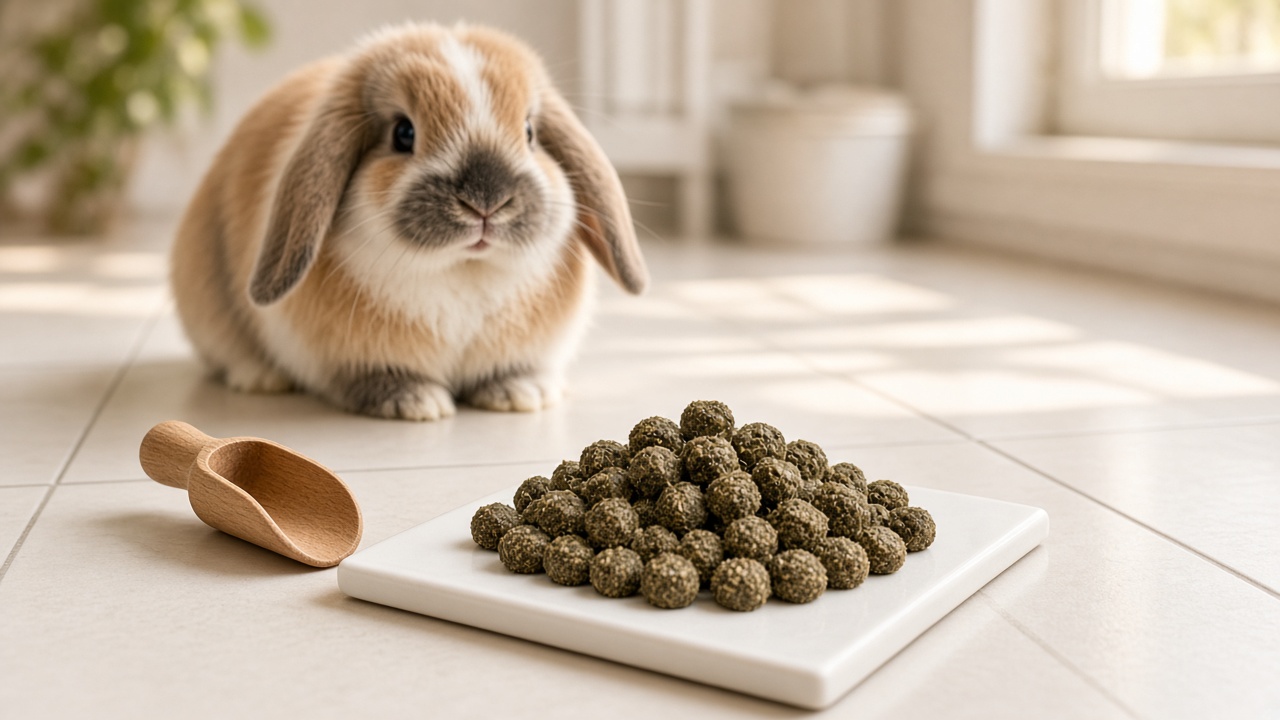
Pellets can support a hay-first bowl. They cannot replace long-stem hay. Our research team analyzed four adult labels that were for sale.
Each maker page published both a protein minimum and a fiber minimum. We compared those published specs. We did not feed the bags or score stools from rabbits on them.
Across those four maker pages, minimum crude fiber ran from 21.5% to 25%. Two of the four list a 25% minimum. That spread sits at or above the Merck Veterinary Manual’s 15% to 20% pellet-fiber band.
| Product | First listed plant ingredient | Crude protein, min | Crude fiber, min–max | Calcium, min–max | Form |
|---|---|---|---|---|---|
| Oxbow Essentials Adult Rabbit Food | Timothy grass meal | 14.00% | 25.00–29.00% | 0.35–0.75% | Uniform pellet |
| Small Pet Select Rabbit Food Pellets | Timothy hay | 14% | 25–29% | 0.4–0.6% | Uniform pellet |
| Kaytee Timothy Complete Rabbit Food | Sun-cured timothy grass hay | 13.0% | 22.0–27.0% | 0.25–0.75% | Uniform pellet |
| Science Selective Adult Rabbit Food | Alfalfa meal pellets | 12.5% | 21.5–28.5% | 0.3–1.2% | Extruded nugget |
Oxbow Animal Health lists 1/8 cup daily for a 1 to 4 pound mature rabbit. A 4 to 8 pound rabbit gets 1/4 to 1/3 cup. Those cups sit on top of unlimited grass hay.
Small Pet Select sets a later adult range. From 1 year to 5 years, it lists 1/4 to 1/2 cup per six pounds. Hay stays available 24 hours a day.
Kaytee lists 1/3 to 1/2 cup for a small breed. A large breed gets 2/3 to 1 1/2 cups. The same label lists 100,000 CFU per gram of Bacillus species.
Mix a new Kaytee bag in over 7 to 10 days. Supreme Petfoods lists 2 to 2.5 ounces per day for a 5.5 pound adult. That equals 60 to 70 grams for a 2.5 kilogram rabbit.
Fresh hay and water still stay out at all times. Science Selective’s first ingredient is alfalfa meal, even though the bag is sold for adults from 20 weeks. That is why our rule uses published fiber and protein numbers, not a timothy-only filter.
Calcium on that label runs as high as 1.2%. Oxbow’s listed calcium cap is 0.75%. A high fiber number on a bag does not prove the litter box is healthy.
Hay intake still sets pellet size. Use the table to read labels. Use the litter box to read the rabbit.
FAQ
How many pellets should a healthy rabbit pass in a day?
The BUNS rescue guide puts the pet average at 200 to 300 pellets a day. Wild counts cited in the Journal of Small Animal Practice run 300 to 500 in 24 hours. Your rabbit’s own usual count is the better baseline.
Are leftover cecotropes the same as diarrhea?
No. Cecotropes are normal, nutrient-rich clusters that rabbits usually eat. House Rabbit Society says leftover piles can mean a rich diet, a gut illness, or a reach problem.
True watery stool needs a same-day clinic visit.
What does it mean if pellets suddenly get smaller?
Stress can shrink pellets for a few hours. Pellets that stay small, or that keep shrinking, can mark pain or a partial blockage. A rabbit that also stops eating needs a clinic, not a new treat.
Why are pellets stuck together with fur?
House Rabbit Society calls that string-of-pearls poop. The rabbit swallowed coat while grooming. Step up brushing and keep hay in front of the rabbit at all times.
Can I put rabbit droppings in the garden?
House Rabbit Society says droppings make good fertilizer. They are rich in nitrogen, phosphorus, and potassium. That group does not recommend using droppings from rabbits on medication.
How much hay should I offer if pellets look dark and tiny?
Offer more grass hay than the rabbit can finish. House Rabbit Society wants hay at about 80% of the diet. The Merck Veterinary Manual wants 85% to 90%.
When is missing poop an emergency?
The rescue guide treats 24 hours with no pellets as a same-day clinic trip. The University of Illinois College of Veterinary Medicine treats reduced appetite past 4 hours as a stasis presentation. Do not wait for both clocks to run out.