I have verified maker specs and authority figures. Drafting the article to the audit rules and word cap.
How to Transition a Dog to New Food: 7-Day Schedule
Quick answer: Mix the new kibble into the old kibble over seven days. Use one-quarter new food on days 1–2, then half, then three-quarters. Serve only the new food on day 7 if stools stay formed.
A healthy adult dog can finish a kibble-to-kibble switch in seven days using 25-percent new-food steps every two days.
This page is a research-desk mixing schedule drawn from maker feeding pages and published label rules. We did not run feeding trials, collect stool scores, or examine any household dog.
Our research team compared published kcal-per-cup figures on five currently sold adult dry foods. The spread ran from 321 to 365 kcal per cup. That gap is large enough to change body weight if you match cups instead of calories.
The American Animal Hospital Association tells pet parents that dogs should transition over seven days. Its handout starts the mix at 25 percent new food.
What this guide includes, and what it leaves out
We used one selection rule. A food entered this article only if it is a currently sold complete-and-balanced dry adult formula whose maker page publishes both a kcal-per-cup figure and a protein figure. We excluded prescription diets, raw kits, freeze-dried toppers, puppy-only bags, and any food whose maker page omitted calories.
The scenarios we cover are a healthy adult kibble-to-kibble switch, a slower mix for a sensitive gut, and a calorie-matched dry-to-wet change. We do not cover elimination-diet trials or an urgent clinic-directed switch off a therapeutic food.
That rule is why Pedigree Small Dog Adult Roasted Chicken, Rice & Vegetable is in the table. Pedigree’s own product page publishes 332 kcal per cup and a 21.0 percent minimum crude protein. It is also why we skip bags that advertise protein without a calorie line.
The Bench Four-Step Bowl Mix
Keep the daily calorie target the same all week. Change only the ratio inside the bowl. The American Animal Hospital Association’s 2010 nutritional assessment guidelines say some dogs tolerate an abrupt change. The same document says other dogs have fewer gut issues when the change runs 7 to 10 days. We use the slower default.
Hill’s Pet Nutrition publishes the same seven-day ladder on its changing-food page. Days 1–2 use 25 percent new food and 75 percent old food. Days 3–4 use a 50/50 mix. Days 5–6 use 75 percent new food. Day 7 is 100 percent new food.
Pedigree’s Small Dog Adult page tells owners to mix the new food over a 4-day period. That is a real maker instruction. We still start at seven days because the American Animal Hospital Association’s pet-parent handout uses seven, and Hill’s product page for Adult Chicken & Barley Recipe also uses seven.
Days 1–2
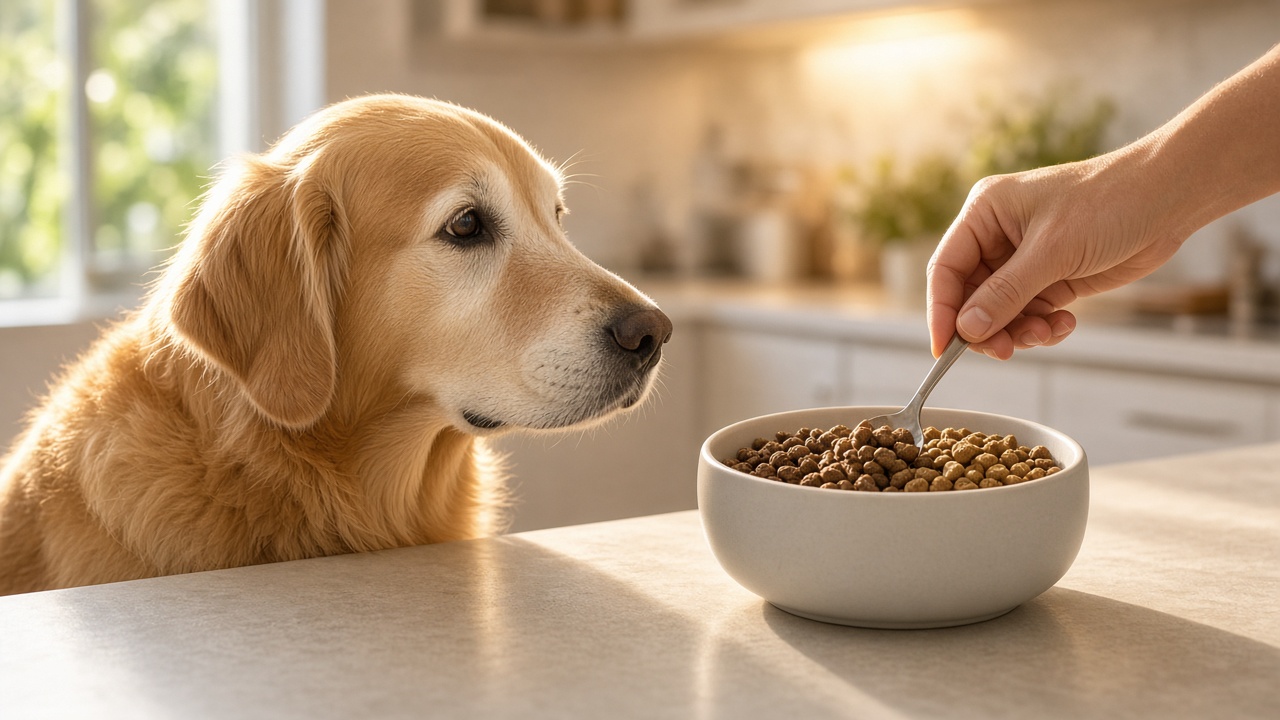
Measure the full daily portion first. Then replace one-quarter of it with the new food. Stir until the kibbles are mixed. A layered bowl lets a picky dog eat around the new pieces.
Days 3–4
Move to half old food and half new food. Hold this step if stools turn soft. Holding a ratio is still a transition. It is not a failure.
Days 5–6
Use three-quarters new food. Keep meal times, bowl, and water the same. The only planned change this week is the mix.
Day 7
Serve the new food alone if stools stayed formed. If they did not, drop back one step for two more days. Then advance again.
Hill’s changing-food page says to extend the whole plan to two weeks when stool stays runny. Use that longer ladder. Do not jump to a third brand in the same week.
Match calories, not cups
A cup is not a calorie. The Association of American Feed Control Officials requires a calorie statement in kilocalories per kilogram and per familiar unit, such as a cup. The U.S. Food and Drug Administration notes that dry pet food is typically 10 to 12 percent moisture. Canned food is typically 75 to 78 percent moisture. Those moisture bands are why a wet cup and a dry cup are not interchangeable.
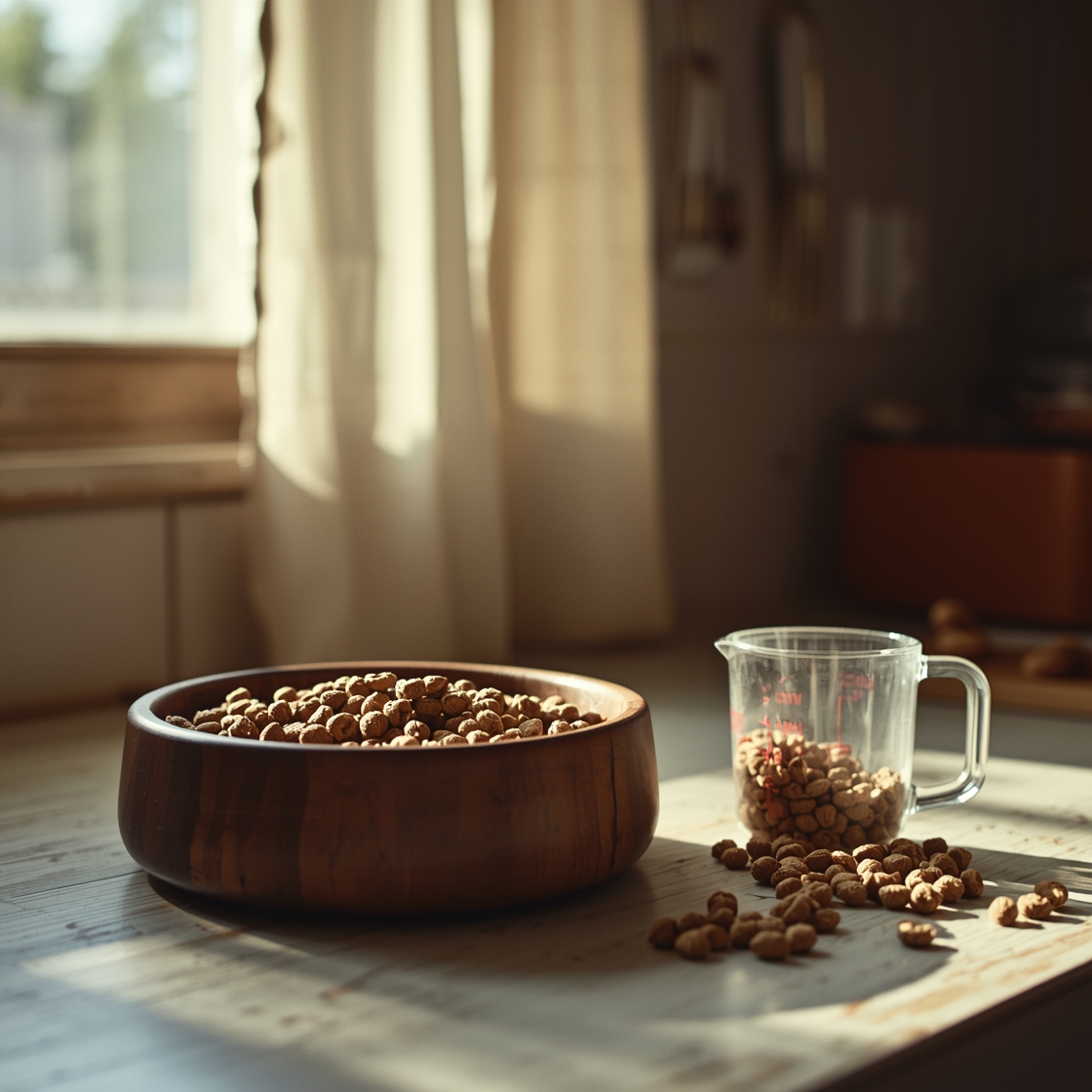
In the Pet Bench Cup-Match Check, our research team lined up five maker-published kcal-per-cup figures. Hill’s Science Diet Adult Chicken & Barley Recipe lists 365 kcal per cup. Royal Canin Medium Digestive Care lists 321 kcal per cup. Matching cups 1:1 from the lower food to the higher food raises calorie intake about 14 percent.
The American Animal Hospital Association’s nutritional assessment guidelines say a dog’s maintenance energy need can vary by 30 percent in either direction. That is why a chart cup is a start, not a verdict. Weigh the dog after the switch. Then trim or add food.
The Association of American Feed Control Officials also sets a cap for a “lite” dry dog food at 3,100 kilocalories per kilogram. Royal Canin Medium Digestive Care lists 3,823 kcal per kilogram. That food is not a lite diet. Treat its cup as energy-dense.
Hill’s lists 3,675 kcal per kilogram and 365 kcal per cup for Adult Chicken & Barley Recipe. Its page says an 8-fluid-ounce cup of that kibble weighs 3.5 ounces. Nutro’s page for Natural Choice Adult Beef & Brown Rice Recipe says an 8-ounce cup holds 3.31 ounces. Same household cup. Different grams. Different calories.
| Product | kcal per cup | Protein as published | Fat as published | Moisture max |
|---|---|---|---|---|
| Hill’s Science Diet Adult Chicken & Barley Recipe | 365 | 23.8% (dry matter) | 15% (dry matter) | Not listed as a guarantee |
| Royal Canin Medium Adult | 340 | 23.0% min | 12.0% min | 10.5% |
| Royal Canin Medium Digestive Care | 321 | 23.0% min | 16.0% min | 10.0% |
| Nutro Natural Choice Adult Beef & Brown Rice Recipe | 341 | 22.0% min | 14.0% min | 10.0% |
| Pedigree Small Dog Adult Roasted Chicken, Rice & Vegetable | 332 | 21.0% min | 11.0% min | 12.0% |
These five foods sit in a 44 kcal-per-cup band. They are not ranked. They are examples of how published energy density shifts the math inside one measuring cup.
Hill’s Adult Chicken & Barley Recipe is written for dogs 1 to 6 years of age. Its page says it is not for puppies or for pregnant or nursing dogs. Royal Canin Medium Adult is written for dogs 23 to 55 pounds and over 12 months old. Pedigree’s Small Dog Adult chart tops out around 25 pounds, then adds a quarter cup for every extra 5 pounds.
The Association of American Feed Control Officials calculates crude protein by measuring nitrogen and multiplying by 6.25. That is a lab method, not a quality score. Compare protein figures only when they use the same basis. Hill’s 23.8 percent is a dry-matter average. The other four protein figures are as-fed minima.
When to stretch the schedule past seven days
Stretch the Bench Four-Step Bowl Mix when stools soften, when the dog is a recent adoption, or when the gut has been touchy before. Keep the same 25-percent steps. Double the days on each step. That turns seven days into about 14.
Dogs that already struggle with loose stool often need that longer mix. If the destination food is meant for a sensitive gut, read our best dog food for sensitive stomach guide before you buy a second bag. Royal Canin Medium Digestive Care is one adult dry food whose maker page aims at that job. Royal Canin cites a 2017 internal study in which 91 percent of medium dogs fed Digestive Care had optimal stool quality.
Puppies are not small adults. The U.S. Food and Drug Administration explains that the Association of American Feed Control Officials keeps separate nutrient profiles for growth and for adult maintenance. Those profiles first appeared for dogs in 1991 and were last updated in 2016. A growth recipe and an adult recipe are different nutrient jobs. Use a puppy food until the dog reaches the age on the bag.
Newly adopted dogs have two changes at once. Home and diet. Hill’s changing-food page tells adopters to keep the shelter food for about the first week. Then start the seven-day mix. If the old bag is gone, Hill’s says to offer small meals every four to six hours and watch between meals.
Switching formats, not just brands
A dry-to-wet switch is still a 25-percent mix. The calorie math is stricter. The U.S. Food and Drug Administration’s moisture example is the reason. A canned food at 75 to 78 percent moisture looks low in protein on the as-fed label. After you convert to dry matter, the protein share often rises.
The U.S. Food and Drug Administration says a food may claim “complete and balanced” if it meets an Association of American Feed Control Officials nutrient profile or if it passes a feeding trial that uses those procedures. Treats usually fail that test. Do not replace kibble calories with biscuits during the mix week.
Royal Canin’s Medium Adult page tells owners to feed 2 to 4 equal portions a day. Split the mixed bowl the same way you already feed. Do not add a third meal just because the kibble looks different.
Older dogs often move toward wet food for aroma and water. If that is the plan, use the same seven-day ratio and count calories from both cans and cups. Our best wet dog food for senior dogs page walks through senior wet formulas. Keep this page for the mix math.
Nutro’s Adult Beef & Brown Rice Recipe page says the food may be served dry or lightly moistened. A splash of water is not a new diet. A full can of a second brand is. Transition the can the same way you transition kibble.
What to watch each day
Check the stool once a day. Formed stool means you can advance on schedule. Soft stool means hold the current ratio. Watery stool, blood, or repeated vomiting means stop the mix and call the clinic that already knows the dog.
Watch the bowl, not just the yard. A dog that sorts out the new kibble is not transitioning. Mix more thoroughly. Or add a teaspoon of warm water so the pieces cling.
Do not stack new treats, new chews, and a new bag in the same week. The Association of American Feed Control Officials requires feeding directions on most complete-and-balanced foods. Those directions already assume the bag is the meal. Extras blur the cause if the gut objects.
Weigh the dog on day 1 and again two weeks after day 7. The American Animal Hospital Association’s 30 percent energy swing is the reason. A cup-matched switch can fatten a quiet dog or thin a busy one.
Keep a one-line log: date, ratio, stool, appetite. That note is for you. It is not a diagnosis.
FAQ
How long should I take to transition a dog to new food?
Plan on seven days for a healthy adult on dry food. The American Animal Hospital Association’s pet-parent handout says dogs should transition over seven days and start at 25 percent new food. Hill’s Adult Chicken & Barley Recipe page uses a 7-day mix. Stretch to 10 or 14 days if stools soften or the dog is a new arrival.
What happens if I change dog food overnight?
Some dogs handle an abrupt swap. The American Animal Hospital Association’s nutritional assessment guidelines say no transition method has clear proof it is best. The same guidelines say gradual 7- to 10-day changes appear to bring fewer gut issues for some dogs. Overnight swaps make it harder to know whether the new food, the portion, or the speed caused a problem.
What if my dog gets diarrhea during the switch?
Return to the last ratio that produced formed stool. Hold it for two days. Then advance in smaller steps. Hill’s changing-food page says to extend the plan to two weeks when stool stays abnormally soft. Call the clinic if diarrhea is watery, lasts more than a day or two, or comes with vomiting or lethargy.
Do I still need a transition if I stay in the same brand?
Yes, if the recipe changed. Protein, fat, and fiber can differ inside one brand family. Royal Canin Medium Adult lists 12.0 percent minimum crude fat. Royal Canin Medium Digestive Care lists 16.0 percent minimum crude fat. That is not the same bowl. Use the seven-day mix.
Can I use this 7-day schedule for a puppy?
Use the same 25-percent steps. Use a food written for growth. The U.S. Food and Drug Administration explains that adult-maintenance profiles use lower levels of some nutrients than growth profiles. Hill’s Adult Chicken & Barley Recipe page says it is not for puppies. Pick from our best dog food for puppies list, then mix.
How do I switch from dry food to wet food?
Keep the seven-day ratios. Convert both foods to calories before you scoop. The U.S. Food and Drug Administration’s 75 to 78 percent canned-moisture figure is why a wet cup is not a dry cup. For older dogs that need wet food, pair this schedule with our best wet dog food for senior dogs guide.
What if my dog refuses the new food?
Hold the current mix for a few extra days. Warm the new kibble with a splash of water. The American Animal Hospital Association’s handout lists low-salt chicken or beef broth as a flavor helper for dogs. If the dog skips meals for two days, stop the experiment and ask the clinic that already knows that dog.