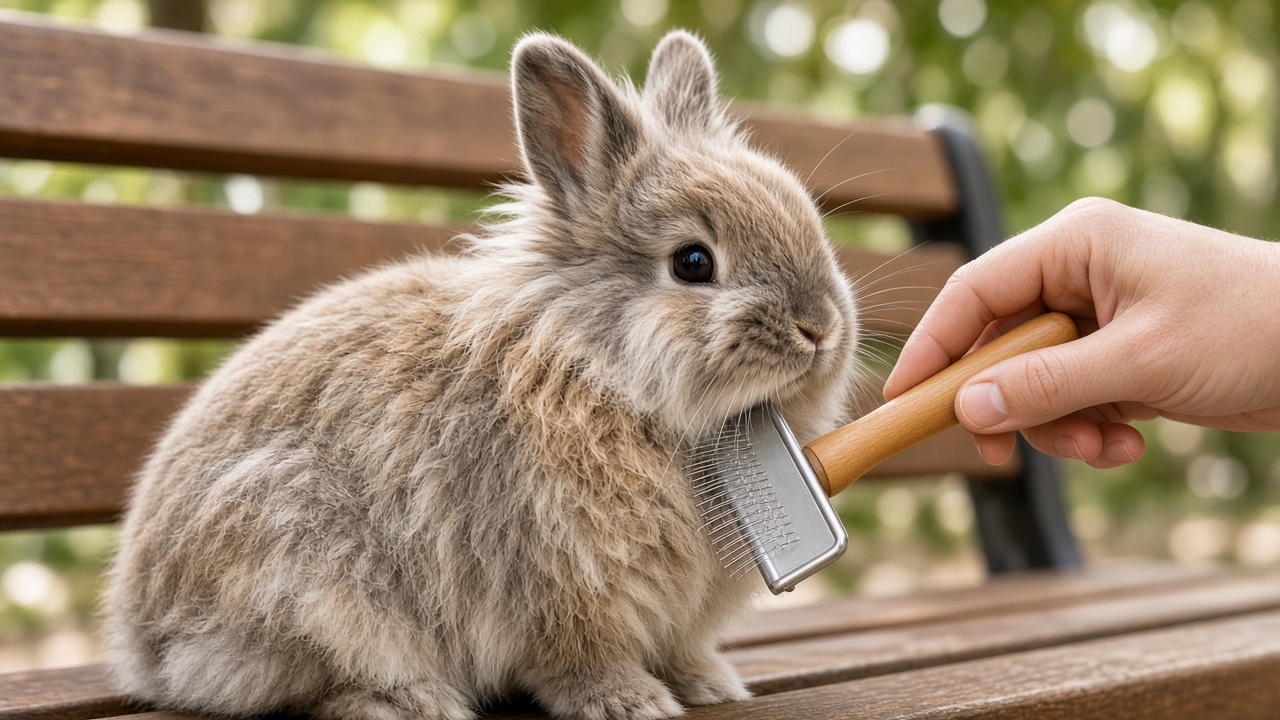
Quick answer: A Jersey Wooly is a small indoor wool rabbit. Plan for a 3-pound adult, daily combing, and a hay-first diet with a measured timothy pellet. It is a companion breed, not a low-care toy.
The American Rabbit Breeders Association sets the Jersey Wooly’s senior maximum at 3.5 pounds. That cap is the fastest way to place this dwarf wool breed.
This page is a research-desk brief on published club rules and current pellet labels. We did not keep a Jersey Wooly colony, run feeding trials, or score household temperament.
The National Jersey Wooly Rabbit Club lists an ideal senior weight of 3 pounds. That is the working size used in every feeding example below.
How this desk chose what to cover
We used one rule for every product and every scenario on this page. Call it the Three-Pound Label Rule.
A product entered the table only if it is currently sold. The maker page had to list crude protein and crude fiber. The feeding note had to scale to 3.5 pounds or less.
We left out seed mixes, yogurt drops, and alfalfa-only grower bags. We also left out pellets whose maker pages hid those two guarantees.
We covered home companion care, not show stacking or breeding programs. We also skipped outdoor hutch build-outs.
What the clubs publish on size and history
The American Rabbit Breeders Association names Bonnie Seeley as the breed’s developer. Its breed page says recognition came in 1988. The same page states a maximum weight of 3.5 pounds.
The National Jersey Wooly Rabbit Club fills in the earlier dates. Seeley first showed the breed at the 1984 convention in Orlando, Florida. Recognition came at the 1988 convention in Madison, Wisconsin.
Broken Jersey Woolies were accepted as a variety in 2004. That vote happened at the Rhode Island convention.
The club describes a dwarf body, a mug head, and wool meant to be easier than Angora wool. That “easier” line is the club’s wording. It is not a lab result from this desk.
Our research team counted the named colors on the club’s breed page. Six groups appear: Agouti, Any Other Variety, Broken, Self, Shaded, and Tan. Across those groups we counted 31 named color listings.
The National Jersey Wooly Rabbit Club states a membership of over 700 worldwide. That is a club census, not a national pet count.
Temperament claims we can and cannot make
The National Jersey Wooly Rabbit Club calls the breed friendly. It also lists pets, 4-H projects, and hobby breeding as common uses. We did not run a handling study.
We cannot turn that club line into a guaranteed personality. A 3-pound rabbit is still a prey animal. Sudden grabs and loud rooms can undo a calm first meeting.
What we can say from size alone is practical. A senior under 3.5 pounds is easier to lift than an 8-pound commercial breed. It is also easier to miss on a busy floor.
Indoor housing and a closed door matter more than a cute head shape. The American Rabbit Breeders Association still presents the breed as a show animal and a pet. Ask how that rabbit was raised.
A hay-first diet scaled to 3 pounds
House Rabbit Society states that hay should make up 85% of an adult rabbit’s diet. The same page wants a high-fiber timothy pellet. It sets a minimum of 18% fiber.
Gourmet mixes with seeds, nuts, or fruit pieces are on its avoid list. House Rabbit Society also gives a vegetable rule of 1 to 2 cups per 4 pounds of body weight. For a 3-pound Jersey Wooly, that scales to about 0.75 to 1.5 cups of leafy greens.
Introduce one new green at a time. House Rabbit Society’s second diet page uses a pellet band of 1/4 cup per 6 pounds. Scaled to 3 pounds, that is about 2 tablespoons.
The Merck Veterinary Manual asks for about 15% crude fiber in the overall diet. It also recommends ad-lib timothy hay with about 30% to 35% fiber. For nonbreeding adult pets, it restricts pellets to 1/4 cup per 5 pounds per day.
Scaled to 3 pounds, that pellet cap is about 2.4 tablespoons. Treat both bands as starting points. Then watch body condition.
The same manual reports water use of about 120 mL per kilogram per day. A 3-pound rabbit weighs about 1.36 kilograms. Our arithmetic on that published rate is about 163 mL a day.
The manual also notes rabbits drink more from an open bowl than from a sipper bottle. Offer both if you can.
House Rabbit Society flags wool breeds, including Jersey Woolies, as needing more coat protein. That is a special-case note. It is not a license to free-feed pellets.
A wool coat can hide fat. Weigh the rabbit.
The Association of American Feed Control Officials treats household rabbits as specialty pets. Its 2025 purpose-statement guidance uses “Daily Specialty Pet Food” when no recognized nutritional authority exists for that species. Read pellet bags as maker formulas, not as a dog-food completeness stamp.
For a wider pellet walk-through, see our guide to the best rabbit pellets. That page uses the same label-first method.
Four adult pellets, compared by label
Our research team compared four currently sold adult formulas. We used only the protein, fiber, first ingredient, and feeding notes on each maker page. We did not feed these bags to a colony.
| Product | First listed ingredient | Crude protein, min | Crude fiber | Maker feeding note |
|---|---|---|---|---|
| Oxbow Essentials Adult Rabbit Food | Timothy grass meal | 14.00% | 25.00%–29.00% | 1/8 cup daily for adults of 1–4 lb |
| Small Pet Select Rabbit Food Pellets | Timothy hay | 14% | 25%–29% | 1/4–1/2 cup per 6 lb from 1–5 years |
| Kaytee Timothy Complete Rabbit Food | Sun-cured timothy grass hay | 13.0% | 22.0%–27.0% | 1/3–1/2 cup for a small breed |
| Science Selective Adult Rabbit Food | Alfalfa meal pellets | 12.5% | 21.5%–28.5% | 60–70 g daily for a 2.5 kg (5.5 lb) adult |
Crude-fiber minima on those four labels run from 21.5% to 25%. Science Selective Adult Rabbit Food sits at the low end. Oxbow Essentials Adult Rabbit Food and Small Pet Select Rabbit Food Pellets sit at 25%.
All four sit above the House Rabbit Society 18% floor. The feeding notes do not agree. Oxbow Animal Health sets 1/8 cup a day for any adult between 1 and 4 pounds.
A 3-pound Jersey Wooly falls in that Oxbow band. Kaytee lists 1/3 to 1/2 cup for a small breed. That is 2.7 to 4 times Oxbow’s 1/8 cup on the same body size.
That spread is a label clash, not a ranking. Small Pet Select’s adult band is 1/4 to 1/2 cup per 6 pounds. Scaled to 3 pounds, that is about 2 to 4 tablespoons.
Supreme Petfoods writes 60 to 70 grams a day for a 2.5 kilogram rabbit. Scaled to 1.36 kilograms, our arithmetic is about 33 to 38 grams. That is desk math, not a new feeding trial.
Science Selective Adult Rabbit Food lists alfalfa meal pellets first. The other three list timothy. The Merck Veterinary Manual warns that long use of alfalfa-heavy maintenance diets can raise urinary calcium.
If you use the Supreme bag, keep grass hay unlimited. Then watch urine sludge with a clinician. Oxbow Animal Health also prints calcium as 0.35% minimum and 0.75% maximum.
The Merck Veterinary Manual aims for 0.4% to 0.5% calcium in the whole diet for nonlactating adults. Pellets are only part of that diet. Hay still has to do most of the work.
Coat work and indoor housing
Bonnie Seeley bred for wool that is easier to keep than classic Angora wool. The American Rabbit Breeders Association and the National Jersey Wooly Rabbit Club both repeat that origin story. Easier is not the same as no comb.
Wool still mats behind the ears, under the chin, and at the rear. Daily light combing beats a weekly battle. House Rabbit Society ties unlimited hay to a lower risk of hair blockages.
A wool rabbit that stops eating hay is a clinical emergency. It is not a picky eater. Get help the same day.
For tool choice, start with our rabbit grooming kit review.
For the actual sequence, use our step-by-step rabbit grooming guide. Both pages stay at the desk level.
They do not claim a salon trial on this breed. Plan on a daily comb during heavy shed. Plan on a daily check year-round.
The Merck Veterinary Manual sets an optimal indoor range of 61° to 72°F. It also uses a heat-stress rule of thumb. Fahrenheit temperature plus relative humidity should stay at or under 150.
An 80°F room at 70% humidity sits on that line. Wool holds heat. A Jersey Wooly in a sunny window can overheat before a short-coated rabbit does.
The same manual says smaller breeds can use an 18-by-24-inch cage. The rabbit must still stand on its hind legs. That is a minimum box, not a life plan.
The manual also wants daily run time outside the cage. A 3-pound wool rabbit still needs a full hop, a hide, and a litter box. Aquariums fail the manual’s ventilation test.
Wire floors raise sore-hock risk on long sits. If two rabbits share a pen, the Merck Veterinary Manual cites 3.5 to 10 square feet per rabbit. Neutered pairs fight less, but introductions still need a barrier period.
A Jersey Wooly is a daily animal. Hay, water, a litter check, and a coat pass are the minimum. Skip a few days and mats plus gut slowdown arrive together.
The National Jersey Wooly Rabbit Club still frames the breed as a 4-H and show project. That path adds grooming to a written standard.
A pet-only home can ignore ear-length points. It cannot ignore wool in the mouth.
FAQ
How big does a Jersey Wooly get?
The American Rabbit Breeders Association caps seniors at 3.5 pounds. The National Jersey Wooly Rabbit Club lists 3 pounds as the ideal senior weight. Plan housing and pellet math around that 3-pound mark, then weigh the actual rabbit.
Are Jersey Wooly rabbits good pets?
The National Jersey Wooly Rabbit Club calls them friendly and lists them as pets and 4-H projects. That is a club description. This desk did not score home temperament, so treat each rabbit as an individual.
How much should a Jersey Wooly eat?
House Rabbit Society wants unlimited grass hay as about 85% of the diet. Oxbow Animal Health lists 1/8 cup of Essentials Adult Rabbit Food for a 1- to 4-pound adult. Match the bag you buy, then adjust for body condition.
Do Jersey Woolies need special pellets?
House Rabbit Society prefers a timothy pellet with at least 18% fiber for adults. It also notes that long-haired breeds may need more protein for coat growth. All four labels in our table meet that 18% fiber floor.
How often should I groom a Jersey Wooly?
Plan on a daily comb during heavy shed and a daily check year-round. The breed was built for shorter, easier wool, not for a no-groom coat. Use the grooming guide linked above for the order of brush, comb, and sanitary trim.
Can a Jersey Wooly live outside?
The Merck Veterinary Manual still describes outdoor hutches, then warns about heat stroke, flies, and predators. Its optimal range is 61° to 72°F.
A wool coat makes the high end harder. Indoor housing is the safer default on this desk.
How much water does a 3-pound Jersey Wooly need?
The Merck Veterinary Manual publishes about 120 mL per kilogram per day. For a 3-pound (1.36 kg) rabbit, that scales to about 163 mL. Offer a heavy bowl and a bottle, then watch which one actually gets used.