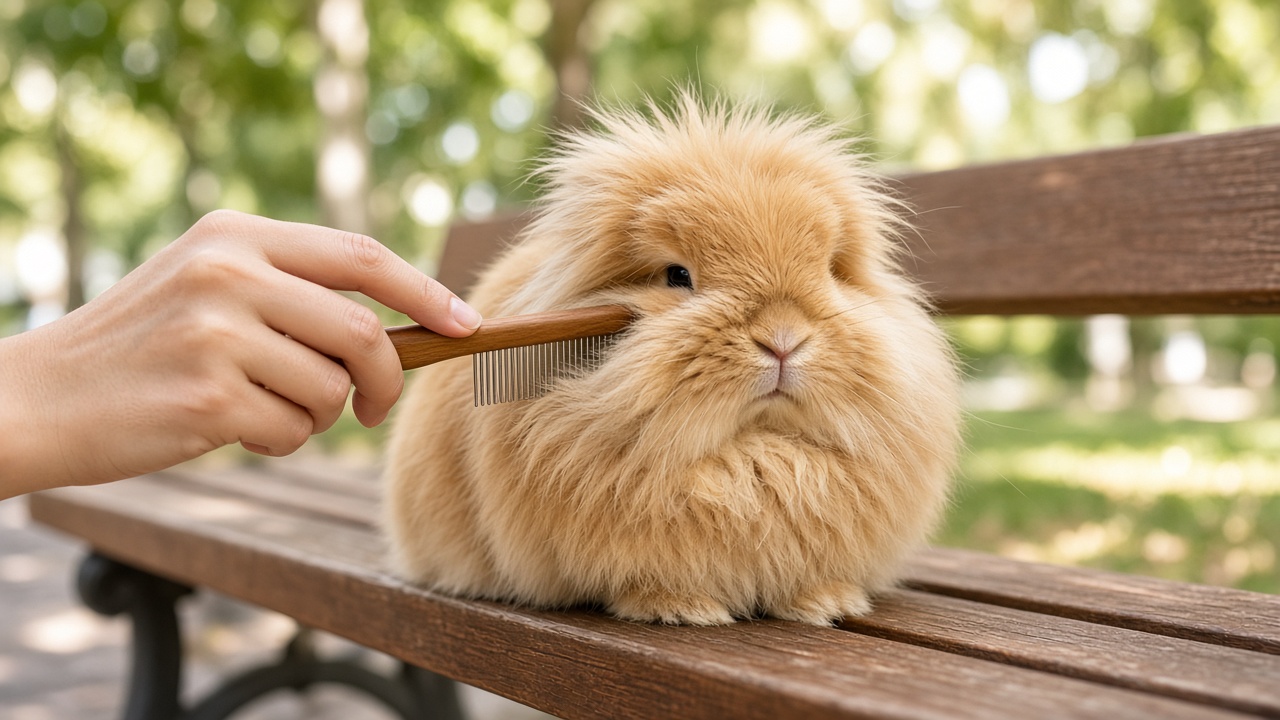
Quick answer: Keep a Lionhead on unlimited grass hay, a measured timothy pellet, and a daily mane check. The American Rabbit Breeders Association caps adult Lionheads at 3.75 pounds, so plan food around that size. Plan indoor room and a short daily groom instead of a tiny starter cage.
The American Rabbit Breeders Association sets the Lionhead maximum weight at 3.75 pounds and first recognized the breed in 2014.
This page is a research-desk brief from The Pet Bench, written from published specs. We compared published breed notes and current pellet labels, and we named every source. We did not weigh live rabbits, run feeding trials, or sit at a show table.
What counts as a Lionhead
A Lionhead is a small companion breed with a wool mane around the head. People search the name for that mane, but daily care still starts with size and food.
The American Rabbit Breeders Association first recognized the breed in the United States in 2014. The same American Rabbit Breeders Association page lists a maximum weight of 3.75 pounds.
The American Rabbit Breeders Association also records a 2018 first Convention Best in Show for the breed. That 2018 date is a hobby milestone, not a feeding rule or a housing rule.
Use the 3.75-pound cap as a planning number for scoops, space, and weekly weigh-ins. A small body still needs full hay access and enough room to hop each day.
Watch weight with a kitchen scale once a week, because extra pellets add grams fast. A Lionhead near the American Rabbit Breeders Association cap still needs a measured pellet scoop.
The selection rule for this guide
We used one clear rule for every scenario and product named in this article. We cover indoor companion Lionheads that eat grass hay and a uniform adult pellet.
We include a product only if its maker page lists protein, fiber, and a first ingredient. We exclude seed mixes, junior-only bags, and setups built only for outdoor hutches.
We also skip show-table trims and housing built for meat-line rabbits, which need other tools. That rule is why the pellet table has four adult bags, not a ranked list.
The table shows label attributes from maker pages, and it does not rank brands. Our research team compared those published specs side by side on the maker pages.
We did not open bags, run a feeding trial, or measure fiber in a lab.
Daily diet: hay first, then greens, then pellets
Hay is the main food for a Lionhead, and pellets stay a measured add-on. Greens sit in the middle of that daily plate and add water and variety.
The House Rabbit Society lists this adult pattern for rabbits from 1 to 5 years:
- Unlimited hay
- At least 2 cups chopped vegetables per 6 pounds of body weight each day
- 1/4 cup pellets per 6 pounds of body weight each day
- Treats only in small amounts
A Lionhead at the American Rabbit Breeders Association 3.75-pound cap sits under that 6-pound unit. Scale the House Rabbit Society pellet line with this short bit of published-number math:
- Start with 1/4 cup per 6 pounds
- Divide 3.75 by 6, which is 0.625
- Multiply 0.625 by 1/4 cup
- The result is about 1/8 cup
That scaled scoop matches Oxbow Animal Health’s published band for mature rabbits from 1 to 4 pounds. Oxbow Animal Health lists 1/8 cup daily in that band, plus unlimited grass hay.
Hay
The House Rabbit Society calls hay the most important food for a pet rabbit. Hay keeps the gut moving, and it also wears teeth that never stop growing.
The House Rabbit Society names timothy, orchard, oat, and other grass hays for adults. The same House Rabbit Society page reserves alfalfa hay for nursing mothers and young rabbits.
Keep hay out all day, and refill the rack as soon as it looks thin. An empty hay rack is a care problem, not a sign of a tidy cage.
Greens and fruit
The House Rabbit Society wants at least three leafy green types in the bowl each day. It says leafy greens should make up about 75% of the daily fresh portion.
It caps non-leafy vegetables at about 15% of that same daily fresh portion. The same page gives 1 tablespoon per 2 pounds of body weight per day for those non-leafy items.
The House Rabbit Society also caps fruit as a small extra, not a daily main dish. Keep fruit at or under 10% of the diet, or about 1 teaspoon per 2 pounds each day.
Wash leafy produce with care before any of it goes into the bowl. The House Rabbit Society asks for at least two minutes in a bowl, with the water changed several times.
Pellets
The House Rabbit Society wants a pellet with at least 18% fiber on the label. It prefers timothy-based pellets for adults and rejects bags that mix in fruit, seeds, nuts, corn, or yogurt drops.
From 7 months to 1 year, the House Rabbit Society lists 1/2 cup timothy pellets and 1 cup greens. After 1 year of age, drop pellets to the 1/4-cup-per-6-pound adult line.
For more pellet context on other adult bags, see our best rabbit pellets brief.
Four adult pellets compared from maker pages
Label fiber is the first filter our research team used on this comparison desk. All four bags in the table clear the House Rabbit Society 18% fiber floor.
Our research team lined up the four current maker pages and copied each fiber line. Minimum crude fiber ran from 22.0% on Kaytee Timothy Complete Rabbit Food to 25.00% on Oxbow Essentials Adult Rabbit Food.
| Product | First listed ingredient | Crude protein | Crude fiber | Calcium |
|---|---|---|---|---|
| Oxbow Essentials Adult Rabbit Food | Timothy grass meal | 14.00% min | 25.00% min, 29.00% max | 0.35% min, 0.75% max |
| Kaytee Timothy Complete Rabbit Food | Sun-cured timothy grass hay | 13.0% min | 22.0% min, 27.0% max | 0.25% min, 0.75% max |
| Small Pet Select Rabbit Food Pellets | Timothy hay | 14% min | 25% min, 29% max | 0.4% min, 0.6% max |
| Science Selective Adult Rabbit Food | Alfalfa meal | 14.0% | 25.0% | 0.6% |
Oxbow Animal Health lists those protein, fiber, and calcium figures on its Essentials Adult Rabbit Food page. It also lists moisture at 10.00% max and vitamin E at 190 IU/kg min.
Kaytee lists 13.0% crude protein min and 22.0% to 27.0% crude fiber on its Timothy Complete Rabbit Food page. The same page lists 100,000 CFU/g of Bacillus species and a 4.5-pound bag size.
Small Pet Select lists 14% crude protein min and 25% to 29% crude fiber on its Rabbit Food Pellets page. Calcium on that Small Pet Select pellets page is 0.4% min and 0.6% max.
Supreme Petfoods lists 14.0% crude protein and 25.0% crude fiber for Science Selective Adult Rabbit Food. Calcium on that Supreme Petfoods product page is 0.6%, and phosphorus is 0.4%.
First ingredients differ, and three bags open with timothy while Science Selective Adult Rabbit Food opens with alfalfa meal. That first-ingredient split matters because the House Rabbit Society prefers timothy-based pellets once a rabbit is grown.
Makers also disagree on scoop size, so compare these published directions:
- Oxbow Animal Health: 1/8 cup daily for mature rabbits from 1 to 4 pounds
- Kaytee: 1/3 to 1/2 cup for a small rabbit breed
- Small Pet Select: 1/4 to 1/2 cup per 6 pounds from 1 to 5 years
- Supreme Petfoods: 60 to 70 g per day for a typical 2.5 kg adult
Our research team used the House Rabbit Society weight rule plus the Oxbow Animal Health 1-to-4-pound band. Those two lines both land near 1/8 cup for a Lionhead at 3.75 pounds.
Kaytee’s small-breed cup range is larger, so treat it as that maker’s own direction. Switch bags slowly if you change brands, using the mix weeks on the new label.
Oxbow Animal Health publishes a four-week mix, and Kaytee publishes a 7-to-10-day mix.
Indoor space and daily rhythm
A Lionhead needs indoor room, a solid floor, and a hide it can enter. A starter cage works as a bedroom, but it is not the whole home.
Give a litter box, a hay feeder, a water bowl, and chew-safe toys, and keep the floor solid. Let the rabbit out to hop each day in a room you have rabbit-proofed.
A bored Lionhead will chew baseboards, and a busy Lionhead will work through hay. Watch room air around the pen and the litter box, because hay dust bothers wool.
Refresh the litter often so stale dust does not sit in the wool mane. Do not leave a Lionhead in a hot car or in a sealed sunroom.
If the rabbit pants or goes still, move it to shade and call a rabbit-savvy clinic.
Mane care without a show trim
The wool mane on a Lionhead mats fast if you skip the daily check. Look at the ruff, the chest, and the fold of fur under the chin.
Use a short session on the floor, not a long hold on your lap. Work in small sections, and stop at once if the rabbit stamps or twists.
Follow our how to groom a rabbit guide when you want the full stroke order. See our rabbit grooming kit review if you need names for the basic tools.
Never bathe a healthy Lionhead as a default weekly step, because water soaks wool. Spot-clean with a damp cloth if urine crusts the fur on the hind end.
Look at the droppings while you groom, because they tell you about today’s appetite. Small dry pills should stay round, and a sudden stop in eating is an emergency.
FAQ
How big does a Lionhead rabbit get?
The American Rabbit Breeders Association lists a maximum adult Lionhead weight of 3.75 pounds. That is the published show-and-breed cap, not a guess from a pet shop. A pet that sits near that number still needs a small, measured pellet scoop.
How much should I feed an adult Lionhead?
The House Rabbit Society lists 1/4 cup of pellets per 6 pounds of body weight, plus unlimited hay. Scale that House Rabbit Society line to 3.75 pounds and you get about 1/8 cup. Oxbow Animal Health lists the same 1/8 cup for mature rabbits from 1 to 4 pounds.
Do Lionheads need daily grooming?
Yes, the wool mane tangles faster than a short coat on this breed. A daily check of the ruff and chest stops mats before they pull skin.
Which pellets fit a Lionhead?
Pick a uniform adult pellet with at least 18% fiber, per the House Rabbit Society. Oxbow Essentials Adult Rabbit Food, Kaytee Timothy Complete Rabbit Food, and Small Pet Select Rabbit Food Pellets all list timothy first. Science Selective Adult Rabbit Food lists alfalfa meal first on the Supreme Petfoods page.
Are Lionheads good indoor pets?
Yes, if you give indoor room, hay all day, and a daily mane check. The American Rabbit Breeders Association size cap makes them compact house companions, not low-care pets.
How many vegetables should I offer?
The House Rabbit Society lists at least 2 cups of chopped vegetables per 6 pounds of body weight each day. Use at least three leafy types from the House Rabbit Society daily vegetable list. Keep fruit at about 1 teaspoon per 2 pounds of body weight per day.
When do I leave junior pellets?
The House Rabbit Society moves young adults, from 7 months to 1 year, to 1/2 cup timothy pellets and 1 cup greens. After 1 year, use the adult 1/4-cup-per-6-pound pellet line from that same page. Supreme Petfoods marks Science Selective Adult Rabbit Food for rabbits aged 20 weeks and older.