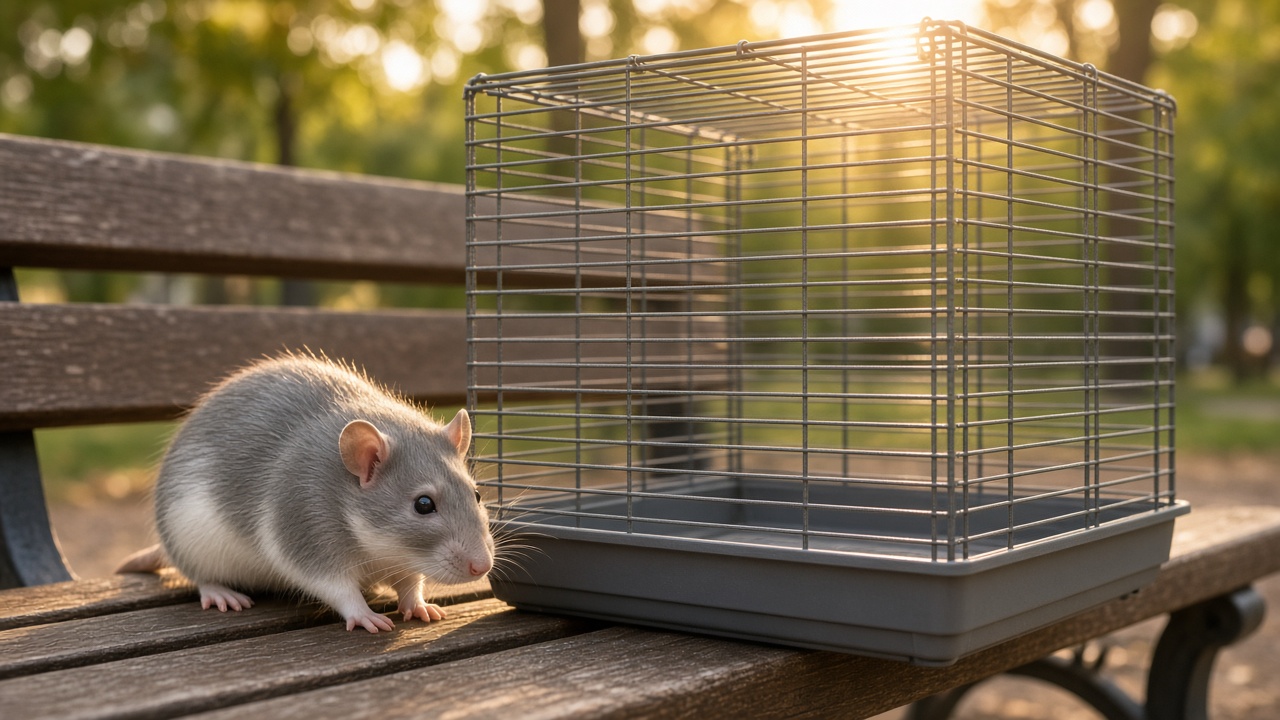
Quick answer: Keep pet rats in same-sex pairs in a tall, solid-floor wire cage. Feed a uniform pellet, not a seed mix. Plan on two to four years of daily handling.
Pet rats live 2 to 4 years and need a same-sex pair, uniform pellets, and a tall solid-floor wire cage. This research-desk page compares published cage and diet labels and omits housing, feeding trials, and factory visits.
Affiliate disclosure: This article may contain affiliate links. Product cards added after the table are affiliate listings. As an Amazon Associate we may earn a commission if you buy through those links.
What we included, and what we left out
Our selection rule is the Pair-Pellet-Height Rule. A product stayed in only if it was currently sold and printed a checkable number.
For food, that number is a guaranteed analysis on a uniform pellet. For cages, that number is wall-wire spacing at 7/16 inch or tighter.
We left out seed mixes, hamster starter kits, glass tanks, and rabbit hutches.
Our research team analyzed maker labels and compared those numbers side by side.
The American Veterinary Medical Association states that rats are social and thrive in same-sex pairs. The same AVMA page says rats need a larger cage than smaller rodents.
Cage size, wire spacing, and floor type
A pet rat climbs, chews, and uses height.
Height and floor area
The American Veterinary Medical Association notes that rats need larger cages than typical pet-store kits.
Prevue Pet Products lists the Critter Animal Cage 495 at 31 by 20 1/2 by 40 inches. It ships with two metal platforms and two metal ramps.
Prevue lists the Deluxe Critter Cage 484 at 37 by 23 1/8 by 63 3/8 inches. That model includes five platforms, three ramps, and a hammock.
Our floor-area math on those published lengths and widths is 636 square inches for the 495. The 484 comes to 856 square inches.
That is about 220 extra square inches of footprint on the 484. The 484 also stands about 58 percent taller on Prevue’s own height figures.
If you are shopping a first habitat, match the model name, not the aisle tag. Pet supplies deals sometimes list the same cages.
Skip any “starter” box shorter than 24 inches.
Wire spacing
Prevue prints 3/8 inch wall-wire spacing on the 495. It prints 7/16 inch on the 484.
Both sit under a half-inch bar gap. Wider ferret bars can let a young rat slip out.
Floors, grilles, and latches
Use a solid floor or a solid-covered shelf. Wire floors cut feet and collect droppings.
Prevue’s 495 uses a pull-out grille and tray. The maker lists that bottom grille at 3/4 inch wire spacing.
Cover any open grid with a solid insert before a rat lives on it.
Lock the doors. Rats test latches.
The American Veterinary Medical Association says cages must have secure latches. Rodents are expert escape artists.
Supervise any time out of the cage if a dog or cat shares the home.
Diet: pellets, produce, and stage changes
Rats pick favorites from a seed mix. They then skip the rest. A uniform pellet blocks that habit.
Oxbow Animal Health prints 15.00 percent minimum crude protein on Essentials Adult Rat Food. Crude fat is listed at 4.00 percent minimum.
Fiber on that adult bag is 2.00 percent minimum and 5.00 percent maximum. Moisture is capped at 10.00 percent.
Oxbow directs adult rats over six months to that adult bag, fed unlimited. The same page says the adult formula is not for young, pregnant, or nursing rats.
Oxbow’s Essentials Mouse & Young Rat Food lists 18.00 percent minimum protein and 6.00 percent minimum fat. That is three points more protein and two more points of fat than the adult bag.
Oxbow reserves the young formula for rats under six months. It tells owners to switch adults off it.
Kaytee lists Forti-Diet Pro Health Nourish+Protect at 14.0 percent minimum protein. Fat is 4.0 percent minimum.
Kaytee caps fiber at 10.0 percent and moisture at 12.0 percent. The same page lists 50 mg/kg ascorbic acid and 0.7 percent minimum omega-3 fatty acids.
Kaytee also lists 120,000 CFU/g of Bacillus species. Its feeding line for a rat is one tablespoon, about 15 grams.
Supreme Petfoods lists Science Selective Rat & Mouse Food at 14.0 percent protein and 4.0 percent fat. Crude fiber is 4.0 percent.
Supreme prints calcium at 0.6 percent and phosphorus at 0.4 percent. Its feeding guide is 20 to 25 grams per adult rat per day.
That Supreme portion is 33 to 67 percent heavier than Kaytee’s 15 gram tablespoon.
Oxbow’s adult bag lists vitamin A at 8,000 IU/kg and vitamin E at 125 IU/kg. Supreme lists vitamin A at 20,000 IU/kg on the Selective nugget.
Offer a limited amount of vegetables and a little fruit. Oxbow says that on both rat bags.
Oxbow also suggests grass hay for foraging and nesting. Keep seeds and nuts as rare extras.
Change foods slowly. Oxbow’s switch plan runs four weeks, from one-quarter new food to a full bowl.
Kaytee’s switch window is 7 to 10 days. Follow the bag you are using.
Fresh water stays up at all times. Use a bottle or a heavy crock the rats cannot tip.
Affiliate disclosure: The four bags below may appear with affiliate product cards after this page. Those cards can include paid Amazon links.
| Product | Form | Protein (min) | Fat (min) | Fiber (maker listing) | Maker feeding note |
|---|---|---|---|---|---|
| Oxbow Essentials Adult Rat Food | Uniform pellet | 15.00% | 4.00% | 5.00% max | Unlimited after 6 months |
| Oxbow Essentials Mouse & Young Rat Food | Uniform pellet | 18.00% | 6.00% | 6.00% max | Unlimited under 6 months |
| Kaytee Forti-Diet Pro Health Nourish+Protect | Pellet blend | 14.0% | 4.0% | 10.0% max | About 15 g (1 tablespoon) per rat |
| Science Selective Rat & Mouse Food | Extruded nugget | 14.0% | 4.0% | 4.0% | 20–25 g per adult rat per day |
This table is an attribute sheet, not a ranking. Match the bag to the rat’s age first.
Handling, playtime, and a daily rhythm
Short, calm sessions beat one long chase.
How to pick up a rat
Sit at cage level. Let the rat come to your hands.
Scoop from below. Support the chest and hips.
Do not lift by the tail or a single limb. The American Veterinary Medical Association tells families never to pick rodents up by their tails.
Young children need an adult in the room for every hold. The American Veterinary Medical Association notes that rats rarely bite with this handling.
Daily out-of-cage time
Give daily time outside the cage in a rat-proof room. Close toilets and hide chewable cords.
Watch the whole session. The American Veterinary Medical Association says to supervise any time a rodent is out of its cage.
A solid wheel with a running surface, not open rungs, helps at night. The American Veterinary Medical Association states that rats are nocturnal.
Nails that click on a hard floor need a look. Use a small clipper from our home grooming tools list.
Hygiene after contact
The Centers for Disease Control and Prevention flags pet rodents for homes with children 5 or younger. The CDC also flags pregnancy and weakened immune systems.
Wash with soap after every session. The U.S. Food and Drug Administration tells people to wash for at least 20 seconds after handling feeder rodents.
Use that same 20-second wash after you touch a pet rat, the cage, or soiled bedding.
In 2017, the CDC described Seoul virus spread from pet rats to people in the United States and Canada. That MMWR report found 31 U.S. facilities in 11 states with human or rat infections.
Seventeen people had recent infection. Eight became ill.
Three were hospitalized and recovered. No deaths were reported in that investigation.
The same CDC investigation tested serum from 183 people in the United States and Canada. Twenty-four people, or 13.1 percent, had Seoul virus antibodies.
Rats can shed virus in urine, feces, and saliva without looking sick. Keep wild rats away from the cage.
Do not kiss a pet rat. Do not hold one near your face.
Lifespan and health watch-points
The American Veterinary Medical Association lists an average life span of 2 to 4 years for rats. The same AVMA page lists 1 to 3 years for mice and 5 to 7 years for guinea pigs.
Weight loss, noisy breathing, a new lump, or a dull coat need a veterinarian who treats small mammals. This desk does not diagnose illness.
The Journal of the American Veterinary Medical Association reviewed 105 subcutaneous masses in 100 companion rats. The cases ran from 1990 to 2015.
Mammary gland fibroadenoma was the most common finding. It accounted for 56 of 105 masses, or 53 percent.
The same JAVMA paper found 26 of 105 initial masses, or 25 percent, were malignant. Mammary gland carcinoma made up 13 of 105 masses, or 12 percent.
After fibroadenoma removal with no extra treatment, a second lump showed up in 1 to 8 months. The median gap was 4.5 months.
Feel the body during weekly handling. Note any new lump early.
Respiratory noise is common in older rats. Ammonia from wet bedding makes that worse.
Clean before the cage smells sharp.
Smell, bedding, and cleaning
A clean cage smells like paper and food, not ammonia.
Use paper or other dust-low bedding on solid floors. Skip cedar and pine shavings with a strong scent.
The American Veterinary Medical Association says some bedding can be toxic for small animals.
Rats often pick one toilet corner. A small litter pan there cuts the mess.
Change that pan more often than the rest of the cage. Spot-clean wet spots every day.
Do a full tray change on a set weekday. Wash dishes and bottles at the same time.
Kaytee tells buyers to use an opened bag of Nourish+Protect within 30 to 45 days. Store pellets in a cool, dry place.
After a deep clean, leftover urine in plastic pans can still smell. See our pet odor control guide for room-level cleanup.
Place the cage out of direct sun and away from drafts. Keep it near family traffic so the rats stay social.
The American Veterinary Medical Association says an adult must supervise a child’s rodent care.
FAQ
Can I keep one pet rat alone?
The American Veterinary Medical Association says rats thrive in same-sex pairs or groups. A single rat can live, but it will lean harder on you for company. Never house intact males with females.
How big should a pet rat cage be?
Use a tall wire cage with a solid floor and bars no wider than 7/16 inch. Prevue’s 495 measures 31 by 20 1/2 by 40 inches. Prevue’s 484 measures 37 by 23 1/8 by 63 3/8 inches.
What should I feed a pet rat every day?
Feed a uniform pellet that names rats on the bag. Oxbow lists 15.00 percent protein for adults and 18.00 percent for rats under six months. Kaytee lists about 15 grams per rat. Supreme lists 20 to 25 grams for adults.
How long do pet rats live?
The American Veterinary Medical Association lists 2 to 4 years as the average life span for rats. That is longer than many mice and shorter than guinea pigs on the same AVMA page. A pair bought together may not die in the same week.
Do pet rats smell?
Rats stay fairly clean if the cage is dry. The smell people hate is usually wet bedding. Scoop daily and wash pans on a schedule.
Are pet rats safe around young children?
The CDC says pet rodents are not recommended for families with children 5 or younger. It also flags pregnancy and weakened immune systems. Older children still need an adult in the room.
How do I pick up a pet rat without getting bitten?
Let the rat climb onto your hands. Scoop from the chest and hips. Do not grab the tail.
A pet rat is a short, intense companion. Pair them and feed a labeled pellet. Give them height, time, and a dry cage.