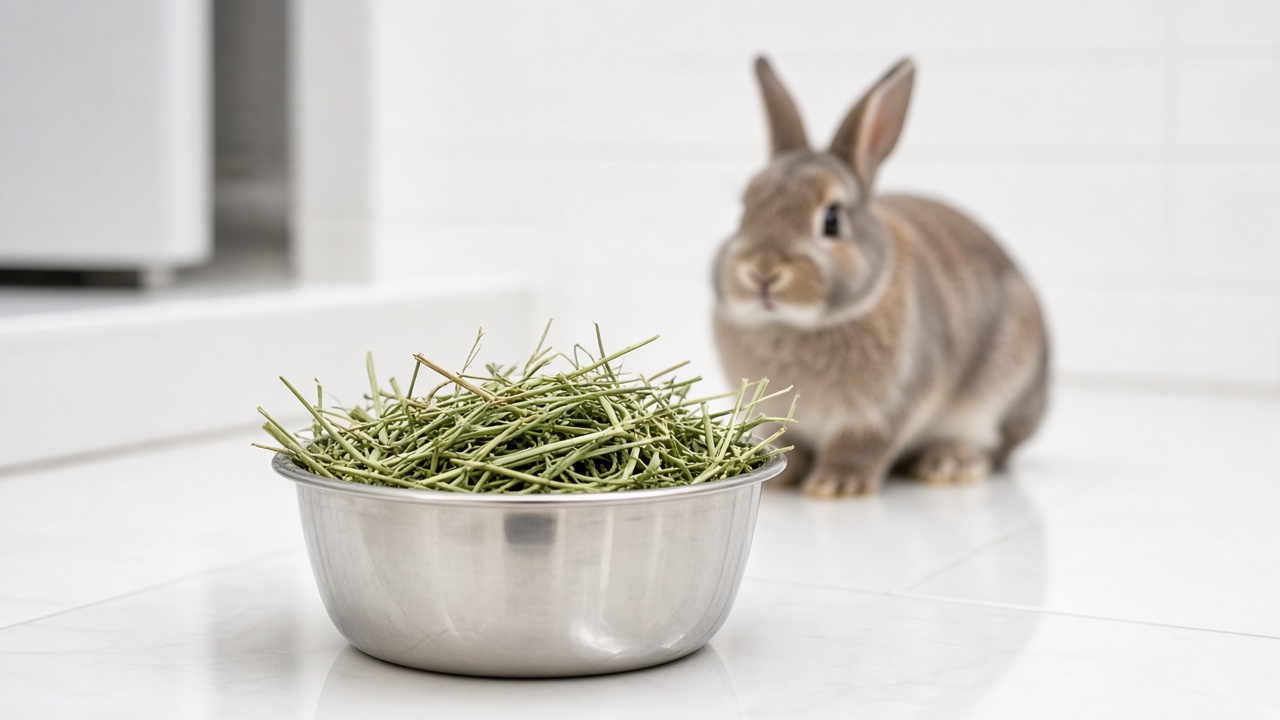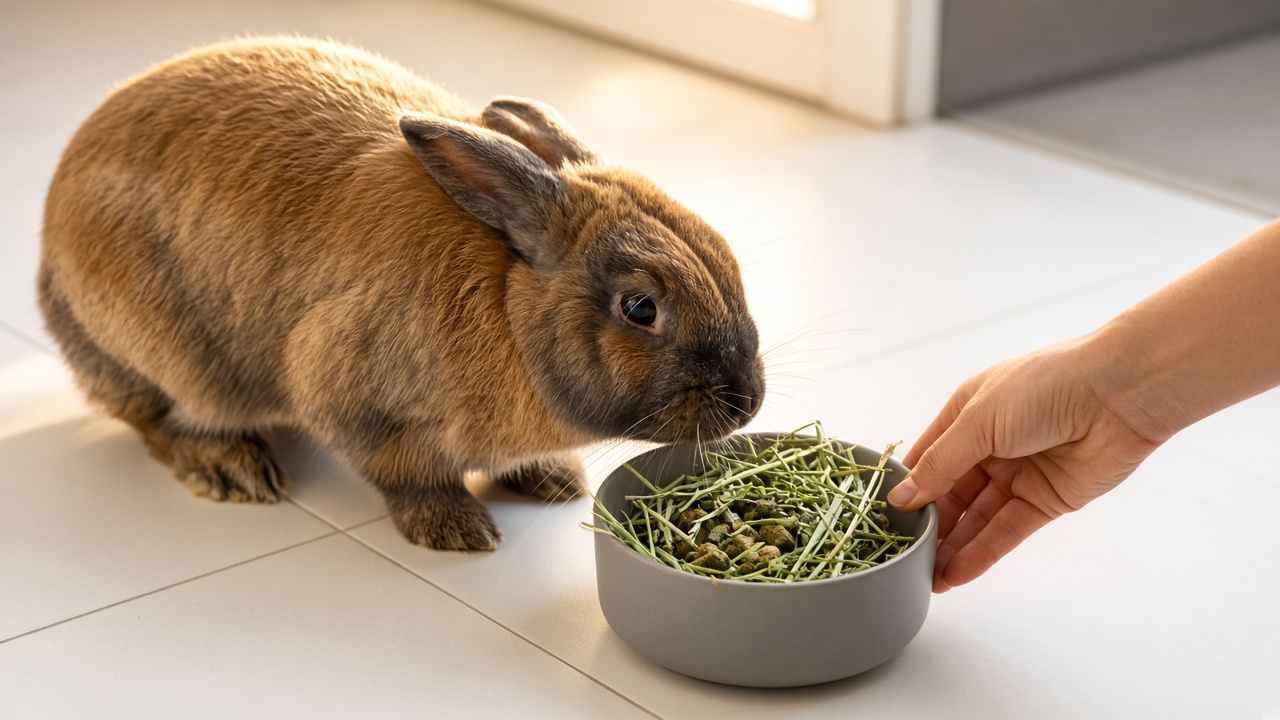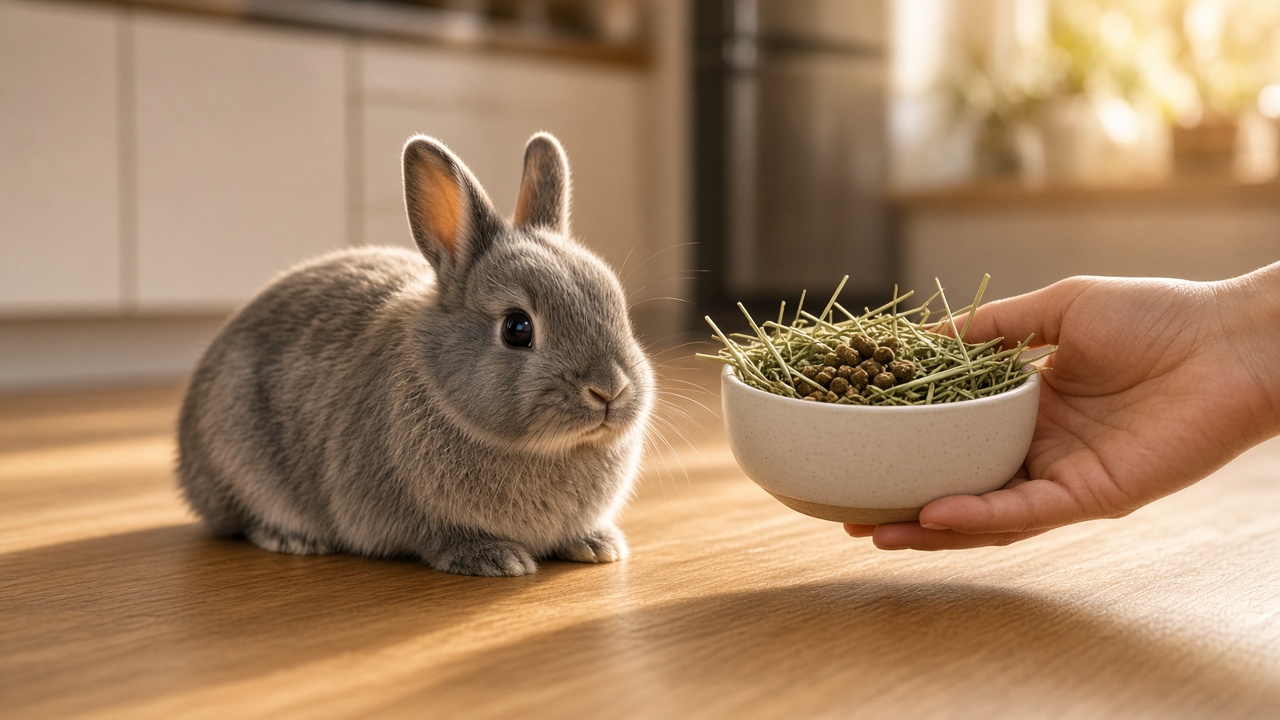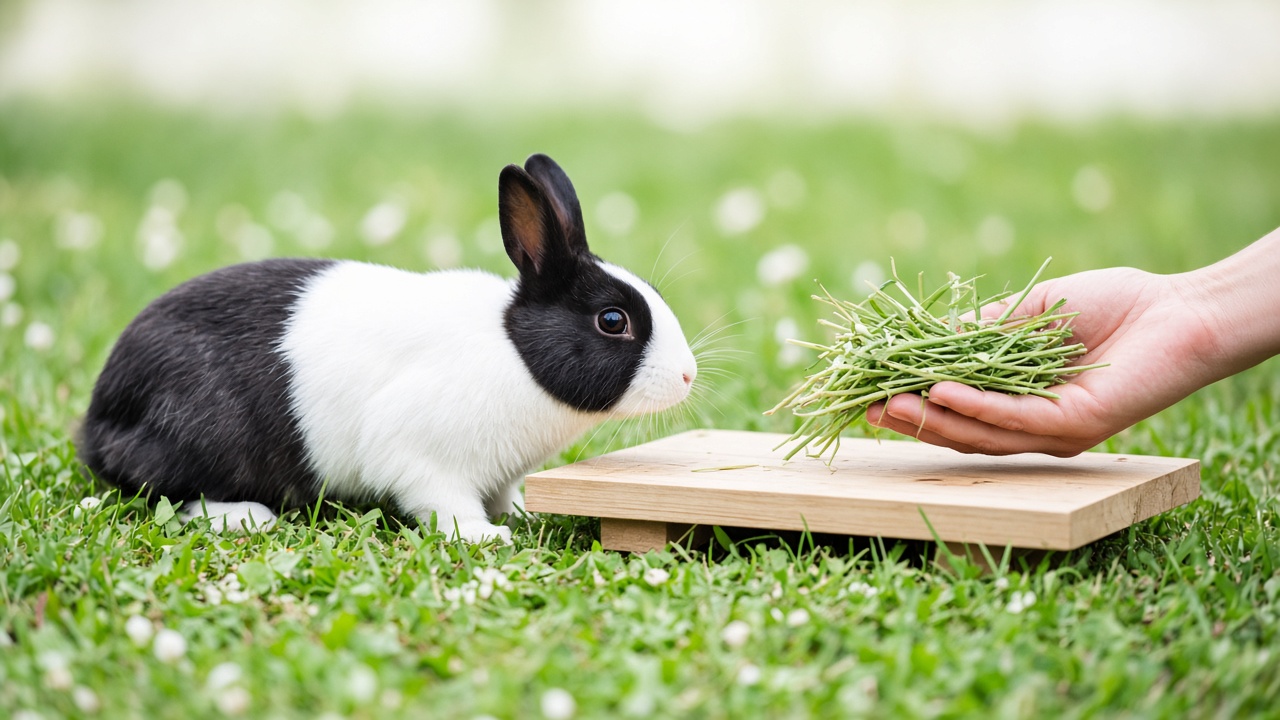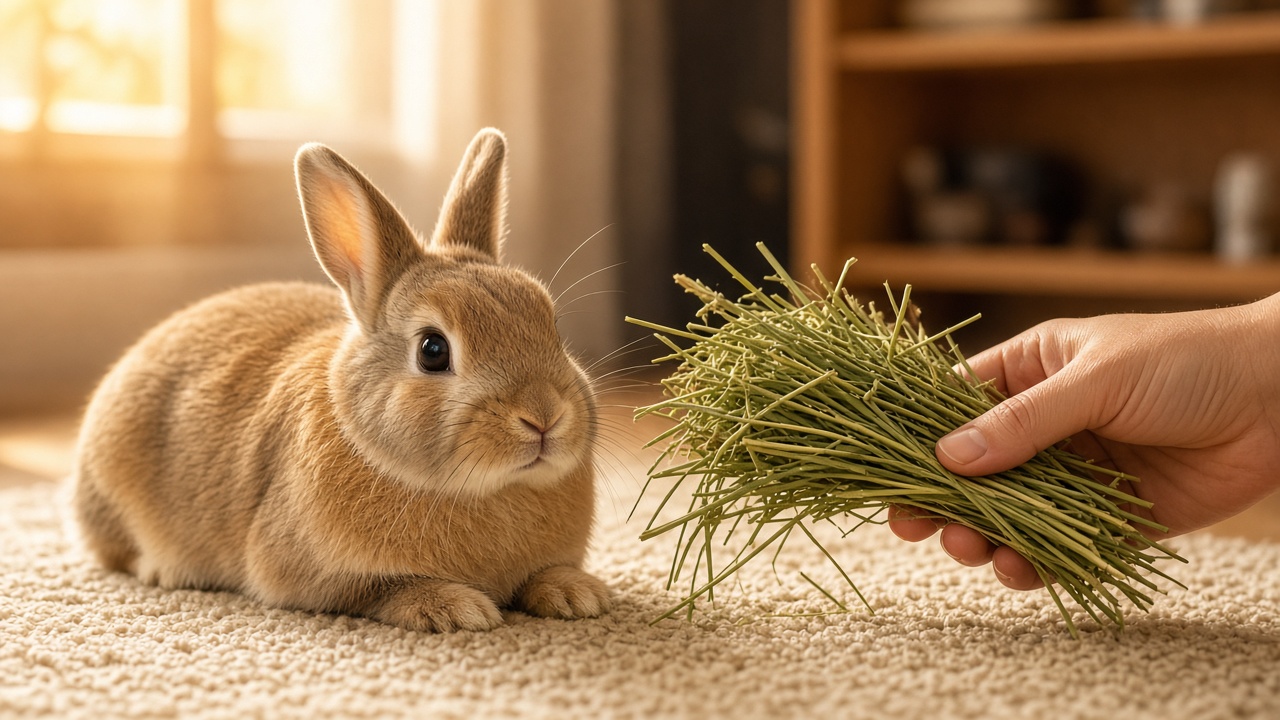
Quick answer: Start with a Mini Rex if you want a rex bunny as a house pet. ARBA caps Mini Rex at 4.5 pounds and standard Rex at 10.5 pounds. Plan on unlimited grass hay, not a cage-only life.
Rex and Mini Rex bunnies share velvet fur; ARBA caps them at 10.5 and 4.5 pounds. This page is a Pet Bench research-desk breed brief. We did not handle rabbits for this article, run feeding trials, score home temperament, or walk a show table.
Selection rule: we cover only the two ARBA-recognized rex-coated breeds kept as United States pets, Rex and Mini Rex. We skip Satin, wool breeds, and unnamed rex-mix kits.
For gear, we include only currently sold items whose maker pages publish a numeric fiber, protein, feeding, or enclosure spec. The first listed forage must be timothy. We leave out fruit-and-seed mixes, alfalfa-first adult pellets, and treats.
Our research team analyzed ARBA breed listings, House Rabbit Society care pages, and maker labels. We compared those published specs. We did not invent lab results.
Two ARBA sizes sit under one coat idea
People search “rex bunny” and get two animals. Both wear the same short velvet coat. They do not share a body size.
The American Rabbit Breeders Association lists Rex at a maximum of 10.5 pounds. It lists 16 color varieties.
ARBA says Rex first appeared in public at the Paris International Rabbit Show in 1924. John Fehr and Alfred Zimmerman imported the breed to the United States that same year.
The American Rabbit Breeders Association lists Mini Rex at a maximum of 4.5 pounds. ARBA says Monna Berryhill developed the breed in Texas in 1984. ARBA recognized Mini Rex in 1988.
ARBA also says Mini Rex is consistently the number 1 or number 2 top entry at any ARBA Convention. That is a show-entry fact. It is not a pet-home score.
A four-pound Mini Rex and a ten-pound Rex are not interchangeable roommates. The smaller rabbit still needs room to hop. The larger rabbit needs more floor and more hay.
Do not buy on coat photos alone. Confirm which breed name the seller uses. Ask for a current weight in pounds.
The velvet coat and what it changes
ARBA attributes Rex popularity to a mutation that produces short, dense, velvet-like fur. Guard hairs do not stand up as a long topcoat. The coat feels plush because the hair lengths stay even.
That even length is the breed idea. It is also the handling cue. A rex coat shows dirt and oil faster than a longer flyback coat.
House Rabbit Society tells caregivers to brush a rabbit regularly with a soft brush. A rex coat is short, so mats are rare. Shed hair still gets swallowed.
House Rabbit Society warns that hairballs and blockages are a hay problem, not a brush problem. Hay should make up 85 percent of an adult rabbit’s diet for that reason.
Rex feet carry less pad fur than wool breeds. House Rabbit Society states that wire-bottom cages can ulcerate a rabbit’s feet. A velvet coat does not add cushion on the hocks.
Our research team compared that flooring note with MidWest Homes for Pets’ published mesh spec. The Wabbitat Deluxe Rabbit Home lists 1 inch mesh spacing. Treat any wire floor as a risk surface and cover it.
Do not trim a rex coat for style. Uneven clipping makes the velvet look patchy.
Temperament in a house, not a hutch
We did not score rex personalities in homes. House Rabbit Society describes domestic rabbits as inquisitive, intelligent, sociable, and affectionate.
House Rabbit Society says well-cared-for indoor rabbits can live seven to 10-plus years. Its children-and-rabbits guide states rabbits can live 8 to 12 years.
House Rabbit Society says an adult should be the primary caretaker. Rabbits are physically delicate. Children who squeeze or drop a rabbit can cause broken legs or backs.
House Rabbit Society notes rabbits cannot cry out when distressed. They may scratch or bite instead. Ground-level visits beat pickup sessions.
House Rabbit Society’s children guide says three to four hours of exercise outside the cage is essential each day. Its care primer asks for several hours per day.
Intact pairs are not a temperament project. House Rabbit Society says a doe can have a litter every 30 days. She can become pregnant within 30 minutes of giving birth.
Keep sexes apart unless a clinic has already altered both animals. Size is not permission to carry the rabbit around the house. Support the chest and the hindquarters at once, as House Rabbit Society describes.
Housing that matches the two body sizes
House Rabbit Society’s minimum recommended cage space for a single rabbit is 2 feet by 2 feet by 4 feet. Its children-and-rabbits guide also names at least 12 square feet of living space. That example is a 4-foot by 3-foot enclosure.
Those figures are floors, not show crates. A rex bunny still needs hours outside the box.
House Rabbit Society prefers a pen over a cage. It treats a cage as a bedroom, not the whole home. Keep the door open inside a rabbit-safe room when you can.
MidWest Homes for Pets lists the Wabbitat Deluxe Rabbit Home with a 5.5 inch deep plastic pan. It includes a hay feeder, water bottle, and feeding bowl. Those extras help a starter setup.
They do not replace the 12 square foot House Rabbit Society floor target. Our research team compared that published pan depth with the 12 square foot figure. A deep pan controls litter, not hop length.
House Rabbit Society says indoor housing is essential. Outdoor hutches isolate a social animal. Predators can kill a domestic rabbit by approach alone, according to that same primer.
House Rabbit Society lists outdoor risks that include fleas, ticks, RHDV2, raccoon roundworm, and flystrike. Cover electrical cords. House Rabbit Society says rabbits chew.
Place hide boxes on solid floors. House Rabbit Society says a cardboard hidey box can make a rabbit feel secure.
Diet: hay first, then a measured pellet
House Rabbit Society sets the adult plate in percents. Hay is 85 percent. Vegetables are 10 percent.
Pellets are 5 percent. Fruit and treats stay under 5 percent.
House Rabbit Society’s veggie rule is 1 to 2 cups of vegetables for every 4 pounds of body weight. A 4 pound Mini Rex sits near the low end of that cup range. A 10 pound Rex needs more greens, not more cookies.
House Rabbit Society wants at least three types of leafy greens each day. Add one new green at a time. Stop the new green if stools go soft.
House Rabbit Society says pellets should be fresh and relatively high in fiber, with an 18 percent minimum. It warns against gourmet mixes with nuts, seeds, or grains.
House Rabbit Society’s care primer measures plain pellets at 1/4 cup per 5 pounds of body weight per day. A Mini Rex near 4 pounds stays under that quarter cup. A Rex near 10 pounds is closer to a half cup on that rule.
Oxbow Animal Health’s Essentials Adult Rabbit Food page lists a different cup chart for rabbits over 1 year. At 1 to 4 pounds it lists 1/8 cup daily. At 4 to 8 pounds it lists 1/4 to 1/3 cup daily.
At 8 to 10 pounds Oxbow lists 1/3 to 1/2 cup daily. At 10 pounds and up it lists 3/4 cup daily. Those cups sit beside unlimited grass hay.
Oxbow’s same page lists crude protein at a 14.00 percent minimum. Crude fiber is 25.00 percent minimum and 29.00 percent maximum. Moisture maxes at 10.00 percent, with calcium at 0.35 to 0.75 percent.
Kaytee’s Timothy Complete Rabbit Food page lists crude protein at a 13.0 percent minimum. Crude fiber is 22.0 percent minimum and 27.0 percent maximum. Moisture is 12.0 percent maximum.
Our research team compared those two fiber floors with House Rabbit Society’s 18 percent pellet minimum. Both maker pages clear that floor. Kaytee sits at a 22.0 percent minimum, and Oxbow sits at a 25.00 percent minimum.
Kaytee lists small-breed feeding at 1/3 to 1/2 cup. It lists large-breed feeding at 2/3 to 1 1/2 cups. A Mini Rex is a small breed on that split.
Oxbow Western Timothy Hay lists crude protein at a 7.00 percent minimum. Crude fiber is 32.00 percent maximum, and moisture is 15.00 percent maximum. Oxbow’s page says to place large handfuls in the habitat daily.
House Rabbit Society reserves alfalfa hay for babies, nursing mothers, and elderly or injured rabbits. Adult rex bunnies stay on grass hay.
Oxbow’s pellet page uses a four-week switch. Kaytee’s page uses a 7 to 10 day mix. Follow one maker chart.
Care products we compared from maker pages
The table below is an attribute sheet. It is not a ranking. We list only specs the maker pages already print.
| Product | Role | Protein on maker page | Fiber on maker page | Other listed spec |
|---|---|---|---|---|
| Oxbow Essentials Adult Rabbit Food | Adult pellet | min 14.00% | min 25.00%, max 29.00% | 5, 10, and 25 lb bags; 1/4–1/3 cup at 4–8 lb |
| Kaytee Timothy Complete Rabbit Food | Adult pellet | min 13.0% | min 22.0%, max 27.0% | 4.5, 9.5, and 25 lb bags; small breed 1/3–1/2 cup |
| Oxbow Western Timothy Hay | Daily grass hay | min 7.00% | max 32.00% | Moisture max 15.00%; sizes from 15 oz to 50 lb |
| MidWest Wabbitat Deluxe Rabbit Home | Starter habitat | — | — | 5.5 in pan; 1 in mesh; hay feeder, bottle, bowl |
Oxbow Essentials Adult Rabbit Food is a uniform pellet. The first ingredient on Oxbow’s page is timothy grass meal. That matches our timothy-first rule.
Kaytee Timothy Complete Rabbit Food also lists sun-cured timothy grass hay first. Kaytee’s page lists total Bacillus species at a 100,000 CFU/g minimum.
Oxbow Western Timothy Hay is loose forage, not a pellet. Use it as the 85 percent House Rabbit Society hay share. Pellets stay the side dish.
The MidWest Wabbitat Deluxe Rabbit Home is a bedroom with tools. House Rabbit Society still wants a pen-scale floor and daily out time. Use the deep pan for litter and cover the 1 inch mesh.
We did not include alfalfa-first adult pellets. We did not include muesli mixes. Those fail the timothy-first rule we set above.
FAQ
What is a rex bunny?
A rex bunny is a domestic rabbit with short, dense, velvet-like fur. ARBA lists Rex to 10.5 pounds and Mini Rex to 4.5 pounds. Most “rex bunny” pet searches point at Mini Rex.
How big does a Mini Rex get?
The American Rabbit Breeders Association lists Mini Rex at a 4.5 pound maximum. ARBA says the breed was developed in Texas in 1984 and recognized in 1988. A seller’s “teacup rex” label is not an ARBA class.
Are rex bunnies good indoor pets?
House Rabbit Society says domestic rabbits do best indoors with family contact. It also wants hours of daily exercise outside a cage. A Mini Rex’s 4.5 pound cap makes lifting easier. It is not a pass on space.
Do rex coats need special grooming?
House Rabbit Society asks for regular brushing with a soft brush. A rex coat rarely mats, yet it still sheds. Keep hay at the House Rabbit Society 85 percent share so swallowed hair can move.
How much should a rex bunny eat?
House Rabbit Society wants unlimited grass hay and 1 to 2 cups of greens per 4 pounds of body weight. Its primer lists 1/4 cup of plain pellets per 5 pounds each day. Oxbow’s adult chart lists 1/8 cup at 1 to 4 pounds. It lists 1/4 to 1/3 cup at 4 to 8 pounds.
Is a pet-store cage enough for a Rex?
House Rabbit Society’s minimum cage figure is 2 feet by 2 feet by 4 feet. Its children guide also cites 12 square feet, such as 4 feet by 3 feet. MidWest’s Wabbitat Deluxe lists a 5.5 inch pan and 1 inch mesh. Use that habitat as a bedroom and add a pen.
Rex or Mini Rex — which should I get?
Choose Mini Rex if you need ARBA’s 4.5 pound cap and a smaller food and litter load. Choose Rex if you can house a rabbit up to ARBA’s 10.5 pound maximum. Both share the velvet coat. Neither thrives as a hutch-only animal.