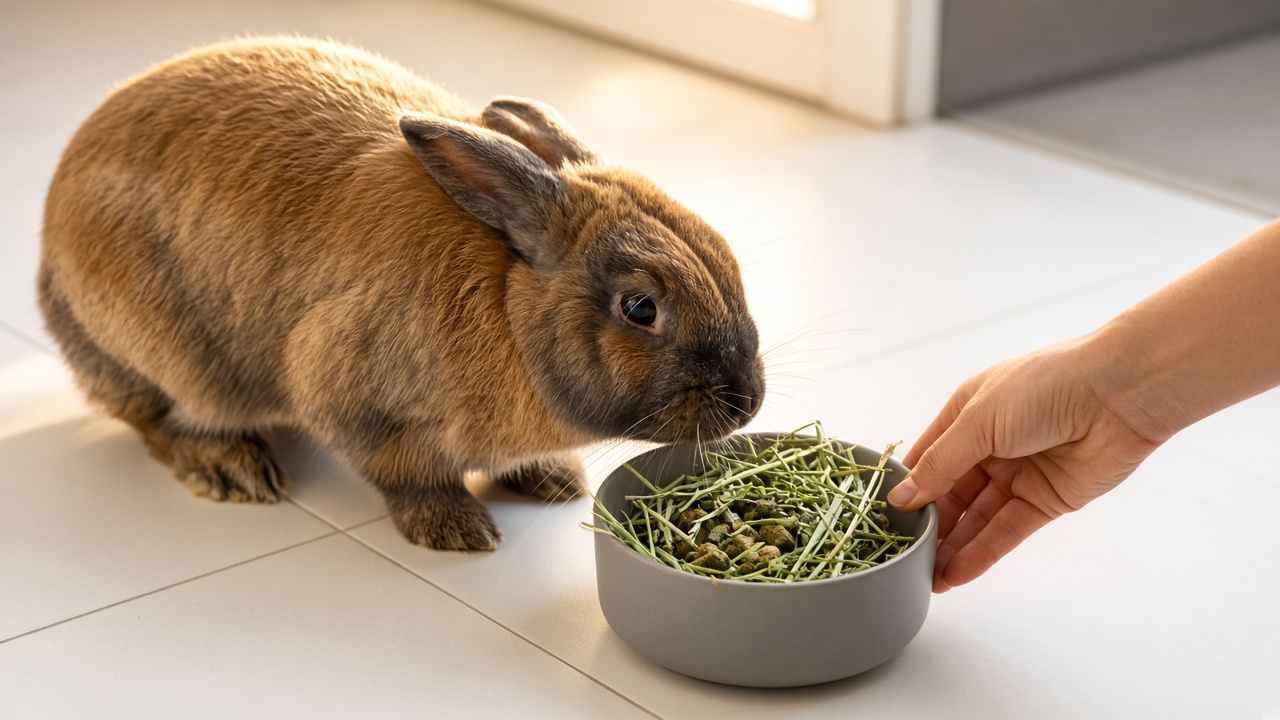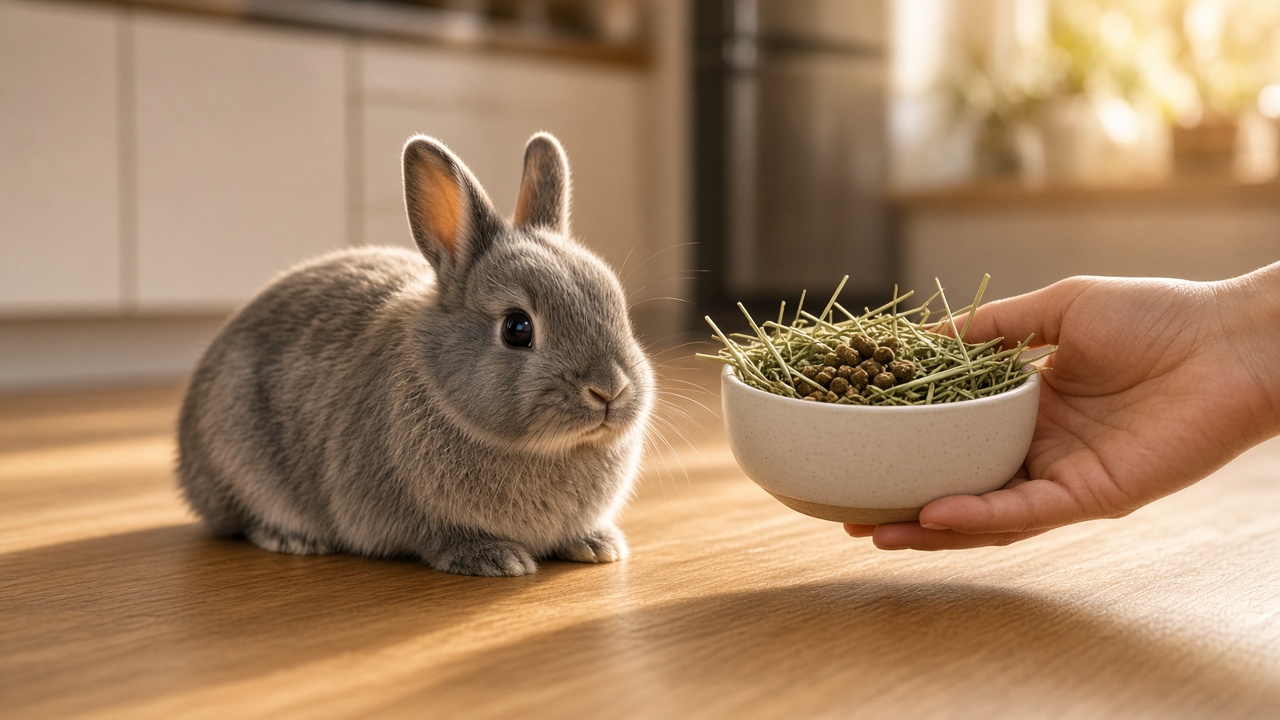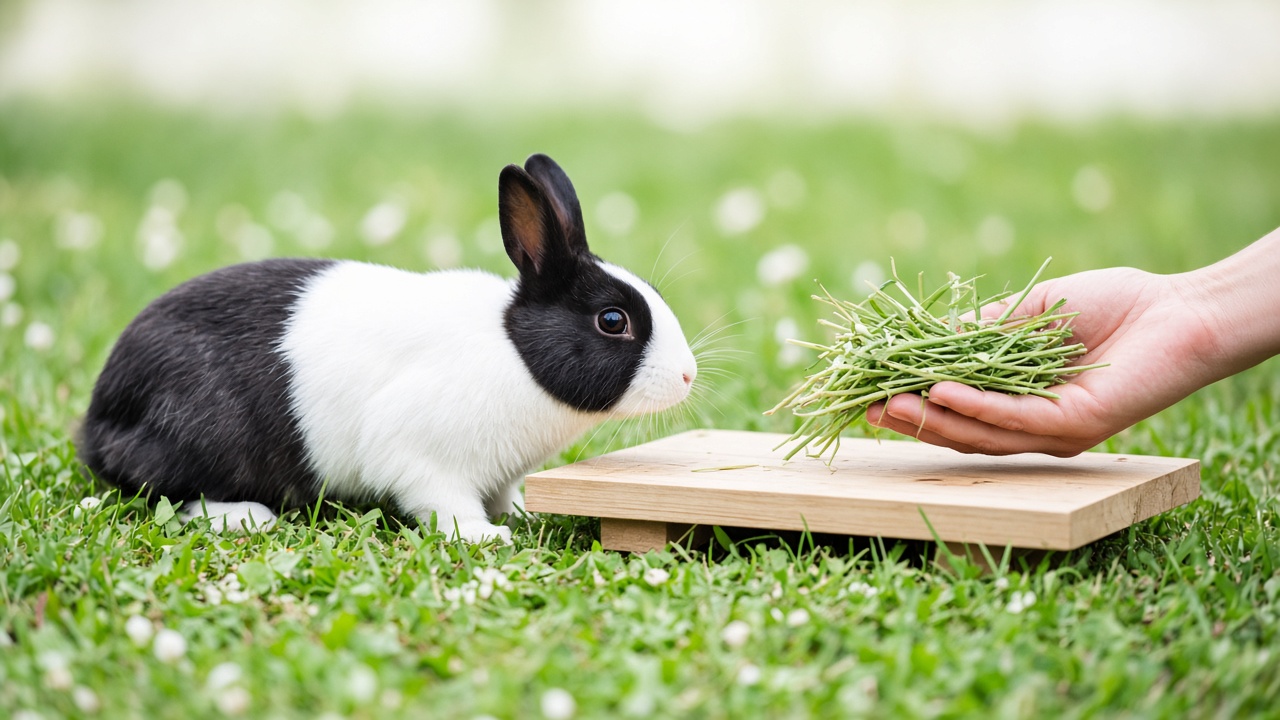
Quick answer: A Dutch bunny is a small, clearly marked house rabbit, not a dwarf. Plan indoor space with daily run time, unlimited grass hay, and a measured timothy pellet. Treat a store cage as a rest box, not a full home.
A Dutch bunny is a marked companion rabbit that the American Rabbit Breeders Association lists at a 5.5-pound maximum.
This page is a research brief from The Pet Bench. We compared published breed text and current pellet labels. We did not weigh live Dutch rabbits, run feeding trials, or visit breeding barns.
We used the 5.5-Pound Indoor Rule. A scenario entered this brief only if it serves an adult Dutch at or under that ARBA cap, kept indoors. We left out meat-pen husbandry, outdoor colonies, and dwarf-breed starter kits.
What a Dutch bunny is
The American Rabbit Breeders Association calls the Dutch “perhaps the most recognizable breed.” The page credits breeders in England during the 1830s. Those breeders selected the white blaze, collar, and saddle that still define the type.
ARBA also says the Dutch remains one of the top 10 most popular breeds. That line is about show demand. It is not a care guarantee.
A Dutch is small. It is not a dwarf. A short rabbit is not a low-work rabbit.
The ARBA Dutch page does not publish a color list. It stresses distinct markings paired with type. If a seller cannot show a clean blaze and saddle, you are not looking at a marked Dutch.
Adult size and how that changes portions
ARBA lists a maximum weight of 5.5 pounds for the Dutch. That is the only weight figure on the breed page we read. It is a show cap, not an average.
Many house Dutch sit under that cap. Our research team treated 5.5 pounds as the ceiling for every portion we scaled.
House Rabbit Society publishes adult portions on a 6-pound base. That base sits above the ARBA Dutch maximum. A typical Dutch therefore needs less than the printed cup measures.
House Rabbit Society lists 1/4 cup of pellets per 6 pounds each day. Scale that down for a Dutch. At 4.5 pounds, the same ratio is about 3 tablespoons.
House Rabbit Society lists a minimum of 2 cups of chopped vegetables per 6 pounds each day. At 4.5 pounds, that ratio is about 1.5 cups. Split the pile if greens remain.
House Rabbit Society limits fruit to about 1 teaspoon per 2 pounds each day. At 4.5 pounds, that is a little over 2 teaspoons. Fruit is a treat, not a meal.
Oxbow Animal Health prints a different chart on Essentials Adult Rabbit Food. Rabbits from 1 to 4 pounds get 1/8 cup daily. Rabbits from 4 to 8 pounds get 1/4 to 1/3 cup daily.
A Dutch near 4 pounds sits on the Oxbow break point. Start at the lower line. Raise the pellet only if hay intake stays high.
Kaytee prints a breed-size chart on Timothy Complete Rabbit Food. A small breed gets 1/3 to 1/2 cup daily. That range is larger than the House Rabbit Society 6-pound pellet line.
Supreme Petfoods prints a weight chart on Science Selective Adult Rabbit Food. A typical 5.5-pound adult gets about 2 to 2.5 ounces per day. The same page lists 60 to 70 grams per day for a 2.5-kilogram adult.
Those maker lines do not match each other. They also do not match House Rabbit Society’s 1/4-cup-per-6-pounds rule. Our research team reports the spread and does not pick a winner.
Temperament without a scorecard
The ARBA Dutch page discusses markings, type, and the 5.5-pound maximum. It does not publish a temperament score. Any claim that every Dutch is calm is not on that page.
House rabbits still need daily contact. A Dutch that sits still in a photo may sprint at dusk. Watch the actual animal for several minutes before you commit.
Let the rabbit come forward first. Fast hands teach a small breed to bolt. Children need an adult in the room for every pickup.
Boredom looks like chewing. That is not a personality flaw. It is a housing and diet problem.
Housing for a compact athlete
A 5.5-pound maximum does not shrink the floor plan. A Dutch still needs a full hop, a stretch, and a hide. A starter cage is a rest box.
Give the rest box a solid floor. Wire underfoot can bruise hocks. Cover any grid with a stiff mat the rabbit cannot swallow.
House the rabbit in a shared room when you can. A back-room hutch cuts contact. Low contact is how a quiet breed becomes a scared breed.
Keep a litter box, a heavy water bowl, a hay pile, and a hide in the base. House Rabbit Society’s diet page assumes the rabbit can reach hay at all times. A rack that empties overnight fails that rule.
Block cords, houseplants, and gaps under sofas. A compact rabbit fits where a larger breed cannot.
Outdoor colonies sit outside the 5.5-Pound Indoor Rule.
Hay, greens, and pellets in that order
House Rabbit Society puts unlimited hay first for adults aged 1 to 5 years. Timothy, orchard, and oat grass hays are the listed adult options. Alfalfa hay is reserved for nursing mothers and young rabbits.
House Rabbit Society wants a pellet with at least 18 percent crude fiber. Every adult bag in our label set clears that floor. Fiber on a bag is still not a hay substitute.
House Rabbit Society wants at least three leafy greens each day. Leafy greens should make up about 75 percent of the fresh portion. Rotate any high-oxalate green so it is only one of the three.
Non-leafy vegetables should stay near 15 percent of the fresh portion. House Rabbit Society also writes that as about 1 tablespoon per 2 pounds per day. For a 4.5-pound Dutch, that is about 2 tablespoons of carrot, pepper, or squash.
House Rabbit Society tells readers to wash vegetables for at least two minutes in a bowl. Change the water several times. The page ties that wash to Rabbit Hemorrhagic Disease Virus Type-2.
Never pour a muesli mix. House Rabbit Society says to skip pellets that mix in fruits, seeds, nuts, corn, or yogurt drops. Those mixes train a rabbit to eat the candy and leave the fiber.
Young Dutch still on alfalfa need a different bowl. House Rabbit Society gives rabbits from 7 weeks to 7 months unlimited alfalfa hay and unlimited alfalfa-based pellets. That is a growth diet, not an adult Dutch diet.
From 7 months to 1 year, House Rabbit Society switches to unlimited grass hay. The same row lists 1/2 cup of timothy pellets and 1 cup of greens. A Dutch under 5.5 pounds should start lower than that 6-pound pellet line.
From 1 to 5 years, the adult row returns to 1/4 cup of pellets per 6 pounds. After 6 years, House Rabbit Society keeps grass hay unlimited and splits pellets by body condition.
Underweight seniors may see alfalfa pellets. Healthy-weight seniors stay on timothy pellets. Fresh water sits beside the hay, not after it.
Four adult pellet labels, side by side
Our research team compared four currently sold adult bags. We used the maker pages, not reseller copy. We call that set the Pet Bench Label Spread.
The spread is not a ranking. It is a label table. A higher fiber number does not prove a Dutch will eat the bag.
Oxbow Essentials Adult Rabbit Food lists Timothy Grass Meal first. Crude protein is 14.00 percent minimum. Crude fiber is 25.00 to 29.00 percent, and calcium maxes at 0.75 percent.
Kaytee Timothy Complete Rabbit Food lists sun-cured timothy grass hay first. Crude protein is 13.0 percent minimum. Crude fiber is 22.0 to 27.0 percent.
Kaytee also lists total Bacillus species at 100,000 CFU per gram. The page names B. licheniformis and B. subtilis. That is a label claim, not a gut trial we ran.
Small Pet Select Rabbit Food Pellets list timothy hay first. Crude protein is 14 percent minimum. Fiber matches Oxbow at 25 to 29 percent, and calcium maxes at 0.6 percent.
From 1 year to 5 years, Small Pet Select lists 1/4 to 1/2 cup per 6 pounds. From 7 months to 1 year, the same page lists 1/2 cup per 6 pounds. Those lines track House Rabbit Society more closely than Kaytee’s small-breed cup range.
Science Selective Adult Rabbit Food, from Supreme Petfoods, lists alfalfa meal pellets first. Crude protein is 12.5 percent minimum. Fiber is 21.5 to 28.5 percent, and calcium maxes at 1.2 percent.
Supreme Petfoods says the food is a daily diet for adult rabbits aged 20 weeks and older. That is the maker’s statement.
Here is the Label Spread in one view.
| Product | First ingredient | Crude protein min | Crude fiber min–max | Calcium max | Maker feeding note |
|---|---|---|---|---|---|
| Oxbow Essentials Adult Rabbit Food | Timothy Grass Meal | 14.00% | 25.00%–29.00% | 0.75% | 4–8 lb: 1/4–1/3 cup daily |
| Kaytee Timothy Complete Rabbit Food | Sun-cured timothy grass hay | 13.0% | 22.0%–27.0% | 0.75% | Small breed: 1/3–1/2 cup daily |
| Small Pet Select Rabbit Food Pellets | Timothy hay | 14% | 25%–29% | 0.60% | Ages 1–5 years: 1/4–1/2 cup per 6 lb |
| Science Selective Adult Rabbit Food | Alfalfa meal pellets | 12.5% | 21.5%–28.5% | 1.2% | 5.5 lb adult: 2–2.5 oz daily |
Three of the four bags lead with timothy. Science Selective leads with alfalfa meal. House Rabbit Society prefers timothy-based pellets for adults.
Minimum fiber in this set runs from 21.5 percent to 25.00 percent. Maximum calcium runs from 0.60 percent to 1.2 percent. Those two ranges are the point of the table.
Kaytee tells buyers to use an opened bag within 30 to 45 days. Store it cool and dry. A 25-pound sack is a poor match for one Dutch on a tablespoon ration.
What this desk will not claim
We compared labels and published care pages. We did not run a feeding trial. A Dutch that ignores one bag is not a data point we collected.
We will not rank these four foods. Rank columns hide the alfalfa-versus-timothy split and the cup-versus-ounce feeding split.
We will not invent a Dutch temperament score. ARBA did not print one. Your rabbit is the sample.
FAQ
How big does a Dutch bunny get?
The American Rabbit Breeders Association lists a 5.5-pound maximum for the breed. That is a show cap on the ARBA Dutch page. Many house Dutch sit under it, so treat 5.5 pounds as the ceiling, not the average.
How much should a Dutch bunny eat each day?
House Rabbit Society puts unlimited grass hay first for adults. Scale the printed 6-pound cup lines down to your rabbit’s weight. At 4.5 pounds, that is about 1.5 cups of chopped vegetables and about 3 tablespoons of pellets.
Are Dutch rabbits good house pets?
ARBA calls the Dutch one of the top 10 most popular breeds. Popularity is not a temperament test. Watch the individual rabbit, keep children supervised, and give daily run time.
Can a Dutch bunny live in a small cage?
A rest box can hold a litter box, hay, and a hide. It cannot replace a hop. The 5.5-Pound Indoor Rule treats a store cage as a bedroom, not a house.
When do I switch a Dutch off alfalfa?
House Rabbit Society keeps alfalfa hay and alfalfa-based pellets unlimited from 7 weeks to 7 months. From 7 months to 1 year, the page switches to grass hay and a measured timothy pellet. Science Selective still lists alfalfa meal pellets first, which is why that bag sits in the Label Spread.
How do I read a pellet bag for a Dutch?
Look at the first ingredient, the fiber minimum, and the calcium maximum. House Rabbit Society wants at least 18 percent crude fiber and no fruit-and-seed mixes.
In our four-bag set, fiber minima ran from 21.5 percent to 25.00 percent. Calcium maxima ran from 0.60 percent to 1.2 percent.