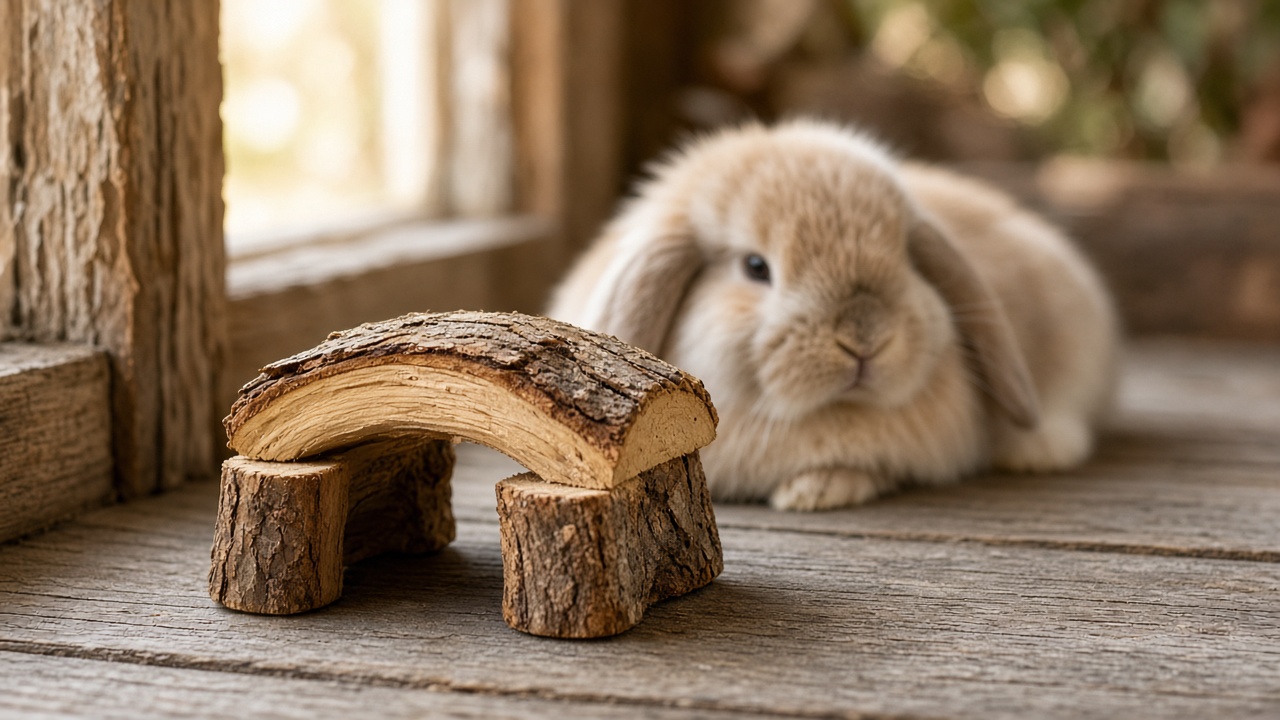
Quick answer: Match the noise to posture, not the noise alone. Soft tooth purrs and honks are social. Loud grinding, growls, and screams need a welfare check.
Rabbits stay quiet because they are prey, so most of their speech is posture, not voice. Rabbits use honks, clucks, tooth purrs, thumps, growls, and rare screams, each tied to a different body context. This page is a desk analysis of published behavior notes and current maker specs, not a home recording study, clinic log, or live-audio score sheet.
The Sound-Context Pair Rule
We used one rule for every sound and every product on this page. A noise entered only if House Rabbit Society names it in Rabbitspeake or in Amy Espie’s glossary. World Rabbit Science frequencies also counted.
A product entered only if its maker page lists rabbits and the item changes what you hear. That means hay crunch, pellet chew, hide quiet, or willow gnaw.
We left out cameras, hamster-only houses, and any SKU we could not confirm on a maker page. We also left out ranked “best noise toys” lists.
Our research team compared published specs. We did not run feeding trials or score live rooms.
Why most rabbit sounds stay quiet
Prey animals hide voice. House Rabbit Society’s Marinell Harriman notes that only a few rabbit “words” are nasal or vocal. Most of the vocabulary is posture.
Louisiana State University School of Veterinary Medicine lists a rabbit hearing range of 360 to 42,000 Hz. The same compiled table lists human hearing at 64 to 23,000 Hz.
That gap matters at home. A rabbit can react to a high tone you never notice. A thump can follow a sound that is silent to you.
The RSPCA asks for space that lets a rabbit stand with ears clear of the roof. For two medium rabbits, that floor is 3 m by 2 m by 1 m, shelter plus run.
A cramped room raises startle noise. A hide that is too low can also keep a scared rabbit from settling.
The RSPCA also wants as many hides as rabbits, plus one extra if you can. Separate eating, resting, and toilet zones cut random thumps.
Contentment sounds: purrs, clucks, and soft grinding
House Rabbit Society calls purring a fast, light tooth vibration with quivering whiskers. It often starts when someone strokes behind the ears.
This is not a cat throat purr. It is teeth. You may feel it more than hear it.
Harriman separates that light purr from “crunching.” Crunching is slower and louder. It can come with protruding eyes when a rabbit feels sick.
Amy Espie’s House Rabbit Society glossary makes the same split. Soft tooth grinding during a flop or a petting session reads as happy. Rare tooth chattering reads as pain.
House Rabbit Society also names a faint cluck after a favorite snack. Harriman glosses it as “Yum, yum.”
Hay is the usual backdrop for that cluck. The People’s Dispensary for Sick Animals says about 85% of the diet should be hay or grass.
PDSA’s floor is a daily hay bundle at least as big as the rabbit. Oxbow Animal Health’s fortified-foods page splits the plate another way.
It lists 70% grass hay, 20% uniform food, 8% greens, and up to 2% treats. Oxbow Harvest Stacks Western Timothy lists 7.00% minimum crude protein and 32.00% maximum crude fiber.
That long fiber is what you hear as a steady crunch, not a scream.
A rabbit that tooth-purrs during a calm brush session is a different animal from one that hunches and chatters. Our step-by-step grooming guide walks through a slow handling order.
If shedding noise or mat pull makes the rabbit growl, pause. A grooming-kit review helps you pick tools that stay quiet on the coat.
Excitement sounds: honks, oinks, and circling
House Rabbit Society treats honking and oinking as a love song. Neutered rabbits may still circle your feet and honk for a mate, a treat, or attention.
Amy Espie shortens honking to “I’m excited,” and context still rules. Circling plus a raised tail is courtship or play. Circling plus a lunge is not.
Mealtime honks are common. PDSA allows one tablespoon of nuggets once a day. Rabbits over 3.5 kg get that tablespoon twice.
Oxbow Essentials Adult Rabbit Food lists a tighter cup rule by body weight. A 1 to 4 lb adult gets 1/8 cup a day. A 4 to 8 lb adult gets 1/4 to 1/3 cup.
Oxbow lists 14.00% minimum crude protein and 25.00% to 29.00% crude fiber. Bags come in 5 lb, 10 lb, and 25 lb sizes.
Kaytee Timothy Complete Rabbit Food lists 13.0% minimum crude protein and 22.0% to 27.0% crude fiber. Kaytee also lists at least 100,000 CFU/g of Bacillus licheniformis and Bacillus subtilis.
Kaytee’s bags are 4.5 lb, 9.5 lb, and 25 lb. The 4.5 lb pack measures 5 by 8.5 by 9.75 inches on Kaytee’s page.
Kaytee’s small-breed scoop is 1/3 to 1/2 cup. That is more food than Oxbow’s 1 to 4 lb line. Watch body shape, not the bag slogan.
Scatter the pellets. PDSA prefers forage over a bowl. Foraging spreads the honks and the chew clicks across the room.
For a wider pellet comparison, see our rabbit pellet guide. Use it to match fiber bands, not to chase a rank.
PDSA wants five to six fresh plant types a day, with food switches over two to four weeks. Oxbow’s Essentials page uses a four-week mix. Kaytee uses seven to ten days.
A sudden diet change can add gut noise that owners mistake for “talking.” Slow the switch if stools change.
Warning sounds: thumps, growls, and snorts
A thump is a hind-foot strike, not a voice. Harriman says it can mean danger, or just “the furniture moved.”
Treat the first thump as a scan, not a verdict. Look at ears, eyes, and the nearest hide.
House Rabbit Society lists snorting and growling as anger warnings. A grunt-lunge-bite can follow if the warning is ignored.
Amy Espie glosses a growl as “Leave me alone.” Ears back, chin up, and tail up raise the stakes.
Wheezing sniffs can be protest, not a cold. Harriman says rabbits mix voice and nasal sound to object.
True respiratory noise lasts. It does not stop when you step back. That is a clinic question, not a dialect note.
Give the rabbit a hide it can enter fully. Ware Pet Products lists the Wood Rabbit Den, item 01569, at 15.00 by 12.00 by 12.00 inches.
Ware’s copy says it is made in the USA of wood. It is a hide below and a rest shelf above.
Ware’s Twigloo Large, item 03913, is 15.00 by 12.75 by 7.25 inches. It is 100% handwoven willow.
Our research team subtracted those maker heights. The den stands 4.75 inches taller than the Twigloo.
A tall hide suits a rabbit that sits up to listen. A low willow dome suits a rabbit that wants to flatten and chew.
The RSPCA wants more than one opening on a hide. A single-door box can trap a scared rabbit and raise the next growl.
Pain and emergency sounds
Loud, slow tooth grinding with bulging eyes is the pain pattern House Rabbit Society flags. Do not wait for a scream.
Amy Espie defines a scream in one line: excruciating pain, panic, and terror. It is not a request for a treat.
World Rabbit Science published numbers in 2019. Orihuela and Ungerfeld recorded nine New Zealand White males.
All nine males voiced during mating. Only four of nine voiced during an aversive procedure.
Aversive calls sat higher. Mean high frequency was 7.2 kHz against 4.1 kHz in mating calls.
Mean fundamental frequency was 1.83 kHz against 0.37 kHz. Mean duration was 1.23 seconds against 0.81 seconds.
Those figures do not turn your kitchen into a lab. They do show that distress calls can sit above social calls.
If a rabbit stops eating, PDSA calls that an immediate clinic problem. Gut stasis is the risk they name.
Do not use a scream, or a silent hunch, as a reason to add treats. Fix the room. Then get hands-on help.
Products that change what you hear
We did not pick these SKUs for a “top toys” board. We picked them because the maker pages list rabbits and a sound-linked job.
Oxbow Harvest Stacks Western Timothy is a 35 oz compressed hay. Oxbow claims 80% less airborne dust than loose hay when fed as directed.
The stack lists a 7.00% protein floor and a 32.00% fiber cap. Oxbow tells you to pull the portion into an S shape.
Less dust can cut sneeze-like noise that owners confuse with wheeze-sniffs. It does not treat illness.
Oxbow Essentials and Kaytee Timothy Complete change meal-time chew and honk patterns. Their fiber bands sit 3.00 to 10.00 points below the 32.00% hay cap.
That is why hay should stay the loudest food in the room. Pellets are a measured accent.
The two Ware hides change fear noise. A rabbit that can vanish after a thump often stops the next thump sooner.
| Product | Format | Maker-listed pack or size | Listed fiber or material | Sound-context role |
|---|---|---|---|---|
| Oxbow Essentials Adult Rabbit Food | Uniform pellet | 5 lb, 10 lb, or 25 lb | Crude fiber 25.00–29.00% | Meal honks and pellet chew |
| Kaytee Timothy Complete Rabbit Food | Uniform pellet | 4.5 lb, 9.5 lb, or 25 lb | Crude fiber 22.0–27.0% | Meal honks and pellet chew |
| Oxbow Harvest Stacks Western Timothy | Compressed timothy | 35 oz | Crude fiber max 32.00% | Clucks and hay crunch |
| Ware Wood Rabbit Den (01569) | Wood hide and shelf | 15.00 × 12.00 × 12.00 in | Pre-stained wood, USA-made | Quiet after a thump |
| Ware Twigloo Large (03913) | Willow hide | 15.00 × 12.75 × 7.25 in | 100% handwoven willow | Hide quiet plus chew clicks |
Kaytee tells owners to use an opened bag within 30 to 45 days. Stale pellets still click, but they are a poorer meal.
Oxbow’s four-week transition and Kaytee’s seven-to-ten-day transition both assume the old food is still on hand. Do not dump a new bag in one night.
FAQ
Why is my rabbit quiet most of the day?
House Rabbit Society says most rabbit language is posture. Voice is the smaller part.
Louisiana State University’s compiled range still shows rabbits hear well past human highs. Silence can mean they are listening, not that they have no feelings.
Watch ears and the flop. A sideways flop with fluttering eyelids is rest, not a faint.
What does a rabbit purr mean?
House Rabbit Society describes a light, fast tooth vibration and happy whiskers. It often appears during ear strokes.
Pair it with a loose body. If the grind turns slow and the eyes bulge, treat it as pain, not pleasure.
Why does my rabbit honk and circle my feet?
House Rabbit Society calls that mix a courtship and food song. Neutered rabbits still use it.
Amy Espie glosses honking as excitement. Add a treat only if the body stays soft and the rabbit is not guarding.
Does a thump always mean danger?
No. Harriman says rabbits thump at sights, smells, and rearranged furniture.
Scan the room once. Offer a hide with more than one way out. Repeat thumps with a freeze need a closer look.
When is teeth grinding an emergency?
House Rabbit Society splits light purr-grinding from louder crunching with protruding eyes. The second pattern is the worry.
A hunched rabbit that stops eating is a PDSA red flag. Do not wait for a scream.
Do rabbits really scream?
Yes, and it is rare. Amy Espie’s House Rabbit Society note ties a scream to extreme pain and terror.
World Rabbit Science also found that aversive calls can sit at higher frequencies than mating calls. Get the rabbit to a clinic if you hear that sound and cannot remove an obvious threat.
Can the food I buy change the noises I hear?
Yes. Hay crunch and pellet chew are normal meal sounds. PDSA still wants hay to be about 85% of the plate.
Oxbow Harvest Stacks list 80% less airborne dust than loose hay. That can cut sneeze-like noise. It does not replace a clinic visit for a true wheeze.