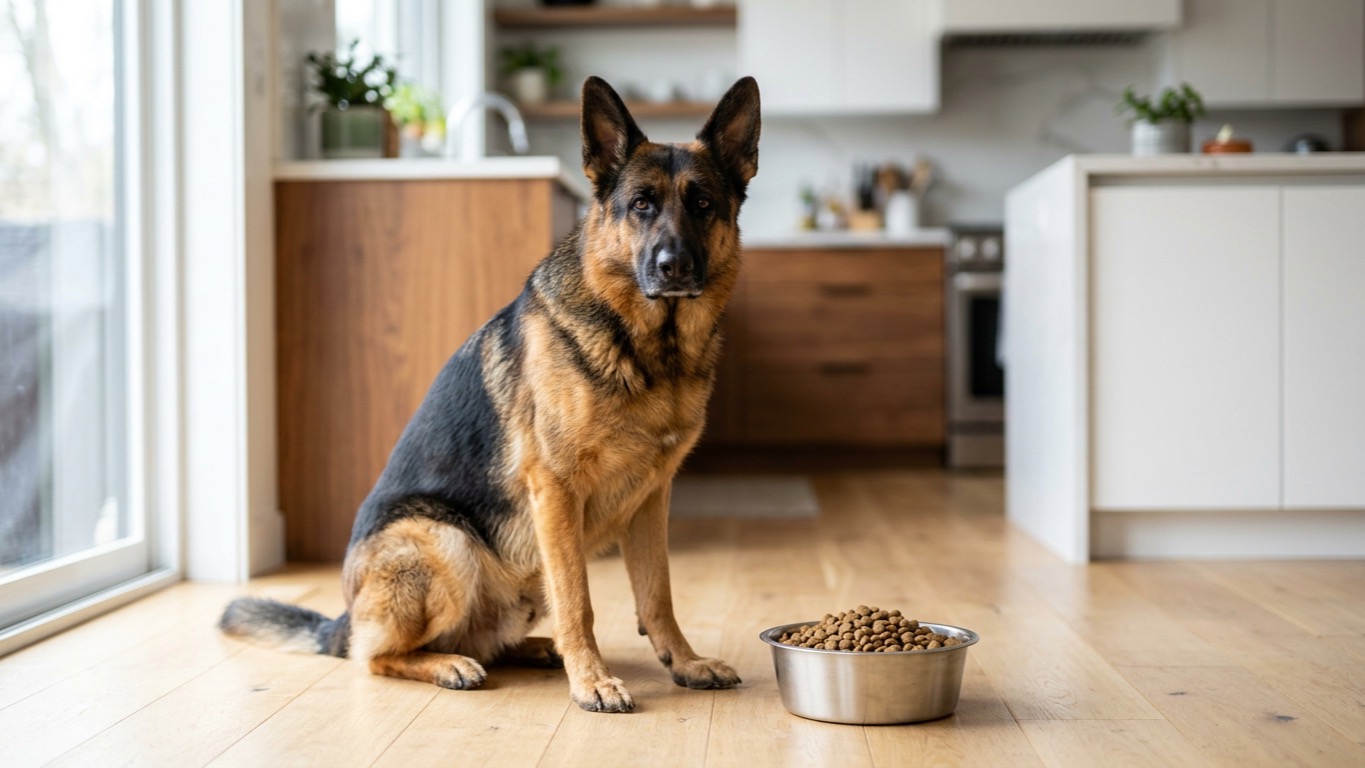
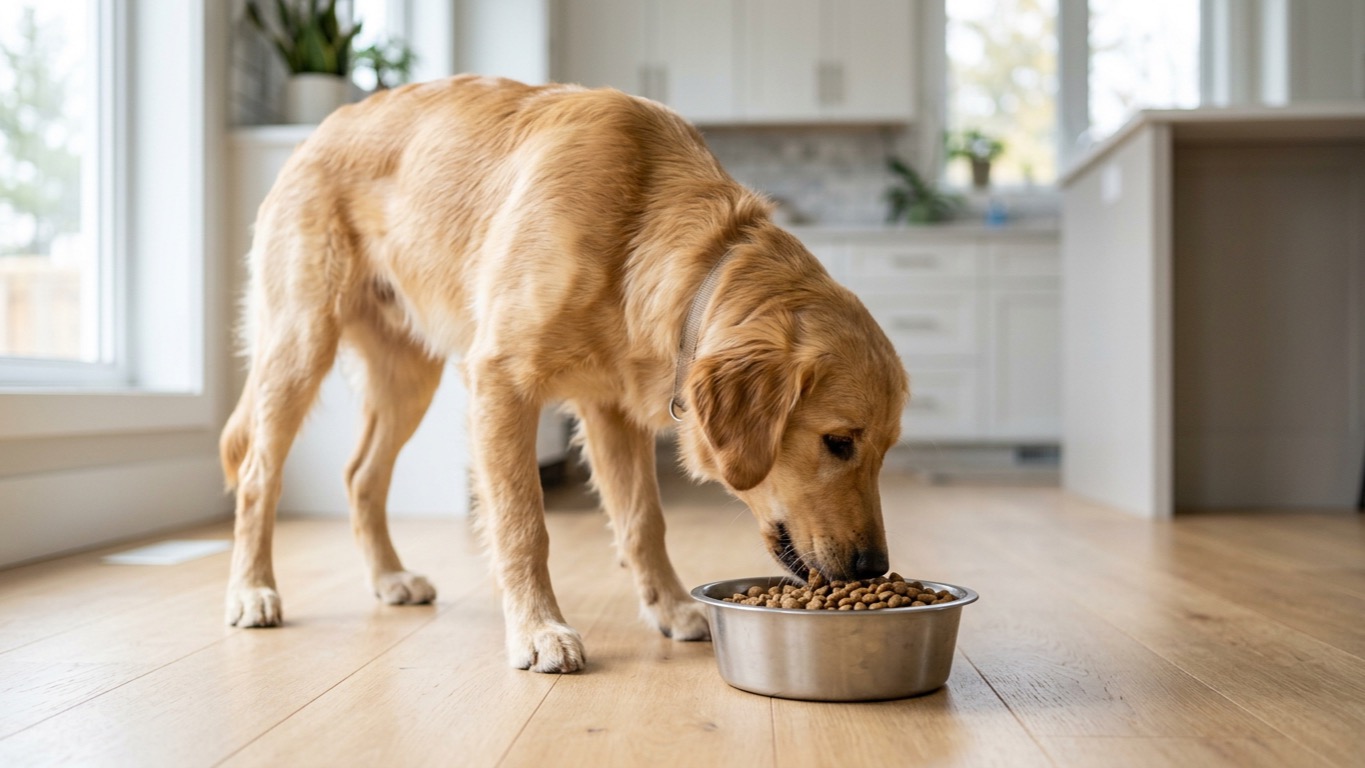
Quick answer: Switch when growth slows, not on a birthday. Small and medium dogs usually move to adult food between 8 and 12 months. Large and giant dogs often stay on a growth formula until 15 to 24 months.
Small breeds switch at 8–10 months, medium at 12 months, and large or giant breeds at 15–24 months.
This page is a research-desk guide to published switch windows and label rules.
Selection rule: a dry adult food had to publish a life-stage statement and a numeric guaranteed analysis. We left out treats, wet food, prescription diets, raw plans, and recipes that hid those facts.
The Size-Window Switch Rule
Our research team analyzed maker feeding windows, not calendar birthdays. The useful clock is expected adult weight.
Royal Canin’s U.S. transition page sets three growth-slowing windows. Small breeds slow around 8 to 10 months. Medium breeds slow around 12 months.
Large and giant breeds slow around 15 to 24 months. Those windows can be shown wrong. A healthy Great Dane on adult maintenance at 8 months would do that.
Royal Canin’s Medium Adult bag is more specific. It is written for dogs from 23 to 55 pounds. It is also written for dogs over 12 months old.
Royal Canin’s Large Adult bag is written for dogs from 56 to 100 pounds. It is also written for dogs over 15 months old.
Many households still switch large dogs too soon. A 2014 survey in the Journal of the American Veterinary Medical Association asked large- and giant-breed breeders about timing.
Of 1,124 breeders, 670 (59.6%) recommended adult food before 12 months. Of those same 1,124 breeders, 533 (47.4%) recommended the switch at 6 months or earlier.
That pattern sits far earlier than Royal Canin’s 15-to-24-month large-breed window. Early switches are common.
Mixed-breed dogs still use expected adult weight. Skip a guess at “medium.” If the adult target is unclear, stay on a growth formula until the outline stops changing.
The American Veterinary Medical Association says regular nutritional assessment belongs in preventive care. Use that visit to confirm the window.
What the bag’s life-stage line actually means
The Food and Drug Administration tells owners to read the nutritional adequacy statement. A “complete and balanced” line is the claim that matters. Treats and snacks often lack that line.
The FDA says a dog food may use that phrase only two ways. It must meet an Association of American Feed Control Officials nutrient profile. Or it must pass a feeding trial that uses AAFCO procedures.
AAFCO writes two dog profiles, not six. One is Growth and Reproduction. The other is Adult Maintenance.
The FDA notes those first dog profiles appeared in 1991. AAFCO last updated them in 2016.
AAFCO’s Dog Food Nutrient Profiles set crude protein at 22.5% of dry matter for growth and reproduction. They set 18.0% of dry matter for adult maintenance.
The same tables set crude fat at 8.5% of dry matter for growth. They set 5.5% of dry matter for adult maintenance.
Those figures assume 4,000 kilocalories of metabolizable energy per kilogram. Denser recipes must be corrected for energy.
The FDA also warns against comparing wet and dry labels as printed. Canned food is typically 75 to 78% moisture. Dry food is typically 10 to 12% moisture.
Convert both to dry matter before you compare protein. AAFCO’s consumer label guide says “complete” means every required nutrient is present. “Balanced” means the ratios are right.
A growth bag can still be a poor adult bag. An adult bag can still be a poor puppy bag. See can puppies eat adult dog food for that mismatch.
Why large-breed calcium makes early switches risky
Protein is not the only gap. Calcium is the sharper one for big puppies.
AAFCO’s growth profile sets calcium at 1.2% of dry matter as a minimum. The general calcium maximum is 2.5% of dry matter.
Formulas that may be fed to large-size puppies have a tighter ceiling. AAFCO defines those dogs as breeds that typically reach 70 pounds or more as lean adults.
For those growth formulas, the calcium maximum is 1.8% of dry matter. Phosphorus sits beside that range.
The growth minimum is 1.0% of dry matter. The adult minimum is 0.4% of dry matter. Both profiles cap phosphorus at 1.6% of dry matter.
The calcium-to-phosphorus ratio must stay between 1:1 and 2:1 on both profiles.
Hill’s Science Diet Adult Chicken & Barley Recipe publishes 0.8% calcium on a dry-matter basis. That figure is legal for adult maintenance. It is not a growth-profile number.
Royal Canin Large Adult lists calcium at 0.84% minimum as-fed. That bag is labeled for dogs over 15 months. It is formulated to meet AAFCO maintenance, not growth.
An early move onto those adult mineral levels can leave a growing giant short of the 1.2% growth minimum. That is the concrete risk.
Stay on a large-breed puppy formula until the published window closes. Then move to a maintenance bag with a matching size line.
How to run a seven-day bowl change
Royal Canin’s U.S. transition page asks for a gradual change over about one week. Hill’s Science Diet publishes the same 7-day mix-in period. That note sits on its Adult Chicken & Barley page.
Use measured cups, not a new scoop each day. Keep the total grams close to the old daily amount while the blend changes.
Days 1 and 2: feed about 75% puppy formula and 25% adult formula. Days 3 and 4: split the bowl in half.
Days 5 and 6: feed about 25% puppy formula and 75% adult formula. Day 7: feed the adult formula alone.
Watch stool quality more than enthusiasm. Loose stool means you hold the current mix for two extra days. Then you step forward again.
A skipped meal during a switch is a data point, not a crisis. If a healthy dog refuses food for more than a day, read how long can a dog go without food.
Then call your clinic. Do not add oils, leftover meat, or extra calcium during the week. Those extras change the ratios the bag was built to hold.
After the week, reset the portion to the adult bag’s chart. Royal Canin Large Adult lists 371 grams a day for a 70-pound dog at moderate activity. That is 3⅞ cups on that maker’s table.
Hill’s Adult Chicken & Barley Recipe lists 365 kilocalories per cup. Royal Canin Medium Adult lists 340 kilocalories per cup. The same cup count is not the same meal.
Adult formulas compared by published attributes
The table below is an attribute grid. It is not a ranking. Our research team compared published specs.
Hill’s publishes dry-matter nutrients. Royal Canin and Purina rows use as-fed guarantees.
Read those protein columns as two different yardsticks.
| Product | Published window | Protein | Fat | kcal per cup | Adequacy path |
|---|---|---|---|---|---|
| Hill’s Science Diet Adult Chicken & Barley Recipe | Adult dogs 1–6 years; not for puppies | 23.8% dry matter | 15% dry matter | 365 | Adult 1–6 years on the Hill’s page |
| Royal Canin Medium Adult Dry | 23–55 lb; over 12 months | 23.0% min. as-fed | 12.0% min. as-fed | 340 | Formulated to AAFCO maintenance |
| Royal Canin Large Adult Dry | 56–100 lb; over 15 months | 24.0% min. as-fed | 15.0% min. as-fed | 360 | Formulated to AAFCO maintenance |
| Purina Pro Plan Adult Complete Essentials Shredded Blend Chicken & Rice | Sold as an adult Complete Essentials formula | 26.0% min. as-fed | 16.0% min. as-fed | 387 | Purina published label analysis |
Convert the as-fed rows before you call one food “higher protein.” Royal Canin Medium Adult lists 10.5% moisture.
23.0% protein as-fed becomes about 25.7% on a dry-matter basis. Purina’s published label lists 12.0% moisture with 26.0% protein.
That converts to about 29.5% protein on a dry-matter basis. Both converted figures sit above AAFCO’s 18.0% adult minimum. They are not interchangeable with a growth-profile bag.
Hill’s Adult Chicken & Barley Recipe also lists 3,675 kilocalories per kilogram. Purina’s published label lists 4,038.
Pick the adult bag for size and life stage first. Then match calories to body condition.
A grain-free adult recipe is a later choice, not a timing rule. If that is the next decision, use our best grain-free dog food for adult dogs guide.
Hill’s states the Chicken & Barley adult recipe is not recommended for puppies. It is also not recommended for pregnant or nursing dogs. Those dogs stay on a growth-and-reproduction formula.
Royal Canin’s Large Adult page tells owners to move to its 5+ large formula at 5 years. That is a later life-stage step. It is not part of the puppy-to-adult switch.
Mixed breeds, all-life-stages bags, and when to wait
An “all life stages” bag is not a free pass to skip timing. AAFCO still ties that claim to the growth profile. The FDA notes adult foods often carry lower levels of some nutrients on purpose.
If a bag meets growth, including large-size growth, a late puppy can stay on it. If the bag is adult maintenance only, a growing giant should not.
Hill’s Adult Chicken & Barley Recipe is the clear maintenance example. Royal Canin Medium Adult and Large Adult are the size-dated examples.
Wait to switch when the dog is still lengthening or the ribs are disappearing under fat. Also wait if stool is already loose on the puppy food. Wait if the household just changed homes or schedules.
A pregnant or nursing dog is not an adult-maintenance case. She needs a growth-and-reproduction statement. The FDA uses a nursing dog with six pups as the example of a higher need.
Giant breeds can sit in puppy food until 24 months. Small breeds can look done at 8 months and still need a clean 7-day blend. Finish the window, then change the bowl.
FAQ
When should I switch my puppy to adult dog food?
Use expected adult size, not the first birthday. Royal Canin publishes 8 to 10 months for small breeds and 12 months for medium breeds. Large and giant breeds stay on growth food until 15 to 24 months.
Can I switch a large-breed puppy at 12 months?
A 12-month switch is early for many large and giant dogs. Royal Canin Large Adult is labeled for dogs over 15 months. AAFCO also tightens calcium to a 1.8% dry-matter maximum for large-size growth formulas.
What happens if I switch to adult food too early?
Adult maintenance allows lower protein, fat, and calcium than growth. AAFCO’s adult protein floor is 18.0% of dry matter. Its growth floor is 22.5%.
Large-breed puppies also lose the 1.2% calcium growth minimum when they move too soon. The common result is a still-growing dog on a finished-adult mineral plan.
Can a puppy eat adult dog food for a few days?
A few mixed meals are not the same as a full switch. Adult maintenance is not built for growth. If the puppy bag runs out, use another growth-and-reproduction formula.
See can puppies eat adult dog food for the label test.
How long should the food transition take?
Royal Canin and Hill’s both publish about a 7-day blend. Start at 25% new food and finish at 100% new food. Hold a step for two days if stool loosens.
Do I need to switch if the current bag says all life stages?
Only if you want an adult-maintenance nutrient set. An all-life-stages claim is tied to AAFCO’s growth profile. Some late puppies can stay on that bag.
A true adult-maintenance bag is still the cleaner match after growth ends.
Should mixed-breed dogs follow age or weight?
Follow expected adult weight. A 20-pound adult is a small-to-medium window. A 70-pound adult is a large-size window.
If the adult weight is unknown, wait until the body outline stops changing. Then run the 7-day blend.
Schema markup for this page
Attach Article, FAQPage, and HowTo JSON-LD in the page head. Do not add a Review type or a ranked ItemList. Map mainEntityOfPage to this article URL and copy FAQ names from the headings above.