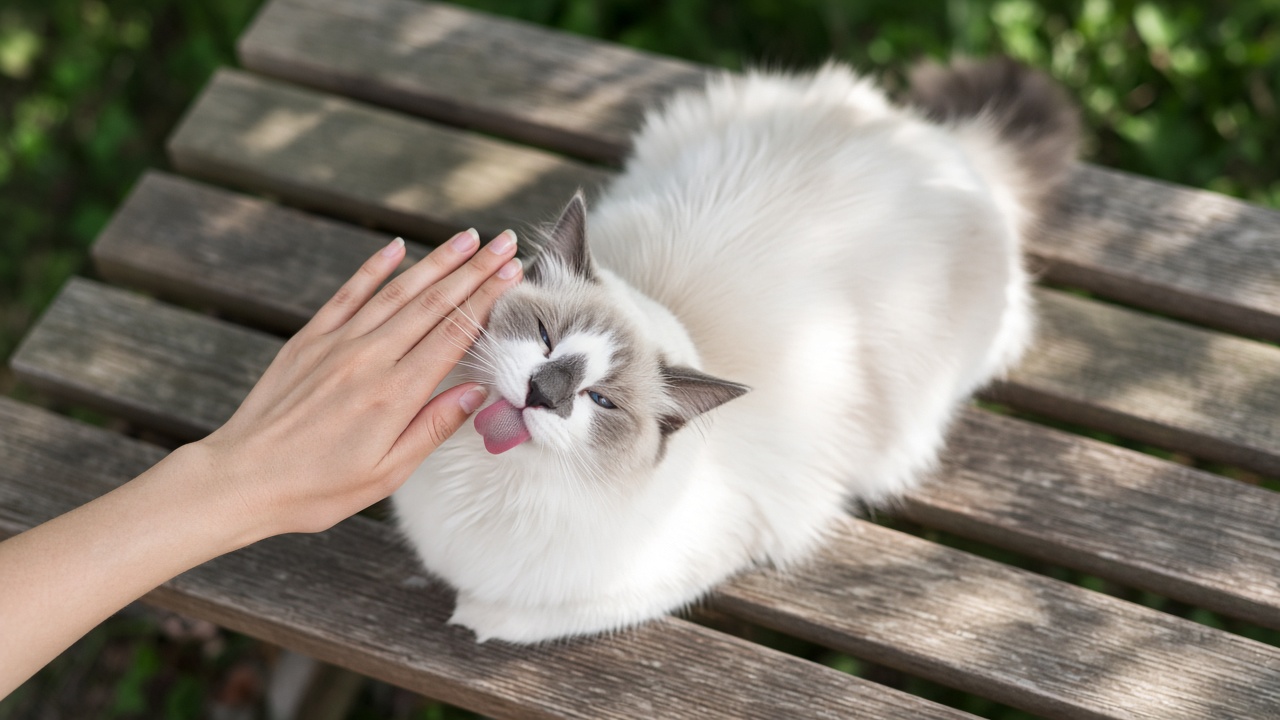
Quick answer: A relaxed cat that licks you is usually grooming you as family. Read the rest of the body, not just the tongue. See a clinic if licking turns frantic, breaks skin, or comes with bald patches.
Cats lick people as social grooming, scent mixing, or a learned attention bid, not as a single secret code. This page is a research-desk brief on published feline-behavior papers and current maker specs. We did not house cats, run an owner poll, or sit in on clinic exams.
What this desk included, and what it left out
We used one selection rule for every reason and every product on this page.
The Checkable-Number Rule. A reason or product enters only if a named organization or maker page supplies a checkable number. A defined clinical pattern also qualifies.
We left out folklore meanings with no published pattern. We also left out “calming” sprays and toys whose maker pages list no duration, size, or nutrient figure.
Our research team analyzed five currently sold products that change licking context. Only two publish both a duration and a coverage or fit number.
Ceva’s FELIWAY Classic Diffuser Kit lists 30 days and 700 square feet. Sergeant’s Pet Care Products lists a 30-day SENTRY Calming Collar for Cats. That collar fits necks up to 15 inches.
That pairing is a spec comparison, not a ranking.
Seven reasons a cat licks you
Licking is ordinary cat work. The Cornell Feline Health Center says cats typically spend 30 to 50 percent of their day grooming themselves.
A tongue on your skin often uses the same motor pattern. The meaning sits in timing, pressure, and the rest of the body.
1. Social grooming
Cats groom cats they accept. That social licking is called allogrooming.
When your cat licks your hand after a nap, it is often extending that family job to you. The session stays slow. The ears stay soft.
The cat can be interrupted. This is the usual first reading for casual, repeatable licking.
2. Scent mixing
Cats build a shared household odor with saliva and facial glands. A lick can add your scent to that mix.
The same cat may also rub its cheeks on you. The lick is one more stamp, not a claim of legal ownership.
If the licking clusters after you return from outdoors, scent checking is a fair first read.
3. A learned bid for attention
Many cats learn that a wet swipe gets talk, laps, or treats. The lick becomes a button.
Watch what you do in the next five seconds. If you always answer, you are teaching a loop.
Redirect with a toy or a scheduled treat. Do not shout. Do not shove the face away.
4. Self-soothing during stress
Cornell notes that licking can be a displacement behavior when a routine breaks. A move, a new pet, or a schedule change can start it.
The same page says a few minutes of daily play, ten to 15 minutes, can help lower that load. The licking may still linger as a habit.
Cornell quotes William Miller saying the behavior is usually forgotten in about a month once the cause is handled.
5. Taste and curiosity
Skin salt, lotion, and food residue all invite a sample lick. This bout is short. It often starts at fingers or hair.
Stop using scented hand cream before cuddle time if the licking tracks the product. Wash snack residue off your hands.
The U.S. Food and Drug Administration lists xylitol among items that can harm pets. Some human toothpastes and mouthwashes contain it.
Do not let a cat finish a blob of people toothpaste.
6. A leftover nursing pattern
Some cats lick while they knead and purr. That cluster can echo kitten nursing.
It is still social. It is not a request for milk. Offer a soft blanket if the claws on your lap are the real problem.
7. Pain, itch, nausea, or oral discomfort
A sudden jump in licking is not a new love language. It can flag itch, mouth pain, or stomach upset.
The Journal of the American Veterinary Medical Association published a 2006 case series. It covered 21 cats sent in for presumed psychogenic alopecia.
Medical causes of itch showed up in 16 of those cats, or 76 percent. Only 2 of the 21 cats, or 10 percent, had a purely behavioral hair-loss diagnosis.
An adverse food reaction was found in 12 cats, or 57 percent.
That paper does not measure friendly lapside licking. It does show how often “just stress” is the wrong first label when licking goes excessive.
How to read the licking, not just the tongue
Match the tongue to the rest of the cat.
Social licking arrives with loose muscle and slow blinks. The tail stays still or softly wraps. The cat stops when you stand up.
Problem licking looks busy. The cat returns to the same patch. Hair breaks.
Your skin reddens. The cat ignores a toy.
A lick-then-bite can be overstimulation, not betrayal. End the session at the first tail twitch.
Keep a two-day log if you are unsure. Note time, body part, and what happened just before. Bring that log to the clinic if the pattern worsens.
When licking is a skin or food problem
Excessive self-licking that leaves bald skin is a different problem than a polite wrist lick.
The JAVMA series required hair loss for at least six months before enrollment. Most of those cats had been balding for 13 months or longer.
Food trials mattered in that group. If your cat licks you and also chews its belly, diet is on the table.
Use the cat feeding chart by weight to check portion math before you add extra snacks.
The Association of American Feed Control Officials publishes cat-food nutrient profiles. Adult maintenance sits at 26.0 percent crude protein, dry matter.
Growth and reproduction sit at 30.0 percent.
AAFCO also sets taurine minimums at 0.10 percent for extruded cat food, dry matter. Canned food sits at 0.20 percent.
A treat is not a complete diet.
The FDA states that acetaminophen is fatal to cats. Do not offer people pain pills because a licking cat “seems sore.”
Hunger licking and the treat loop
Some cats lick your hand on the way to the kitchen. That is a meal cue, not romance.
Answer with the next scheduled feeding, not a random leftover. Random scraps teach more licking.
If you want a lick that stays on a treat, use a listed lickable puree. INABA’s Churu Chicken with Salmon Recipe lists 91.00 percent maximum moisture.
The same recipe lists 6 kcal per 0.5-ounce tube.
INABA also lists 430 kcal per kilogram and a four-tube pack at 2.0 ounces. The same page says the product is a treat, not a meal.
That calorie count is useful because four tubes are 24 kcal. That is still a snack, not dinner.
Products that change the licking context
We did not rank these products. We compared attributes the makers publish.
Use this table when the licking context is stress, worn pheromone, pressure, a food lick, or home dental care. Skip it when the cat only wants a lap.
| Product | Format and listed size | Duration or fit the maker publishes | Listed mechanism | Context it is built for |
|---|---|---|---|---|
| FELIWAY Classic Diffuser Kit | Plug-in diffuser plus 48 mL vial | Up to 30 days in 700 square feet; 4 ft of clear space above the outlet; replace the head every 6 months | Synthetic F3 facial pheromone analog | Indoor stress signs, including excessive grooming listed on Ceva’s page |
| SENTRY Calming Collar for Cats | Adjustable collar | Up to 30 days; fits a neck up to 15 inches; leave about 1/4 inch of slack | Pheromone 0.02 percent, inert ingredients 99.98 percent | Worn, all-day support for meowing, marking, and scratching |
| ThunderShirt for Cats | Machine-washable pressure wrap | Small under 9 lb; medium 9 to 13 lb; large over 13 lb | Constant gentle torso pressure | Short, situational stress such as travel or nail trims |
| INABA Churu Chicken with Salmon Recipe | Lickable puree tubes | 0.5 oz per tube; 6 kcal per tube; 91 percent moisture | High-moisture meat puree | Hand-fed treat or food topper, not a complete diet |
| Virbac C.E.T. Enzymatic Toothpaste | Swallow-safe paste in 5 flavors | Dual-enzyme system of glucose oxidase and lactoperoxidase; no foaming agents | Enzymatic plaque control | Home brushing when a cat licks faces or has breath change |
Ceva says many households see a change within the first seven days. The same page asks for at least one month of use.
Keep the unit on 24 hours a day, per that page.
ThunderWorks lists three weight bands on its ThunderShirt for Cats page. It also claims the wrap is over 80 percent effective.
That figure is the maker’s claim, not a result from our desk.
For a wider look at worn calming gear, see our guide to cat calming collars. Pair a collar with a room diffuser only if both maker pages allow shared use.
If the licking clusters around the mouth, switch to a cat paste. Virbac’s enzymatic toothpaste page lists five flavors and a dual-enzyme system designed to be swallowed.
Human paste is the wrong stand-in. The FDA names xylitol in some toothpastes as a pet hazard.
For kit options, use our guide to cat toothbrush and toothpaste kits.
How to redirect licking you do not want
Decide first whether the licking is social or strained.
For social licking you dislike, stand up and end contact. Offer a brush or a toy two seconds later. Repeat the same exit every time.
For attention licking, move rewards to a schedule. A lick should not unlock dinner.
For stress licking, restore one predictable block. Cornell’s ten to 15 minutes of play is a concrete start. Keep litter, food, and rest spots stable.
For skin or mouth licking, stop guessing. Book the clinic and bring your two-day log.
Do not punish. Punishment adds stress and can raise displacement licking.
FAQ
Why does my cat lick me and then bite?
The lick often runs past the cat’s petting limit. Watch for a hard tail, skin ripples, or ears that slide back. End the session at the first sign, not after the bite.
Why does my cat lick my hair and not my hands?
Hair holds shampoo, sweat, and outdoor smells. Curiosity licking often starts there. If the bouts stay short and the cat is otherwise well, scent checking is the simple read.
Is it unsafe to let a cat lick my skin?
A healthy cat’s lick is usually a hygiene issue for you, not a crisis. Wash the spot if you have a cut. Call a clinician if your skin breaks or the licking becomes constant.
Why does my cat lick only one person in the house?
Allogrooming is selective. Cats pick preferred partners. The chosen person is often the one who feeds, plays, or sits still the longest.
Can licking mean my cat is in pain?
Yes, when the pattern changes fast or targets one body area. The JAVMA series found medical itch in 76 percent of cats labeled as “psychogenic” hair loss. Friendly wrist licking is a weaker signal than bald patches.
How do I stop the licking without scolding?
Stand up, pause contact, then offer a toy or a listed treat. Keep the same exit each time. Scolding can raise the stress that feeds displacement licking.
Do lickable treats make a cat lick people more?
They can, if every hand lick earns a tube. INABA lists Churu as a treat at 6 kcal per tube. Use it on a schedule, not as a jackpot for licking skin.