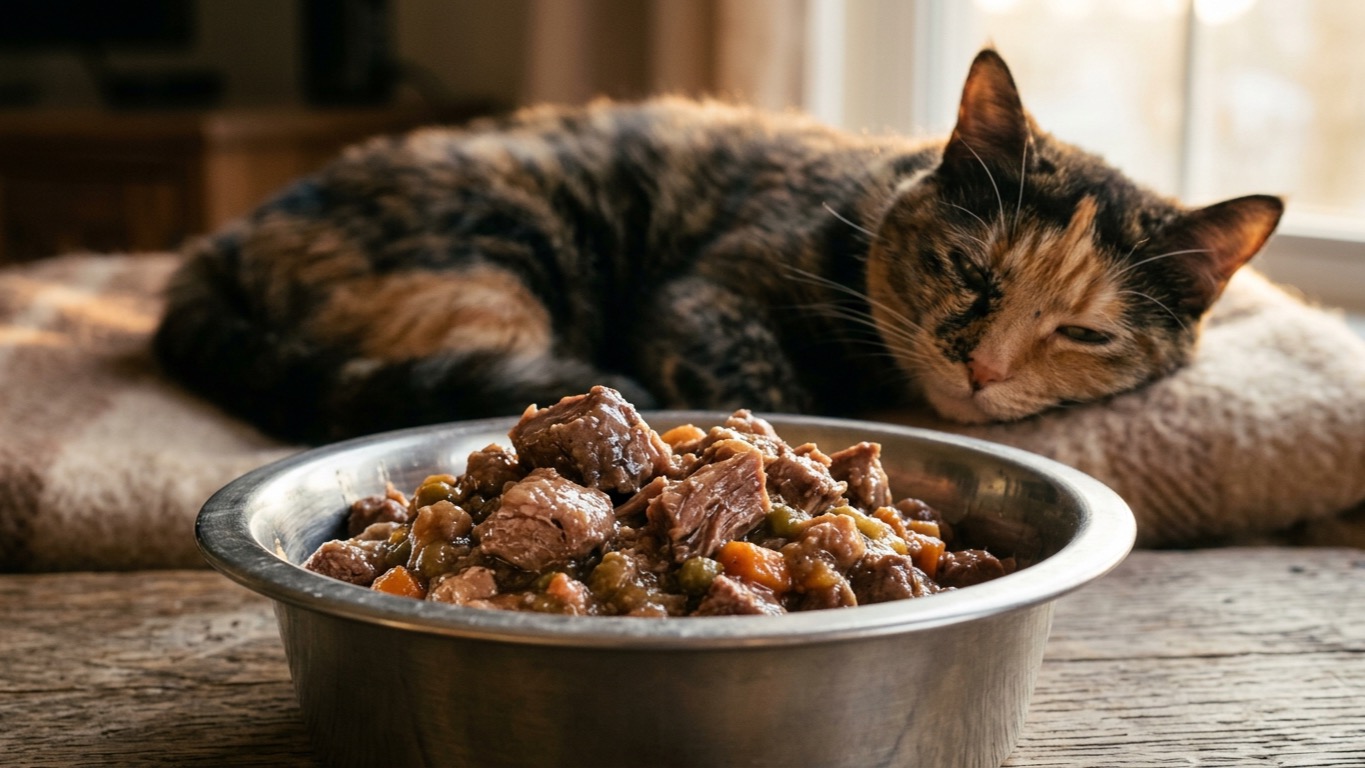
Quick answer: Pull uneaten wet food within one to two hours. Use the shorter time in a warm room. Cover unused food still in the can and refrigerate it at once.
Do not leave wet cat food out more than 2 hours, or 1 hour if the room is above 90°F. This page is a research brief that compares published sit-out times.
Selection rule: We included only wet-food bowl times, leftover-can steps, and fridge windows that appear on FDA, USDA FSIS, or a named maker page. We left out raw-diet schedules, overnight free-feeding plans, and any brand whose own site did not publish a bowl-time number.
Use the Three-Clock Rule, not one guess
The useful split is three clocks: the bowl, the opened can, and the fridge.
Our research team analyzed published handling notes from FDA, USDA FSIS, Wellness, and Hill’s. Those pages do not share one sit-out number, but they do share one pattern.
Food in the bowl is the shortest clock, and unused food still in the can is a storage clock. Covered food in a cold fridge is the longest clock. Treat those clocks as separate, and do not mix a bowl leftover with unused food from the can.
- Bowl clock: served wet food sitting in the dish
- Can clock: unused food still in the opened can or pouch
- Fridge clock: covered leftover food held at a stated fridge temperature
A covered bowl on the counter still counts as unrefrigerated food under the USDA FSIS time limits.
What USDA and FDA publish
USDA FSIS publishes a hard time limit for perishable food left out of the fridge.
USDA FSIS’s page on how temperatures affect food names the “Danger Zone” as 40°F to 140°F. In that range, bacteria can double in as little as 20 minutes.
The same page says never leave food out of refrigeration over 2 hours. If the temperature is above 90°F, the limit drops to 1 hour.
That 2-hour and 1-hour pair is the household ceiling we use in the opener. It is a perishable-food rule, and wet cat food is high-moisture food.
AAFCO’s page on reading labels requires a maximum moisture guarantee on pet food. That moisture line is why wet food spoils faster than dry food.
FDA does not publish a one-hour or two-hour bowl timer for cats. FDA’s storage page gives actions, not a stopwatch.
- Promptly refrigerate or throw out unused or leftover canned and pouched pet food.
- Set the refrigerator to 40°F or below.
- Store dry food and unopened canned food below 80°F.
- Wash and dry pet food bowls after each use.
FDA’s storage page also quotes Lauren Carey, a veterinarian and pet food expert at FDA. She says the lot number, best-by date, and full product name matter when you report a problem. The same page says less than half of FDA pet-food complaints include the lot number.
USDA FSIS also says leftovers should go into shallow containers and into the fridge within 2 hours. Reheating later does not fix food that sat out too long, because some bacterial toxins are heat resistant.
What three maker pages actually say
Maker pages are stricter, or looser, than the USDA 2-hour ceiling. Compare the published numbers, and do not average them.
| Maker page | Bowl time they publish | Fridge time they publish |
|---|---|---|
| storage guide | Toss wet food left in the bowl more than 1 hour | Use sealed, refrigerated wet food within 3 days |
| Wellness FAQ | Leave wet food out no longer than around 1 hour | Covered canned food up to 3–4 days |
| Hill’s storage page | Empty moist food within 4 hours if the room is above 50°F | Opened cans at 40–45°F for 5–7 days |
Purina’s storage page, updated June 5, 2025, also says unused food left in the can should be covered and refrigerated right away. After 3 days, leftover canned food should go to the trash, not back in the bowl.
Wellness’s FAQ says the 1-hour bowl time can shrink with heat, humidity, or sunlight. The same FAQ says unopened Wellness canned food has a 3-year expiration from the date of manufacture.
That long canned date applies only before opening. Once the seal is broken, the fridge window on that FAQ is 3 to 4 days.
Hill’s storage page, dated October 1, 2015, is the outlier on bowl time. It allows 4 hours above 50°F for Science Diet and Prescription Diet moist food.
The same Hill’s page says unopened cans should be stored between 50°F and 100°F. Use the maker’s own number for the food in your cupboard.
If that page is silent, use the USDA 2-hour ceiling. In a room above 90°F, use 1 hour.
Heat shortens the clock
A warm kitchen cuts the safe window, and USDA FSIS is plain on this point.
If the air is above 90°F, USDA FSIS says food should not sit out more than 1 hour. Wellness’s FAQ also says heat, humidity, and sunlight can shorten its around-1-hour bowl time.
Direct sun on a porch bowl is a heat problem, not a shade debate. Hill’s 4-hour note still depends on room temperature.
It applies only when the ambient temperature is above 50°F. It is not a license to leave food out on a hot day.
Use this heat list as a check, not a ranking:
- At or below a normal indoor room: follow the maker’s bowl time, and do not pass 2 hours
- Above 90°F: discard after 1 hour, per USDA FSIS
- In sun or next to an oven: treat the bowl as a hot-room case
Unopened cans are not a free pass in heat either. FDA’s storage page says store unopened canned food below 80°F.
Purina’s storage page uses the same 80°F cap for unopened wet food. Hill’s canned range is 50°F to 100°F.
When those numbers conflict, the colder storage target is the safer published floor.
Opened cans belong in the fridge
Unused wet food still in the can is not the same as food already in the bowl.
FDA says to refrigerate leftover canned and pouched food promptly, and to keep the fridge at 40°F or below. USDA FSIS also says a fridge should hold 40°F.
The FDA notes opened cans should be stored at 40–45 °F, and our editorial team observes manufacturers recommend covering them.
Fridge windows from the maker pages we compared:
: 3 days, then trash
- Wellness: up to 3–4 days if well covered
- Hill’s: 5–7 days, then throw out
Do not reset food that already sat in the bowl past the bowl clock. USDA FSIS says food left out too long should be thrown out.
Cold storage slows growth. It does not erase time already spent in the Danger Zone.
Keep unused can food separate from bowl scraps.
- Scoop the serving first.
- Cover the rest of the can at once.
- Refrigerate that unused portion.
- Discard what the cat left in the dish after the bowl clock ends.
The clean split is unused can food versus served bowl food.
AAFCO’s Cat Food Nutrient Profiles list 44 nutrient specifications, and those specs do not give a sit-out time. They do explain why you still read the label.
The guaranteed analysis must show maximum moisture. That moisture is the spoilage risk you are managing.
When the bowl should go in the trash
If you do not know how long the food sat out, throw it away.
FDA’s storage page lists problems that mean you stop and report. Those signs include a foul odor, a swollen or leaking can or pouch, or a foreign object in the product.
If the cat becomes sick after a meal, FDA says to stop feeding that product and call your veterinarian. USDA FSIS describes spoilage in the fridge as an off odor, off color, sticky or slimy texture, or visible mold.
Those signs mean trash, even if the calendar day still looks fine. Clean-up is part of the time limit.
- Wash and dry the bowl after each use, per FDA.
- Wash scooping tools after each use, and use them only for pet food.
- USDA FSIS says wash hands with warm water and soap for at least 20 seconds.
A dirty bowl starts the next meal with leftover film. That film is not a new serving, and it is yesterday’s clock.
Grazing cats still have a bowl clock
Slow eating does not pause the sit-out clock.
Older cats and cats on kidney-care diets often nibble, but that habit does not change USDA’s 2-hour ceiling or a maker’s 1-hour bowl time. Serve a smaller scoop, and see our notes on wet food for senior kidney health for portion context.
The leftover still follows the bowl clock. If you cannot stand by the dish, split the can.
A wet-food automatic feeder can drop small servings instead of leaving a full can on the floor. The feeder does not make room-temperature food last all day.
It only keeps unused food sealed until the next drop. Some cats take a few bites, then stop to groom.
Long-haired cats often leave the bowl while they work on their coat. A grooming glove for long-haired cats can shorten that pause, but the food clock still runs while they are gone.
Purina’s storage page says opened wet food will dry out in several hours. Dry, crusted food is a quality loss even before you hit a safety limit.
Wellness’s FAQ says to feed wet food at room temperature. Cold fridge food can sit in the dish while it warms, and that warm-up time counts as bowl time.
FAQ
Can wet cat food sit out overnight?
No, overnight is many hours past every published bowl time we compared. USDA FSIS says to discard perishable food left out more than 2 hours, or 1 hour above 90°F. and Wellness publish bowl limits near 1 hour, and Hill’s longest published bowl window is 4 hours above 50°F.
Can I refrigerate wet food my cat already started?
Refrigerate unused food that never left the can, and cover it at once as the maker pages describe. Food that already sat in the bowl follows the bowl clock, and you should discard it if that clock has run out.
Does covering the bowl make wet food last longer on the counter?
No, a lid does not pull food out of USDA FSIS’s Danger Zone of 40°F to 140°F. A cover can slow drying, but it does not move the food onto the fridge clock. Only a covered container in a fridge set to the stated temperature does that.
How long does opened wet cat food last in the fridge?
Follow the maker page for that brand, because the published windows are not the same. Purina’s storage guide says 3 days, and Wellness’s FAQ says up to 3–4 days if the food is well covered. Hill’s storage page says 5–7 days at 40–45°F, and FDA says keep the fridge at 40°F or below.
What if my house is hotter than 90°F?
Use the 1-hour USDA FSIS limit, because Wellness’s FAQ also says heat can shorten its around-1-hour bowl time. Do not apply Hill’s 4-hour note to a hot room. That Hill’s figure is tied to ambient temperatures above 50°F, not to a 90°F kitchen.
Is pouch food different from canned food for sit-out time?
FDA groups canned and pouched pet food together, and it says to refrigerate or throw out unused leftover canned and pouched food promptly. Use the same bowl clock for a served pouch that you use for a served can.
Can I leave mixed wet food and kibble out all day?
No, the wet food sets the clock. USDA FSIS’s 2-hour and 1-hour limits apply to perishable food left out. Purina’s storage page says toss wet food left in the bowl more than 1 hour, so added kibble does not change that toss time.