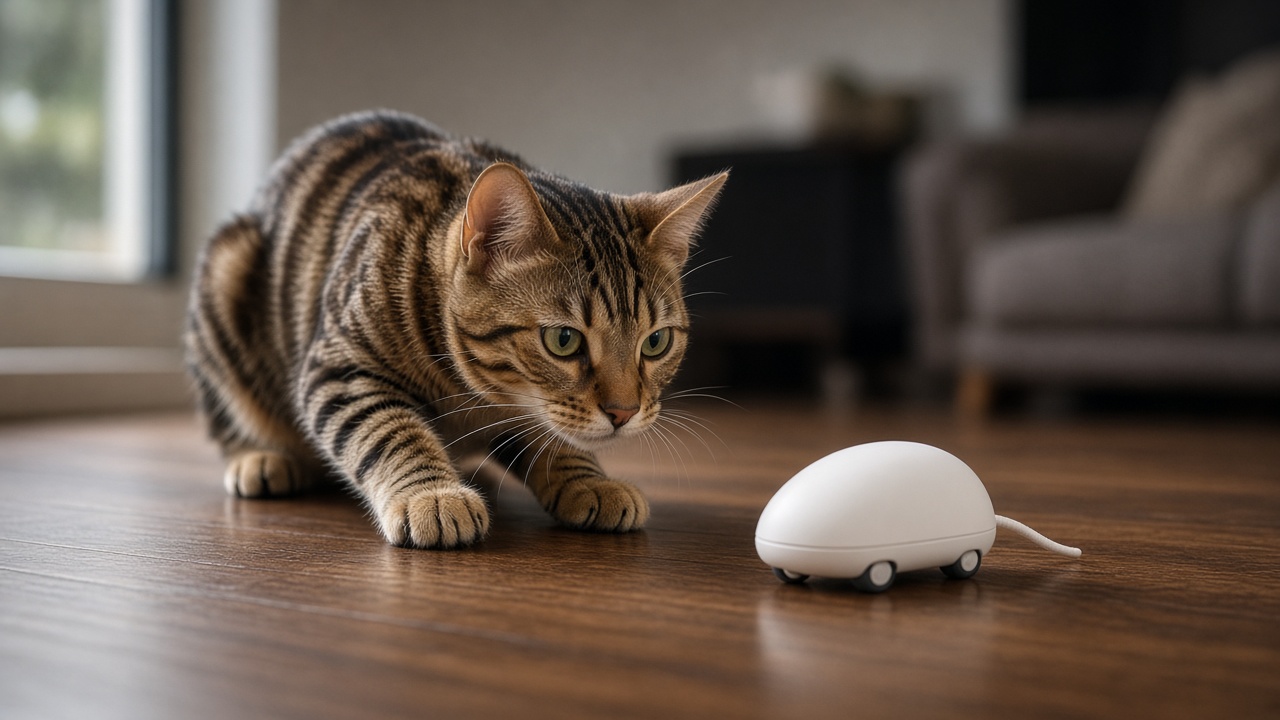
Quick answer: Start with a USB-C mouse that lists a 10-minute run and a 30-minute rest. Cheerble’s Wicked Mouse Neo publishes that cycle plus a 200 mAh cell. Use a smart ball for bounce play, or a timed laser for wall chase.
A USB-C mouse that lists 10 minutes on and 30 minutes off is the automatic cat toy to start with.
This page is a desk comparison of maker-listed cycles, cells, and sizes.
The American Veterinary Medical Association published 2025 cat counts in its Pet Ownership and Demographics Sourcebook. It lists 76.3 million owned cats in the United States. Those cats live in 32.6 percent of households, or 43.1 million homes, at 1.8 cats per cat household.
The 10/30 Cycle Rule
Our research team analyzed published specs. We used one rule for what entered this article.
A model is in only if the maker’s own 2026 product page still sells it. That page must also list either a timed play-and-rest cycle or contact-triggered motion. The toy must move without a person holding a wand.
We left out unpowered ball tracks. We left out feather wands. We left out dog-only balls and treat puzzles.
We also left out any maker SKU marked out of stock on the brand site. HEXBUG’s Mouse listing was out of stock, so it is not in the table.
That rule is the 10/30 Cycle Rule. Four of the five units below publish a short run, then a pause. The fifth is a vibration bug that runs when you switch it on.
Automatic toys cover solo chase. They do not replace a person-led hunt. For wand and prey play you still hold, see our guide to interactive cat toys for indoor cats.
Top 7 Automatic cat toy
The picks below are the 7 automatic cat toys on sale right now, listed with what each suits best and an honest drawback. Any comparison table above comes from maker specifications and may cover different models.
1. BABORUI Interactive Cat Toy Ball
Best for: Open-floor budget ball chasers
This automatic cat toy is a small rolling ball at a sub-$10 price. Maker pages frame it as rechargeable chase play, and owners say cats will sprint after it on a clear floor. The same reports say it slides under sofas and cabinets, which is the usual limit of a motorized ball.
Pros: Sub-ten-dollar rolling ball; Rechargeable chase-style play Cons: Slides under furniture easily
2. Potaroma Cat Toys Chargeable
Best for: Hide-and-seek butterfly hunters
Potaroma’s chargeable model is a stationary pad, not a our research. Published listings pair a feather that ducks under a cover with a butterfly on top. Owners who want one automatic cat toy with two lures like that mix; a cat that ignores feathers may still walk away.
Pros: Two lures on one pad; Rechargeable hide-and-seek base Cons: Needs dedicated floor space
3. AQPU Rechargeable Automatic Cat Toy
Best for: Cheapest touch-activated starter
AQPU is the lowest price on this automatic cat toy list. The listing describes a rechargeable mat that wakes on a touch and pops a concealed feather. Owners treat it as a first solo-play buy, not a brand with a long public track record.
Pros: Lowest price here; Touch-activated feather mat Cons: Thin public track record
4. Qraxond Interactive Cat Toys for Indoor Cats
Best for: Dual-lure bored indoor adults
Qraxond costs near the top of this indoor list. Maker copy highlights dual motors: a rotating butterfly and a tail that hides under a cover. Owners pay extra for that two-lure hide-and-seek loop versus a single-feather mat.
Pros: Butterfly and hiding tail; Rechargeable touch-activated play Cons: Costs more than peers
5. YVE LIFE Interactive Cat Toys Laser for Indoor Cats
Best for: Hands-off laser-dot chasers
This pick is a laser, not a feather or ball. YVE LIFE’s page describes a motion-activated, rechargeable pointer with a random path, and owners like the hands-off chase. The honest limit is that the cat never gets a real catch.
Pros: Hands-off laser movement; Motion-activated rechargeable pointer Cons: No catchable prey object
6. Oxawo Interactive Cat Toys Indoor Cats Toy Automatic Moving Feather
Best for: Feather-wand pounce cats
Oxawo’s title is the brief: an automatic moving feather for indoor cats. Listings in this line hide a wand under a mat and start again on a paw tap. Owners say the hunt looks right until the feather shreds, which is expected at this mid price.
Pros: Automatic moving feather; Mid-list feather-toy price Cons: Feathers wear out quickly
7. Interactive Cat Toys for Indoor Cats
Best for: One higher-priced indoor unit
Amazon titles this only as interactive cat toys for indoor cats, and it is the highest price on the list. In a motion-activated, rechargeable roundup, that usually means a self-play unit with more plastic than a $10 ball. Owners should read the live card before buying, because the title does not name the lure.
Pros: Highest-priced indoor option; Automatic self-play format Cons: Generic title, unclear lure
Comparison: Automatic cat toy at a Glance
Want to browse every option? See the full range of automatic cat toy on Amazon →
Specs the makers actually list
The table below is an attribute sheet. It is not a ranking. There is no price column.
Our research team compared five current maker pages. We copied run times, cells, and sizes as printed.
| Model | Power listed | Run / rest listed | Wake method | Size or weight listed | Maker note |
|---|---|---|---|---|---|
| Cheerble Wicked Mouse Neo (CWJ03) | USB-C, 200 mAh | 10 min play, 30 min rest | Touch; obstacle avoid | 60 g; 2.6 × 2.1 × 1.5 in without tail | Beep if stuck over 2 min; 52–55 min charge |
| Cheerble Wicked Mouse PLUS (CWJ01) | USB-C, 3.7 V 200 mAh | 10 min play every 40 min | Touch to flee | 44 g; 65 × 54 × 39 mm without tail | Beep if stuck over 10 min |
| Cheerble Wicked Ball M3 (CWQ02) | USB-C, 200 mAh, 5 V 1 A | 10 min play, 30 min rest | Tap or shake | 60 g; 47 mm diameter | 3.5 h nonstop; 14 h with cycles |
| PetSafe Bolt Automatic Laser Light | 4 AA, not included | 15 min auto-off | Timer; optional handheld | 3.0 × 3.0 × 10.0 in | Certified Class 3 laser |
| HEXBUG nano Robotic Cat Toy | 1 AG13/LR44, included | Runs while switched on | On/off vibration | Hard-surface use only | Button cell; HEXBUG warns of burns in as little as 2 hours if swallowed |
Across the three Cheerble cat SKUs we opened, every listed pack is 200 mAh. Listed body weights are only 44 g or 60 g.
Cheerble’s product page lists Wicked Mouse Neo at $29.99. HEXBUG’s product page lists the nano Robotic Cat Toy at $9.99.
Those are sticker figures on the brand sites. Live checkout prices can differ.
Rechargeable mice and smart balls
Cheerble’s Wicked Mouse Neo is the USB-C mouse we open first for a printed 10/30 cycle. Cheerble lists a 200 mAh cell and a 52–55 minute Type-C charge.
Cheerble also lists two speeds, Normal and Gentle. A hold of 3 seconds powers the unit. One short press flips the speed.
Cheerble says the Neo beeps if it stays stuck for more than 2 minutes. That alert is the shortest stuck timer in this set.
Cheerble’s Wicked Mouse PLUS uses the same 200 mAh class. Cheerble says the pack is 48 percent larger than the first generation.
The PLUS is the lighter mouse. Cheerble lists 44 g against the Neo’s 60 g.
Cheerble writes “10-minute engaging play every 40 minutes” for the PLUS. That is a 10-minute run inside a 40-minute clock. The rest window is the remaining 30 minutes.
Cheerble says the PLUS beeps if it stays stuck for more than 10 minutes. That is five times slower than the Neo’s 2-minute alert.
Cheerble’s Wicked Ball M3 is the bounce option. Cheerble lists a 47 mm shell and a 60 g body. Cheerble also lists a 200 mAh cell on a 5 V 1 A input.
Cheerble names three modes: Hybrid, Bounce, and Roll. Cheerble says you tap or shake it, then wait 5 seconds before motion starts.
After 10 minutes, Cheerble says the M3 rests 30 minutes. A nudge wakes it.
Cheerble also prints 3.5 hours of nonstop play. With the play-rest cycle, Cheerble prints up to 14 hours on one charge.
That 14-hour figure is clock time with naps, not 14 hours of continuous rolling.
Timer lasers and vibration bugs
PetSafe’s Bolt Automatic Laser Light is the timer laser in this set. PetSafe lists a 15-minute automatic session and a handheld manual mode.
PetSafe lists 4 AA batteries, not included. PetSafe lists the body at 3.0 × 3.0 × 10.0 inches.
PetSafe calls the emitter a certified Class 3 laser. PetSafe says an adjustable mirror aims the dot across floors or walls.
A laser has no body to catch. If you use Bolt, end the hunt with a toy the cat can hold.
HEXBUG’s nano Robotic Cat Toy is the vibration bug. HEXBUG says it uses vibration to scamper and can right itself from its back.
HEXBUG says it works only on hard surfaces. HEXBUG lists one AG13/LR44 button cell, included.
HEXBUG’s product page prints a swallow warning. It says a button cell can burn internally in as little as two hours.
Store spare cells away from children. Pull the toy if any part loosens.
The nano has no USB charge port. It is automatic only in the sense that it runs after you switch it on.
Charge time, floors, and lost-toy alerts
Charge time matters if you work a split shift. Cheerble lists 52–55 minutes for the Neo.
Cheerble does not print a charge-minute figure on the PLUS page we opened. Cheerble does print USB-C on both mice and on the M3.
PetSafe’s Bolt has no charge cable. You replace 4 AA cells.
HEXBUG’s nano uses a single button cell. There is no recharge cycle to plan.
Floor type decides whether wheels or vibration work. Cheerble says the M3 can run on hardwood and thick carpets.
Cheerble’s mice use wheels. Hair in a wheel is a common jam, and Cheerble lists detachable wheels on both mice.
HEXBUG states the nano is hard-surface only. Skip it for deep pile.
Stuck alerts differ by minutes. Cheerble lists 2 minutes on the Neo and 10 minutes on the PLUS and the M3 after play.
If your rooms have sofa gaps, the shorter Neo timer is the spec to match.
Cheerble lists operating bands of 41°F to 104°F on both mice. Cheerble lists the same 5°C to 40°C band in metric.
Do not leave a charging mouse where a cat can chew the cable.
Solo toys and person-led play
An automatic cycle can cover a work block. It cannot finish a hunt the way a wand can.
A USB-C mouse ends when the cat pins it. A laser ends when the dot dies.
Keep a catch toy in the same room. Trade the motor for a stuffed prey at the last pounce.
Person-led play still needs its own slot. Our interactive indoor cat toy guide covers wands and prey you aim by hand.
Rotate the automatic unit off some days. Novelty fades when the same path repeats.
Supervise the first sessions. Watch for chewed tails, loose wheels, and swallowed fibers.
Cheerble’s care notes say to check for loose parts before each use. HEXBUG says to remove the toy if any part detaches.
When the rest of the house is already automatic
Many indoor homes already run a box and a feeder on a clock. A toy cycle should not stack on top of a messy box.
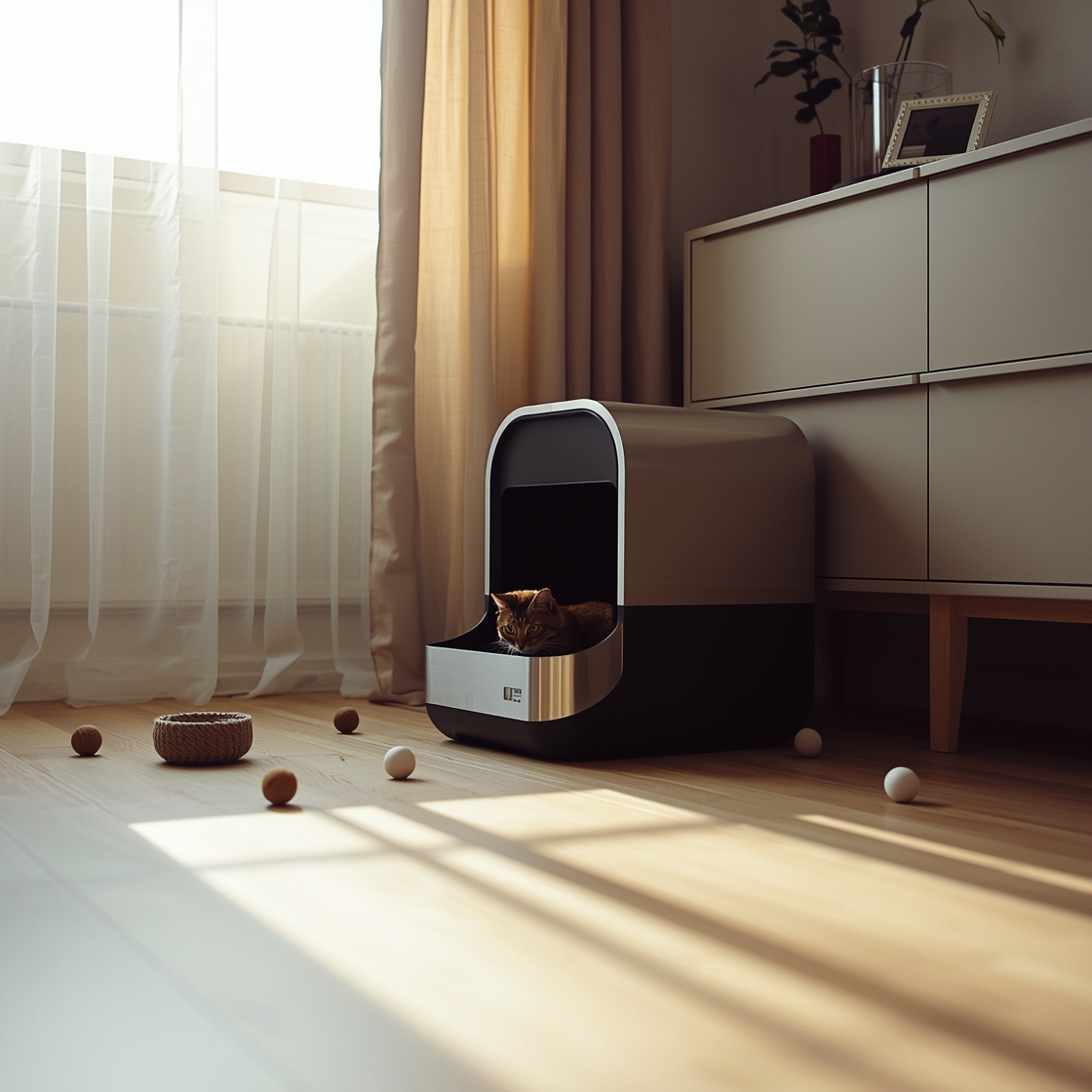
If you want the box to cycle while you are out, read our automatic cat litter box guide first. A clean tray keeps chase paths open.
Multi-cat homes add a second problem. Two cats can guard one mouse.
The AVMA sourcebook’s 1.8 cats per cat household is the average, not a max. A second mouse, or a ball plus a mouse, splits the chase.
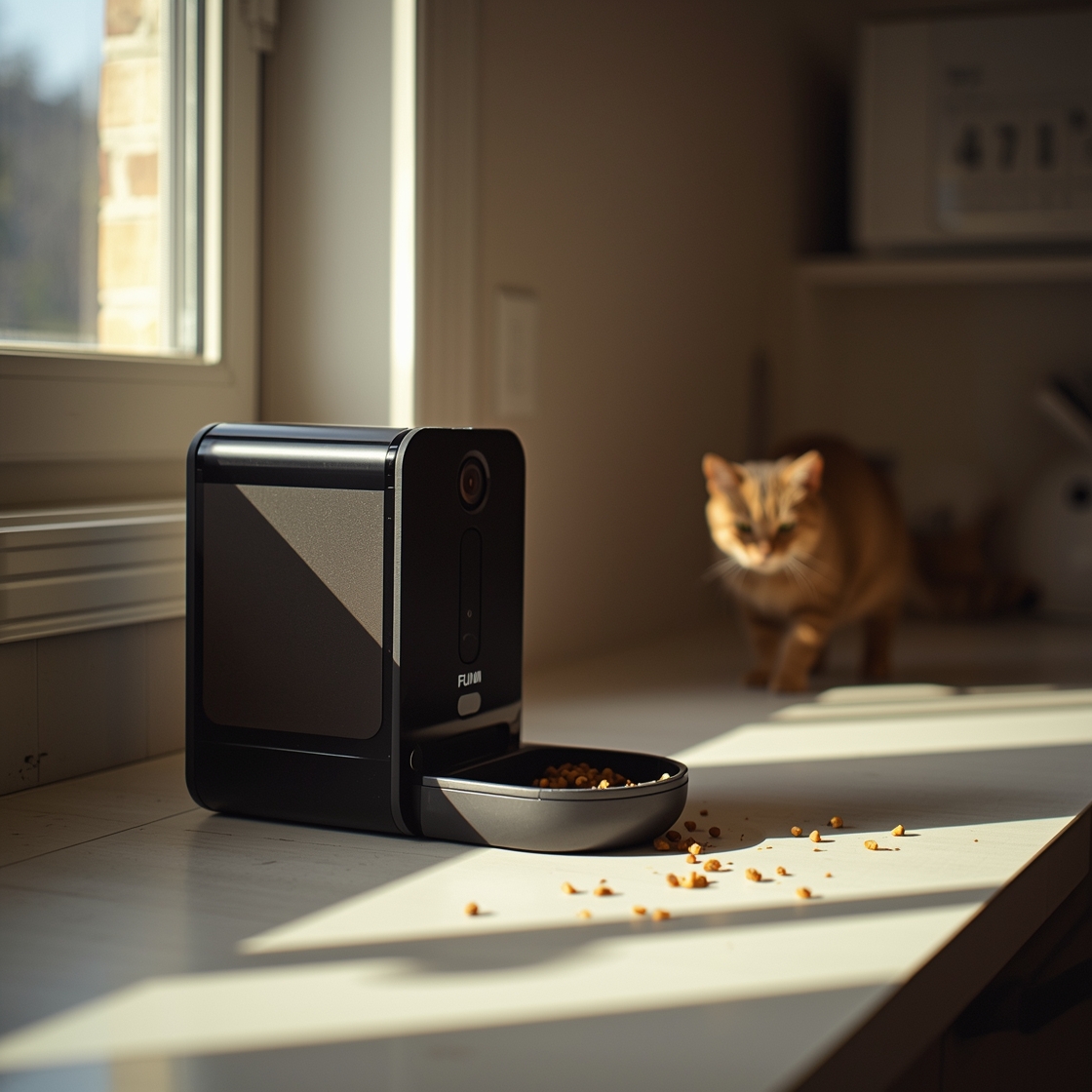
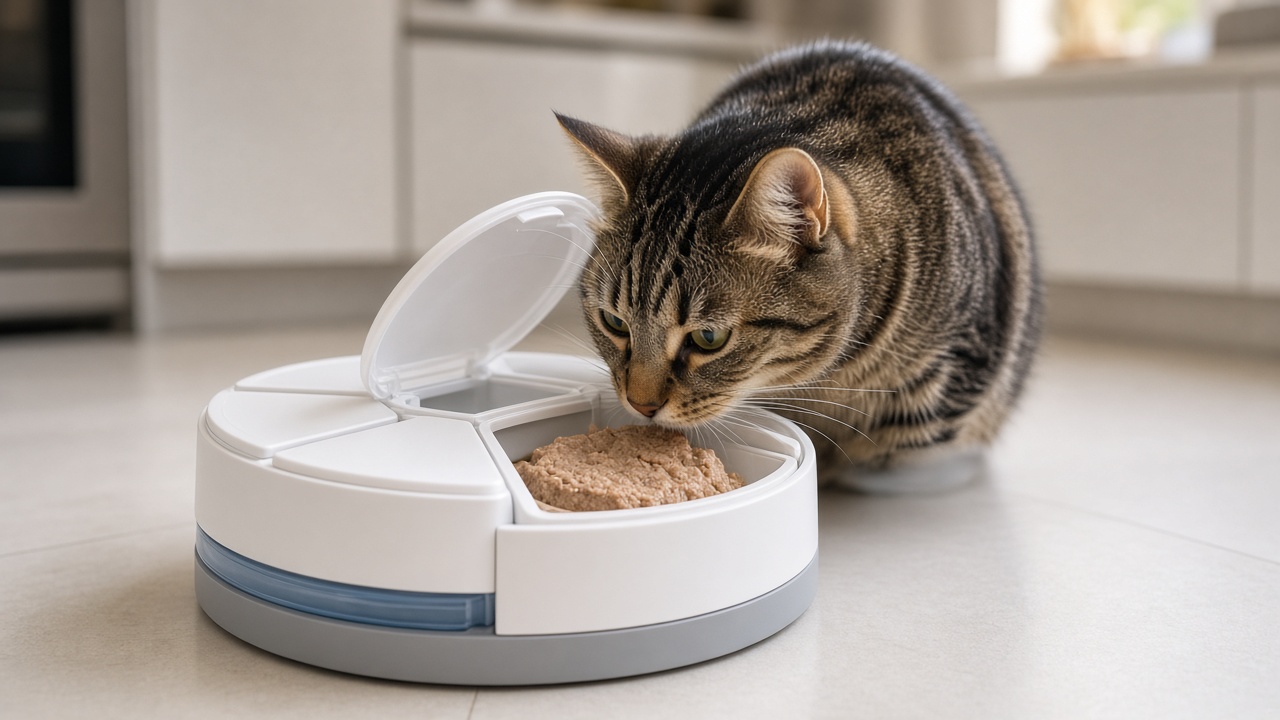
Meal timing still matters. Pair a short toy cycle with a feeder slot if you already split meals. See our automatic pet feeders for multiple cats guide.
Do not run a laser over a food bowl. Do not park a charging mouse on a wet fountain tray.
The AVMA sourcebook also lists $529 as average yearly veterinary-care spend per cat household in 2025. That figure is household care cost, not a toy budget.
FAQ
What counts as an automatic cat toy?
It is a toy that moves on a timer or after a touch, with no wand in your hand. Makers in this article list 10-minute runs, 15-minute lasers, or on/off vibration. A ball track you push by paw is not automatic under the 10/30 Cycle Rule.
Is a rechargeable mouse better than a battery laser?
They solve different rooms. A USB-C mouse gives a body the cat can catch. A PetSafe Bolt session lasts 15 minutes and paints walls.
Pick the mouse for floor chase. Pick the laser only if you will end with a catch toy.
Do these toys work on carpet?
Cheerble says Wicked Ball M3 can run on hardwood and thick carpets. HEXBUG says the nano works only on hard surfaces.
Wheeled mice jam more often in shag. Match the maker’s floor note, not a generic “works everywhere” claim.
How long should one automatic session last?
Cheerble lists 10 minutes of play, then 30 minutes of rest. That cycle is on the Neo, the PLUS, and the M3. PetSafe lists 15 minutes on Bolt.
Those printed caps are the session lengths we used. ”
Can I leave an automatic toy running all day?
Cheerble’s M3 page prints 3.5 hours of nonstop play and up to 14 hours with rest cycles. Cheerble’s 10/30 loops still pause on their own.
You should still check wheels, cables, and chewed tails. Do not treat a printed cycle as all-day babysitting.
What if my cat ignores the motor?
Many cats need a first chase with you in the room. Touch-wake mice restart when a paw lands.
If the cat never starts, switch form: mouse to ball, or ball to a person-led wand. Ignoring a motor is a real outcome, not a defect we can rank away.
Are coin-cell bugs safe to leave out?
HEXBUG includes one AG13/LR44 cell in the nano. It prints a two-hour chemical-burn warning if the cell is swallowed.
That warning is for people, especially children. Keep spare cells sealed. Pull the toy if the shell cracks.