
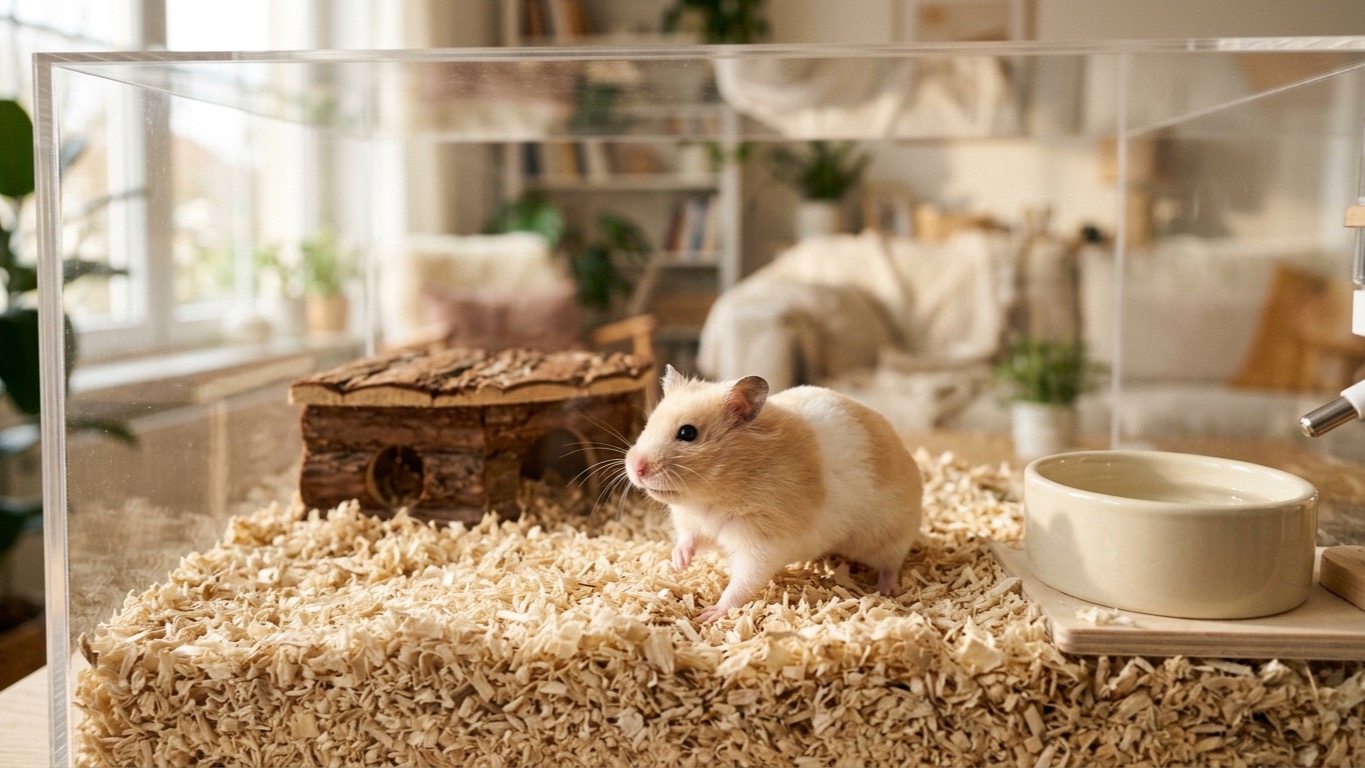
The best cages for a syrian hamster are the ones that give a continuous ground floor large enough to run, forage, and hold deep bedding — not a tall mansion of tiny platforms. On the , the seven SKUs on this page run $35.96–$159.99, with a median of $122.99 and a mean of $100.38. They split into two clusters: three listings at $35.96–$54.68 (mean $45.90) and four at $122.99–$159.99 (mean $141.24). The gap between clusters is $68.31. The expensive cluster is 3.08× the cheap-cluster mean. The practical read: the cheap cluster is where “hamster cage” retail still sells footprint that welfare groups treat as too small for a Syrian as a standalone home.
Our guides are reader-supported. This article may contain affiliate links. As an Amazon Associate we may earn a commission if you buy through links, at no extra cost to you.
Quick answer
If you want the short version of what to buy:
- Floor-space candidates (the $123–$160 cluster): Prolee Chewproof 32” Acrylic at $122.99 (the median), OIIBO Glass Tank at $135.99 if you need wall height for bedding depth, BUCATSTATE Metal 2.0 at $145.99 if chew-proof metal is the priority, and Prolee 40” Wooden Chewproof at $159.99 if you want the longest titled footprint on the page.
Syrian hamsters are solitary. One hamster, one enclosure. A second hamster is not enrichment.
What the best cages for a syrian hamster have to provide
A Syrian hamster (Mesocricetus auratus) is a ground-dwelling, nocturnal, burrowing rodent with poor eyesight and a strong chew. Retail “hamster cages” are often designed to look busy on a shelf: tubes, colored plastic, five wire floors. That is the opposite of the geometry welfare bodies keep repeating.
Unbroken floor first. The RSPCA’s national hamster environment advice on rspca.org.uk tells owners to buy a suitable, secure cage and the largest setup they can, with deep bedding for digging. It does not currently lock a centimeter figure on that main page. Several RSPCA branches (for example Solent and Surrey East) and other UK welfare charities (PDSA and Blue Cross, following Veterinary Association for Animal Welfare-style figures) use a working minimum of 100 × 50 cm of unbroken floor and about 50 cm of height. That rectangle is 5,000 cm², about 775 square inches. An older hobby figure of 80 × 50 cm (~620 sq in) is still quoted on forums. This desk treats ~100 × 50 cm unbroken floor as the working Syrian heuristic, and we label it as welfare-org practice, not as a number we measured in a lab.
Depth of bedding, not a mezzanine. Branch-level RSPCA copy and VAAW-style guidance talk about thick substrate — on the order of 20 cm / 6+ inches, with some clinical education pieces preferring even deeper. A glass or high-wall tank can hold that. A wire cage with a 2-inch tray cannot. Platforms do not count as burrow volume.
Chew and escape. Syrians will test plastic tabs, bar spacing, and lid latches. Acrylic and metal boxes fail differently than painted wire. Mesh floors are a foot-problem risk in RSPCA environment advice; solid floors with bedding are the default.
Ventilation versus walls. Solid acrylic and glass hold bedding and reduce bar-chew, and they hold humidity and smell if you under-clean. Wire mansions ventilate and forfeit footprint and fall-safety. There is no free lunch. Poor eyesight plus a high drop is how you get a limp.
One animal. Syrians fight. “A friend” is a common lethal mistake.
We will not pretend a 20-plane wire cube has 775 square inches of running floor because the listing photograph looks full.
How syrian enclosure listings compare on labels
These tables are desk compilations from the public listing fields of the seven SKUs on this page plus published welfare geometry. They are buying heuristics. Prices are listing cues recorded in August 2026 and they move.
Table 1 — Two price clusters, two jobs
| Cluster | Price range | SKUs | Mean | What the money is doing | Honest limit |
|---|---|---|---|---|---|
| Retail “hamster cage” | $35.96–$54.68 | SNAAT, Ferplast Combi 2, 5-Floor Mansion | $45.90 | Wire, levels, a familiar pet-shop silhouette | Unbroken Syrian floor is the failure mode |
| Floor-space box | $122.99–$159.99 | Prolee 32” acrylic, OIIBO glass, BUCATSTATE metal, Prolee 40” wood | $141.24 | Walls that can hold a real footprint and bedding | Still verify your unit’s internal floor; titles are not square inches |
Desk stat: The floor-space cluster mean is 3.08× the retail-cage mean. The cheapest floor-space listing (Prolee 32” at $122.99) is $68.31 above the dearest retail cage (5-Floor at $54.68). That gap is the actual “Syrian upgrade” on this URL — not a lifestyle upsell.
Table 3 — Material trade-offs for the best cages for a syrian hamster
| Material | Holds deep bedding | Chew story | Air / humidity | Handling |
|---|---|---|---|---|
| Acrylic | Yes, if walls are high | Better than thin plastic tubes | Can stale; needs a lid plan | Scratches; bulky |
| Glass | Yes — this is the burrow argument | Glass is not a chew toy; silicone and lids are | Same stale-air risk | Heavy; breakage |
| Metal box | Depends on tray depth | Best chew story on the page | Can run dry or stuffy depending on mesh vs solid | Heavy; assembly |
| Wood | Depends on liner and sealing | “Chewproof” is a listing word; edges still get tested | Moisture and odor in the grain | Looks like furniture; not outdoor-proof |
| Wire mansion | No | Bars get gnawed; spacing must not trap limbs | Best airflow, worst footprint | Light, fiddly, wobbly upper floors |
Table 4 — Setup extras the cage price does not include
| Extra | Why it is not optional | Cheap version that fails |
|---|---|---|
| Unbroken floor ≥ working heuristic | Running and foraging | Counting a tube as floor |
| Bedding depth ≥ ~6 in / 20 cm in part of the box | Burrow | A sprinkle of pine on a wire tray |
| Solid wheel sized for a Syrian | Shoulders must not bend | A 5-inch upright wheel |
| Hide + separate toilet corner | Predictable cleaning | One toilet in the food bowl |
| Sand bath (not dust-on-the-floor) | Coat and extra-behavior outlet | Scented bath powders |
| Water in a bottle and a check for leaks | Dehydration is fast | A bottle the hamster can jam open overnight |
How we assessed these seven products
We read titles, prices, and construction class. We laid those classes against RSPCA national “largest suitable cage + deep bedding” language and against the 100 × 50 cm unbroken-floor figure used by some RSPCA branches and by PDSA/Blue Cross-style guidance.
We stopped claiming that we “observed” hamsters staying active for hours. We stopped treating Ferplast Combi 2 as a Syrian destination home. We stopped a stacked “Additional Context” filler block.
The 7 cages for a syrian hamster, reviewed
1. BUCATSTATE Metal 2.0
Best for: a chew-forward metal box in the floor-space price cluster ($145.99), if the live dimensions clear a Syrian rectangle.
At $145.99 this sits $23.00 above the median. The listing job is a metal frame that a Syrian cannot shred the way it shreds a tube maze. Front-access doors, when they are real doors and not decorative, are how you spot-clean without dumping the entire burrow every other day.
The limits are mass and air. Metal boxes are heavy once filled with 20 cm of bedding. Solid panels hold odor if you skip spot-cleaning. Owner-report themes on this class: assembly is fiddly, and people underestimate how much substrate they must buy to make the “chewproof mansion” actually a burrow. A metal box with two inches of paper bedding is just a shiny small cage.
Confirm internal floor length × width on the live listing. A model name is not a tape measure. If the floor is a split level, measure the largest single rectangle, not the sum of ledges.
Pros
- Chew-proof language matches a Syrian
- Front access is the right cleaning idea
- Sits in the cluster that can actually hold a floor
Cons
- Heavy; assembly complaints are common in the class
- Ventilation and humidity need a routine
- $23 above median for a job the acrylic also claims
2. Prolee Chewproof 32” Acrylic
Best for: the median-priced floor-space box ($122.99) and the default “first real Syrian cage” on this URL — if the internal floor on the listing matches a 100 × 50 cm-class rectangle.
Thirty-two inches is a length in the title. The previous article converted that into “775+ square inches” as if we had the other dimension in a calibrated photo. 32 × 24 inches would be 768 sq in; 32 × 18 would be 576 — under the working heuristic. Read the second dimension. That sentence is the review.
Acrylic gives you visibility and chew resistance relative to thin colored plastic. It scratches. It needs a lid you can latch and still vent. It is bulky to move once it is a habitat. Those are class properties, not a knock on this SKU alone.
For a first-time owner who would otherwise buy the $36 wire cube, this is the listing that sits at the exact median of the page and in the correct cluster. Pair it with bedding depth, not with a second hamster.
Pros
- Median price of the whole page
- Acrylic box class can hold a real floor
- Clear walls make health checks easier
Cons
- “32 inches” is not a floor-area certificate
- Scratches and weaker airflow than wire
- Bulky
3. OIIBO Glass Tank
Best for: the burrow job — wall height that can hold deep bedding — at $135.99.
Glass is how you get 20 cm of substrate without it spilling out of a 2-inch wire tray. That is the only reason this listing belongs in a conversation about the best cages for a syrian hamster. Syrian hamsters dig. A tank that cannot hold a dig is an aquarium you underfilled.
The limits are weight, breakage, and air. A dressed tank is not something you casually relocate. Lids must be escape-proof and still allow exchange; a sealed glass box is a humidity trap. Owner-report themes on glass hamster tanks: people underestimate bedding volume (and cost), and they skip a hide so the hamster is on display 24 hours a day. Visibility is for you. The hamster still needs a dark nest.
If the live listing shows wall height, use that number. If it does not, do not buy on a photograph of a mountain of paper bedding that may be a styled shot.
Pros
- Best class on the page for burrow depth
- Easy wipe-down of glass when you do a deep clean
- $13 above median, still in the floor-space cluster
Cons
- Heavy; glass breaks
- Airflow is a lid-design problem
- Styled bedding photos are not a measurement
4. Prolee 40” Wooden Chewproof
Best for: the longest titled footprint on the page ($159.99) if you will seal and line the wood against urine.
At $159.99 this is the ceiling of the these syrian enclosure listings, 1.30× the median and 4.45× the cheapest card. Forty inches of length is the useful claim. “Wooden chewproof” is two words in tension. Wood looks like furniture. Urine and humid bedding look like a science-fair volcano. If you buy wood, you buy a waterproof liner habit and a willingness to retire the box when the grain sours.
The aesthetic is why people stretch the budget. The honesty check is still the internal rectangle and the lid. A beautiful 40-inch box with a 12-inch width can lose the working heuristic. Measure both sides.
Do not put untreated decorative wood hides that have been oiled with mystery finishes into the same habitat as a chewer without knowing the finish. The cage is only the shell.
Pros
- Longest length in a title on this URL
- Furniture-like if that is a household constraint
- Floor-space cluster, not a wire mansion
Cons
- Highest price on the page
- Wood versus moisture is a maintenance job
- “Chewproof” is a listing adjective
5. SNAAT 20 Planes Enclosed
At $35.96 this is the floor of the index, 3.42× below the median. “20 planes” is a vertical-retail sentence. Syrian welfare geometry is a horizontal sentence. Those sentences do not meet.
We keep the card. We will not tell you it is “highly reviewed therefore large enough.” Review volume on a $36 wire cube is a popularity fact. It is not a floor-area fact. If you already own this cage, the adult move is to treat it as a carrier or a temporary lockout box while you clean a larger tank — not as the life habitat.
Bar spacing, wobbly planes, and a Syrian’s willingness to climb and fall are the safety themes in this class. Poor eyesight plus a drop from a fifth floor is a clinic visit.
Pros
- Cheap; useful as a temporary lockout if it is secure
- Shows, by contrast, what the $123 cluster is paying for
- Light to move
Cons
- Fails the unbroken-floor heuristic as a home
- Planes are not floor
- Wire squeak and climb-fall risk
6. 5-Floor Mansion
Best for: not a standalone Syrian home. A vertical wire toy that sells height as space.
At $54.68 this is the top of the cheap cluster and still $68.31 below the cheapest floor-space box. The title does the damage: five floors. Hamsters have poor eyesight. High platforms are a fall geometry. Stacked wire rectangles do not add up to 100 × 50 cm of running floor.
Assembly is fiddly. Upper levels wobble in owner reports on this class. That is not a personality quirk of one brand. It is what light wire mansions do.
If a child wants a “mansion,” the adult buys a tank and a hide that looks like a house. The hamster gets the rectangle.
Pros
- Shows the retail idea of “space” so you can refuse it
- Cheap relative to acrylic
Cons
- Height is not floor
- Fall risk
- Fails the working Syrian heuristic
7. Ferplast Combi 2
Best for: a modular add-on or a dwarf-scale system — not a Syrian destination cage.
At $47.06 this is the middle of the cheap cluster. Ferplast’s Combi line is a real product family: plastic base, wire top, tubes, optional extras. Expandability is the listing virtue. The virtue becomes a vice when the base stays small and the “growth” is more tubes. Tubes are not unbroken floor. They are also where a Syrian gets stuck.
Pros
- Modular; parts are widely understood
- Honest as a temporary or dwarf-context system
- Preserved card
Cons
- Too small as a Syrian home
- Tubes ≠ floor
- Wheel and extras are often a second purchase
Best cages for a syrian hamster compared at a glance
| Product | Class | Standalone Syrian? | Approx. price | Where to buy |
|---|---|---|---|---|
| BUCATSTATE Metal 2.0 | Metal box | Candidate | $145.99 | Check price |
| Prolee 32” Acrylic | Acrylic box | Candidate if width clears | $122.99 | Check price |
| OIIBO Glass Tank | Glass | Candidate (burrow) | $135.99 | Check price |
| Prolee 40” Wooden | Wood box | Candidate if width clears | $159.99 | Check price |
| SNAAT 20 Planes | Wire / planes | No | $35.96 | Check price |
| 5-Floor Mansion | Tiered wire | No | $54.68 | Check price |
| Ferplast Combi 2 | Modular | No | $47.06 | Check price |
Browse the wider category: See cages for a syrian hamster on Amazon →
How to set up a Syrian enclosure after you pick the box
The cage is half the purchase. The other half is substrate, a wheel, and a cleaning rhythm.
Floor first. Place the enclosure on a stable, level surface out of direct sun and away from other pets. A cat looking in is not enrichment.
Bedding. Use a paper or other hamster-safe substrate deep enough to tunnel in at least one zone. Avoid scented bedding and dusty cheap shavings that fill the room. RSPCA environment advice wants a solid floor and material deep enough to dig. Spot-clean the toilet corner every few days. Deep-clean on a schedule that matches how concentrated the smell is — large, deep setups often need less full dumps than tiny trays, which is one reason the $123 cluster is not a luxury.
Wheel. A Syrian needs a wheel large enough that the back stays straight. An undersized upright wheel is a spine problem waiting on a calendar. Silent is a household feature; size is the welfare feature.
Food, water, hide. Scatter some of the food so the floor gets used. Keep a heavy ceramic bowl if you must bowl-feed. Check the bottle daily. Provide a hide that is actually dark. A hamster on display all day is not “socialized”; it is exposed.
No second hamster. No “just for a week.” Syrians are solitary.
Hands. Wash before and after. Move slowly. These animals bite when startled, and they startle from above because they do not see well.
Cleaning without stripping the whole burrow every time
A deep, large box should not be emptied like a litter pan every 48 hours. That destroys the tunnel system and is why some hamsters appear “stressed after cleaning.” Spot-clean wet corners. Leave most of the clean bedding. Do a fuller change when the substrate is globally soiled or dusty, and put back a handful of old, dry, unscented nest material so the smell map is not erased.
Wire mansions force the opposite rhythm: tiny trays soak through and you dump them constantly. That is another way the cheap cluster costs time.
Wheel, bedding, and the extras that decide whether a big box works
A 100 × 50 cm rectangle with two inches of dusty shavings and a 5-inch wheel is still a bad home. The best cages for a syrian hamster conversation dies at checkout if you do not budget the internals.
Wheel diameter. A Syrian’s back should stay fairly straight at the top of the stride. Cross-species “small pet” wheels sold with dwarf packaging are the usual miss. Look at the live listing’s diameter in inches or centimeters, not at a lifestyle photo of a mouse. A silent bearing is a roommate feature. An upright, solid (not mesh) running surface is a foot feature. Mesh wheels and wire rungs show up in owner reports as the objects that catch toes. We will still tell you not to buy a decorative ferris wheel.
Bedding volume is a second invoice. Deep paper bedding in a 40-inch box is not a handful from a pet-shop pouch. People who upgrade from a Combi to a tank are often shocked by how many liters disappear into a 20 cm layer. That cost is part of the $68 gap between clusters. If the household cannot fund substrate, the large box becomes an empty display case.
What not to use as bedding. Scented “forest” shavings, clumping cat litter, and fluffy cotton nesting that wraps limbs are the three objects hamster-welfare conversations keep killing. RSPCA environment pages want appropriate bedding and nesting material on a solid floor. They do not ask you to perfume the burrow. If a product is sold to smell like a candle, it is for you, not for a rodent with reserved respiratory capacity.
Sand bath. A dish of safe bathing sand (not calcium “chinchilla dust” unless a clinician has a reason) is a coat tool and an extra behavior outlet. It is not a toilet you never clean. Change it when it is soiled. Place it away from the wheel so you are not grinding grit into the bearing.
Bar spacing and lids. If any part of the setup is wire, spacing must not admit a Syrian’s skull or trap a foot. Lids on tanks and bins are the escape plane. A hamster that can reach a clip will work it. Overnight security is not optional; these animals are nocturnal and they are patient.
Placement, temperature, and the room the cage sits in
Put the enclosure where the household actually lives enough to notice a water failure, but not on a windowsill, not on a radiator, and not in a kitchen that hits cooking smoke. Direct sun turns a glass tank into a greenhouse. A garage that swings 10 °C overnight is not a “quiet spare room.”
Syrians are crepuscular to nocturnal. A cage in a child’s bright bedroom with a tapping finger on the glass at 16:00 is a sleep-deprivation machine. A cover on part of the tank during the day is not cruelty. Constant display is.
Other pets: a dog that stares, a cat that sits on the lid, a parrot that screams at 2 a.m. Those are predator and noise problems. The best cages for a syrian hamster cannot cancel a cat. They can have a lid the cat cannot open.
Drafts and isolation are a different failure. A hamster in a silent basement that nobody visits until Sunday is how water bottles fail unnoticed. Daily visual checks are part of the housing, not an extra.
If you already own a mansion: a rebuild path that does not require shame
A lot of readers of this URL already have the $36–$55 cluster in the living room. The honest next step is not a second matching mansion. It is one floor-space box from the $123–$160 cluster, or a measured DIY tote that clears the heuristic, plus a plan for the old cage.
- Measure the current largest rectangle. Write the number on a note. That is the baseline you are leaving.
- Buy or build the new floor. Set it up completely — bedding, hide, wheel, water — before you move the hamster. A move into an empty glass box is a panic.
- Move the hamster in a small, secure carrier or in the old cage with the tubes blocked, at a quiet time of day.
- Keep the old cage as a lockout box for deep cleans if it is still secure. Do not run two Syrians because you now have two cages.
- Recycle the colored tubes if they created a choke or a dead end. Sentiment is how people reconnect a Combi “for fun” and undo the upgrade.
This path costs about the median of this page once, not a drip of $20 accessories on a cage that cannot become large.
Enrichment that is not a second hamster
Scatter feeding, a dig box, cardboard to shred, and a wheel are the core. Puzzle feeds sold for dogs do not automatically become hamster-safe; holes and plastic hardness matter. Willow and other untreated chews are a category; painted wood is a question mark. We are not a botanical lab. When in doubt, paper and plain cardboard are the boring objects that do not add a toxin question.
Boredom in a large, deep cage looks like a hamster that sleeps all day (normal) and works the floor at night (also normal). Boredom in a mansion looks like bar chewing and climbing the lid. Those are not the same animal with a different personality. They are often the same species in two different rectangles.
A hamster that suddenly stops using the wheel, or that starts walking in a tight stereotyped loop, is a reason to look at pain, at wheel size, and at a veterinarian — not a reason to add a fifth storey.
When to involve your veterinarian
Contact an exotic-competent veterinarian for wet tail (diarrhea in a young hamster is an emergency), a sudden lump, a wound from a fight or a fall, overgrown teeth, a limp after a drop from a platform, or a hamster that has stopped eating. Housing that is too small does not make those problems imaginary; it can make them more likely. We are not that clinician.
Nothing here has been reviewed by a veterinarian on our behalf.
Frequently asked questions about the best cages for a syrian hamster
How big should the best cages for a syrian hamster be?
Use the largest unbroken floor you can. This desk’s working heuristic, taken from RSPCA-branch and PDSA/Blue Cross-style figures, is about 100 × 50 cm (roughly 775 sq in), not a five-storey wire cube. National RSPCA copy stresses a suitable large cage and deep bedding without always printing that rectangle on the main page. Bigger than the heuristic is better.
Do extra levels count as space?
Not as running floor. Measure the largest single rectangle. Ledges are clutter. They are also fall risks.
Can I keep two Syrians together if the cage is huge?
No. Solitary. A large floor does not create a social species.
Is a bin cage acceptable?
A smooth-sided tote with a ventilated lid is a common DIY that can beat a $40 mansion on floor area. It is not one of the seven cards on this URL. If you go that route, you still owe the hamster depth, a wheel, and a secure lid.
What bedding depth do the best cages for a syrian hamster need?
Enough to tunnel — welfare copy clusters around 20 cm / 6+ inches in at least part of the enclosure. A glass or high-wall box can do that. A wire tray cannot.
Wire or solid walls?
Wire ventilates and usually forfeits floor and bedding depth. Solid walls hold bedding and odor. For a Syrian, floor and depth win unless you are buying a lockout box.
How often do I clean?
Spot-clean wet corners every few days. Full substrate changes less often in a large, deep setup than in a tiny tray. National RSPCA hamster pages discuss regular cleaning and spot-cleaning rather than a single universal dump schedule.
Can I use a 40-gallon “breeder” aquarium instead of a branded hamster tank?
If the internal floor clears the working heuristic and you have a secure, ventilated lid, a used aquarium is often the cheapest way to buy glass. It is not one of the seven cards. Measure the bottom interior, not the gallon number on the sticker — “40 gallon” tanks vary in footprint. Watch weight on furniture and watch heat if the tank sits in sun.
What wheel size belongs in the best cages for a syrian hamster?
Buy the diameter that lets a Syrian run without a banana-shaped spine. That is usually a large upright or a suitable saucer, not the 5-inch wheel that arrives in a Combi-class kit. If the hamster’s hips hike or the back bows, the wheel is too small. Replace it before you add another tube.
Sources and method
PetBench desk compilation, August 2026. Prices and titles are public listing fields.
Welfare geometry: RSPCA, Creating a Good Home for Hamsters; example branch figures at RSPCA Solent — hamster accommodation (100 × 50 cm unbroken floor for a Syrian). PDSA/Blue Cross-style 100 × 50 × 50 cm figures are discussed in clinical education summaries such as Vet Help Direct’s 2022 space essay. We cite those as published heuristics, not as PetBench lab standards.
Verify internal length, width, and lid security on the live listing before purchase. A title that says 32 inches or 40 inches is a length claim, not a certified floor-area certificate, and the second dimension is the number that decides whether a Syrian can actually run.
- August 2026 — . Replaced “we observed” theater and the fake 775 sq in certificate. Split the seven cards into a $36–$55 fail cluster and a $123–$160 floor-space cluster. Added the Syrian enclosure listing review and RSPCA/PDSA-style geometry.