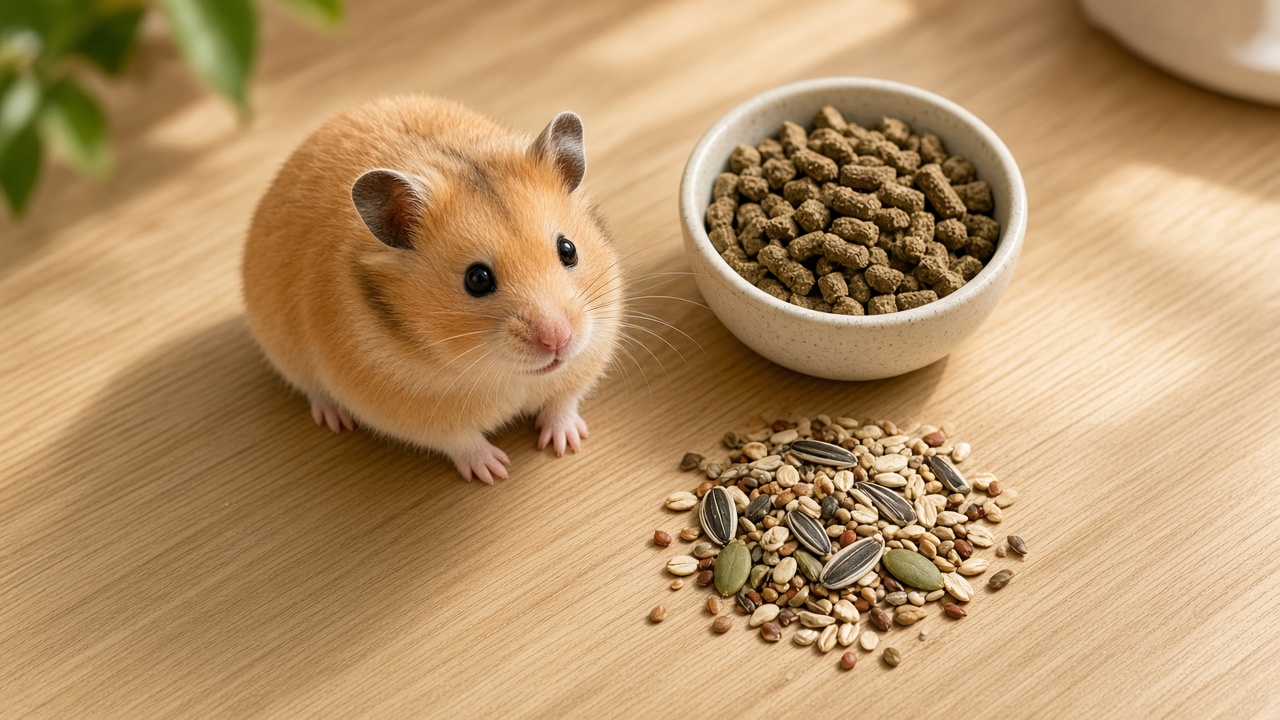
Quick answer: Feed a uniform hamster pellet as the daily staple. Add a measured pinch of seed mix only if leftover pellets still disappear. Skip colorful mixes sold as the whole diet.
A uniform hamster pellet is the best daily food; seed mixes fail as the sole diet when pellets sit uneaten.
This page is a maker-label comparison of six hamster-named diets. We did not run feeding trials, weigh leftover bowls in a colony, or assign brand ranks.
How we chose which diets belong here
We used one selection rule. Call it the Pet Bench Hamster-Named Page Rule.
A diet entered this article only if two facts sat on the maker’s own page. The product name had to include hamsters, and the page had to list protein and fat.
We left out treat sticks, yogurt drops, and rabbit or guinea pig pellets. We also left out any food whose numbers appeared only on a retailer listing.
Competitor blogs stayed out. Every number below comes from a page our research team opened.
Our research team compared maker specs in September 2026. We call that snapshot the Pet Bench 2026 Hamster Label Scan.
Top 7 Hamster food
The picks below are the 7 hamster foods on sale right now, listed with what each suits best and an honest drawback. Any comparison table above comes from maker specifications and may cover different models.
1. Kaytee Forti-Diet Pro Health Nourish+Protect Hamster Food & Gerbil
Best for: Budget everyday pellet feeders
Kaytee’s Forti-Diet Pro Health Nourish+Protect is a pelleted hamster and gerbil food at a low everyday price. Maker pages present the pellets as an even daily diet so pets can’t sort seeds from leftovers. Owners moving off colorful mixes often report a slow switch while the hamster learns the plain shape.
Pros: Affordable everyday pellet diet; Uniform bites limit picking Cons: Little foraging mix variety
2. Kaytee Fiesta Hamster & Gerbil Food
Best for: Foraging-mix variety seekers
Kaytee Fiesta is a fortified mix of seeds, grains, fruits, and vegetables, sold above grocery-pellet prices. The maker pitches the mixed shapes as foraging food for hamsters and gerbils. Owners report pets grab the colorful pieces first and leave the rest, which is the usual seed-mix trade-off.
Pros: Varied seed-and-grain mix; Foraging shapes and textures Cons: Pets pick favorite pieces
3. Oxbow Garden Select Hamster Food & Gerbil Food
Best for: Uniform garden-pellet shoppers
Oxbow Garden Select is a uniform pellet from a small-mammal brand, priced in the middle of this list. Maker pages describe a garden-inspired daily diet for hamsters and gerbils, not a party mix. Owners who want every scoop to match will recognize the form; seed sorters will find little to pick through.
Pros: Uniform daily pellet diet; Specialist small-mammal brand Cons: No colorful seed scatter
4. Sunseed Vitakraft Vita Prima Dwarf Hamster Food 2 lb Bag with Fruits
Best for: Dwarf hamster fruit-mix keepers
Sunseed Vita Prima is a two-pound dwarf hamster food that includes fruit in the blend. The maker presents pellets with grains, seeds, and fruit as a foraging-style daily mix. Dwarf keepers often report their pets hunt the fruit pieces first, so leftover piles are worth watching.
Pros: Two-pound dwarf formula; Fruit-and-grain foraging mix Cons: Mix invites selective eating
5. Abizoo Hamster & Gerbil Treat
Best for: Treat-only enrichment bowls
Abizoo’s product is sold as a hamster and gerbil treat, not a named staple pellet. Listing copy points to a gourmet seed-and-grain snack at treat-tier pricing. Owners use bags like this for scatter feeding and rewards; it is a weak stand-in for a complete daily diet.
Pros: Seed-and-grain treat mix; Priced for snack use Cons: Not a complete staple
6. united pet group p-83138 32 OZ
Best for: Lowest-price 32-ounce restock
This 32-ounce United Pet Group listing is the cheapest hamster and gerbil food here. The SKU is a generic warehouse blend, not a specialist formula. Owners treat it as a low-cost restock when they need volume and do not want a boutique bag.
Pros: Thirty-two-ounce budget bag; Lowest price on list Cons: Generic warehouse-brand mix
7. Supreme Petfoods Science Selective Hamster Foods
Best for: Single-nugget diet keepers
Supreme Petfoods Science Selective is an extruded hamster food sold as one uniform nugget. Maker pages say that single shape stops hamsters from picking only the tasty bits. Owners who already fight leftover seed piles look at this style when they want every bite the same.
Pros: Single extruded nugget diet; Built to stop picking Cons: Almost no texture variety
Comparison: Hamster food at a Glance
Want to browse every option? See the full range of hamster food on Amazon →
Why pellets and seed mixes are not the same job
The Merck Veterinary Manual’s hamster chapter is blunt on this split. Captive hamsters should eat a complete, balanced, pelleted diet made for hamsters.
That same Merck chapter says generic seed mixes should be avoided. Hamsters pick out seeds and ignore pellets.
That sorting habit is the whole problem. A mix can print a complete-looking analysis and still fail in the bowl.
Use the Leftover-Pellet Rule at home. If seeds vanish and pellets remain, the mix is no longer the daily diet.
The leftover pile is not a sick-stomach sign by itself. A hamster that hides whole food is hoarding.
That cache is not a vomit pile. See our dog regurgitation brief.
Check cheek pouches and nest caches before you add more mix. The Merck chapter notes that filled pouches can more than double head-and-shoulder width.
What six current maker pages actually list
These six diets were on sale when we opened the maker pages. The table reports listed attributes only.
| Product | Form | Listed protein | Listed fat | Listed fiber | Maker daily amount |
|---|---|---|---|---|---|
| Oxbow Essentials Hamster & Gerbil Food | Uniform kibble | 15.00% min | 4.50% min | 10.00–15.00% | 1/8 cup, small adult |
| Kaytee Forti-Diet Pro Health Nourish+Protect Hamster and Gerbil Food | Mix with pellets | 12.0% min | 6.0% min | 12.0% max | 2 Tbsp, about 20 g |
| Higgins Sunburst Gourmet Blend Hamster & Gerbil | Seed and forage mix | 15.0% min | 7.0% min | 9.5% max | 2 to 3 Tbsp |
| Science Selective Hamster Food | Extruded nuggets | 19.0% | 5.0% | 5.0% | 5–10 g |
| Harry Hamster Tasty Mix | Seed mix | 18.0% | 6.0% | 6.0% | 5–10 g |
| Wild Harvest Advanced Nutrition Hamster & Gerbil Diet | Grain and seed mix | 18% min | 5% min | 10% max | 1 to 2 Tbsp |
Across those six pages, listed protein ran from 12.0% to 19.0%. That is a 7-point spread on the bag, not in a feeding trial.
Listed fat ran from 4.50% on Oxbow Animal Health’s page to 7.0% on Higgins Premium Pet Foods’ page. That 2.5-point gap is the widest fat split we recorded.
Two Supreme Petfoods bags print the same 5–10 g adult portion. Kaytee’s page lists 2 tablespoons, about 20 g.
Those amounts are maker instructions for different formulas. They are not one universal cup.
Protein, fat, and fiber the labels will defend
AAFCO’s Model Regulations define “Daily Food” as a specialty-pet product for species with no recognized nutritional authority. Hamsters sit in that specialty-pet class, not in the dog-and-cat nutrient profiles.
AAFCO’s consumer page still helps you read the words. “Complete” means the product contains the required nutrients. “Balanced” means those nutrients sit in the stated ratios.
That page also says treats and extras are not complete feeds. Look for “for intermittent or supplemental feeding only” on bags that are not the whole diet.
The National Research Council’s 1995 hamster chapter is older than these bags. It is still the numbered lab chapter most often cited for hamster protein.
That NRC chapter cites 18 percent crude protein for reproductive amino-acid needs on natural-ingredient diets.
Arrington’s growth work, cited there, supported 1.8 to 2 g daily gain on 13.7 percent crude protein.
Kaytee’s current official page lists 12.0% minimum crude protein. That figure is below both NRC reference points we just named.
That gap does not prove a pet will fail on Kaytee. It does show why a higher-protein pellet is the safer staple on paper.
Science Selective lists 19.0% protein and 5.0% fat. Supreme Petfoods also prints calcium at 0.8% and phosphorus at 0.6% on that page.
Harry Hamster Tasty Mix lists 18.0% protein and 6.0% fat. It prints the same 0.8% calcium and 0.6% phosphorus pair.
Wild Harvest lists 18% minimum protein and 5% minimum fat. Moisture is listed at 14% maximum, the highest moisture cap in this scan.
The NRC chapter says hamsters seem to thrive on diets with 4 to 20 percent fat. Knapka and Judge, cited there, saw 1.0 percent mortality at 3.1 and 5.0 percent lipid.
Higher fat brought more weight gain and higher mortality. The authors put maximal-growth lipid slightly above 5 percent. Growth rate should not be the only goal.
Higgins lists 7.0% minimum fat, the highest fat floor in this scan. That bag also lists sunflower seeds, peanuts, cashews, raisins, papaya, and pineapple.
Portions, vitamins, and live cultures the makers publish
Oxbow Animal Health splits adults by size. A small adult hamster gets 1/8 cup. A gerbil or large hamster gets 1/3 cup.
Young, pregnant, or nursing animals are listed as unlimited on that same page. Oxbow also tells owners to hunt for hoarded piles and cut the next ration.
Oxbow’s switch plan lasts four weeks. Week one is one-quarter new food. Week four is the new kibble alone.
Kaytee’s page tells owners to blend old and new food for 7 to 10 days. After opening, it says to use the food within 30 to 45 days.
Kaytee lists omega-3 fatty acids at 0.6% minimum. It also lists 80,000 CFU/g of Bacillus licheniformis and Bacillus subtilis.
Higgins lists omega-3 fatty acids at 0.40% minimum and DHA at 0.03% minimum. Total lactic acid bacteria are listed at 2 x 10^5 CFU/g.
That Higgins culture count is 200,000 CFU/g. It is 2.5 times Kaytee’s Bacillus line. The organisms are not the same class.
Oxbow lists vitamin A at 10,000 IU/kg. Higgins lists 8,000 IU/kg.
Science Selective lists 20,000 IU of vitamin A per kilogram. Wild Harvest lists vitamin A at 10,000 IU/kg minimum and 75,000 IU/kg maximum.
Science Selective and Harry Hamster both list vitamin D3 at 2,000 IU per kilogram. Oxbow lists vitamin D3 at 900 IU/kg.
The NRC chapter reports average water intake of 8.5 mL per 100 g body weight each day. Females in the cited Fitts and St Dennis work drank 14 mL per 100 g. Males drank 5 mL.
Merck lists adult Syrians at 110 to 140 g. A 110 g hamster sits near 9 mL of water on that average.
Keep a full bottle even when the food bowl looks full. The same NRC chapter says 45 g hamsters ate 58 kcal per 100 g body weight each day. Larger 90 g hamsters ate 28 kcal per 100 g.
Dwarf hamsters often sit under 100 g, per the Merck chapter. A 20 g Kaytee scoop is a larger share of that body than a 5 g Selective scoop.
How to read meal words, colors, and leftover piles
The FDA’s animal-food labeling page requires ingredients by common or usual name. They must appear in descending order by weight under 21 CFR 501.4(a).
That same FDA page also requires product identity, net quantity, and the maker’s name and place. It does not pick a winning hamster brand.
Oxbow’s first line is Timothy Meal. That “meal” word means a dried, ground plant input, not a ranking of quality.
The same concentration idea shows up in dog food. See what chicken meal is.
Canola meal, soybean meal, and alfalfa meal follow that dry-weight logic. A whole sunflower seed still carries its oil and shell.
See our meat-versus-meal decoder for the mammal version. Read the hamster list the same way.
Dry meals can outrank wet-looking seeds on solids. The first line won on mix-time weight, not on finished protein.
Kaytee’s ingredient list starts with corn, wheat, milo, millet, and sunflower seed. It also lists cane molasses, FD&C Red No. 40, and FD&C Blue No. 1.
Wild Harvest lists sugar plus FD&C Yellow #5, Red #40, and Blue #1.
Science Selective’s list is short. It names wheat, soya bean meal, barley, oats, locust bean husks, linseed, soya oil, and hydrolyzed yeast.
Supreme Petfoods says that formula has no added sugars. Harry Hamster Tasty Mix makes the same claim, then lists sunflower seeds and peanuts in shells.
The American Veterinary Medical Association’s Selecting a Pet Rodent leaflet puts hamster life span at 2 to 3 years. The Merck chapter uses the same window.
That is a short clock. A seed-only bowl that trains fat-first sorting spends much of that life off the printed analysis.
The AVMA leaflet also says the cage needs fresh bedding, food, and water. Food still has to be the species-named diet.
Merck’s husbandry notes add one more feeding fact. Syrian hamsters have broad muzzles, so pellets belong on the cage floor, not only in a high hopper.
FAQ
What is the best hamster food, pellets or a seed mix?
A uniform pellet is the better daily staple. The Merck Veterinary Manual tells owners to use a hamster-specific pelleted diet and to skip generic seed mixes. A seed mix can still be a measured extra if leftover pellets disappear.
How much should I feed an adult hamster each day?
Follow the bag you actually bought. Oxbow lists 1/8 cup for a small adult. Supreme Petfoods lists 5–10 g for Science Selective and Harry Hamster.
Kaytee lists 2 tablespoons, about 20 g. Those are different formulas, not one universal cup.
Is 12% protein enough on a hamster food label?
Kaytee’s official page lists 12.0% minimum crude protein. The National Research Council’s 1995 hamster chapter cites 13.7% crude protein as supporting fast growth. It also cites 18% for reproductive amino-acid needs on natural-ingredient diets.
A higher listed protein on a uniform pellet is the cleaner paper match.
Can I use a seed mix as the only food?
Not if pellets or fortified pieces sit uneaten. The Merck chapter says hamsters pick seeds and ignore pellets, which breaks the printed balance. If the leftover pile is mostly pellets, switch the staple to a uniform kibble.
Why do some mixes list probiotics?
Those lines are maker guarantees, not proof of a healthier gut in your cage. Kaytee lists 80,000 CFU/g of two Bacillus species. Higgins lists 2 x 10^5 CFU/g of lactic acid bacteria.
Different organisms. Different counts. The pellet still has to get eaten.
Do dwarf hamsters need a different food than Syrians?
They need a hamster-named diet and a smaller calorie share. The Merck chapter puts dwarf species under 100 g and Syrians at 110 to 140 g.
A 20 g scoop is a larger daily load for a dwarf than a 5 g scoop. Watch body shape and leftover caches, then cut the portion.
How fast should I switch foods?
Use the maker’s own ramp. Oxbow’s page uses a four-week mix. Kaytee and Higgins both describe a 7 to 10 day blend of old and new food.
Dumping a full new mix overnight is the one change none of those pages describe.