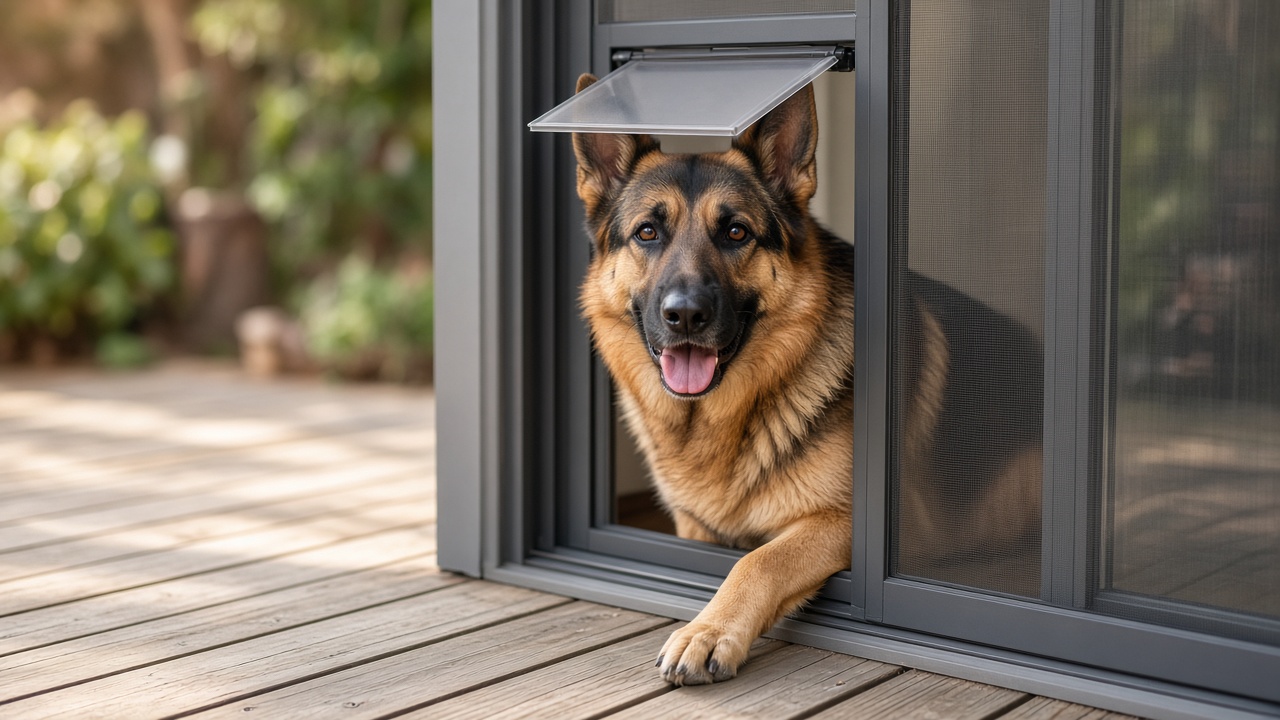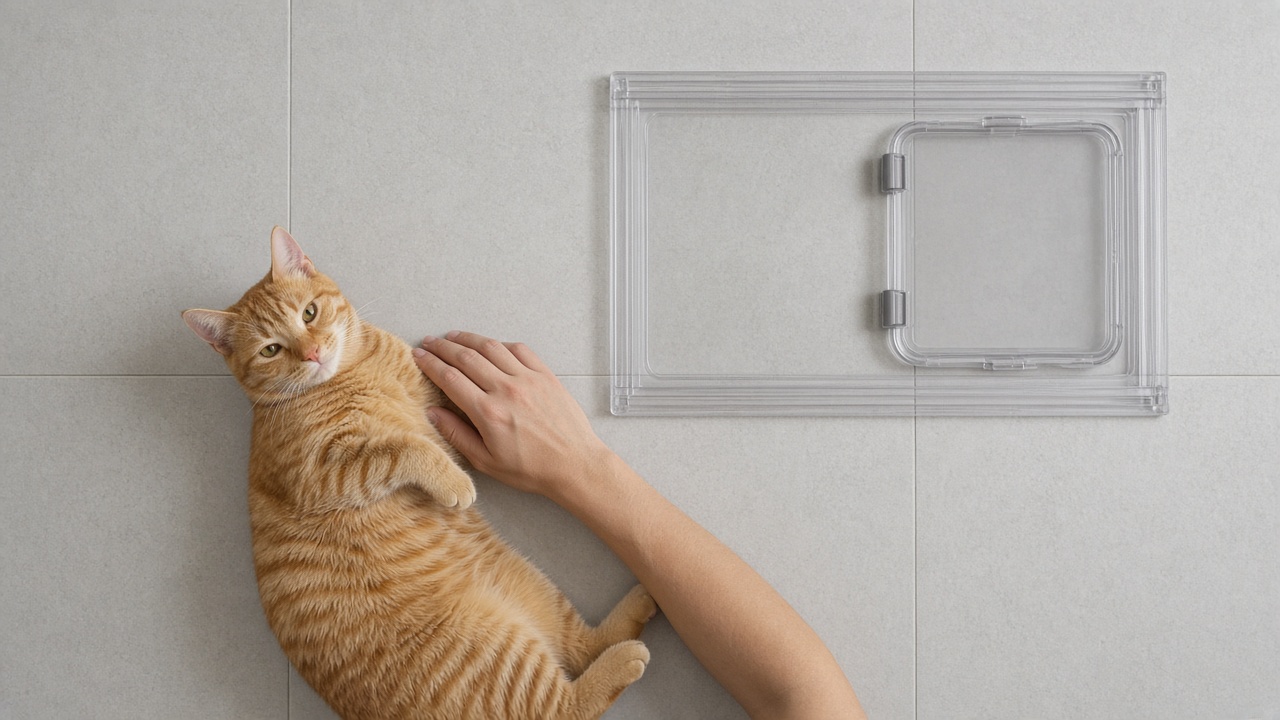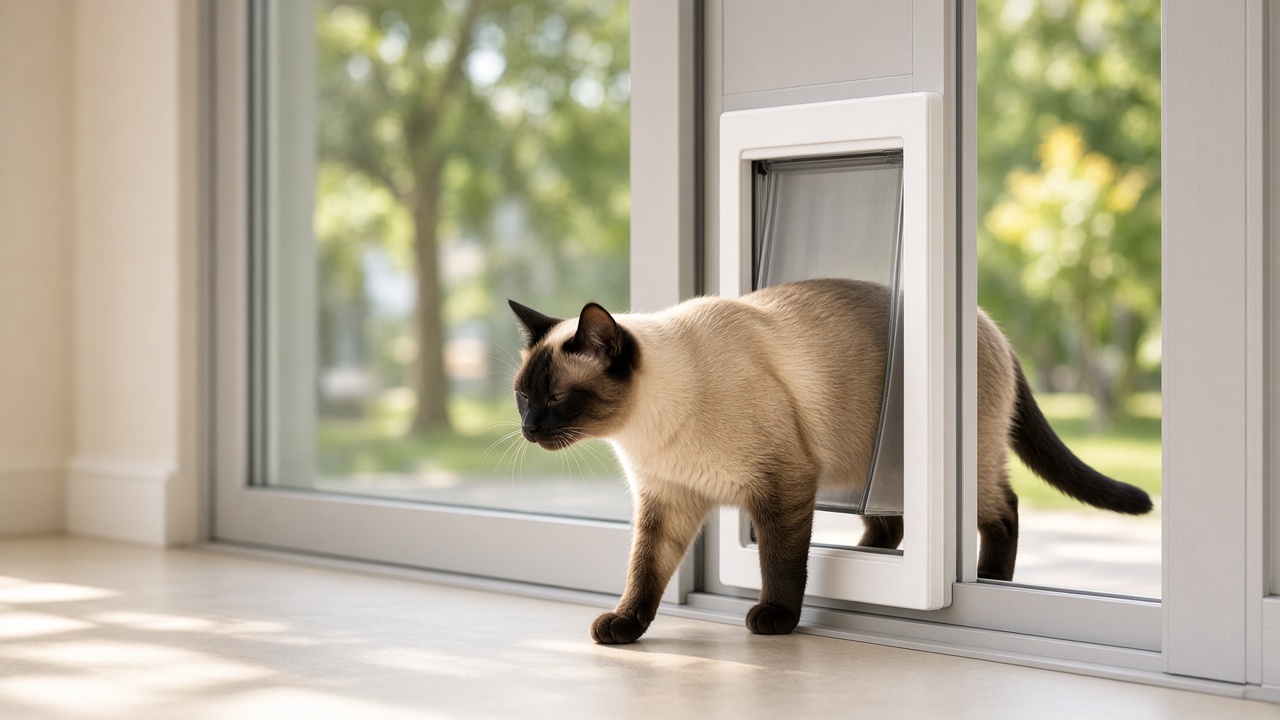
Quick answer: Buy a removable patio-track insert, not a hole in the glass. For most cats, pick a panel with a flap under 7 inches wide and a slide-in closing cover. Match the maker’s listed track-height range to your frame before you order.
Our research team compared published specs on five sliding-track inserts still listed in 2026. A removable track insert with a locking flap under 7 inches wide is the cat door that fits most sliding glass doors without cutting glass. This page is a published-spec comparison, not an install log, glass-cut job, or leak test.
How a sliding-glass cat door actually works
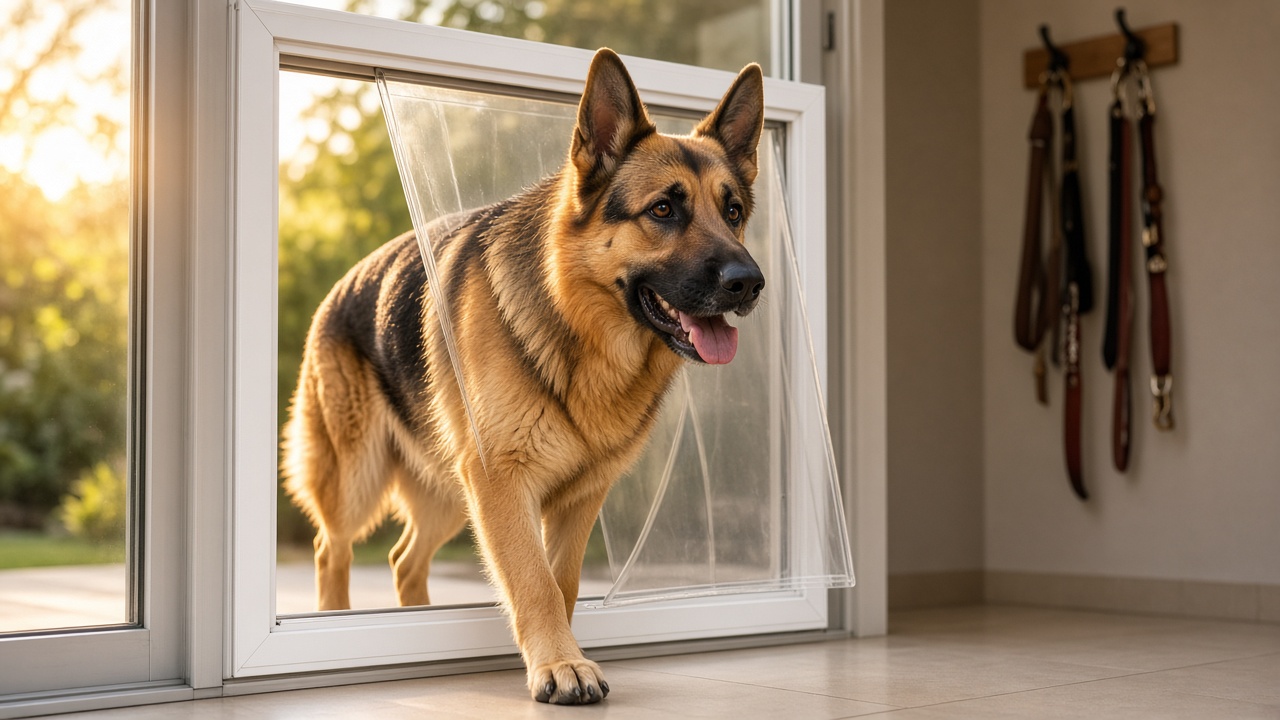
A patio cat door is a tall, narrow panel. It sits in the same track as your sliding glass door. You close the human slider against that panel.
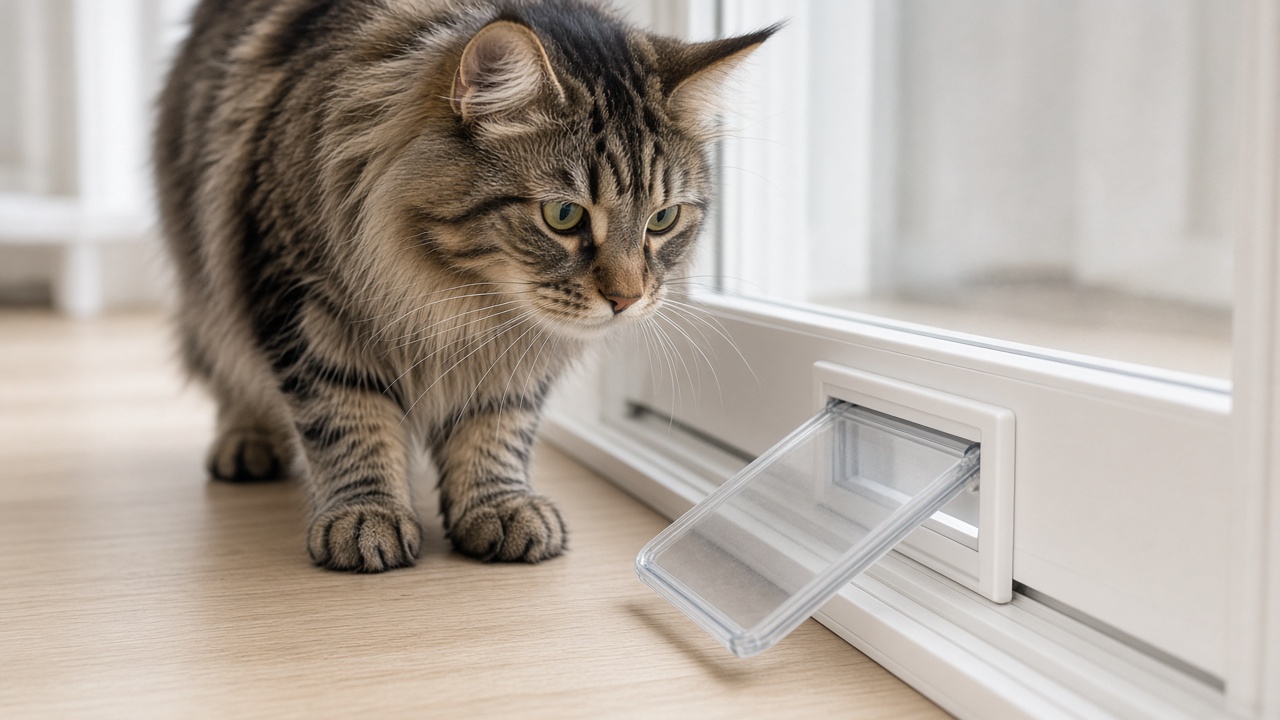
The cat uses a flap near the floor. The original glass stays whole. That is the point of a track insert.
The Consumer Product Safety Commission covers patio-type sliding glass doors in 16 CFR 1201.1. Those doors must use complying safety glazing. In 16 CFR 1201.2, the Commission defines tempered glass as glass that fractures if cut after treatment.
A track insert avoids that fracture. It also leaves a renter a way to remove the panel later.
The panel steals some walk-through width. Endura Flap Pet Doors lists the Small vinyl cat panel at 10 3/8 inches wide. PetSafe lists the Small two-piece frame at 8 1/2 inches wide.
Measure the remaining opening before you buy.
Top 7 Cat door for sliding glass door
The picks below are the 7 cat doors for sliding glass door on sale right now, listed with what each suits best and an honest drawback. Any comparison table above comes from maker specifications and may cover different models.
1. Hakuna Pets Dog Door for Sliding Glass Door
Best for: Homes sharing the flap with a dog
Hakuna Pets lists this as a dog door for a sliding glass door, so the flap is sized for a dog first. Maker pages describe a removable patio-track insert that does not cut the glass. Owners say the panel goes in quickly, then they spend extra time sealing drafts at the edges.
Pros: Removable sliding-door panel; Midrange dog-door price Cons: Opening oversized for cats
2. Dreampedal Cat Dog Door Insert for Sliding Patio Door
Best for: Budget shoppers with small pets
Dreampedal sells this as a cat-and-dog insert for a sliding patio door, and Amazon lists it under one hundred dollars. That is the budget end of this roundup. Owners call assembly simple, then they mention air slipping around the flap.
Pros: Lowest price on this list; Sold for cats and dogs Cons: Cheaper insert, leakier flap
3. Petoasis Cat Door for Sliding Glass Door
Best for: Cat-only households wanting a dedicated flap
Petoasis brands this as a cat door for a sliding glass door, not a leftover opening on a dog panel. It is the highest-priced insert here, which puts it in the premium tier. Maker pages stress a lockable flap; owners still say the track measurement has to be exact or the panel sits poorly.
Pros: Cat-specific door branding; Premium price, dedicated flap Cons: Steep cost for one cat
4. Ideal Pet Products Aluminum Pet Patio Door
Best for: Owners matching an aluminum patio slider
Ideal Pet Products names this an aluminum pet patio door, and that material is the buying decision. It is meant for an aluminum slider track, not a vinyl one. Owners like the no-cut install, then they warn that the wrong track type leaves gaps you cannot ignore.
Pros: Named aluminum patio door; Specialist patio-door brand Cons: Aluminum tracks only, not vinyl
5. FANTREK 7FT Cat Door for Sliding Glass Door
Best for: Homes with seven-foot sliding doors
FANTREK puts 7FT in the title, so this insert is aimed at a taller sliding glass door. The listing still sells it as a cat door, not a large-dog flap. Owners tell other buyers to measure the frame first; a seven-foot panel will not drop into a shorter track.
Pros: Named for seven-foot doors; Cat-door patio insert Cons: Useless on shorter sliders
6. PetSafe Sliding Glass Pet Door
Best for: Renters who want a familiar brand
PetSafe is the brand most owners already recognize, and this model is a sliding-glass insert rather than a hole cut in the door. The maker’s page pitches it for apartments and rentals that need a removable panel. Owners report a straightforward install, then they add weatherstripping because drafts still sneak through.
Pros: Familiar national pet brand; Removable rental-friendly insert Cons: Drafts need extra weatherstripping
7. Large Dog Door for Sliding Glass Door
Best for: Households that also own a large dog
This listing is sold as a large dog door for a sliding glass door, so the opening is built for a big dog. The price sits near the top of this set, without a household brand in the title. Owners who share a slider with a large dog get the flap they need; cat-only homes pay for unused space.
Pros: Large opening, as named; Upper-tier sliding-door insert Cons: Oversized for cat-only homes
Comparison: Cat door for sliding glass door at a Glance
Want to browse every option? See the full range of cat door for sliding glass door on Amazon →
The Track-Fit Rule we used
We used one rule to decide what entered this article. A model had to be a currently sold sliding-track insert. Its maker page also had to publish a numeric flap opening and a numeric track-height range.
That is the Track-Fit Rule. Flap size decides whether the cat can pass. Track height decides whether the panel will seat.
We left out wall-cut doors. We left out through-glass replacements that need a new pane. We left out screen patches with no listed height range.
We also left out listings that hid those two measurements. The rule is a data filter, not a quality ranking. A panel can pass it and still fail your track.
Retail product cards may appear after this article. This comparison uses maker-listed attributes only.
Five current inserts compared by published attributes
Four of the five cat-scale openings we compared are under 7 inches wide. The median listed width is 6.25 inches. That cluster is the practical cat door for a sliding glass door.
The fifth opening is wider. PetSafe lists the Extreme Weather medium flap at 8 3/4 by 13 3/16 inches. The same page rates that SKU for pets up to 40 pounds.
That SKU still meets the Track-Fit Rule. It is a shared cat-and-dog opening, not a cat-first cutout.
Height span is the other split. Four listed ranges cover less than 6 inches of track height. Only the Hakuna Pets mesh insert lists a span over 2 feet.
| Model | Flap opening | Track-height range | Frame and flap | Closing cover | Rise / step-over |
|---|---|---|---|---|---|
| PetSafe Sliding Glass Pet Door, 2-Piece (Small) | 5 1/4 × 8 3/16 in | 75 7/8–81 in | Aluminum, vinyl flap, tempered glass | Slide-in panel | 1 3/4 in |
| Endura Flap Vinyl Sliding Glass Cat Door (Small) | 6 × 11 in | 74–77.5 in (shortest band) | Vinyl frame, magnetic flap | Interior slide-in cover | 4 in |
| Ideal Pet FastFit Regular Cat Flap | 6 1/4 × 6 1/4 in | 75–77 3/4 in or 77 5/8–80 3/8 in | Tempered glass, clear vinyl flap | Not stated on maker page | 4 in |
| Hakuna Pets Mesh Patio Pet Door V2 (Small) | 6.7 × 9.1 in | 55.12–84.3 in | Aluminum, PVC flap, mesh + weather panels | Not lockable (maker note) | 1.38 in |
| PetSafe Extreme Weather Sliding Glass Pet Door (Medium) | 8 3/4 × 13 3/16 in | 75 7/8–81 in | Aluminum, dual-pane glass, 3 vinyl flaps | Closing panel + security bar | 1 3/4 in |
PetSafe rates the Small two-piece flap for pets up to 15 pounds. Ideal Pet Products rates the Regular Cat Flap for 2 to 12 pounds. Endura Flap Pet Doors lists a recommended pet height of 9 to 15 inches on the Small vinyl cat flap.
Ideal Pet Products also lists a Chubby Kat FastFit flap at 7 1/2 by 10 1/2 inches. That SKU is rated for pets from 2 to 25 pounds. Use it if the 6 1/4-inch square opening looks tight.
Hakuna Pets lists a 1.38-inch frame thickness on the Small V2. The same page lists a 1.38-inch step height. Endura Flap Pet Doors says the vinyl panel needs a channel at least 1 1/2 inches thick.
Those thickness numbers decide vinyl-slider fit, not flap width.
Measure the track before you order
Do the Track-Fit Check in this order. First measure track height. Then measure channel thickness.
Then measure the cat.
Endura Flap Pet Doors says to measure from the innermost bottom track to the innermost top track. Include a pencil rail if the panel will straddle it.
PetSafe lists a 5 1/8-inch adjust span on both glass panels. The listed band is 75 7/8 to 81 inches. Ideal Pet Products splits the same problem into two SKUs.
The Shorty band is 75 to 77 3/4 inches. The Standard band is 77 5/8 to 80 3/8 inches. A 79-inch track misses Shorty and fits Standard.
A 76-inch track fits Shorty. It also fits the shortest Endura Flap band of 74 to 77.5 inches. Both PetSafe glass panels cover 76 inches as well.
Hakuna Pets is the height outlier. The Small V2 lists a minimum of 55.12 inches and a maximum of 84.3 inches. That span can cover a short slider or a tall one.
It does not change the lock story. Hakuna Pets states that the flap is not lockable. You remove the panel to lock the human door.
Channel thickness is the silent fail. Endura Flap Pet Doors says the vinyl cat panel will not work with monorail tracks. The same page says the panel can be trimmed up to 5/16 inch from the top.
That trim is a fine fit. It is not a substitute for the 1 1/2-inch channel.
For the cat, use the maker’s own method. Ideal Pet Products says to measure shoulder width. Then measure from the top of the back to the bottom of the chest.
Pick an opening wider and taller than those two numbers. PetSafe lists a 10-inch shoulder-height guide on the Small two-piece door.
Weather, drafts, and what the specs actually claim
We did not run energy tests. The published weather claims still split the field.
Endura Flap Pet Doors says the flap stays shut in winds up to 50 mph. The same maker compares the closing cover to 16-gauge steel. The vinyl cat page lists a one-piece install at 5 steps and 0.5 hours.
PetSafe describes the two-piece door as one magnetic flap with weather stripping. The Extreme Weather page lists dual-pane glass and three insulated flaps.
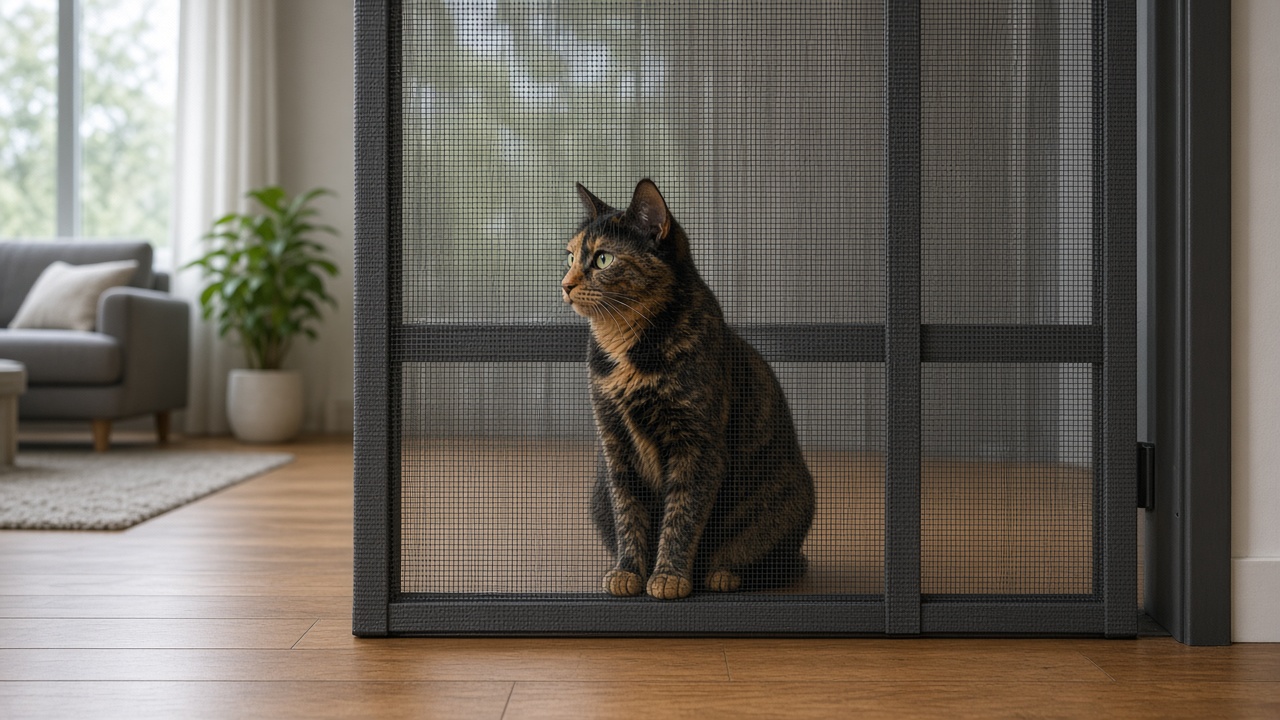
Hakuna Pets sells a fiberglass insect screen plus clear weather panels. Those panels slide in as a draft block, not a lock.
Ideal Pet Products lists single-pane tempered safety glass and a weather strip against the slider. None of these pages replace a closed human slider in a storm. A cover still needs a seated panel and intact weatherstrip.
Security, wildlife, and when a gate is the better tool
A flap is a hole with a hinge. Endura Flap Pet Doors says its door is manual. The same FAQ offers no guarantee that small animals will stay out.
The maker says the magnets are hard for small critters to push. That is a claim, not a wildlife trial.
Four of the five models publish a closing cover or panel. Use it at night if wildlife is active. Hakuna Pets tells you to pull the insert and lock the slider instead.
The human door still needs a lock. PetSafe includes a latch kit on the two-piece door. The Extreme Weather door includes a security bar.
Endura Flap Pet Doors includes a SlideLock. The height-adjustment locks face indoors. The maker says the panel cannot be lifted from outside.
A patio flap is the wrong tool if the cat should stay inside. The American Veterinary Medical Association counts 76.3 million owned cats in the United States. Those 2025 Sourcebook figures appear on the AVMA site.
The same AVMA table lists cats in 32.6 percent of households, or 43.1 million homes. The listed average is 1.8 cats per cat-owning household. Many of those cats never need a yard hole.
If the goal is room-to-room access, keep the patio sealed. A pet gate with a cat door handles indoor rooms.
Supervised outdoor time is another path. A safest cat harness keeps the outing on a leash. A modern cat tree adds height indoors.
Training and the limits of this comparison
PetSafe says most pets learn a pet door in 1 to 3 days. That figure is the maker’s training note. It is not a trial we ran.
Hold the flap open at first. Reward a pass. Then let the flap rest on the back.
Endura Flap Pet Doors describes its flap as a little foggy but still see-through. A visible far side helps a cautious cat.
This article has limits. We compared five maker pages. We did not open every height SKU Endura Flap Pet Doors sells.
We also skipped a full Andersen or Pella map. Endura Flap Pet Doors warns that those tracks need extra build-out.
We did not score “best.” The Track-Fit Rule only decides what has enough published numbers. Your track, channel, and cat measurements decide the buy.
FAQ
Can I put a cat door in a sliding glass door without cutting the glass?
Yes. A track insert is the usual method. The Consumer Product Safety Commission treats patio-type sliding glass doors as safety-glazing products under 16 CFR 1201.1.
A panel leaves that tempered pane intact.
What flap size fits a typical house cat?
Start with openings under 7 inches wide. PetSafe lists 5 1/4 by 8 3/16 inches on the Small two-piece door. Ideal Pet Products lists 6 1/4 by 6 1/4 inches on the Regular Cat Flap.
Endura Flap Pet Doors lists 6 by 11 inches on the Small vinyl cat door.
Will a vinyl sliding door take these panels?
Only if the channel matches the maker’s thickness note. Endura Flap Pet Doors requires a vinyl channel at least 1 1/2 inches thick and rejects monorail tracks. Hakuna Pets lists a 1.38-inch frame, so measure your track.
Can I still lock the sliding door after the panel is in?
On four of these models, the maker lists a latch, bar, or SlideLock. PetSafe includes a latch kit or a security bar, and Endura Flap Pet Doors includes a SlideLock. Hakuna Pets says you remove the insert, then lock the slider as usual.
Do these flaps keep out raccoons or stray cats?
A closing cover is the only listed control that fully blocks the opening. Endura Flap Pet Doors says a manual flap cannot guarantee pest exclusion. If wildlife pressure is high, close the cover or remove the panel.
What if I rent and cannot alter the door?
Pick a removable insert with a published height range that matches your track. PetSafe describes adhesive or screw options and a removable two-piece body. Hakuna Pets describes a tool-free slide-in install.
Should an indoor-only cat have a patio flap at all?
Not by default. The AVMA’s 2025 figures put 76.3 million owned cats in U.S. homes, and many of those cats live without yard access. Use a flap only if outdoor time is an intentional plan.