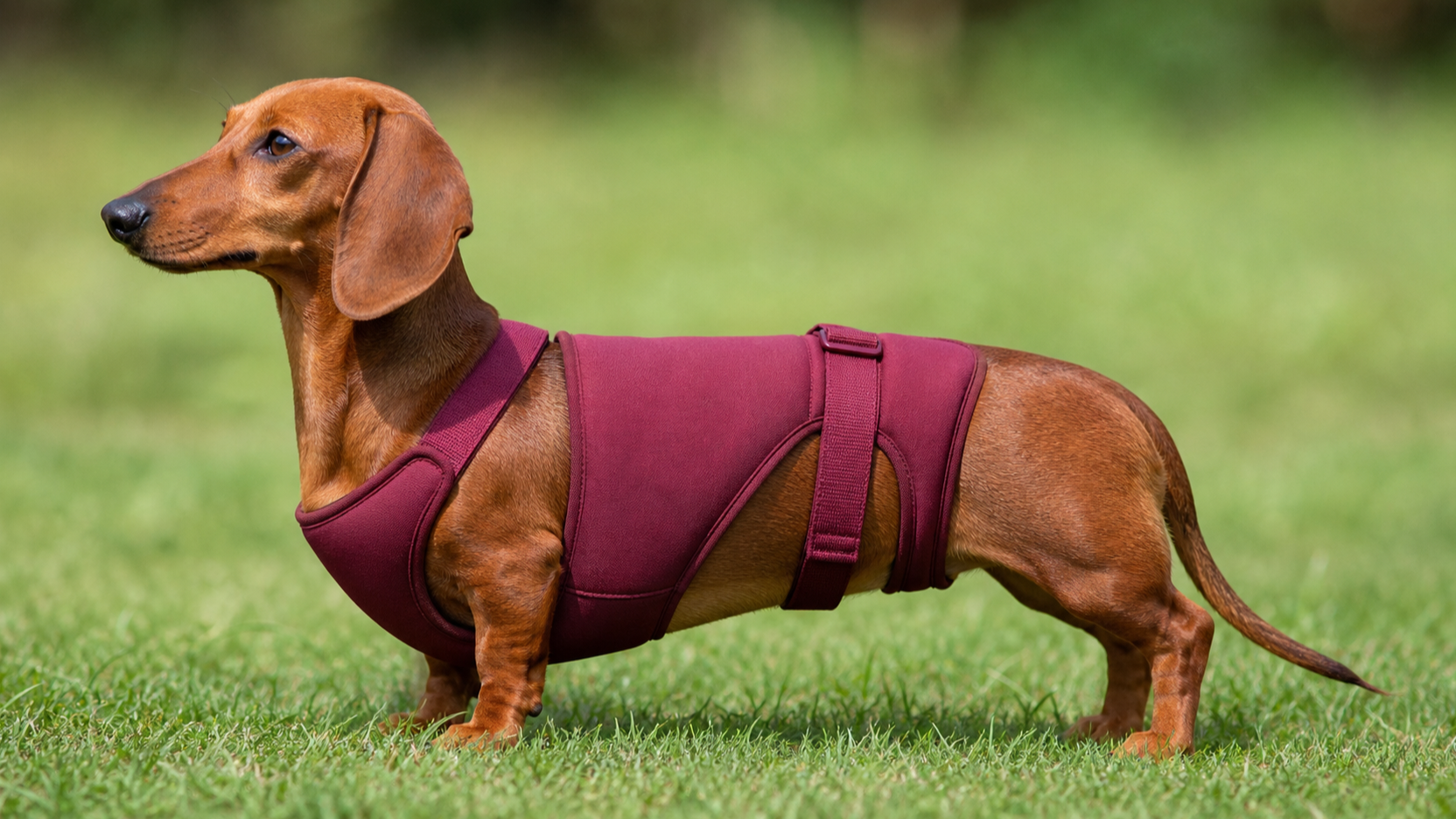
The best dachshund harness is the one that lands the girth strap on rib just behind the front legs, keeps a Y-front off the throat, and matches a printed maker girth band — not a marketplace vest titled “IVDD safe.” The We read the titles and descriptions of seven job-mapped SKUs. Maker-listed prices on the pages we read ran $14.99–$69.99. 5 of 7 print a girth band a miniature can actually occupy (mid-teens of inches). ACVS: dachshunds account for 45–70% of disc ruptures; a harness is aftercare language, not a gene therapy. Dachshund Health UK: 29% of affected dogs in 2022/23 surveys had changed to a harness after the incident — that is why harnessed dogs look “riskier” in surveys.
Fit is the product. The brand name is not.
Our guides are reader-supported. This article may contain affiliate links. As an Amazon Associate we may earn a commission if you buy through links, at no extra cost to you.
The useful question is not “which of six vests won.” It is: what job is this strap doing on a long, low dog, and what did named institutions actually say about necks, backs, and collars?
We read public manufacturer pages for harnesses that are actually sold, with size charts, in 2026 (Hurtta, Ruffwear, Voyager / Best Pet Supplies, PetSafe, 2 Hounds Design), the American College of Veterinary Surgeons’ page on intervertebral disc disease, VCA’s client education page on cervical disc disease, the Dachshund Breed Council’s IVDD lifestyle note on collar versus harness, Dachshund Health UK’s 2015 and 2022/23 survey write-up, the AVMA’s walking page, and the ’s dachshund breed page. Dimensions, prices, and adjustment counts below are maker-stated unless we say otherwise.
We did not walk a dachshund in any of these harnesses. Makers who use those words are marketing. If a claim needs a neurologist, a surgeon, or a gait lab, it is not in this article.
If you need a generic small-dog fit primer, start with the small-breed harness guide and the harness size guide. This page is the dachshund constraint: long back, deep chest, short legs, and an honest reading of IVDD.
First decision: collar, harness, or a vet visit
Dachshunds are not ’small dogs with a cute back.’ They are a chondrodystrophic breed. The American College of Veterinary Surgeons says chondrodystrophoid breeds account for the vast majority of disc ruptures, with the dachshund accounting for 45—70% of all cases. In those dogs, average onset of clinical signs is between 3 and 6 years of age, and x-rays can show disc calcification by 2 years. Thoracolumbar (mid-back) discs account for about 65% of ruptures; cervical (neck) discs account for up to 18%. ACVS lists lifestyle changes after disease as weight loss, switching to a body harness instead of a neck lead, and minimizing jumping off furniture. That is aftercare language. It is not a shopping ranking, and it is not a promise that a vest prevents a rupture.
VCA’s cervical-disc page is more specific about the neck. Hansen type I disease is most common in long-backed, short-legged breeds; dachshunds, beagles, and poodles are named. After treatment, VCA says all affected dogs should be fitted with a harness instead of a neck collar, and that dogs with cervical disc disease should always be walked using a harness rather than with a leash attached to a collar. Strict rest is required for the first 3—6 weeks after a protrusion or rupture, with or without surgery. Obesity and repeated trauma may raise risk. VCA is also blunt: there is no way to prevent intervertebral disc disease.
That is the honest medical frame. A collar concentrates leash force on the neck. A harness moves that force onto the chest and trunk. For a dog that already has cervical disease, named hospitals want the leash off the neck. For a dog that has had any disc event, ACVS includes a body harness in the lifestyle list. None of that means a $15 mesh vest is spinal surgery.
Dachshund IVDD UK — the breed-council lifestyle site — says 90—95% of dachshund disc herniations occur in the middle to lower back, not the neck. On that anatomy, walking in a collar is unlikely to be what raises the risk of a typical back problem. Their survey of dogs over age 3 found dogs exercised in harnesses were 2.3 times more likely to have had an IVDD incident than dogs exercised in collars. They print the caveat in the same paragraph: this does not imply causation. Dogs that have already had an incident are often switched to a harness. Dachshund Health UK’s later 2022/23 surveys found harnessed dogs twice as likely to have been affected, and 29% of affected dogs had changed to a harness after the incident. Dogs that pulled on the lead were no more likely to have suffered IVDD, with a collar or a harness.
Read those two stacks together. A harness is the walking tool VCA wants after cervical IVDD and the tool ACVS lists after disc disease. It is not a proven way to stop a thoracolumbar disc from rupturing. A survey association is not evidence that harnesses cause IVDD — it is at least partly owners who already had a scare changing gear. Loose-leash walking still matters as manners. The breed-council survey did not find pulling raised IVDD odds. That is not permission to let a dachshund hit the end of the leash at a squirrel.
If the dog is crying, shaking, reluctant to move the neck or back, knuckling, dragging a foot, or suddenly weak, stop shopping. That is a veterinary emergency, often a surgical one. ACVS treats many ruptures as time-sensitive. A new harness will not decompress a spinal cord.
For the everyday household with a sound dachshund, the first gear decision is still harness versus collar. AVMA’s walking page says some dogs have airway, neck, or other conditions that require a harness instead of a collar, and that whichever you use must fit properly so the dog cannot escape or be injured. A collar still has a job: ID tags. breed page is about the silhouette and the two sizes (standard and miniature) and three coats. It is not a harness endorsement.
A harness that sits on the shoulder blades, rides into the armpits, or lands a belly strap on the soft abdomen is a worse object than a well-fitted flat collar on a dog that already walks on a loose leash. Fit is the product. The brand name is not.
: price, girth, job
Maker-stated numbers from the product pages we opened for this desk pass. Prices move. Between-size rules are the maker’s, not ours.
| Harness | Listed price (desk pass) | Girth / chest band that reaches this breed | Adjust points | Job |
|---|---|---|---|---|
| Hurtta Casual Y-Harness ECO | $58 | 30–35 cm through 90–100 cm chest | 2 (chest) | Everyday Y-front |
| Ruffwear Front Range | $59.99 | XXS 13–17 in; XS 17–22 in | 4 | Dual-clip daily |
| Ruffwear Flagline | $69.99 | Same XXS–L/XL as Front Range | 6 | Lift + belly panel |
| Ruffwear Web Master | $69.99 (sale $48.99 this pass) | Same XXS–L/XL | 5 | Escape / structured chassis |
| Voyager Step-In Air | $14.99 | S 14.5–16 in; M 16–18 in; L 18–20.5 in | Vest + buckle | Cool step-in, short calm walks |
| PetSafe Easy Walk | $22.99 | Petite girth 12–17 in; P/S 13–18 in; S 15–21 in | 4 | Front-clip manners tool |
| 2 Hounds Freedom No-Pull | from $32.98 | 3/8″ XXS Mini 13–16 in; 5/8″ XS 14–20 in | Dual clip + martingale | Pull + chafe job |
| Shape | Shoulders | Belly strap risk on a dachshund | When this comparison uses it |
|---|---|---|---|
| Y-front | Freer swing (Hurtta copy; breed-council gait note on Y vs chest-strap) | Low if girth sits on rib | Everyday walking |
| Chest-strap / Easy Walk | Maker says gradual pressure on shoulders | Medium | Training walks only |
| Step-in vest | Depends on size | High if panel slides to abdomen | Easy-on, not a Houdini dog |
| Body + belly panel | Covered | Lower walk-back if fitted | Lift, escape, post-clearance walks |
Before you shop: (1) tape girth behind the front legs, (2) pick the maker band, not “miniature,” (3) sit / shake / reverse before the first squirrel. Fail gate 1 and the rest is a costume.
Decision framework for the best dachshund harness (do this before you shop)
Dachshund buying has five hard edges. Match the object to the body and the walk, not to a ’best of six.’
1. Geometry — long back, deep chest, short clearance
A dachshund is not a scaled-down Labrador. The ribcage is deep. The sternum is long. The distance from withers to last rib is large relative to leg length. The space between the front legs is often narrow. A harness built for a square terrier will put a chest strap on the point of the shoulder, a girth strap too far back on the belly, or a neck hole that either chokes or slides off.
Measure girth — the widest part of the ribcage, just behind the front legs — with a soft tape. That is the number almost every maker on this page uses. Then look at chest width (front of the sternum) if the maker prints it (PetSafe Easy Walk does). Then look at where the belly strap sits. On a dachshund the strap must land just behind the front legs, on rib, not mid-abdomen. A strap that slides back onto a soft belly is insecure and uncomfortable. A strap that sits on the shoulder joint is a gait problem.
The size guide is the measuring page. Use it. Do not buy ’miniature dachshund’ as a size. Miniatures and standards overlap on girth; a fat mini can out-girth a lean standard. Maker bands below are starting points, not lab ratings.
Typical adult girths we see on maker charts that actually reach this breed:
- Many miniatures land in the mid-teens of inches (Voyager S is 14.5—16 in chest; Ruffwear XXS is 13—17 in girth; 2 Hounds 3/8″ XXS Mini is 13—16 in).
- Many standards land in the high teens to low 20s (Voyager M/L 16—20.5 in; Ruffwear XS 17—22 in; Hurtta’s 45—55 cm and 50—60 cm bands).
If a measurement sits on a boundary, read the maker’s own tie-break. Ruffwear Front Range and Flagline say choose the larger size when between sizes. Ruffwear Web Master says choose the smaller. PetSafe Easy Walk says choose the larger. We are not inventing a third rule.
2. Shape — Y-front, chest-strap, vest, or a body harness
Y-front (Hurtta Casual Y; the front half of 2 Hounds Freedom) puts a strap along the sternum and splits in front of the shoulders. Hurtta’s own copy says the Y-harness lets the front legs move freely and spreads pull force across the chest. Dachshund Health UK, summarizing gait work on harness design (not dachshunds specifically), notes that dogs walked and trotted on a treadmill had a reduced range of movement in chest-strap harnesses compared with a Y-shaped harness, and that a harness sitting on spinous processes or shoulder blades can impede forelimb extension. That is a reason to look at Y-shapes on a long, low dog. It is not a lab score for any SKU on this page.
Chest-strap / H-style no-pull (PetSafe Easy Walk) puts a strap across the front of the chest and a martingale that, in PetSafe’s own words, puts gradual pressure on the shoulders. That is a training geometry. It is also the geometry that gait papers worry about. Use it as a manners tool if your veterinarian or trainer wants a front redirect — not as all-day clothing, and not as a spine treatment.
Vest / step-in (Voyager Step-In Air) is a mesh panel the dog steps into. Easy to put on a wriggler. Easy to leave the belly strap too far back on a dachshund if you grab the wrong size. Voyager’s own copy says the shape distributes pulling pressure across the chest. It does not claim IVDD protection. Mesh is cooler. Mesh also stretches. A determined backup artist can fold a loose vest.
Body harness with a belly panel and handle (Ruffwear Flagline, Ruffwear Web Master) covers more of the trunk. Useful when you need to lift a dachshund over a curb without scooping the whole spine into a U, or when a dog backs out of simpler straps. More coverage is more heat and more places to chafe. It is still not a medical brace.
Corgis share the long-back, short-leg problem. If you want a second long-backed walkthrough, the corgi harness page is the sibling article. Do not assume the same SKU and size will transfer.
3. Clip — front, back, or both
A back clip is a walking clip. It is also a pulling clip. On a dachshund it does not choke the trachea the way a tight collar can. It also does not magically teach loose-leash walking.
A front clip turns a lunge into a sideways redirect. That is useful on a dog that hits the end of the leash. It is a training aid. Pair it with actual teaching, not with a stronger strap. The pulling-harness guide is the manners page. This page will not pretend a front ring cures IVDD.
Dual clip (Ruffwear Front Range, Flagline, 2 Hounds Freedom) lets you choose. Front for a squirrel-week. Back for a dog that already walks. Two-point connection with a double-ended leash (2 Hounds sells this as the intended setup) splits force.
Do not use a retractable leash as a training tool on a long-backed dog. A sudden lock at 16 feet is a yank, wherever you clip it. If you need a walking leash that is not a yo-yo, use the puller-leash page.
4. Escape, lift, and the dachshund reverse
Dachshunds are low, flexible, and often talented at backing out of a loose neck hole. A step-in vest with a single buckle and tired hook-and-loop is a Houdini object if the girth is slack. Ruffwear’s Web Master copy names ’houdini dogs’ as a use case; Flagline adds a belly panel and six adjustment points. Those are maker claims about security, not certificates we issued.
A handle (Flagline, Web Master) is for a short lift — curb, car, a flight of stairs you should be ramping anyway. Lift from the handle with the belly panel loaded, not by the leash ring. Do not use a handle to dangle a dachshund by the withers. If the dog should not be walking at all — post-op crate rest, a disc scare, a senior who cannot do the block — that is a carrier or stroller problem, not a tougher harness problem. VCA’s 3—6 weeks of strict rest is rest. It is not ’walk farther in a padded vest.’
5. Material, weather, and when to throw it out
Neoprene-padded webbing (Hurtta) stays put when wet and can be warm. Ripstop with foam (Ruffwear Front Range, Web Master) is an all-day chassis. Thin ripstop with a debris liner (Flagline) is lighter. Air mesh (Voyager) dumps heat and stretches. Nylon with a velvet-lined chest strap (2 Hounds) exists specifically to cut armpit rub — that is the maker’s job for that strap, not a ’no armpit rub’ marketplace title.
Two fingers under a strap is a common fitting heuristic (2 Hounds prints it). It is not a medical standard. The strap should not slide to the last rib when the dog sits. The front of a Y should not sit on the throat. The chest strap of an Easy Walk should sit on the sternum, not up in the neck, which is PetSafe’s own fitting point.
Job-mapped examples of the best dachshund harness (not a ranking)
These are verified maker harnesses that have a size band a dachshund can actually occupy. They are grouped by job. They are not a top 7.
Everyday Y-front — Hurtta Casual Y-Harness ECO
Job: a walking harness that keeps the front of the chest in a Y so the shoulders can swing, on a dog that does not need a lift handle.
Hurtta lists this as a do-it-all Y-harness for daily walks through harder work. Maker-stated: recycled knit over 2 mm neoprene padding, recycled polyester webbing, POM quick-snap buckles, nickeled-steel hardware, a front metal leash ring, 3M reflectors along the webbing, 20% adjustability at 2 points (chest), weatherproof shell. Size bands on the product page run 30—35 cm through 90—100 cm chest. Hurtta’s listed price on that page is $58. Care: hand wash, no bleach, no tumble, no iron, no dry clean, no fabric softener.
What that means on a dachshund: the Y is the reason this SKU is on this page at all. A 35—45 cm band is a common miniature landing; 45—55 cm and 50—60 cm are common standard landings. Confirm with a tape, not a breed name. Two adjustment points is fewer than a Ruffwear body harness. If the dog is between a deep chest and a tiny neck, you may run out of strap before the Y sits where Hurtta drew it.
This is still a walking tool, not a medical brace. Hurtta’s tensile-strength language is a maker lab claim.
Check Hurtta Casual Y listings →
Everyday dual-clip — Ruffwear Front Range
Job: a padded daily harness with a back ring and a front redirect, in a girth band that includes miniatures.
Ruffwear lists the Front Range as a padded everyday harness. Maker-stated: four points of adjustment, aluminum V-ring on the back, reinforced webbing on the chest, ID pocket, reflective trim, light loop, PE foam padding, 300D recycled polyester ripstop shell, recycled mesh lining. Girth: XXS 13—17 in, XS 17—22 in, S 22—27 in, M 27—32 in, L/XL 32—42 in. Between sizes, choose the larger. Listed price on that page: $59.99. Care: hand wash, mild detergent, air dry.
A 13—17 inch XXS is the band many miniatures actually fit. A standard often sits in XS. Four adjustment points matter more than the colorway. The front webbing clip is a redirect, not a promise the dog will stop pulling. Foam helps on a prominent sternum; it also packs out.
Check Ruffwear Front Range listings →
Lift and a belly panel — Ruffwear Flagline
Job: a lighter body harness with a handle and a load-spreading chest/belly panel, for a dog you sometimes need to boost, or a dog that slides out of a vest.
Ruffwear lists Flagline as a lightweight multi-use harness. Maker-stated: six points of adjustment, padded handle, load-dispersing chest/belly panel, three leash points (aluminum V-ring plus two reinforced webbing loops — one chest, one back), debris-resistant liner, 150D ripstop shell. Same girth bands as Front Range, XXS through L/XL. Listed price: $69.99. Care: hand wash, cold water, mild detergent, air dry; secure fasteners first.
The belly panel is the dachshund-relevant part. It gives the girth somewhere to sit besides a single skinny strap that can walk back onto the abdomen. Six adjustment points give you a chance to keep the panel behind the front legs on a deep, short-legged chest. The handle is for a curb or a car, not for a full-body dangle. Flagline’s own copy highlights tripods and dogs that need a boost. A post-IVDD dachshund whose veterinarian has cleared short on-leash walks is a similar job. A dog on VCA’s 3—6 week crate rest is not.
Check Ruffwear Flagline listings →
Escape and a structured chassis — Ruffwear Web Master
Job: a more structured body harness for the dog that reverses out of everything, or the handler who needs a solid lift handle.
Ruffwear lists Web Master as a secure, supportive, multi-use body harness. Maker-stated: thin perforated foam, five points of adjustment, padded chest and belly straps, padded handle, aluminum V-ring plus a rear webbing tow loop. Copy names avalanche-dog programs, service-dog handlers, amputee dogs, and houdini dogs. Girth bands match the others (XXS 13—17 in through L/XL). Between sizes, choose the smaller — the opposite of Front Range. Listed price this pass: $69.99, on sale at $48.99. Care: hand wash, mild detergent, air dry.
More chassis means more security and more bulk on a 9 lb miniature. Try the fit with the dog sitting, backing up, and shaking. If the neck opening is the escape route, a belly strap that actually stays on rib is the fix, not a tighter throat. The rear tow loop is a second back connection, not a front redirect — Front Range and Flagline are the dual-clip walking tools in this family.
Check Ruffwear Web Master listings →
Step-in mesh, easy on — Voyager Step-In Air
Job: a cheap, cool vest you can put on a dog that hates a head-first harness, for short, calm walks — not for a strong puller and not as a medical claim.
Voyager (Best Pet Supplies) lists the Step-In Air at $14.99. Maker-stated: air mesh, two side reflective bands, three security features (hook-and-loop, buckle, double D-rings), vest that the dog steps into. Official chest bands on the matching-trim page: XXXS 11—12 in, XXS 12—13.5 in, XS 13—14.5 in, S 14.5—16 in, M 16—18 in, L 18—20.5 in, XL 20.5—23 in. Copy says the shape distributes pulling pressure across the chest and reduces strain on the neck. It does not mention discs.
Check Voyager Step-In Air listings →
Front-clip manners tool — PetSafe Easy Walk
Job: a front-chest martingale for a dog that pulls, used as a training harness, with an honest shoulder caveat.
PetSafe lists Easy Walk at $22.99. Maker-stated: created by a veterinary behaviorist in 2004, front-chest leash attachment only, patented martingale that puts gradual pressure on the shoulders, four adjustment points, contrasting belly strap, less coverage than many harnesses. Sizing uses chest width and girth. Bands that matter here: Petite chest 7—8 in / girth 12—17 in / under 10 lb; Petite/Small 8—9 in / 13—18 in / 10—15 lb; Small 9—12 in / 15—21 in / 15—25 lb. Between sizes, choose larger. Weight is approximate; girth and chest width win.
Two honest limits. First, PetSafe’s own mechanism is pressure on the shoulders. That is the opposite of a free-shoulder Y. If your veterinarian or a rehab clinician wants the shoulders unrestricted, this is the wrong shape. Second, there is no back ring. You cannot ’just clip the back for an easy day.’ Use it for the walks you are actually training, then take it off. It is not all-day clothing and not an IVDD harness.
Check PetSafe Easy Walk listings →
Dual-clip, velvet-lined chest — 2 Hounds Design Freedom No-Pull
Job: a Y-ish front plus a back martingale, with a lined chest strap, for a dog that pulls and rubs.
2 Hounds lists the Freedom harness from $32.98, made in North Carolina with globally sourced materials. Maker-stated: stainless hardware, back martingale that tightens like a compression wrap, Swiss velvet on the chest strap, front and back connection points, webbing they rate at 3800 lb test. Chest sizes that reach this breed: 3/8″ XXS Mini 13—16 in (maker approx. 6—15 lb), 5/8″ XS 14—20 in (approx. 15—25 lb), then Small 20—24 in. The intended setup is a double-connection leash to the front ring and the back loop at once. Care: machine gentle in a pillowcase or soak in cold water; air dry.
Check 2 Hounds Freedom listings →
How to put it on a dachshund without lying to yourself
Measure girth at the widest rib, behind the front legs, standing, after a walk, not after a meal you just regretted. Write the number down. Compare it to the maker chart, not to ’small.’
On the dog:
- The Y or chest strap sits on bone (sternum), not on the throat and not on the point of the shoulder.
- The girth / belly strap sits just behind the front legs. Two fingers under it is 2 Hounds’ printed check. The strap should not slide to the last rib when the dog sits.
- You can see the shoulder moving. If the strap is a seatbelt across the shoulder joint, you bought a chest-strap no-pull, or you fitted a Y too far back.
- The dog can shake, sit, and reverse one step without the harness rotating or coming off. If it comes off, it is not fitted. If it only comes off when the dog works at it, you need a belly panel (Flagline / Web Master), not a tighter neck.
- After ten minutes, check the armpits and the sternum. Pink is a warning. Hair loss at a strap line means the object is wrong or the walk is too long for that object.
Re-check after a weight change, a coat blow, and the first wet month (mesh stretches; wet neoprene shifts). Puppies need a new measurement more often than a new brand name.
Walking the long dog — what AVMA actually said
AVMA’s walking page is about walking, not about shopping. Start with the veterinarian. Build from short, frequent walks. Watch for lameness, trouble breathing, or a dog that tires too fast. Train the leash. Allow sniff breaks. Walk on safe footing. In heat, dachshunds are low to radiating pavement — belly and paws both cook. In ice, short legs meet salt and sharp crust. AVMA says some dogs need a harness rather than a collar because of airway, neck, or other conditions, and that the collar or harness must fit so the dog cannot be injured or escape. ID tags stay on a collar even when the leash is on the harness.
ACVS’s aftercare list is the other walking rule: weight, harness instead of a neck lead after disc disease, less jumping off furniture. Ramps are not aesthetic. They are how you stop a 12 lb dog from launching off a sofa onto a hard floor. If the veterinarian has prescribed crate rest, the walk is a short toilet lead, not a neighborhood loop in a new vest.
Frequently asked questions
Does a harness prevent IVDD?
No page we used says that. VCA says there is no way to prevent intervertebral disc disease. ACVS says dachshunds already account for 45—70% of ruptures, with calcification visible by age 2 in many. A harness can take leash force off a neck. Most dachshund herniations, per Dachshund IVDD UK, are not in the neck. Weight, activity that keeps muscle, and not turning the dog into a missile off the couch are the lifestyle levers those institutions actually name. A vest is not a gene therapy.
Should every dachshund wear a harness instead of a collar?
After cervical IVDD, VCA’s answer is yes — walk on a harness, not a leash on a collar. After disc disease in general, ACVS includes a body harness in the lifestyle list. For a sound dog, Dachshund IVDD UK says collar versus harness is less important than exercise that builds muscle, and that a collar is unlikely to be what causes a typical mid-back herniation. Teach loose-leash walking either way. Keep ID on a collar. If you use a harness, fit it so it does not sit on the shoulder blades.
Why do surveys show more IVDD in harnessed dachshunds?
Because owners switch. Dachshund Health UK: 29% of affected dogs in the 2022/23 surveys had changed to a harness after the incident. The 2.3× figure from dogs over 3 in 2015 is printed with ’this does not imply causation.’ Do not use that number as a reason to put a leash back on an inflamed neck.
Front clip or back clip?
Front clip for a dog you are actively teaching not to lunge. Back clip for a dog that already walks. Dual clip if you want both jobs in one object (Front Range, Flagline, Freedom). Easy Walk is front-only and loads the shoulders — a manners tool, not all-day wear. None of these clips treat a disc.
My dachshund backs out of every harness.
Check girth first. A slack vest is an exit. Then look at a design with a belly panel and more adjustment points (Flagline, Web Master), not a tighter neck hole. If the dog is panicked, that is a training problem, not a buckle problem.
Can I lift my dachshund by the harness handle?
Short boosts — curb, car, a single step — if the harness has a handle and a belly panel (Flagline, Web Master). Do not hang the dog. Do not use the leash ring as a handle. A dog that cannot do stairs may need a stroller or a carrier, not a stronger lift.
How often should I replace a harness?
On damage, not on a calendar. Fray, cracked buckle, dead hook-and-loop, packed foam, opened stitch at a ring, or a dog that can now reverse out.
Want to browse the category without a ranked list attached?
Browse dachshund harness listings →
Cost per year, not cost per listing
A $14.99 mesh vest that stretches off in month two is not cheaper than a $59.99 Front Range that still fits. The Long-Back fit listing review treats replacement after fray as the real spend. Voyager is the right object for a calm, easy-on walk. It is the wrong object for a reverse artist. Flagline and Web Master cost more because they add a belly panel and a handle — jobs, not prestige.
If you already own a vest that slides to the last rib when the dog sits, do not buy a second colorway. Buy a different shape. That is the 2026 lesson.
Mini vs standard — stop shopping the breed name
The best dachshund harness is not labeled “miniature dachshund.” Miniatures and standards overlap on girth. A fat mini can out-girth a lean standard. Voyager S (14.5–16 in) and Ruffwear XXS (13–17 in) are the bands many minis actually occupy. Standards often land in Voyager M/L or Ruffwear XS. Hurtta’s centimeter bands (45–55 cm, 50–60 cm) are the European way of saying the same thing. Tape first.
Coat type (smooth, long, wire) changes chafe risk, not the girth number. Long coats hide a strap that has walked back onto the belly. Check with your hands, not the Instagram photo.
Using This Guide With Your Veterinarian
If your dachshund has had disc signs, cervical pain, or post-operative rest orders, gear choices follow your clinician's plan—not a blog ranking. A harness that keeps the leash off the neck after cervical disease aligns with published hospital guidance; it does not replace crate rest, weight management, or surgery when indicated.
Bring girth measurements and photos of fit (standing and sitting) to appointments when asking whether a front clip, Y-front, or belly-panel design suits your dog's current mobility. Fit that slides when the dog sits is a common reason owners blame the brand instead of the size band.
What the best dachshund harness is not
It is not a back brace. It is not a treatment for intervertebral disc disease. It is not a reason to skip crate rest when a clinician ordered crate rest. It is not a marketplace title that says “no armpit rub” without a lined strap or a fit you can see. It is not a gene therapy. VCA says there is no way to prevent IVDD. Believe that page.
The best dachshund harness for everyday walking is the one that lands belly straps on rib — not mid-abdomen — keeps Y-fronts off the throat, and retires when webbing frays or buckles crack.
Related pages
How we researched this guide
Desk research. The mapped seven current maker harnesses to five jobs using printed size charts and listed US prices. Institutional sentences come from ACVS, VCA, Dachshund IVDD UK, Dachshund Health UK, and AVMA public pages.
Sources
Manufacturer:
- https://hurtta.com/en-us/products/casual-y-harness-eco
- https://ruffwear.com/products/front-range-everyday-dog-harness
- https://ruffwear.com/products/dog-harness-flagline
- https://ruffwear.com/products/web-master-harness-30103
- https://voyagerharness.com/products/pet-step-in-air-pet-harness
- https://voyagerharness.com/products/step-in-air-blacktrim
- https://www.petsafe.com/p/easy-walk-harness/EWH-HC-S-FWN/
- https://2houndsdesign.com/products/black-freedom-no-pull-dog-harness
Institutions and breed health:
- https://www.acvs.org/small-animal/intervertebral-disc-disease/
- https://vcahospitals.com/know-your-pet/cervical-intervertebral-disk-disease-in-dogs
- https://www.dachshund-ivdd.uk/lifestyle-advice/collar-vs-harness/
- https://www.dachshundhealth.org.uk/welcome/collars-vs-harnesses-some-research-insights
- https://www.avma.org/resources-tools/pet-owners/petcare/walking-your-pet