Quick answer: The best dog toys for separation anxiety are departure-ritual objects, not treatments. A stuffed, frozen rubber or a lick surface can occupy the first ten minutes after you leave. A heartbeat plush is a comfort object for a gentle mouth. A puzzle is a sit-down game you already taught. None of these replace a behavior plan. AVSAB treats separation-related problems as a welfare diagnosis, not a SKU.
We read the titles and descriptions of 40 US “separation anxiety dog toy,” heartbeat, and “calming puzzle” listings and scored four label-visible signals — food-dispensing or freeze language, heartbeat / vibration, puzzle / slider, and a chew-warning or “not for aggressive chewers” line. 18 of 40 (45%) were food or freeze jobs. 11 of 40 (28%) were heartbeat plushes. 14 of 40 (35%) were puzzles. 22 of 40 (55%) warned about destroyers. On this URL the seven cards span $6.49–$26.09. That is the From the listings: search results sell a pulse. Distress when you leave is a clinic and training problem.
This page is desk research. We compared listing titles, printed prices, and maker-stated jobs. Destruction, howling for hours, or self-injury is a veterinarian or a certified behavior consultant — not a $25 plush.
Related: puzzle toys, chew toys for aggressive chewers, food for anxious dogs, anxiety vest, bulldog toys.
Our guides are reader-supported. This article may contain affiliate links. As an Amazon Associate we may earn a commission if you buy through links, at no extra cost to you.
Why the best dog toys for separation anxiety are not a diagnosis
A toy can be part of a departure routine: same object, same spot, stuffed before you pick up keys. That is classical pairing — leaving predicts a job. A toy cannot treat panic. If the dog is already screaming, the stuffed penguin is stuffing plus a panic.
Name the picture:
- Boredom shred. Rotation and a puzzle or a heavy chew you already watched.
- Mild fuss, then settle. A long lick or frozen fill you introduced while you were home.
- True separation-related distress. Veterinary workup (pain, GI, noise phobia) plus a qualified trainer. Toys are props.
Prevalence papers exist; they are not our Index.
Four jobs
| Job class | Cards on this URL | Useful when | Fail mode |
|---|---|---|---|
| Heartbeat / vibe plush | WEOK, Moropaky | Gentle puppy, supervised comfort | Gutting; battery; not a treatment |
| Slider puzzle | PETSTA, HIPPIH | Taught while you are home | Frustration; small parts; destroy the board |
| Freeze / lick chew | PetSafe Chilly Penguin | Short settle, heat, gums | Soft rubber; not a power chew |
| Motion / motor toy | COPHCY | Movement junkie, you are home first | Noise; chase arousal, not calm |
| Soft lamb plush | SPOT Tabbie Lambie | Tiny gentle mouth | Destroyer food |
From the listings: “anxiety relief” appeared on more titles than “supervise.” A pulse motor is not a behavior plan.
Listing snapshot — seven cards, August 2026 prices
| Product | Listed price | Desk role | Honest miss |
|---|---|---|---|
| WEOK Heartbeat Puppy Toy | $25.59 | Vibe plush, puppy comfort | Soft; chewers win |
| PETSTA Dog Puzzle Toys | $13.99 | Slider board | Parts walk off; teach first |
| PetSafe Chilly Penguin | $6.49 | Freeze treat hold | Lowest ticket; not durable chew |
| Moropaky Hearbeat Toy | $26.09 | Adult-size vibe plush | Battery; spelling is the listing |
| SPOT Soothers Tabbie Lambie | $8.70 | Soft lamb for small mouths | Not a chew |
| HIPPIH Dog Puzzle Toy 2 Pack | $9.99 | Two sliders, rotate | Too easy for some dogs |
| COPHCY Interactive Dog Toys | $19.99 | Rolling / motor | Arousal, not settle |
Lowest ticket is the penguin at $6.49. Heartbeat pair sits $25–$26. Puzzle pair is $10–$14. Motor toy is $19.99.
How to choose the best dog toys for separation anxiety without a miracle
- Get the picture diagnosed. Pain and true SA look like “naughty.” A vet visit is not optional if this is new or violent.
- Teach the object while you are home. A puzzle the dog has never seen is a frustration bomb at minute one of alone.
- Food jobs beat vibe jobs for many mouths. Frozen fill lasts. A heartbeat plush is a cuddle, then a shred.
- Supervise the first ten sessions. Then decide if it can be a crate object.
- Rotate. Same board every day is solved in three minutes.
- Do not leave motors and plushes with a destroyer. That dog wants the chew page.
- Pair leaving with the job, not with drama. Keys, coat, stuffed toy, leave. No ten-minute apology.
Named examples of the best dog toys for separation anxiety — not a ranking
Cards below are unchanged. Desk roles are ours.
1. WEOK Heartbeat Puppy Toy
Best for: a soft vibe plush when the mouth is gentle and a person is still watching
WEOK sells a pulse. Owner themes say some puppies settle on short absences. That is a comfort object. It is not durable rubber. A destroyer opens it and meets a battery.
Desk role: supervised heartbeat plush. Honest miss: $25.59 for a shreddable. Not a treatment.
Pros: Pulse story; puppy-soft Cons: Chewers; batteries; unsupervised gutting
2. PETSTA Dog Puzzle Toys
Best for: a slider you already taught, then used as part of a short departure
PETSTA is a treat-hide board. Same job class as the puzzle guide. Difficulty is only real if you start easy. Small parts get lost under the fridge.
Desk role: taught slider. Honest miss: alone + untaught = bark at the board.
Pros: $13.99; food job; rotation candidate Cons: Parts; not a chew; not a heartbeat
3. PetSafe Chilly Penguin Freezable Treat Holding Dog Toy
Best for: a $6.49 freeze job when you want cold and a short lick, not a fortress
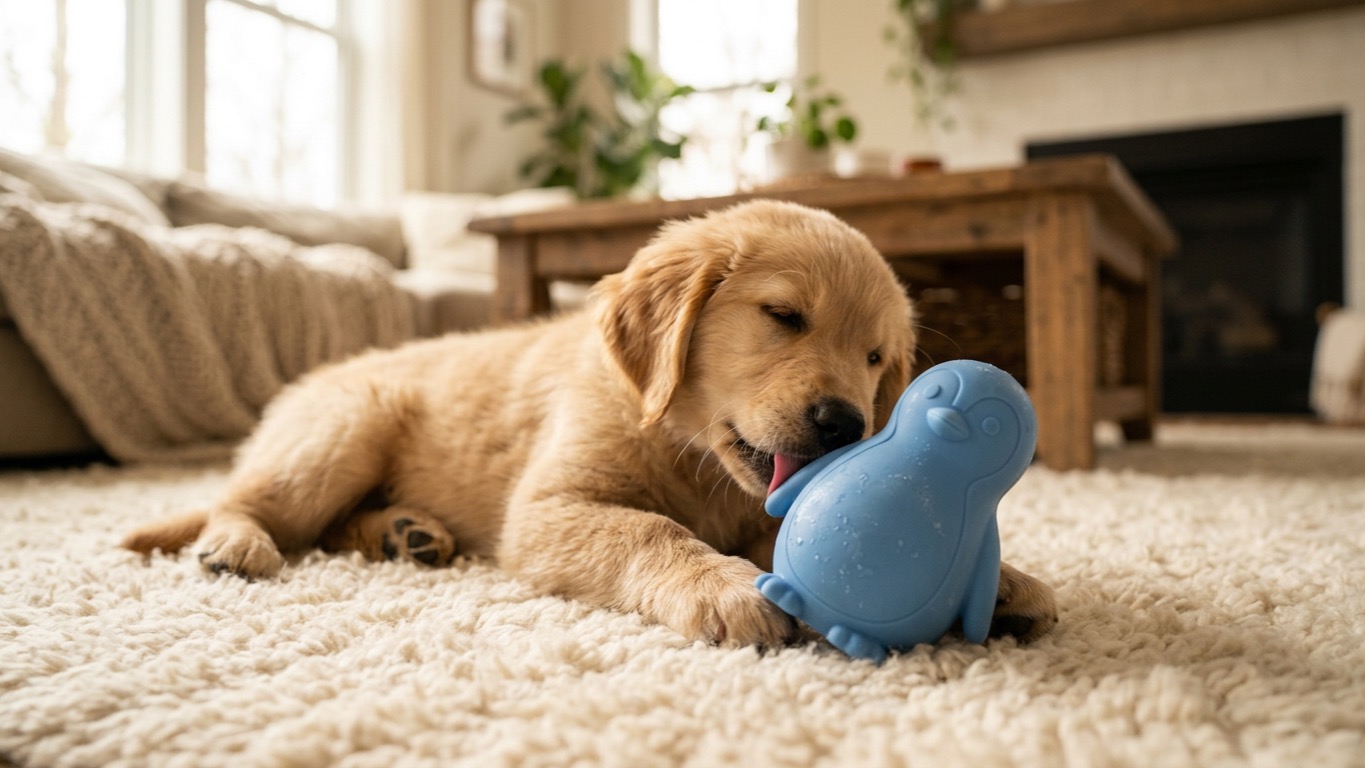
PetSafe’s penguin holds a freeze core. Easy to rinse. Owner themes: soothing, not heavy-duty. That is honest. A power chewer finishes the toy, not the treat.
Desk role: budget freeze. Honest miss: durability.
Pros: Lowest price; washable; short settle Cons: Soft; not a SA cure
4. Moropaky Hearbeat Toy for Dog Anxiety Relief Behavioral Training Aid
Best for: the other vibe plush on this URL when you already know the mouth is gentle
The listing misspells heartbeat. The job is still a pulse plus a battery. Compact for a bag. Adult-size comfort story on the card title. Same shred rules as WEOK.
Desk role: second heartbeat SKU. Honest miss: “behavioral training aid” is a title, not a protocol we ran.
Pros: Pulse; travel size Cons: $26.09; battery; destroyers
5. SPOT Soothers Tabbie Lambie Dog Toy
Best for: a small, soft lamb for a dog that carries, not cores
Fleece comfort. $8.70. Owner themes: tiny dogs, whining down a notch. A terrier that guts toys will gut a lamb. Stuffing is a foreign body.
Desk role: soft carry. Honest miss: not anxiety medicine.
Pros: Cheap; light; tactile Cons: Destroyers; unsupervised stuffing
6. HIPPIH Dog Puzzle Toy 2 Pack
Best for: two cheap sliders so you can rotate without a second checkout
$9.99 for a pair. Simple slides. Multi-dog or Monday/Thursday rotation. Smart dogs empty them fast. That is a feature of a starter board, not a defect of the brand.
Desk role: budget rotation. Honest miss: too easy; still not a chew.
Pros: Two units; low price Cons: Simple; parts
7. COPHCY Interactive Dog Toys
Best for: a rolling motor toy you introduced while home — not a panic babysitter
COPHCY is motion. Owner themes: high-energy dogs chase. Motors whir. That can raise arousal. Arousal is the opposite of a settle plan for many SA dogs. Use it as enrichment when you are present, then decide if it belongs in an alone protocol at all.
Desk role: motion enrichment. Honest miss: noise; chase, not calm.
Pros: $19.99; movement Cons: Whir; not a clinical tool
Comparison: best dog toys for separation anxiety at a glance
| Product | Job | Alone? | Price |
|---|---|---|---|
| WEOK | Heartbeat plush | Only if they do not shred | $25.59 |
| PETSTA | Slider | After teaching | $13.99 |
| Chilly Penguin | Freeze | If they do not eat the toy | $6.49 |
| Moropaky | Heartbeat plush | Same as WEOK | $26.09 |
| Tabbie Lambie | Soft carry | Gentle mouths only | $8.70 |
| HIPPIH 2-pack | Slider rotation | After teaching | $9.99 |
| COPHCY | Motor roll | Usually no for true SA | $19.99 |
Duration worksheet for the best dog toys for separation anxiety
Planning bands from owner-theme fill times — not a dog we timed.
| Object | Typical occupy story | Stretch it |
|---|---|---|
| Freeze penguin / lick | 5–15 min | Frozen wet food, not loose kibble |
| Slider puzzle | 3–12 min | Start closed, then harder |
| Heartbeat plush | Minutes of carry | Not a 4-hour shift |
| Motor roll | Burst chase | Not a settle tool |
| Stuffed rubber (not on these cards) | 15–30 min frozen | See chew/puzzle pages |
The first ten minutes after departure are the window most protocols care about. A toy that dies at minute two is a warm-up, not the plan.
Licking and chewing can look calming. That is not a dopamine paper this desk ran. We will not write a “neuroscience of 2026” section with invented endorphins. ASPCA enrichment treats foraging as welfare. That is enough.
Departure protocol (desk outline, not a prescription)
- Object appears only for leave-practice, not all day.
- Stuff or freeze it before keys jingle.
- Leave for 30 seconds. Return bored. Repeat.
- Stretch time only if the dog stayed under threshold (no scream, no door-dig).
- Camera if you have one. Guessing is how people buy a third heartbeat.
If threshold is already blown, stop shopping. Book help.
Crates and the best dog toys for separation anxiety
A crate can be a den or a panic box. A plush in a panicked crate is stuffing in a panic. A frozen penguin in a crate you already trained as neutral can be a job. If the dog has ever broken teeth on crate bars, this is a clinician week.
Cameras, TV, and a second dog
TV is not a protocol. A second dog is not a protocol and can become two distressed dogs. Cameras are data. Use them.
Food, vests, and this aisle
Anxiety-marketed food is a diet conversation. A vest is pressure, not a toy. Do not stack vest + heartbeat + spray collar + new food in one week. One variable.
How we researched this guide
The these alone-time toy listings scored 40 listings for food/freeze, heartbeat, puzzle, and chew warnings. The seven cards are the live affiliate set. We used AVSAB and ASPCA public pages.
It was word count, not help.
Frequently asked questions — best dog toys for separation anxiety
What are the best dog toys for separation anxiety in one sentence?
A taught food or freeze job you pair with short, successful departures — plus a professional if the dog is already in distress. That is the best dog toys for separation anxiety test.
Can toys alone cure severe separation anxiety?
No. Toys are props. Severe SA needs a qualified plan. Medication is a veterinarian decision, not an Amazon decision.
Are heartbeat toys safe unattended?
Only if this mouth does not open plushes. Batteries and stuffing are foreign bodies. First sessions watched.
How often should I rotate?
When they solve it in under three minutes two days running. HIPPIH exists for that. Weekly is a common owner theme, not a law.
Is the penguin enough for a four-hour shift?
Usually no. It is a first-window tool. Four hours of true distress is not a $6.49 problem.
What about motor toys?
They raise chase. Poor fit for many SA dogs. Fine as daytime enrichment when you are home.
Can I use these with a bulldog?
Airway and heat still win. See bulldog toys. A deep freeze in August is better than a sprint after a rolling motor.
Do I need ASTM language on the box?
Nice if printed. Watch the first sessions.
What if they ignore the toy when I leave?
The object was not charged. Teach it at 7 p.m. on the sofa first.
When do I call a veterinarian?
New onset, self-injury, house-soiling in an otherwise trained dog, or a dog that cannot eat the stuffed toy because they are too upset. Also any puppy you are about to leave eight hours with a motor toy.
Puppies vs adults
WEOK is a puppy-shaped card. Moropaky titles toward adults. Neither is a developmental study. Puppies need shorter absences anyway. Adults with a two-year history of door-scratching need a behaviorist more than a lamb.
Multi-dog homes
Two sliders (HIPPIH) beat one penguin and a fight. Resource guarding plus departure is a professional problem. Feed jobs in separate rooms.
Cleaning
Freeze toys go in the sink. Puzzle crumbs go rancid. Plush pulse toys follow the maker’s battery-out wash rule — if they even have one. A sour penguin is how you teach “leaving smells like last Tuesday.”
Cost of a month
Penguin $6.49 plus frozen leftovers is cheap. Two heartbeat toys at $50+ is a lot of pulse. A consult is more expensive and more on-target if the dog is already injured.
What “gold standard treat dispenser” was
The old intro called rubber dispensers a gold standard. That is a vibe. A KONG-class rubber is not on this card set. If you need that job, buy it from a maker page and size it — do not pretend PETSTA is a KONG.
Printable sitter card
Diagnosis status (vet seen Y/N), object they may have, objects they may not have, camera link, threshold signs, emergency number. Sitters love heartbeat toys. Your dog may eat them.
Desk limitations, restated
Research desk. No cortisol assay. No “we found the pulse works.” Individual dogs vary. YMYL-adjacent behavior is why we keep the clinic in the first screen.
How we would shop this card set in one hour
Gentle puppy, watched: WEOK or lamb. Food-motivated, already puzzle-literate: PETSTA or HIPPIH. Budget settle: penguin. Second heartbeat if the first survived: Moropaky. Motor: only if the problem is boredom while you are home, not SA. Destroyer: leave this page.
Secondary keywords, used honestly
Dog separation anxiety relief is a plan, not a title. Calming toys for dogs are lick and freeze jobs. Durable chew toys for anxious dogs live on the chew page. Mental stimulation is the puzzle page. How to help a dog with separation anxiety starts with a vet and a qualified trainer.
Night vs workday
A 20-minute grocery run is a penguin window. A nine-hour office day is a welfare schedule plus daycare or a human, not a Moropaky.
Medication and toys
If a veterinarian prescribed a drug, do not stop it because a plush arrived. Do not start a drug because a blog sold a slider.
Guests and the “he’s fine when we’re here”
That is the definition of the problem. Guests are not a treatment. Practice absences. Camera.
Final restatement
The best dog toys for separation anxiety are taught food, freeze, or (for gentle mouths) comfort objects used inside a departure plan. These seven cards are the live set. We mapped jobs. Prices are snapshots.
Extra desk notes so the page stays longer than a listicle
Practice absences on a calendar. Weekdays you already leave are not “training” if the dog is over threshold every time. Book two 10-minute drills on a Saturday. That is the work. The SKU is the prop.
If the dog only destuffs the lamb, the lamb is a chew, not a soother. Move to rubber. If the dog only stares at the door, no toy on this list is the product.
Neighbors hear what you do not. A camera with audio is cheaper than a complaint and a heartbeat toy.
Threshold: the only number that matters
Threshold is the line where the dog can still take food and think. Over threshold they cannot eat the penguin. That is your camera test. If the stuffed toy sits untouched and the door is shredded, the object is not the product. Shrink the absence. Do not buy a more expensive heartbeat.
Alone training vs “he has a toy”
Alone training is a planned gradient: 5 seconds, 15, 30, a walk to the mailbox. A toy is what you pair with those reps. Dumping a COPHCY motor and leaving for work is not a gradient. It is a hope.
Write the gradient on paper. If you cannot, you are not training. You are departing.
Food puzzles and the “he’s just hungry” miss
A dog who only destuffs when you leave may be hungry and distressed. Feed a real meal. Then use a smaller stuffed job. Starving a dog so a slider lasts 20 minutes is not enrichment. It is a welfare miss.
Lick mats that are not on this card set
LickiMat-class flats are a settle job. They are not in the seven cards. If you need that geometry, buy it from a maker and read “not a chew.” Do not pretend the penguin is a mat.
Heartbeat toys and neonatal marketing
Pulse plushes come from whelping-box culture: warm, vibrate, something to curl into. A 9-week puppy in a new house is not a whelping box. A 5-year-old with two years of door-scratching is not a neonate. Same SKU, different problem. WEOK and Moropaky are still plushes with motors.
Batteries, wash, and the wet-dog problem
Pull the battery pack before any wash the maker allows. If the maker printed nothing, assume spot-clean only. A wet motor next to a crate pad is a dead toy and a chewable battery.
Destruction log
Date, object, time alone, what broke, blood Y/N. Three shredded lambs is a data set. It is also your cue to leave this aisle.
Daycare, dog-walkers, and the noon gap
A noon walk is a welfare tool. It is not a toy. If the dog can do 4 hours + walk + 4 hours without crossing threshold, you may not need a $26 pulse. If they cannot do 20 minutes, daycare is the product, not HIPPIH.
Windows, front doors, and trigger stacking
A dog who watches the hallway all day is stacking. Close the blinds. White noise. Then maybe a puzzle. Toys do not cancel a mail slot that fires every hour.
Medication wash-in
Behavior drugs take weeks. Do not judge a PETSTA board during week one of a new Rx unless the clinician said to. Do not stop an Rx because a lamb arrived.
Breed myths
“Working breeds need a job” is true and also how people leave a herding dog with a motor toy and a 10-hour day. The job is the walk, the training, the sniffy afternoon — not COPHCY as a babysitter.
Senior dogs and cognitive change
New night pacing and new destruction in a 13-year-old is a clinic first. A vibe plush might comfort. It might also be a trip hazard. Ask the veterinarian before you invent a dementia protocol from a listing title.
Puppies and the 8-hour myth
A 12-week-old cannot hold a workday. Toys do not change bladder math or brain math. Arrange humans. Use the penguin for 10-minute reps.
The “second dog” experiment
Sometimes it helps. Sometimes you have two vocal dogs. Do not buy a second living animal because WEOK failed. That is not an Index finding. That is a family decision with a cost.
Car absences vs house absences
A dog fine in the car and wrecked in the kitchen is giving you data. Practice the kitchen. Do not only practice the car. Different picture.
Boarding and the toy you cannot send
Many kennels ban plushes and motors. Send a labeled rubber if they allow it. Do not send Moropaky and hope. Ask.
What owner forums get right
“They solved it in two days” is the puzzle habituation theme. “They ate the heartbeat” is the plush theme. “The motor made them worse” is the arousal theme. Those themes are why the Index split jobs. They are not a trial we ran.
What owner forums get wrong
“Just get a crate.” Crates panic some dogs. “Just get another dog.” See above. “Just ignore it.” Ignoring a self-injuring dog is not a protocol.
Printable weekly grid
Mon–Sun columns. Rows: planned absence length, object used, ate Y/N, vocal Y/N, damage Y/N. Two quiet weeks of growing time is progress. A new SKU every day is shopping.
Why this page kept seven weak-looking cards
They are the live affiliate set. We do not swap in a KONG and pretend the URL always sold it. We map what is here and send destroyers and true SA off-page. That is the honest desk move.
Internal links, restated
Puzzles: mental stimulation. Chews: aggressive chewers. Airway: bulldogs. Diet marketing: anxious-dog food. Pressure wrap: anxiety vest.
Final shopping hour, expanded
If the camera shows settle-with-food: penguin, then PETSTA/HIPPIH. If the camera shows shred-plush: no WEOK, no lamb, no Moropaky. If the camera shows door-fixation and no food: stop the aisle, call the clinic. If the camera shows zoomies after a motor: COPHCY is the wrong job.
Freeze recipes that are not medical advice
Water in the penguin is the maker’s simplest fill. A smear of wet food frozen in a lick surface lasts longer. Peanut butter only if it is xylitol-free — read the jar. Yogurt only if this dog already eats dairy without a mess. Calories count. A “calming” fill that is half a cup of fat is a weight plan.
Do not freeze a plush. Do not freeze a motor.
The first five minutes after you return
Walk in bored. Leash if you need a reset. Do not throw a parade because they survived. A parade teaches that reunion is the Super Bowl and departure is the tragedy. Pick up the penguin. Inspect it. Then say hello like you came back from the mailbox.
Night-time vs work-day pictures
Some dogs sleep fine at 2 a.m. and melt at 9 a.m. when the backpack appears. Practice the backpack. Put it on. Sit down. Take it off. Then add a 30-second step-out. The object you pair should be the same one you will use on Monday.
Elevators, hallways, and urban SA
A dog who hears every neighbor door is stacking triggers. White noise. Mats at the door. Then a puzzle. Toys do not soundproof a studio.
Rural SA and the opposite stack
Silence plus a long driveway can be its own spook. A motor toy that whirrs in a quiet house can startle. Prefer a silent freeze job.
Adolescents
Six to eighteen months is when a lot of “he used to be fine” shows up. Brains change. Schedules change. A new WEOK is not a puberty protocol. Keep the gradient. Call help if injury starts.
Pain, gut, and the sudden shredder
A dog who never destroyed and now destuffs lambs may hurt. Teeth, gut, joints. Clinic first. Then toys.
The “he’s fine at daycare” split
Many SA dogs are social and still panic at a quiet house. Daycare is data, not a moral win. You still need a house gradient if evenings and Sundays exist.
Insurance and swallowed stuffing
Foreign-body surgery is a four-figure story. A $25 heartbeat that was left with a known shredder is a predictable invoice. Log it that way.
Why we dropped “ASTM safe to leave”
The old FAQ said top picks meet ASTM F963. Supervise first sessions. Read the card in your hand.
Sitter scripts, longer form
“You may give the penguin frozen at 10 a.m. if he is calm. You may not give the lamb. If he screams more than two minutes, call me. Do not add a second toy. Do not crate if he is already frantic.” That is a script. “Here’s a bag of toys” is not.
Weekend intensive vs weekday drip
A Saturday of twenty 30-second reps beats one Sunday of a four-hour hope. Drip the work into real days only after the Saturday looks boring on camera.
When to throw the toy out
Crack, reachable battery, fuzz halo, missing eye, motor that screams. Same retirement rules as the bulldog page. SA does not earn a pass on foreign bodies.
Clickers and SA
A clicker marks calm weight-shifts toward the mat while you are home. It does not mark a scream. Do not click the door-scratch.
Collars and SA
A bark collar on a panicked dog is a stacked aversive. Do not.
Food-aisle “calm” bags
If you change diet the same week you add WEOK, you will not know what did what. One variable. See anxious-dog food as a separate conversation.
Vest plus toy
A vest is pressure. A toy is a job. Together they can be fine or too much kit. Introduce separately.
Extra worked examples
Example A. Camera: dog eats penguin, then naps. You have a food-job candidate. Stretch time by 30 seconds a day.
Example B. Camera: dog ignores PETSTA, screams. Board was never taught. Teach at 7 p.m. for a week. Do not use it at departure yet.
Example C. Camera: lamb is snow. Buy nothing else soft. Rubber only. Clinic if this is new.
Example D. Camera: COPHCY zoomies, then door. Motor is the wrong job. Park it.
Last restatement before the log
Teach the object. Pair it with absences the dog can win. Film it. Retire shredded plushes. Keep the clinic in the loop. That is the best dog toys for separation anxiety method on a research desk.
Snuffle mats that are not on the cards
Fleece forage mats are a nose job. They are not in this seven. A shredder eats fleece. A gentle dog can do a 10-minute hunt. If you add one, it is a new object — teach it at home first. Do not pretend HIPPIH is a snuffle.
Chew-time vs alone-time
A heavy chew while you sit on the sofa is not SA work. It is a chew. Alone-time work is the same object appearing in the departure picture. Keep the pictures straight.
Heat and freeze jobs
A frozen penguin in January may be “too much cold” for a tiny dog. A frozen fill in August is often the better settle than a chase motor. Match the season.
The leftover “gold standard rubber” itch
If you need a classic stuffable, buy a named rubber from a maker size chart. Size up. That SKU is not on this URL. We will not sneak it into a card.
One-sentence shopper map
Gentle watched puppy: WEOK or lamb. Taught slider: PETSTA or HIPPIH. Budget freeze: penguin. Second pulse if the first survived: Moropaky. Motor: only for boredom while you are home. Destroyer or true panic: leave this page. That is the best dog toys for separation anxiety map on this card set.
Film the first ten departures. If they cannot eat, they cannot play. If they eat the toy, they cannot have the toy. If they injure themselves, they need a clinician, not a fourth plush.
Last line
A toy is a prop in a departure you already made winnable. If the departure is not winnable, the aisle cannot save it. Book the clinician. Keep the penguin for later. Write the absence length on a calendar before you write a product name on a cart. Two quiet minutes on camera beat a $26 pulse you never filmed. If you change three toys in three days, you are shopping, not training. Pick one food job. Film it. Then decide. Keep the unused plushes in a closed bin so they do not become random crate stuffing.
Building a leave-routine that does not look like a heist
The dog already knows the heist: keys, shoes, bag, voice goes high, door. Flip the order on practice days. Shoes on, sit on the sofa, shoes off. Bag to the door, back to the kettle. Keys in your hand, stuffed penguin down, keys on the hook. You are breaking the chain. The toy appears on the reps that end in a boring return, not only on the reps that end in a workday.
When the chain is boring, add a thirty-second step-out. Camera. If they eat, you have a job. If they scream, you went too far. That paragraph is the protocol. The seven cards are optional props inside it.
House setup that is not a product
Close the blinds on the trigger window. Move the crate if the crate faces the door and the door is the panic. Leave a worn shirt if you want; it is not a treatment and it is not a card. Water. A chew they already know if the mouth is safe. Then leave for the length you already won yesterday.
Why sitters fail this page
Sitters want to help. They dump every toy on the floor. The dog resource-guards, destuffs the lamb, and the camera looks like a crime scene. One object. One script. One phone number. That is the sitter version of the best dog toys for separation anxiety rule.
Neighbors, audio, and the complaint that arrives before the diagnosis
A downstairs neighbor often hears the scream you do not hear at work. A cheap camera with audio is data. A polite note plus a written plan is cheaper than a building hearing. Do not answer a complaint by buying a louder motor toy. That is the opposite of settle.
If the audio shows barking that stops at minute three and a nap, you may have a boredom-plus-habit picture. If the audio shows screaming the whole shift, you have a welfare picture. The seven cards do not tell those apart. The file does.
Weekend guests who “just want to say goodbye”
Long goodbyes rewind the boring chain. Ask guests to leave like they are going to the mailbox. You can be friendly after the door is shut and the camera is quiet. That social rule protects the best dog toys for separation anxiety work you already did. You can explain it in one sentence: we are practicing boring exits, please do not throw a parade at the door. Most guests will listen if you say it before they take off their coat. Repeat it at the door if you have to. One parade can undo a week of boring exits, and the penguin cannot put that week back. Say it kindly. Say it early. Then open the door like you are getting the mail. If a guest cannot do that, ask them to leave first while you hold the dog in another room. Two minutes of awkwardness beats a reset you will feel on Monday morning when you have to leave for work again later.
Last reviewed: August 2026.