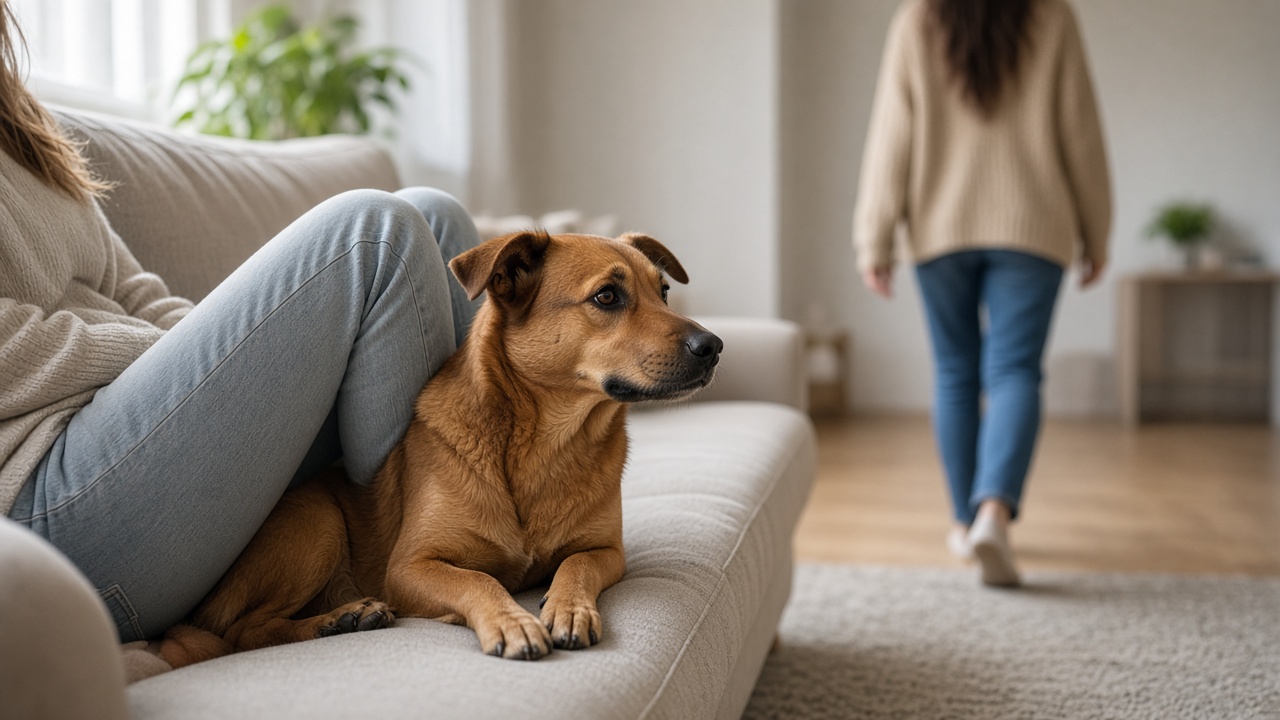
Quick answer: Do not confront the dog. Block rehearsals of the guard. Have the approaching person pay the dog, and have the favorite human quietly leave at the first freeze.
Person-guarding is not loyalty. It is a learned bid to keep a valued human close.
A dog who growls when anyone nears their favorite person is guarding access; management plus reward-based counterconditioning is the working fix.
This brief uses published papers and maker specs; we ran no trial, filmed no dogs, and used no shock collar.
What person-guarding looks like
A dog can treat a person the way another dog treats a bone. The person is the resource.
The usual picture is simple. The dog parks on one adult. Another person, child, or dog steps in, and the parked dog freezes, stares, body-blocks, growls, or snaps.
Frontiers in Veterinary Science published an expert-language study in 2018. The editors invited 85 canine-behavior specialists. Most preferred the term resource guarding over possessive aggression.
Their definition covers avoidance, threats, or aggression used to keep food or non-food items when someone approaches. A favorite human fits that non-food slot. The dog is trying to keep access, not award a medal for love.
Our research team read five first-page how-to pages for this query on 6 September 2026. Zero of those five pages told readers to punish a growl. All five named management plus a reward-based plan.
That pattern matches published owner data. Jacobs and colleagues wrote in Preventive Veterinary Medicine in 2018. They recruited 3,068 owners on social media.
After a five-video quiz, 2,207 owners (72 percent) stayed in the sample. They reported on 3,589 dogs.
In that sample, a reliable “drop” cue tracked with less people-directed guarding aggression. Taking the food dish away during meals tracked with more severe guarding. Adding palatable bits of food during meals tracked with milder patterns.
The paper is cross-sectional. It does not prove cause. It still warns against the old bowl grab.
What this article covers, and what it leaves out
Selection rule: We cover homes where a dog guards one household adult from other people, children, or dogs. We include only tools that block that rehearsal or pay the dog away from the guarded person’s hands.
We leave out shock collars, prong collars, choke chains, and “alpha” products. The American Veterinary Society of Animal Behavior issued its Position Statement on Humane Dog Training in 2021. It says reward-based methods should be used for all dog training, including behavior problems.
A 2025 board note on the same site rejects electronic collars, prong collars, choke chains, and leash corrections.
We also leave out food-bowl kits sold as a complete person-guarding cure. A stuffed toy can help a dog leave a lap. It does not, by itself, teach the dog that another adult may sit down.
We do not cover livestock guardian work. We do not treat porch barking at strangers as the same problem. Those are different jobs.
Stop the rehearsals first
Every successful growl is a practice rep. The first job is to cut those reps.
Use a closed door or a tall walk-through gate when the high-risk person enters. Keep the dog off the couch if that is the stage. Put a house line on the collar so you can guide the dog off a lap without a grab.
Regalo’s Easy Step Extra Tall Black Safety Gate, Model 1166B, is a 36-inch pause button, not a lesson. The maker warns never to use it at the top of stairs. It keeps a child from walking into a freeze.
JAVMA published Reisner, Shofer, and Nance in 2007 on 111 child-directed bites. For children under 6 years, 44 percent of those bites were tied to resource guarding. Among 103 dogs screened in that series, resource guarding was a listed stimulus in 61 percent of cases.
Those numbers include food, toys, and resting spots as well as people. They still show why a child should not “test” the dog.
If the dog already snaps or bites, stop the home DIY. Hire a force-free behavior professional who will write a distance plan. Do not run leave-and-pay at a range that produces a lunge.
The leave-and-pay sequence
Once the room is safe, change what the approach predicts.
The approaching person is the treat machine. The favorite human is the one who leaves.
Start far enough away that the dog’s body stays loose, with a soft mouth and soft eyes. The helper tosses a high-value bite, then steps back. Repeat until the dog looks at the helper and expects food.
If the dog stiffens, the helper is too close. Add distance. Do not talk the dog down or reach over the dog.
When a freeze still appears, the favorite human stands up and walks out. Guarding then costs the resource.
That is the Leave-and-Pay Rule. The helper pays. The favorite person leaves.
Keep sessions short. Five minutes beats a twenty-minute argument.
Do not punish the growl. A growl is data. Remove the growl and the next signal may be teeth.
AVSAB’s 2021 humane-training statement says aversive methods have not been shown to outperform reward-based work.
Give the dog a second resting place that is not a human body. A stuffed rubber toy on a mat is a legal job.
Feed meals in a quiet room. Do not stage sofa drills with guests on day one.
If another dog is the trigger, work each dog alone first. Jacobs’s companion 2018 paper in the same journal found multi-dog homes more likely to show dog-directed guarding. Do not run both dogs through a doorway toward the same lap.
Tools that move food off the favorite human
Hardware does not replace the sequence. It makes the sequence possible.
Our research team compared published maker specs for five currently sold products. We kept a product only if it pays the dog away from a lap or blocks a hallway rehearsal. We did not rank them or invent prices.
| Product | Maker | Job in this plan | Listed size or capacity | Power or mount | Maker note |
|---|---|---|---|---|---|
| Teach & Treat Remote Reward Trainer | PetSafe | Pays the dog away from the guarded lap | 3-cup hopper; 11.1 × 9.5 × 11.5 in; 90 ft remote | 4 D batteries | Maker lists all ages and all sizes |
| KONG Classic (Medium) | KONG Company | Occupies the dog off the person | 2.25 × 2.25 × 3.5 in; 0.25 lb | None | 100% natural rubber; made in the USA |
| Toppl Treat Toy (Large) | West Paw | Same job, with a listed fill volume | 3.5 × 4 × 3.5 in; holds 3/4 cup | None | Zogoflex; made in Bozeman, Montana |
| i-Click Original Clicker | Karen Pryor Clicker Training | Marks the instant the dog stays loose | Palm-sized; sold in 3-, 5-, and 30-packs | None | Maker describes a quiet click for sound-sensitive dogs |
| Easy Step Extra Tall Black Safety Gate, Model 1166B | Regalo | Blocks hallway rehearsals | 36 in tall; 29–36.5 in openings; 16 in door | Pressure mount plus wall cups | ASTM; 2 in bar gap; 6-month limited warranty |
Place the PetSafe Teach & Treat on a crate or across the room. The maker says to train one dog at a time. The helper can pay a sit-stay that is not on the favorite human.
Stuff a KONG Classic or a West Paw Toppl with the dog’s own kibble. That job should not become an extra meal. Use the i-Click as a marker, not a punish button.
Treat calories and meal math
Counterconditioning uses food. Food has calories.
AAFCO, the Association of American Feed Control Officials, requires “snack” or “treat” on the front panel. AAFCO does not require those products to meet complete-and-balanced rules. Extra treats can add unneeded calories, so use them sparingly.
The cleanest math is to pull training bites from the daily ration. Our how much to feed a dog guide walks through portion math. The hopper and the bowl should not double the day.
If kibble is dull, pick a small commercial treat and subtract those calories from the meal. See our dog treats guide for labeled options. Our dog food versus human food explainer covers why chocolate, xylitol, and grapes are not training pay.
Do not hover over the bowl to prove you can take food. Jacobs’s 2018 people-directed survey tied dish removal during meals to worse guarding scores. That is the opposite of the old dominance drill.
Shelter numbers help set expectations. Mohan-Gibbons, Weiss, and Slater surveyed U.S. shelters for Animals in 2012.
Respondents said about 14 percent of dogs showed food guarding on assessment. The reported range was 7 to 30 percent.
Only 34 percent of those shelters tried to modify the behavior. Fifty-one percent said they would not offer a food-guarding dog for adoption.
McGuire reviewed Tompkins County SPCA records from 1 September 2014 through 31 May 2019 for Animals in 2019. Staff evaluated 1,051 dogs. One hundred sixty-one dogs, or 15.3 percent, were assessed as resource guarders.
Of 146 guarders placed on the adoption floor, 30.8 percent guarded on the food-bowl test. Another 83.6 percent guarded on the possession test.
Freezing was the most common signal. Snapping or biting the Assess-a-Hand occurred in less than 14 percent.
Our research team lined those two Animals figures up on the same desk. A 14 percent shelter-survey average and a 15.3 percent single-shelter rate sit in a tight band. Treat published food and toy rates as a floor, not a ceiling.
When a household plan is not enough
A plan that still produces lunges is the wrong plan for that room.
Call a certified applied animal behaviorist or a force-free behavior consultant if any of these are true. The dog has broken skin. The target is a child.
Also call if the dog guards several people, or cannot eat or rest without a freeze.
Ask the professional how they will measure distance. Ask what happens if the dog growls. If the answer is a leash pop or a shock, keep looking.
Medical pain can tighten a guard. A sudden new pattern belongs on a veterinary exam list. This desk does not diagnose that pain; we only flag the overlap.
Do not wait for a “real bite.” Reisner’s JAVMA series tracked prior bite history. Sixty-six percent of those dogs had never bitten a child before that incident.
FAQ
Is a dog who guards me being protective?
Usually no. Protection is aimed at a threat. Person-guarding is aimed at a roommate, a partner, a child, or another dog who simply came closer.
The dog is keeping access, not standing sentry.
Should I scold the growl so it stops?
No. A growl is the cheap warning. Punish it and you may delete the warning.
The 2021 AVSAB humane-training statement rejects punishment tools for behavior problems. Step back, pay the right behavior, and end the rehearsal.
Can I still cuddle the dog?
Yes, on your terms. Cue the dog onto a mat first. Cuddle there.
If another person must sit, park the dog on that mat with a stuffed KONG Classic. A filled West Paw Toppl works the same way.
How fast should this change?
Count sessions, not days. If the dog still freezes at that doorway after two weeks, the helper is still too close. Shrink the drill.
What if the dog guards me from the other dog?
Work each dog alone. Feed in separate rooms. Walk them apart until both can pass a closed gate without a hard stare.
Then hire help before you restack the household.
Are baby gates enough?
No. A gate stops today’s bite. It does not teach a new feeling.
Pair the Regalo gate with leave-and-pay. The dog should learn that another person arriving predicts food, not a fight.
Which treats should I use?
Use the dog’s kibble first. Step up to a tiny labeled treat only if kibble is dull. Keep the word “treat” or “snack” on the packet, as AAFCO requires on the front panel.
Subtract those calories from the meal.