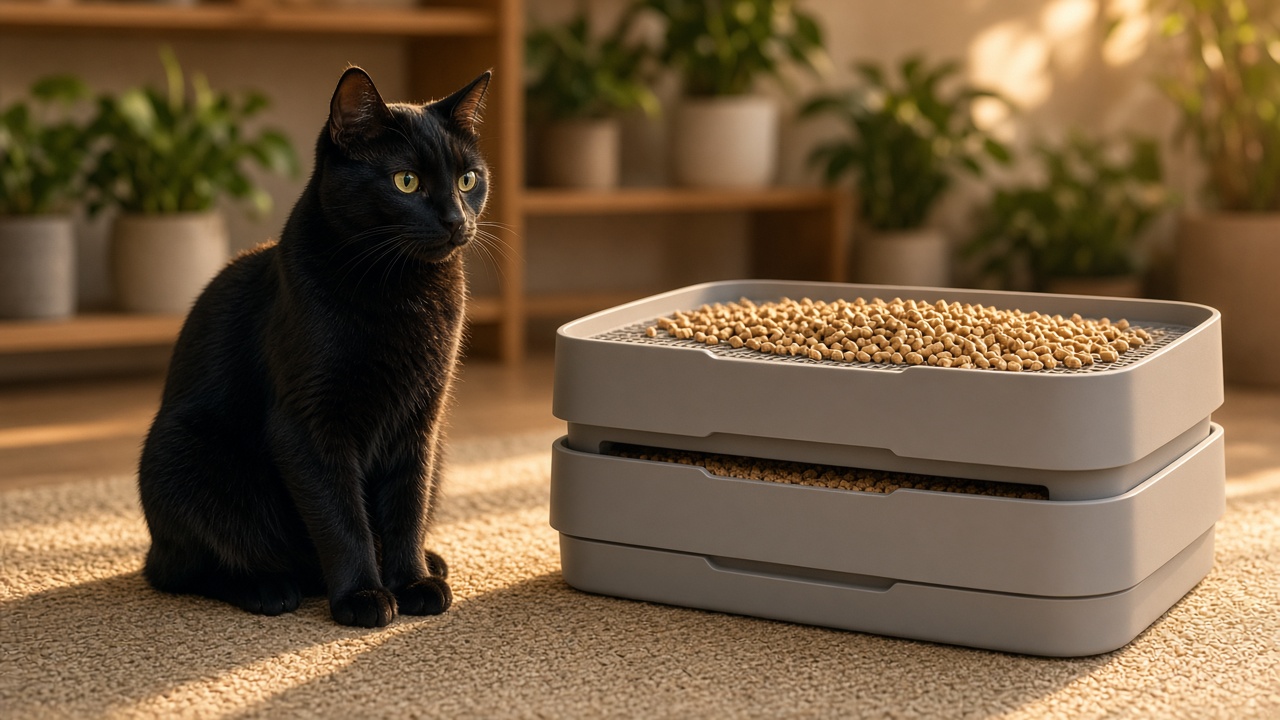
Quick answer: Choose a stacked two- or three-pan sifter so whole pellets stay and sawdust drops through. Skip roll-to-dump boxes, which treat leftover pellets as trash.
Use a stacked two-pan sifter, not a roll-to-dump box, so sawdust falls and intact pine pellets stay. This page is a published-spec comparison of four sifters.
Our research team analyzed maker pages. We did not weigh pellets, did not time a sift cycle, and did not open any motorized box.
The Keep-the-Pellet Rule
We used one rule for this guide. A box had to keep intact pine pellets on a grate while letting crumbled pine fall.
Pine pellets do not clump. They break into sawdust when they absorb urine. Feline Pine states that its non-clumping litter is 100% pine.
The pellets act like sponges, then fall apart. That is the opposite of clay clump sifting. Clay sifters are built so unused granules fall through and clumps stay.
A roll-to-dump box then throws away what stayed on the grill. For pine, what stays on the grill is the reusable litter. What falls through is the spent dust.
We covered stacked pans that let you reverse that motion. We also listed one roll-to-dump model so the geometry is visible.
We did not cover motorized cleaners. We did not cover crystal-tray pellet systems. We did not cover scoops sold without a pan.
Top 7 Sifting litter box for pine pellets
The picks below are the 7 sifting litter boxes for pine pellets on sale right now, listed with what each suits best and an honest drawback. Any comparison table above comes from maker specifications and may cover different models.
1. Stainless Steel Sifting Litter Box with Lid
Best for: Shared rooms needing a lidded steel box
This listing is a stainless steel sifting box sold with a lid. Maker pages for this form show a sieve tray over a catch pan so crumbled pellets can fall through. Owners who want metal and a cover in one unit land here, though a generic card at this price rarely names hole size.
Pros: Stainless steel and a lid; Covered sifter, mid price Cons: Generic card at this price
2. Arm and Hammer Large Sifting Cat Litter Box with Microban
Best for: First pellet try on a tight budget
Arm & Hammer’s large sifting box is the budget pick on this list, and the name calls out Microban. The maker’s page presents a lift-to-sift stack, not a steel pellet grate. Owners who already use pine pellets treat it as a cheap trial pan.
Pros: Lowest price on this list; Large box with Microban Cons: Not a steel pellet grate
3. Suzzipaws Enclosed Stainless Steel Sifting Litter Box for Pine Pellets
Best for: Scatter-prone cats wanting enclosed pellet steel
Suzzipaws sells this as an enclosed stainless sifter made for pine pellets, and the listed price sits well below the other steel boxes. The enclosure is the point: pellets stay in, and the sieve is aimed at wood litter. Owners who want privacy in a metal box start here.
Pros: Enclosed steel for pellets; Cheapest stainless on this list Cons: Hood adds extra handling
4. Tevila Stainless Steel Sifting Cat Litter Box for Pine Pellets
Best for: Pine-pellet steel without a listed lid
Tevila’s card names stainless steel and pine pellets. The title does not list a lid or a pull-out drawer. Owners who want a steel sifter for pellets, without paying for a cover, shop this mid-high band.
Pros: Named for pine pellets; Stainless sifting tray Cons: No lid in the title
5. KISENG Stainless Steel Sifting Litter Box for Pine Pellets
Best for: Mid-price steel upgrades from plastic pans
KISENG sits in the same steel-and-pellets band as Tevila, a few dollars lower. Maker copy for this type is a two-piece sift: wet crumble drops, whole pellets stay. Owners shopping mid-price metal pans will see lookalikes; the draw is the pellet label and the steel.
Pros: Pine-pellet stainless sifter; Steel sifter, mid price Cons: Looks like nearby listings
6. Sorstrem Pull-Out Sifting Cat Litter Box with Lid for Pine Pellets
Best for: Pull-out sifting under a fitted lid
Sorstrem’s listing is the pull-out sifter with a lid, aimed at pine pellets. The drawer is the use case: slide, sift, dump, close. Owners who want less lifting than a stacked tray pay this mid-high price, and more sliding parts means more edges to wipe.
Pros: Pull-out sifting tray; Lid built for pellets Cons: More parts to wipe
7. APPKER 23.6"x15.7"x13.78" Stainless Steel Sifting Litter Box
Best for: Large cats needing the named XL box
APPKER prints the footprint in the title: 23.6 by 15.7 by 13.78 inches. It is also the costliest box here. Owners shopping for a large cat use those numbers; an XL steel sifter eats floor space.
Pros: Named 23.6-inch length; Tall 13.78-inch walls Cons: Biggest footprint, highest price
Comparison: Sifting litter box for pine pellets at a Glance
Want to browse every option? See the full range of sifting litter box for pine pellets on Amazon →
How pine pellets are supposed to be used
Feline Pine’s own FAQ is specific. Scoop solids daily. Shake the box so good pellets rise and sawdust drops.
Leave the sawdust in the box. Change the whole box when it is about 90% sawdust.
That official method does not require dumping the dust every day. A sifting pan still helps. It separates the two layers so you can see the mix.
Feline Pine also states that one 7 lb bag of its non-clumping litter lasts about 4 weeks. For a switch, start with one inch of pellets. Then add one to two inches of the old litter on top.
Those fill numbers matter more than brand slogans. Depth still changes by pan shape. See our how much litter in a litter box guide.
If you want other pellet formulas, use our pellet cat litter comparison. This page stays on boxes, not bags.
Four sifters, listed attributes only
Our research team compared published specs. There is no rank column. There are no price bands.
| Model | Listed size | Sift hardware | Maker note on waste |
|---|---|---|---|
| Petmate Arm & Hammer Sifting Litter Box | 18.88 × 15.21 × 7.86 in; 3.0 lb | One sifting pan plus two solid pans | Petmate’s steps pour dirty litter through the sifter and discard what stays on the tray |
| Van Ness Large Sifting Cat Pan (CP5) | 19.00 × 15.38 × 5.38 in | Open pan with a built-in sifting system | Van Ness describes a lift-and-sift cleanup |
| Van Ness Giant Enclosed Sifting Cat Litter Pan (CP77) | 21.50 × 17.50 × 19.00 in | Lift-up sifting screen under a hood | our editorial team says loose litter falls; clumps lift out |
| Omega Paw Roll’n Clean Large | 20 × 23 × 19 in | Internal grill plus a pull-out tray | Omega Paw’s product page says the grill scoops clumped waste into the tray |
None of those four rows lists a 34-inch side. That number is not a style pick.
The American Association of Feline Practitioners and the International Society of Feline Medicine recommend a rectangular box. Size should be 1.5 times the cat’s length from nose to base of tail. In the study they cite, adult cats preferred 34 × 15 inches (86 × 39 cm).
Every listed sifter is shorter than that 34-inch mark. The longest single figure on these maker pages is Omega Paw’s 23-inch Large side. None of the four maker pages lists a grate-hole diameter.
Stacked pans: the pine workflow
The Petmate Arm & Hammer Sifting Litter Box is a three-piece stack. Petmate lists 18.880 × 15.210 × 7.860 inches and 3.0 lb. It ships one sifting pan and two regular pans.
The page says the box is made in the USA. Petmate also lists built-in antimicrobial protection.
Petmate’s printed steps assume clay. You pour the dirty pan into an empty pan through the sifter. Then you throw away what the sifter held.
For pine, invert that habit. Leave intact pellets in the sifting pan. Set that pan over a solid catch pan.
Shake. Sawdust should drop. Pellets should stay.
Empty the catch pan when you want the dust gone.
The Van Ness Large Sifting Cat Pan, item CP5, lists 19.00 × 15.38 × 5.38 inches. Van Ness says it is made in the USA from BPA-free plastic. The sides are low.
That helps a kitten or a stiff senior step in. It also lets a high-spray cat clear the rim.
Use CP5 the same way. Pellets live on the sieve. Dust lives below.
Do not pour the whole bed through and trash the pellets.
Hooded and roll models
The Van Ness Giant Enclosed Sifting Cat Litter Pan is item CP77. Assembled size is 19.00 inches high, 17.50 inches wide, and 21.50 inches deep. Van Ness states the plastic uses 20% recycled content.
It includes a replaceable zeolite air filter. The hood has an odor door.
Van Ness describes a lift screen. Loose litter falls. Clumps stay on the screen.
For pine, treat the screen-held pellets as keepers. Treat the fallen dust as the spent layer. The hood cuts scatter.
It also hides the box from view.
The Omega Paw Roll’n Clean Large is the contrast case. Omega Paw lists Large as 20 × 23 × 19 inches. Regular is 17 × 20 × 16.5 inches.
Omega Paw’s product page says the patented grill scoops clumped waste into a pull-out tray. You roll the box onto its top, then back up. Large is listed for big cats or multi-cat homes.
That roll dumps what the grill caught. For clay clumps, that is the point. For pine, the grill is likely to catch whole pellets.
Those pellets then land in the trash tray. That is why this design fails the Keep-the-Pellet Rule as a daily pine tool.
Size, sides, and large cats
A 19-inch sifter can work for a small cat. It is a squeeze for a long-bodied adult. The AAFP and ISFM 34 × 15 inch preference is larger than every row in the table.
If your cat is long, do not force a short sifter as the only box. Pair a roomy open pan with a separate sifting step. Or accept that a short sifter is a compromise.
Our litter boxes for large cats guide covers floor space. It does not cover pellet grates.
Watch the entry height. Van Ness CP5 sits at 5.38 inches. That is the lowest wall in this set.
Petmate’s stack is 7.86 inches tall. CP77’s hood reaches 19.00 inches. Omega Paw Large is 19 inches tall as well.
Low walls help arthritic cats. High hoods help with scatter. Neither trait changes hole geometry.
Daily habit, without invented tests
Solids still need a scoop. Pine pellets do not wrap feces. Feline Pine tells owners to scoop solids every day.
Do that first. Then shake.
Decide how you will treat the dust. Feline Pine’s FAQ says leave sawdust in place until the box is about 90% dust. A two-pan setup also lets you dump the bottom pan sooner.
We did not compare those two schedules by smell. Report both. Then pick one and stay consistent.
Top up with a thin layer of dry pellets after you dump dust. Feline Pine’s switch plan starts at one inch. That is a starting depth, not a forever rule.
A deeper bed hides urine on the floor of the pan. A shallow bed is easier to shake.
Wash the pans with hot water. Skip harsh cleaners unless a soiled plastic pan will not rinse clear. We are a research desk, not a clinic.
If house soiling starts, stop guessing. Have the cat examined.
Used pine belongs in the trash at changeout. Feline Pine’s FAQ treats the 90% sawdust mark as a full reset.
FAQ
Do I need a sifting box to use pine pellets?
No. Feline Pine’s FAQ describes a single box that you shake. The dust stays until the mix is about 90% sawdust.
A sifting pan only makes the two layers easier to split. If you already own a solid pan, you can keep it. Add a matching sifter tray later if shaking in place feels clumsy.
Why would a “sifting” box waste clean pellets?
Because most US sifters were drawn for clumping clay. The maker wants unused granules to fall and clumps to stay. The stay-on-grate layer then goes in the trash.
Pine flips that. Intact pellets should stay. Dust should fall.
If you follow clay steps with pine, you throw away the good bed.
How much pine litter should I put in the box?
Feline Pine tells new users to pour one inch of non-clumping pellets. Then add one to two inches of the old litter on top. Do not mix those layers yourself.
For other pans, start thin. Add as the cat uses the box.
When should I empty the sawdust tray?
Feline Pine’s change cue is about 90% sawdust in the box. That is a full reset, not a daily dump.
If you use two pans, you can empty the catch pan sooner. We did not measure odor at day three versus day ten. Watch ammonia and moisture, then set a fixed weekday.
Are these sifters big enough for a Maine Coon?
Probably not as a sole box. AAFP and ISFM cite a 34 × 15 inch preference. The longest listed side among these four sifters is 23 inches.
Give a large cat a longer open pan. Use the sifter as a cleaning tool, not the only bathroom.
Can I use clumping pine in these same pans?
Feline Pine sells a separate clumping formula. Its FAQ says that mix is 50% lighter than clay by volume. The fill instruction is three-quarters full, not a one-inch pellet layer.
Clumping pine behaves like other clumping litter. Use clay-style sifting if the clumps hold. Do not treat it like whole-wood pellets.
How many sifting boxes does a two-cat home need?
This desk did not invent a household count. A sifter is still one box. Two cats still need more than one station if they do not share well.
Put boxes in separate quiet spots. Do not stack two sifters in one corner and call it done.