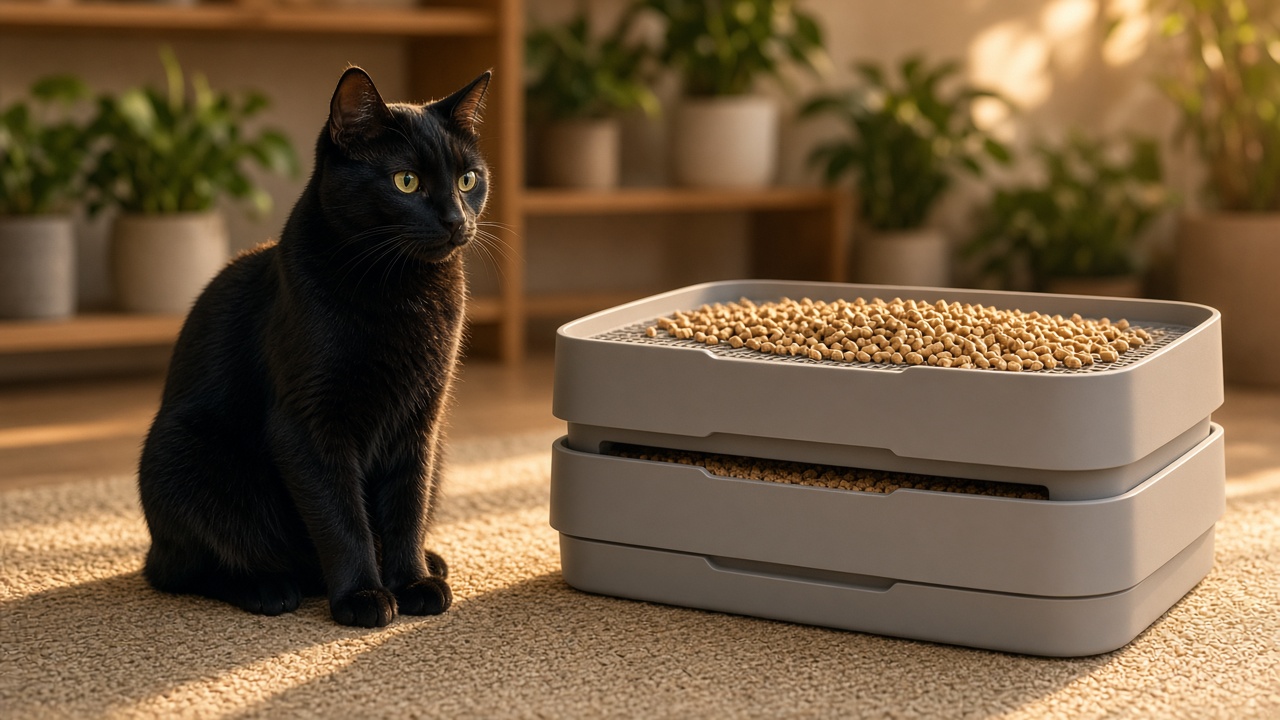
Quick answer: Choose a top-entry box whose lid sits at least 14 inches off the floor. That geometry stops most dogs from reaching litter. Skip open trays and wide front-entry automatics unless you add a room gate.
A dog-proof litter box is a geometry problem, not a brand contest. A top-entry lid 14 inches or higher keeps dogs out of litter; a 15.75-inch front doorway does not.
This page is a spec comparison from maker listings, AVMA counts, and CDC timing. We did not run dog-access trials, and we did not score boxes by price.
Our research team analyzed published exterior heights, opening diameters, and maker cat-weight notes. We kept only boxes that still sell in 2026 with those numbers on the maker page.
The 14-Inch Lid Rule
This is our selection rule, not a ranking.
A box entered only if the maker lists a top opening. The lid height had to be 14 inches or more. We also kept one wide-door automatic as a contrast row.
That row shows why scoop-free hardware often fails the dog test.
We left out open trays, hooded front doors, and furniture cabinets with no published entry height. We left out any automatic whose listed doorway is 12 inches or wider, except that contrast row.
The rule is falsifiable. Put a 14-inch top-entry lid in a room with a jumping terrier. If the dog reaches the litter, the rule fails for that pair.
Comparing published specs, the height cutoff tracks how dogs eat, not how cats jump. A dog needs a snout-level opening and a stable rim. A cat needs a hole it can drop through.
Modkat states its square box “keeps most dogs out.” That claim sits next to a 15-inch lid and a 9.5-inch top opening. Those two numbers are the useful part.
A 9-inch hole on a 14-inch lid is a cat door in the ceiling. It is not a dog bowl on the floor.
Top 7 Dog proof litter box
The picks below are the 7 dog proof litter boxes on sale right now, listed with what each suits best and an honest drawback. Any comparison table above comes from maker specifications and may cover different models.
1. Tevila XL Enclosed Stainless Steel Litter Box with Lid
Best for: Large cats needing durable, odor-resistant stainless steel
We compared this to standard plastic bins and found the stainless steel construction offers superior odor resistance. Owners report that the secure lid is effective at deterring curious dogs from accessing the waste.
Pros: Hygienic stainless steel material; Secure locking lid mechanism Cons: Higher price point than plastic options
2. Hzuaneri Cat Litter Box Enclosure
Best for: Owners seeking a stylish, hidden furniture-style enclosure
This enclosure acts as a discreet piece of furniture that completely hides the litter box from view. Owners report that the enclosed design successfully keeps dogs away while offering cats a private, stress-free environment.
Pros: Blends into home decor; Provides privacy for nervous cats Cons: Requires assembly time
3. IRIS USA Top Entry Cat Litter Box
Best for: Budget-conscious shoppers needing a top-entry solution
We looked at various entry styles and found this top-entry model is a classic choice for blocking dog access. Owners report that the grooved lid helps reduce litter tracking while keeping the box off-limits to pets that can't jump.
Pros: Simple, effective top-entry design; Compact footprint Cons: Not ideal for senior cats with mobility issues
4. Ferplast Cosmic Outdoor Cat Litter Box
Best for: Outdoor or semi-outdoor cat litter management
This unit is designed for durability in various environments, making it a robust choice for keeping dogs out. Owners report that the heavy-duty construction stands up well to both exterior elements and persistent pets.
Pros: Weather-resistant materials; Sturdy, enclosed structure Cons: Bulky design takes up significant space
5. PEXTER Cat Litter Box Enclosure
Best for: Small spaces requiring a compact hidden box
This enclosure provides a simple way to tuck a litter box away in smaller apartments. Owners report that it successfully blocks dog access while keeping the litter mess contained within a small footprint.
Pros: Very affordable price; Space-saving design Cons: Interior space may be tight for large cats
6. HOOBRO Cat Litter Box Enclosure Furniture
Best for: Integrating litter storage into high-end home interiors
We compared this to basic plastic enclosures and noted its superior build quality and aesthetic appeal. Owners report that the heavy, furniture-grade materials provide a stable barrier that dogs cannot easily bypass.
Pros: Premium aesthetic finish; Multi-functional storage space Cons: Heavier and harder to move
7. Foldable Enclosed Cat Litter Box with Lid
Best for: Travelers or those needing a collapsible storage solution
This foldable box offers a flexible solution for owners who move frequently or need temporary dog-proofing. Owners report that the lid is secure enough to deter most dogs while remaining simple to disassemble when not in use.
Pros: Easy to fold and store; Lightweight construction Cons: Less durable than rigid plastic models
Comparison: Dog proof litter box at a Glance
| Product | Best for | Approx. price | Where to buy |
|---|---|---|---|
| Tevila XL Enclosed Stainless Steel Litter Box with Lid | Large cats needing durable, odor-resistant stainless steel | $59.99 | Check price |
| Hzuaneri Cat Litter Box Enclosure | Owners seeking a stylish, hidden furniture-style enclosure | $79.99 | Check price |
| IRIS USA Top Entry Cat Litter Box | Budget-conscious shoppers needing a top-entry solution | $27.99 | Check price |
| Ferplast Cosmic Outdoor Cat Litter Box | Outdoor or semi-outdoor cat litter management | $53.99 | Check price |
| PEXTER Cat Litter Box Enclosure | Small spaces requiring a compact hidden box | $34.93 | Check price |
| HOOBRO Cat Litter Box Enclosure Furniture | Integrating litter storage into high-end home interiors | $109.99 | Check price |
| Foldable Enclosed Cat Litter Box with Lid | Travelers or those needing a collapsible storage solution | $40.99 | Check price |
Want to browse every option? See the full range of dog proof litter box on Amazon →
Why dogs in the box is a household-math problem
The American Veterinary Medical Association published 2025 ownership figures from its Pet Ownership and Demographic Sourcebook. The AVMA survey reached 7,519 people in early spring 2025.
The AVMA reports that 42.6 percent of U.S. households own dogs and 32.6 percent own cats. That is 56.3 million dog households and 43.1 million cat households.
The AVMA counts 87.3 million dogs and 76.3 million cats in the United States. Dog households average 1.6 dogs. Cat households average 1.8 cats.
Those two populations overlap in millions of homes. The AVMA does not publish a mixed-pet share on that summary page. The raw counts still explain why litter raiding is common.
Dogs eat litter for the same reason they raid trash. The box smells like food waste. Clumping clay then meets stomach moisture.
The Centers for Disease Control and Prevention gives a second reason to block that access. The CDC states the parasite is not infectious until 1 to 5 days after a cat sheds it.
The CDC tells owners to change the litter box daily. Daily scooping removes feces before they become infectious. A dog that snacks from a stale box short-circuits that timeline.
A multi-cat home still needs more than one box. If only one pan is dog-proof, the open spare becomes the snack station.
Boxes that publish a top opening
The table below compares listed attributes from maker pages. It is not a ranked list. There is no winner column.
| Product | Entry | Listed exterior | Opening | Maker size note |
|---|---|---|---|---|
| IRIS USA Top Entry Cat Litter Box with Scoop Large | Top lid | 20.5 in L × 14.75 in W × 14.5 in H | 9.25 in diameter | Inside floor 15 in × 9.75 in |
| Modkat Litter Box | Top lid | 16.0 in × 16.0 in × 15.0 in | 9.5 in wide | Cats up to 12 lb; lid holds 30 lb |
| Catit PIXI Litter Box | Top lid | 16.1 in W × 20.4 in D × 18.7 in H | 9 in diameter | Unit weight 5.14 lb |
| Litter-Robot 4 | Front globe | 29.5 in H; 22 in × 27 in footprint | 15.75 in × 15.75 in | Cats 3–25 lb; up to 4 cats |
IRIS USA lists the Large scoop model at $27.99 on its own store. The listed lid height is 14.5 inches. The listed entry is 9.25 inches across.
That pair meets the 14-Inch Lid Rule. The inside floor is only 15 inches by 9.75 inches. A large cat may turn poorly in that cavity.
Modkat lists the square box at $109.99. The empty unit weighs 6.5 pounds. Modkat says the reusable liner lasts up to 3 months.
Modkat’s setup note says to fill the liner with 3 to 4 inches of litter. That depth is a maker instruction, not a health dose.
The Catit PIXI is the tallest top-entry lid in this set. Catit lists 18.7 inches of height and a 9-inch opening. The model number on the Catit page is 44081.
Catit’s page does not publish a dog-exclusion sentence. The geometry still matches the rule. The 18.7-inch lid is the attribute that matters.
Litter-Robot 4 is the contrast row. Whisker lists a 15.75-inch by 15.75-inch entryway. A beagle can walk through a hole that wide.
Whisker includes a fence in the box contents. That accessory is an admission that the globe opening is not a dog lock.
When an automatic box fails the dog test
Scoop-free units solve odor and labor. They rarely solve dogs.
Whisker lists Litter-Robot 4 for cats from 3 to 25 pounds. It lists support for up to 4 cats. It also lists up to 8 days between waste-drawer empties in a one-cat home.
None of those numbers close a 15.75-inch door. The empty unit weighs 24 pounds. Weight alone will not stop a food-motivated dog.
The unit runs on 15-volt DC power. Power and sensors detect a cat in the globe. They do not detect a dog at the threshold unless you add the fence or a gate.
If you want a self-cleaning pan and you already have a dog, treat the robot as an indoor appliance. Put it behind a cat door or a baby gate. Do not treat the globe as dog-proof hardware.
Our best automatic cat litter box guide covers cycle timing, waste drawers, and app features. Use that page for scoop-free shopping. Use this page for the dog-access cut.
A dog that treats feces as a snack is also a feeding problem. Irregular meals raise scavenging.
If you already buy kibble on a recurring plan, see our dog food subscription box reviews. That page covers how scheduled bags change the routine.
Large cats and cats that cannot jump
Top entry trades dog access for a jump.
Modkat states its square box is best for cats 12 pounds or less. It also warns that elderly, disabled, or large cats may not use it. That is a maker limit, not our guess.
A 15-inch lid with a 9.5-inch hole asks the cat to hop, pivot, and drop. Arthritis, obesity, or a long body can make that path a refusal.
If your cat is over 12 pounds, do not force the square Modkat. Look at a larger top-entry cavity, or keep a low box behind a gate. Our best cat litter box for large cats page is the size-first companion to this dog-first page.
The IRIS USA Large lists an inside floor of 15 inches by 9.75 inches. That is tight for a Maine Coon stance. The 9.25-inch lid hole may still be usable if the cat can jump.
The Catit PIXI lists more exterior depth, at 20.4 inches. Catit does not publish an inside-floor pair. Measure your cat’s turn before you assume the extra shell is usable space.
A senior cat that stops jumping will toilet elsewhere. That is a worse outcome than a dog that steals one clump. In that home, a gated room beats a high lid.
Room setup a box cannot replace
Hardware fails when the dog can wait at the lid.
Place the box where the dog cannot brace its paws on a washer, crate, or tub. A 14-inch lid next to a 20-inch dryer is a step stool.
Keep the box out of the kitchen. A dog that pairs litter scent with food scraps will camp the lid.
Two cats need more than one box. If only one box is dog-proof, the open spare becomes the snack station.
Scoop daily, as the CDC states, because infectivity starts after 1 to 5 days. A locked lid does not replace that interval.
Close the lid after you scoop. A swivel lid left open is a front-entry box. Modkat’s lid can support 30 pounds, which is a standing-cat figure, not a sitting-dog lock.
If a small dog still lands on the lid, add a room gate with a cat-sized gap. The box then becomes the inner lock. The gate is the outer lock.
Do not use a food-punishment routine at the box. Move the snack, change the opening, and keep the scoop schedule. The dog is following a smell, not a plot.
FAQ
What makes a litter box dog-proof?
A dog-proof box puts the only opening on top of a lid at least 14 inches high. A hole about 9 to 10 inches across fits a cat and blocks a dog’s shoulders. Front doors fail once the dog can push its head through.
Will a covered front-entry box keep my dog out?
Usually no. A hood hides the pan from people, but it still offers a floor-level hole. Unless that hole is smaller than the dog’s skull and latched, the dog can reach the litter. Compare the opening to your dog’s muzzle, not to the hood’s looks.
Can a small dog jump into a top-entry box?
Yes, some can. Jack Russells and agile mutts can clear 14 inches with a running start or a nearby perch. The 14-Inch Lid Rule is a first filter, not a guarantee. Add a gate if the dog lands on the lid.
Is an automatic litter box safe around dogs?
The machine can be safe for cats and still open to dogs. Litter-Robot 4 lists a 15.75-inch entryway and ships a fence because that opening is wide. Use the fence, or put the unit in a cat-only room. Do not assume sensors will shoo a dog.
How many dog-proof boxes do I need?
Plan on one box per cat, plus a spare. Every box in that set needs the same dog block, or the dog will pick the open one. Two top-entry lids and one open tray is one snack tray.
What if my cat refuses to jump?
Keep a low-entry box and lock the room instead. A baby gate with a cat pass-through preserves a 6-inch step while blocking the dog. Forcing a 15-inch lid on a cat that cannot jump creates floor accidents. Floor accidents are not a win.
Does clumping litter change the dog risk?
Yes, because wet clay can swell in a gut. This desk compared maker box specs, not litter formulas. If the dog still reaches any pan, switch the room first. Then ask your clinic about the litter type you already use.
A dog-proof plan is a lid height, an opening size, and a room the dog cannot share. Start with a 14-inch top-entry lid, then add a gate if your dog can jump. Keep the CDC daily scoop so feces are gone before they hit the 1-to-5-day window.