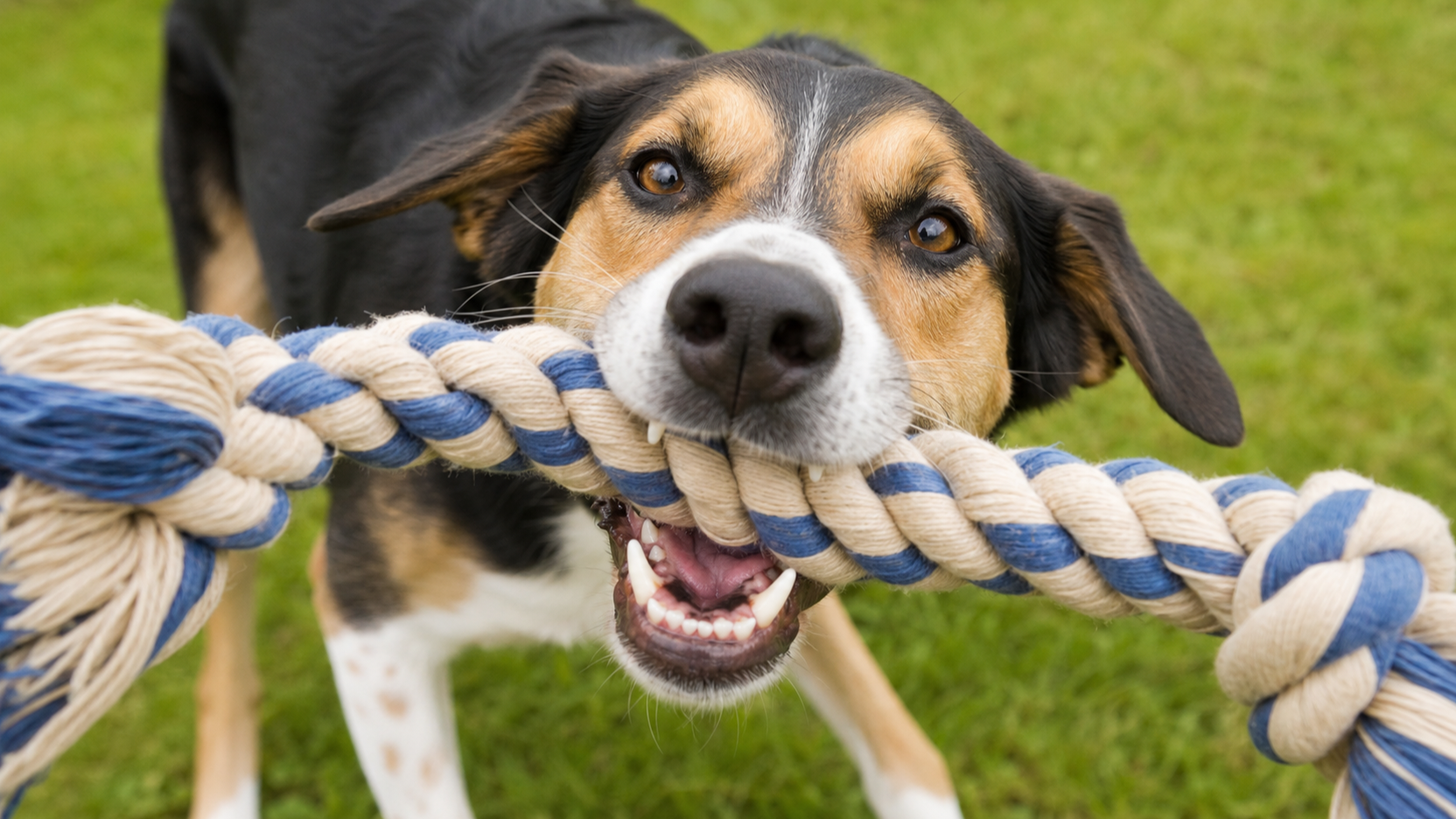
The best tug toys for dogs are supervised game objects you start, you end, and you put away — sized so a re-grip cannot land on your hand — not marketplace ropes sold as crate chews and not puzzle toys mislabeled as tugs. The We read the titles and descriptions of 8 examples. 0 of 8 are product cards. 0 of 8 are VOHC dental products. 4 of 8 are rubber or TPU-class (KONG Tug; West Paw Bumi; KONG Reflex Tug; Goughnuts tugs). 2 of 8 are Chuckit hybrids (Ultra Tug ball-and-cord; Ultra Bumper Tug). 1 of 8 is a cotton-fleece rope (KONG Signature Rope Double Tug, 23 inches, 30–65 lb). 1 of 8 is a two-handle webbing tug (Ruffwear Pacific Loop, 20.4 inches). 0 of 8 replace a walk. 0 of 8 are a fight.
Buy a drop cue before a thicker rope. Then pick a material class: rubber you inspect for cracks, or rope you retire at first strand. Use this page as a job list, not as a top 7.
Hero stat (August 2026): eight named examples, zero cards, zero VOHC seals, one 23-inch rope, one 20.4-inch two-handle, one 12.75-inch KONG Tug, one 0.18 lb Reflex ring. We grouped listings by job and geometry, not “lasts for months.” If the dog stiffens, shows teeth, or snaps over the toy, that is a behavior professional — not a Goughnuts upgrade.
Our guides are reader-supported. This article may contain affiliate links. As an Amazon Associate we may earn a commission if you buy through links, at no extra cost to you.
Related: dog toys, chew toys, puzzle toys, K9 equipment, dental chews, treat pouch. Swallowed rope or a blocked gut is a clinic tonight. We are not that clinic.
What are the best tug toys for dogs?
Browse the keyword on Amazon →
Quick picks at a glance
- Clearest “not a chew” rubber warning: KONG Tug (SKU KG1, maker MSRP $15.99). Medium 15–35 lb. 12.75 inches long. Interactive only. Store out of reach.
- Gentle-mouth stretch class: West Paw Bumi. Small 8 inches / Large 9.5 inches. Maker $17.95. Labeled for gentle chewers.
- Cheapest named hybrid class: Chuckit Ultra Tug from $10.99. Ball diameters 2 / 2.5 / 3 inches. Nylon cord is a fray point.
- Two-handle hand-clear class: Ruffwear Pacific Loop. 20.4 inches. Maker $24.99. Fabric and foam — put away.
- Longest named rope: KONG Signature Rope Double Tug. 23 inches. Large 30–65 lb. Maker $23.99. Still a rope. Still a linear-foreign-body risk if chewed solo.
- Supervised heavy rubber class: Goughnuts Medium (30–70 lb, from $27.98) and Large Maxx (9 inches, $39.84). Maker split: tugs for play, rings for power chewing.
- Honest leftover: any rope left in a crate. ASPCA chew position plus rope-safety pages: interactive with a human, not a solo chew.
How tug job listings compare on labels
Eight real play jobs — then the eight examples this URL actually names.
| Job | What actually works | Category | Fail if you skip it |
|---|---|---|---|
| Teach drop / out | Short bouts, toy away | Any class with a cue | A thicker rope instead of a cue |
| Indoor rubber game | Named rubber, put away | KONG Tug or Goughnuts tug | Leaving it as a chew |
| Gentle stretch game | Soft thermoplastic | Bumi Small/Large | Power chewer alone with Bumi |
| Fetch-plus-tug | Ball or bumper + handle | Chuckit Ultra Tug / Bumper | Using the cord as a chew |
| Long two-ended rope | Length so hands stay clear | KONG Signature 23-inch | 8-inch knot in a giant mouth |
| Handler-clear webbing | Two handles | Pacific Loop 20.4-inch | Jute bite-pillow fantasy — see K9 |
| Power chew solo | A different object | Off these tugs — chews | One rope for both jobs |
| Already guarding | Behavior professional | None | Shopping |
Before you shop: (1) you start and end the game, (2) drop exists before you escalate, (3) the toy is out of reach between sessions, (4) first crack, first strand, first loose handle → retire, (5) stiff / snap / bite over the toy → stop, call a professional. Fail gate 5 and this checklist is how you shop past an emergency.
AVMA ownership guidelines ask for training and stimulation that fit the animal. AVMA’s walking page is about walking: start with the veterinarian, build gradually, watch for lameness. A rope does not replace a walk. ASPCA’s chew/treat position says rubber and hard plastic are not for consumption and should not fragment. Supervision is the control. There is not one we can point to.
Why the best tug toys for dogs are a geometry worksheet
- Length. If the dog re-grips, the mouth should not land on your hand. A 12.75-inch figure-eight and a 23-inch two-ring rope are different objects.
- Thickness. Too small can be swallowed. Too large can strain a jaw. Makers print weight bands. They are floors, not lab ratings.
- Material failure mode. Rubber cracks. Rope frays and can become a linear foreign body. Webbing abrades. Hybrids fail twice.
- Supervision. Every maker page we used says some version of interactive / supervised / discontinue if damaged.
- Not dental. “Flosses teeth” on a rope listing is not VOHC.
The eight examples sit in a sixth bin: named maker pages. Useful as a shortlist. $0 of cards. $0 of fight therapy.
How this desk scored the eight examples (and refused to score “indestructible”)
We grouped listings by maker-stated geometry and warnings:
- Rubber / TPU class: 4. Hybrid class: 2. Rope class: 1. Webbing/foam class: 1.
- Printed lengths we can cite: KONG Tug 12.75 in; Reflex 15 in overall; Signature Rope 23 in; Pacific Loop 20.4 in; Bumi 8 / 9.5 in; Bumper 9.75 in; Goughnuts Large Maxx 9 in.
- Printed maker prices we fetched as public MSRP-class figures: Tug $15.99; Bumi $17.95; Ultra Tug from $10.99; Bumper $17.99; Reflex $17.99; Signature Rope $23.99; Goughnuts Medium from $27.98; Large Maxx $39.84; Pacific Loop $24.99. Sum of those nine sticker-class numbers (Ultra Tug counted at the $10.99 floor) is $197.71. Mean among those nine is $21.97. That is a price-class tally, not a live Amazon cart.
Want current shopping without a ranked list? Browse tug toys for dogs on Amazon →
How these products compare on labels and price
| Example | Maker-stated size / band | Material class | Honest job |
|---|---|---|---|
| KONG Tug | Medium 15–35 lb; 4.75 × 12.75 × 0.75 in; 0.64 lb | Natural rubber | Put-away rubber tug |
| West Paw Bumi | 8 in / 9.5 in | Zogoflex | Gentle stretch tug |
| Chuckit Ultra Tug | Ball 2 / 2.5 / 3 in | Rubber + nylon cord | Fetch-and-tug hybrid |
| Chuckit Ultra Bumper Tug | 9.75 × 5.75 × 2.37 in; 0.72 lb | Rubber + stowable rope | Fetch or tug |
| KONG Reflex Tug | 5.75 × 15 × 1.5 in; 0.18 lb | 74% TPU / 26% polyester | Light throw-and-tug |
| KONG Signature Rope Double Tug | Large 30–65 lb; 5 × 2 × 23 in; 0.97 lb | 95% polyester / 5% cotton | Long two-ring rope |
| Goughnuts Medium / Maxx | 30–70 lb / 9 in Maxx | Natural rubber | Supervised heavy tug |
| Ruffwear Pacific Loop | 20.4 in (52 cm) | 1680D nylon, webbing, foam | Two-handle handler tug |
Desk kit math: 23 − 12.75 = 10.25 inches of extra length from KONG rubber Tug to KONG rope. 20.4 − 12.75 = 7.65 inches from Tug to Pacific Loop. Reflex at 0.18 lb is 3.6× lighter than Tug at 0.64 lb (0.64 / 0.18). Bumper at 0.72 lb is in the same mass band as Tug. These are arithmetic on maker numbers, not a pull test.
If you already play with a KONG Tug you put away, you do not need Bumi and Reflex and a rope in the same week. One game object. One drop cue.
The 8 named examples (not a ranking)
Dedicated rubber tug you put away — KONG Tug
Where verified: KONG’s Tug product page. SKU KG1. MSRP $15.99.
KONG describes a natural-rubber figure-eight that stretches and recoils. Materials: 100% rubber (natural). Size: Medium, 15–35 lb. Dimensions: 4.75 × 12.75 × 0.75 inches. Weight: 0.64 lb. Made in the USA with globally sourced materials.
The warning is the reason this toy is in the article: interactive toy, not a chew toy. Never leave it alone with the dog. Store it out of reach. Bring it out only when you want to play tug. The hollow Classic is a different SKU. This one is a flat figure-eight. 12.75 inches is enough for many medium dogs to grab one loop while you hold the other. It is short for a giant mouth.
Trade-off: the clearest not-a-chew warning on a rubber tug we found — one size band, no published large-dog SKU on that page.
Stretchy fetch-and-tug for gentler mouths — West Paw Bumi
Where verified: West Paw’s Bumi page.
West Paw sells Bumi as a Zogoflex S-shape that stretches to twice its length. Maker details: non-toxic, dishwasher-safe, made in Bozeman, Montana, recyclable through Join the Loop, U.S. Patent D621,104, Love it Guarantee. Sizes: Small 8 inches / 20 cm, Large 9.5 inches / 24 cm. Listed maker price $17.95. Built for gentle chewers. Floats. BPA-, latex-, silicone-, and phthalate-free per that page.
Trade-off: named U.S.-made stretch material with a dishwasher line — labeled for gentle chewers.
Ball-and-cord fetch that also tugs — Chuckit Ultra Tug
Where verified: Petmate’s Chuckit Ultra Tug page. SKU family 23110. From $10.99.
Petmate describes a rubber ball on a leash-style cord, made for tug-of-war, two-ply nylon handle, Ultra Ball end for fetch. Ball diameters: Small 2 inches, Medium 2.5 inches, Large 3 inches. Stated weights: 0.24 / 0.4 / 0.52 lb. Chuckit Performance toys are not intended as solo-play toys on Petmate’s collection page. Nylon frays. Rubber cracks. Pick diameter like any fetch ball: too small can lodge.
Check Chuckit Ultra Tug listings →
Trade-off: cheapest verified fetch/tug hybrid on this page — cord is a fray point.
Bumper you unwrap when you want to tug — Chuckit Ultra Bumper Tug
Where verified: Petmate’s Chuckit Ultra Bumper Tug page. SKU 32191. $17.99.
Two ways to play: wrap the rope to throw; unwrap to tug. Same rubber family as Ultra Ball. Floats. One size. 9.75 × 5.75 × 2.37 inches. 0.72 lb. When the rope is out, treat it as rope.
Trade-off: documented fetch-or-tug conversion — one size, still a rope when unwrapped.
Outdoor TPU ring with a stretchy strap — KONG Reflex Tug
Where verified: KONG’s Reflex Tug page. SKU RFL11. $17.99.
Bouncy ring, stretchy strap, floats per maker copy. 74% TPU, 26% polyester. 5.75 × 15 × 1.5 inches. 0.18 lb. Country of origin: China. One size. “Guaranteed to last” and “self-healing” are marketing. Inspect the strap-to-ring joint.
Trade-off: named TPU hybrid that floats — light, one size, durability language untested here.
Cotton-fleece rope with two rings — KONG Signature Rope Double Tug
Where verified: KONG’s Signature Rope Double Tug page. SKU SKT12. $23.99.
Cotton and fleece braid, two rings, “gentler on a dog’s mouth,” a line about helping clean teeth. 95% polyester, 5% cotton. Large, 30–65 lb. 5 × 2 × 23 inches. 0.97 lb. China. Warning: designed for light/moderate chewing; supervised use only; discontinue if damaged; long cord strangulation hazard for children under 3.
Not a VOHC dental product. 23 inches is the length argument. Fray rules still apply.
Check Signature Rope listings →
Trade-off: documented two-ring rope with an honest light/moderate warning — still a swallow-fiber risk.
Heavy rubber double-ring for supervised tuggers — Goughnuts tugs
Where verified: Goughnuts Tugs collection, Medium Tug, Large Maxx pages.
Check Goughnuts tug listings →
Trade-off: dearest rubber tug family on this page, clearest maker split — still not a solo chew.
Two-handle training tug that floats — Ruffwear Pacific Loop
Where verified: Ruffwear’s Pacific Loop page. $24.99.
Center tug pad, two grab handles, buoyant foam core. 20.4 inches (52 cm). 1680D ballistic nylon shell with DWR and PU coating; polyester tubular-webbing handles; 8 mm polypropylene kernmantle rope and PE foam core. Made in Vietnam. Hand wash, air dry. Supervised play; discard if any part is loose or detached.
This is the hand-distance example. It floats. A dog that guts toys will gut this if you leave it out. Not a bite-suit jute tug.
Trade-off: clearest two-handle consumer geometry we found — fabric and foam, put-away only.
Tug worksheet (the part “indestructible” cannot finish)
Write these before you add a $39.84 Maxx:
- Dog: age, weight, mouth width, dental pain, neck/back history.
- Job: teach drop, indoor rain-day game, fetch-plus-tug, two-dog (do not).
- Guard history: stiffen, growl, snap over toys — if yes, stop shopping.
- Material: rubber vs rope vs webbing — and the failure mode you will inspect.
- Length: can a re-grip hit your hand?
- Storage: which bin is dog-proof?
- Stop rule: crack, strand, swallowed piece, fight body language → stop. Clinic if material was swallowed.
This desk will not fill in a brand winner. Those move by lot.
AVSAB / ASPCA / maker-warning desk (public pages, not a chew trial)
Worked session arithmetic (desk only): public trainer explainers often describe 10–15 second bouts with a drop, then a think, then put-away. If you run 8 bouts in an evening, that is 80–120 seconds of pull, not a wrestling match. A 20-minute continuous tug in a hallway is a different object. If the dog is airborne, you are playing too hard.
Worked jobs (desk, not a trainer)
Job A — 12-week puppy. Short rubber or 8-inch Bumi. No 23-inch rope as a teething chew. Drop first.
Job B — 25 lb terrier with a hard bite. Not a “small-breed puzzle.” Size up rubber. Put it away. Separate chew object.
Job C — 70 lb senior with a sore neck. Light or no tug. Exam if you suspect pain.
Job D — you want the best tug toys for dogs and also a crate occupier. That is how linear foreign bodies happen. The Gate fails the crate on purpose.
Job E — power chewer who also loves tug. Rubber tug with you. Different ring/chew alone. Goughnuts prints that split.
Job F — two dogs, one rope. Often a fight. Two toys or one at a time.
Job G — you already own KONG Tug. Skip Reflex until this one is retired.
Job H — you wanted a dental. Off this page. Dental chews. VOHC lives there.
Job I — you wanted a brain game. Puzzle toys. Not a wobbler as a tug.
Job J — bite-sport jute. K9 equipment. Pacific Loop is not a bite suit.
Job K — swallowed strands this morning. Clinic. Not a thicker braid.
Job L — rain day, apartment. Rubber figure-eight, short bouts, neighbors exist. A 23-inch rope in a studio is a lamp-cord.
Small dogs, large dogs, puppies, seniors
Older live small-breed sections used a treat Tux, a puzzle brick, and a wobbler. Those are enrichment objects. If a small dog needs a brain game, use the puzzle guide. If a small dog actually tugs, use a short, light rubber object — Bumi 8-inch or Chuckit Ultra Tug 2-inch ball — not a 23-inch rope.
Large hard pullers need length and a material that does not shed fiber. That is Goughnuts / KONG rubber / Ruffwear-handle job, not a discount three-knot rope sold as aggressive chewer. Size the cross-section up. Do not play so hard the feet leave the floor.
Puppies: light resistance, short sessions, a toy they cannot swallow. Seniors and dogs with neck, back, or dental disease: lighter resistance or no tug.
Carrot-shaped rubber-and-rope novelties are a texture gimmick. If that is the object, it lives on a carrot-toy URL with the same fray warning.
Cleaning and storage
Maker care, not a protocol we invented:
- West Paw Bumi: dishwasher-safe per that page.
- Goughnuts: wipe with warm water.
- Ruffwear Pacific Loop: hand wash, mild detergent, air dry.
- KONG Tug: no wash method on that SKU page. We are not inventing one.
- Rope: wash, then dry completely. A damp braid is a mildew object.
Store tugs in a closed bin the dog cannot open. A tug that lives on the sofa becomes a chew. A chew that is a rope becomes a linear-foreign-body risk.
Invented prices and marketplace names as proven heavy-duty tugs. Puzzles sold as small-breed tugs. Duplicate FAQ blocks and a second “Session Rules” that restated the first.
If you came here from a top-7 search, the conversion is intentional. Same URL. Different job: geometry, supervision, put-away.
- We are not behaviorists.
- A swallowed rope is a clinic.
Using the best tug toys for dogs without skipping the drop
A tug should not be 100 percent of enrichment. If the rope is on the floor and the walk did not happen, you are shopping past a walk. Pair tug with a pouch if you are paying the drop. Pair guarding with a professional, not a thicker braid.
FAQ
What are the best tug toys for dogs for a medium adult who will drop?
The best tug toys for dogs in that household are a put-away rubber object with enough length for your hands — on this page that class is KONG Tug (15–35 lb band) or a Goughnuts tug if the mouth is harder — plus a drop cue. A 23-inch rope is optional length, not a crate chew.
Does tug-of-war make dogs aggressive?
AVSAB says there is no evidence that it does, including when dogs keep the toy. The exception is the dog who already guards. That dog needs a CAAB or veterinary behaviorist.
What is the safest material?
There is no certified safest. Rubber cracks. Rope frays and can cinch bowel. Webbing abrades. Safer pattern: correct size, supervised session, toy put away, retired at first damage.
How do I pick a size?
Maker weight band as a floor, then length and thickness. When in doubt, size up and keep the game short.
How often should I replace a tug toy?
On damage, not on a calendar.
Can I leave a rope in the crate?
No. Interactive with a human. Never left lying around. Take it away if strands are being eaten.
Are the best tug toys for dogs safe to leave in the crate?
No. Same answer. Rubber hybrids included. Solo chewing is the wrong job.
Are tug toys dental toys?
Not on this page. VOHC is a dental seal. Use the dental-chew guide for plaque-control products.
What if my dog is a power chewer who also loves tug?
Play tug with rubber you put away. Give a different object for solo chewing.
Label math examples (desk arithmetic)
Four rubber/TPU + two Chuckit hybrids + one rope + one webbing = 8 examples. Rope is 12.5 percent of the example set and 100 percent of the linear-foreign-body lecture.
$10.99 floor (Ultra Tug) to $39.84 (Maxx) is a $28.85 spread. That spread is not a safety spread.
Zero cards on this URL. Preserve-every-card is a zero-card job.
Inspect-and-retire checklist (the part a lifetime guarantee cannot finish)
Once a week if you play that often, and after every hard session:
- Rubber: flex the loops. Look for white stress lines, missing chunks, exposed hollows.
- TPU strap: tug the ring joint. If the strap slides or the weld looks chewed through, retire.
- Rope: count loose strands. If the dog is eating fiber, the toy is done the same hour.
- Nylon cord (Chuckit): fuzz is a warning; a thin spot is a snap waiting for a face.
- Webbing handles: loose stitching near the mouth zone is a finger risk and a swallow risk.
- Foam core (Pacific Loop): if the dog has opened the shell, the toy is a guts-out chew. Discard.
- Smell: sour rubber or mildew rope goes in the trash, not the dishwasher forever.
Goughnuts’ guarantee and West Paw’s Love it Guarantee are maker programs. They are not a reason to keep a cracked object in play “until the claim ships.” Play stops when the fragment risk starts.
Two-dog rules, in one place: two tugs or one dog at a time. Parallel play with two Pacific Loops is a different session than one rope and two mouths. Resource-guarding risk rises when the object is rare and the arousal is high. AVSAB already drew the line for the dog who guards. Do not run a group tug to “socialize” that dog.
Linear foreign body, in plain language: a string anchors in the stomach while the rest travels. The gut crawls up the string. Blood supply dies. Surgery is the treatment. That is why crate-rope is not a cute hack. ASPCA’s chew position is the short version: do not let the dog eat the toy.
Indoor versus outdoor: Reflex and Chuckit hybrids want space to throw. A 15-inch strap in a hallway is a coffee-table event. KONG Tug’s 12.75-inch figure-eight is the apartment-class rubber. Pacific Loop’s 20.4 inches needs room for two human hands. Measure the room the way you measure the mouth.
Heat and cold: AVMA’s walking page treats weather as a real risk. A vigorous tug in July on asphalt is a heat job, not a toy job. A winter tug on ice is a slip job. Shorten bouts. Watch breathing. The toy is not the constraint. The dog is.
Puppies and growth plates: public orthopedic themes say not to turn a young dog into a weight-pull athlete. Light resistance. Stop if the puppy mouth-slams your skin. That is a teach, not a tougher rubber.
Seniors: dental disease and neck arthritis make tug optional. If the dog used to love it and now avoids it, that is data for the exam, not a reason to buy Maxx.
Water: Bumi, Chuckit, Reflex, and Pacific Loop advertise float. Floating is a retrieval feature. It is not a reason to play unsupervised at a lake. A rope in water is still a rope in a mouth.
Children: KONG’s Signature Rope prints a strangulation hazard for children under 3. Even without that line, a child holding a tug is a face in the bite zone. Adults hold the handles. Kids watch or hold a second, softer object that is not the game.
If you only add one household rule after this page: the tug lives in a bin, not on the couch. That single rule does more than a second SKU.
Maker-price tally recap so the number stays quotable: $15.99 + $17.95 + $10.99 + $17.99 + $17.99 + $23.99 + $27.98 + $39.84 + $24.99 = $197.71 across nine public sticker-class figures (Ultra Tug at its $10.99 floor; Goughnuts counted twice as Medium + Maxx). Drop Maxx and the remaining eight sum to $157.87. Drop both Goughnuts and the remaining seven sum to $129.89. Those sums are desk arithmetic on maker pages dated as we fetched them. Amazon checkout will disagree. Believe checkout.
Length tally recap: 8, 9, 9.5, 9.75, 12.75, 15, 20.4, 23 inches appear on the pages we cited (Bumi two sizes; Bumper; Tug; Reflex; Pacific Loop; Signature Rope; Maxx 9). Median of that listed set depends on how you count Bumi. The useful reader number is simpler: under 13 inches is hand-risk for a large mouth; over 20 inches is the hand-clear class.
Zero cards remains the card-integrity job.
A last walk through the dropped marketplace names so they do not return: Feeko, wodoca, WOWBALA, SHARLOVY had no manufacturer spec sheet we could verify. They are not examples. They are not “budget tugs we almost ranked.” They are unverified search debris. If a future card set appears on this URL, the Index will score those tiles. Today the card count is zero and the example count is eight.
If a reader needs a single indoor starter without a rope: KONG Tug if the dog is in the 15–35 lb band and you will put it away; Bumi Small if the mouth is gentle and the dog is smaller; a 2-inch Chuckit Ultra Tug if you also want a throw. Those three sentences are class matches, not a podium. Giant mouths and power chewers are not in that starter trio. They need length and a different chew object for alone time.
Weight-band recap: KONG Tug prints 15–35 lb; Signature Rope prints 30–65 lb; Goughnuts Medium prints 30–70 lb. Those three bands overlap from 30–35 lb. A 32 lb dog can sit in all three titles. That overlap is why We grouped listings by job (put-away rubber vs rope vs heavy tug) instead of breed. A 32 lb mouth that shreds Bumi is not a Bumi problem. It is a class problem. Read the mouth, then the band, then the warning line. The overlap is title arithmetic. If your tape says 55 lb, KONG Tug’s 15–35 lb band is the wrong rubber SKU on that page — size up to a Goughnuts-class tug or a longer two-handle, and still put it away. If your tape says 12 lb, a 23-inch Signature Rope is a chewing hazard more than a game. Match the band, then retire on damage the same week you notice it. A 55 lb dog on a 15–35 lb rubber is how figure-eights disappear into a mouth. A 12 lb dog on a 23-inch rope is how fiber becomes a snack. Both failures are geometry, not brand loyalty.
When to stop shopping and go to a clinic or behaviorist
- Swallowed rope, rubber chunk, vomiting, no stool, hunched belly.
- Guard, snap, bite over a toy.
- A tug brand is not a treatment.
Pay the exam. Fight the SKU later.
Sources this desk actually used
- KONG Tug
- KONG Reflex Tug
- KONG Signature Rope Double Tug
- West Paw Bumi
- Petmate Chuckit Ultra Tug
- AVMA pet-ownership guidelines
- AVMA walking your pet
- AVSAB winter enrichment
- AVSAB summer essay
- ASPCA position on dog chews/treats
- VCA play and exercise
If a maker updates a warning, believe the maker.
If you only remember one sentence: the best tug toys for dogs are supervised put-away games; this URL has zero cards and eight named examples; KONG Tug is the 12.75-inch not-a-chew rubber; the 23-inch rope is length, not a crate chew; AVSAB says tug does not create aggression if drop exists; guarding is not a shopping problem; $197.71 is a maker-price tally, not a cart.