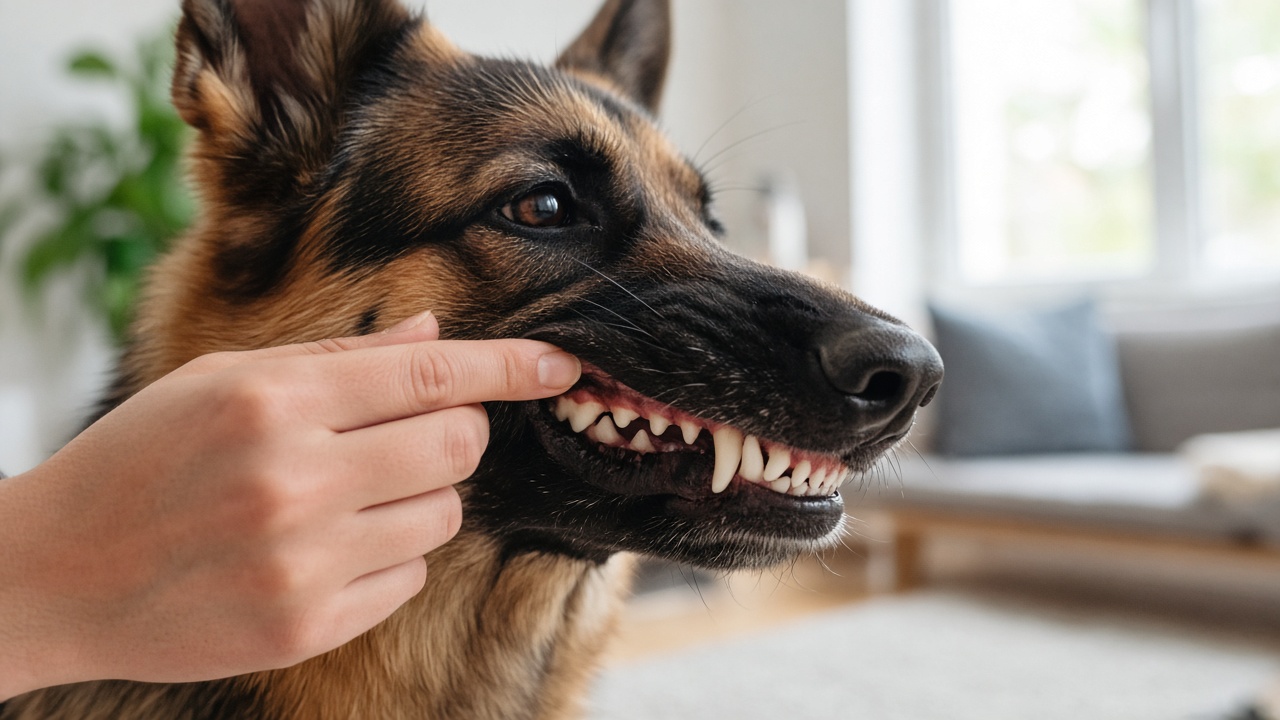
Quick answer: Plan for 28 puppy teeth, then 42 adult teeth once the swap is done. Use the type-by-type tally if a mouth looks short. Hold adult dental chews until the maker’s age line says the dog is old enough.
A typical adult dog has 42 permanent teeth, and a typical puppy has 28 deciduous teeth.
This page is a count-and-timeline brief from published anatomy and maker labels. We did not X-ray any dog, score any mouth, or run a chew trial.
The 28-to-42 split
The Merck Veterinary Manual’s pet-owner dental page states the split in one line. Most dogs have 28 deciduous teeth and 42 permanent teeth.
That is not a breed-size rule. A Chihuahua and a Great Dane are built on the same count.
The extra 14 adult teeth are molars and first premolars. Puppies never had those teeth.
The American Kennel Club’s dental explainer breaks the adult set by class. It lists 12 incisors, 4 canines, 16 premolars, and 10 molars.
The Merck Veterinary Manual’s professional dentition chapter matches that class list. It also maps the mouth with the modified Triadan system.
In that system, the right upper quadrant is the 100s. The left upper is the 200s.
The left lower is the 300s. The right lower is the 400s.
The canine tooth is always numbered 04. The first molar is always numbered 09.
That numbering stays the same even when a tooth is missing. The gap keeps its number.
When the count changes
Puppies are born without erupted teeth. The first set then comes in fast.
The Merck Veterinary Manual puts deciduous eruption at 3 to 5 weeks of age. It puts the start of permanent eruption at about 4 to 5 months.
It also says the full permanent set is present by 7 months of age.
The American Kennel Club page quotes a tighter early window. It says the 28 deciduous teeth begin to appear two weeks after birth.
It says they are usually fully in 8 to 10 weeks later.
Those two published windows do not match on the first week. Treat them as a range, not as a single clock.
The American Kennel Club also sequences the loss. Incisors are first out at around 4 months.
Canines usually follow at 5 to 6 months. Premolars and molars come in between 5 and 8 months.
Between those months the mouth is mixed. A puppy tooth and its adult replacement can sit side by side.
That mixed window is also when owners switch food too soon. Adult kibble is sized and balanced for adult mouths, not for a jaw still shedding needles.
If you are weighing that switch, start with our note on whether puppies can eat adult dog food. Then use the calorie and texture rules in our puppy nutrition guide.
A house with a new kitten hits a parallel growth-food question. Adult cat food is built for adult mouths and adult calories.
We cover that mismatch in can kittens eat adult cat food.
How to tally the four tooth types
Count by class, not by a blur of white points.
Start at the midline. Six small incisors sit on the upper jaw. Six sit on the lower jaw.
Next come the four canines. Two above. Two below.
Behind each canine sit the premolars. The adult set has eight on top and eight on the bottom.
The molars sit at the back. The American Kennel Club lists four on top and six on the bottom.
Add those classes and you get 42. Twelve plus four plus sixteen plus ten.
A puppy set has no molars. It also lacks the first premolar that adults grow later.
That is why the puppy total stops at 28.
The Merck Veterinary Manual’s professional chapter also lists root counts. Upper fourth premolars and the upper first and second molars have three roots each.
Lower third molars have one root. Those details matter when a clinic reads a film. They do not change the home count.
The 6-Month Printed-Kcal Rule
Our research team did not rank chews. We used one inclusion rule.
A product entered this table only if its maker page prints a numeric energy line or a printed once-daily dose. It also had to print an age line, a puppy line, or a species-use line.
Energy means kcal per unit or a stated meal-kcal offset. We dropped rawhide, antlers, and any chew whose page is silent on energy, dose, and age.
Comparing those published specs produced a simple ledger. GREENIES Dental Puppy Treats Teenie tell you to cut the main meal by 26 kcal.
GREENIES Original Petite, for dogs 15-25 lb, tells you to cut 52 kcal. GREENIES Original Regular, for dogs 25-50 lb, tells you to cut 88 kcal.
All three GREENIES pages bar dogs under 6 months and under 5 lb.
PEDIGREE DENTASTIX Toy & Small Original lists 22 kcal ME per treat and 2,943 kcal ME/kg. Its feeding line is one treat a day for dogs 7-22 lb.
That Pedigree page also says the stick is not for puppies or dogs under 7 lb.
Virbac’s C.E.T. VEGGIEDENT FR3SH page lists calories by size. Extra Small is 24 kcal. Small is 48 kcal.
Medium is 75 kcal. Large is 105 kcal.
Medium is for dogs 22-66 lb. Virbac allows a puppy only after it eats solid food with ease.
It also says the puppy must chew, not gulp.
Petsmile’s professional toothpaste page does not list a chew calorie. It tells you to use a pearl-size drop once a day.
It also reports a 62% greater plaque reduction and a 28% greater gingivitis reduction versus a control pet toothpaste.
GREENIES Original Regular’s own page claims 47% less tartar and 40% less plaque in 28 days, as data on file.
The Veterinary Oral Health Council does not test products itself. Its trial protocol still sets a bar for any seal.
For a mechanical chew, VOHC requires at least a marked reduction in each trial. It also requires a mean reduction of at least 20% across the two trials.
VOHC’s news page dates that 15% and 20% standard to January 1, 2011. It also sets a 28-day minimum for plaque and calculus trials.
| Product | Form | Maker weight or use band | Printed energy line | Age or life-stage line | Format on the maker page |
|---|---|---|---|---|---|
| GREENIES Dental Puppy Treats Teenie | Chew | 5-15 lb | Cut main meal by 26 kcal | Not for dogs under 6 months or under 5 lb | Bendable toothbrush shape |
| GREENIES Original Petite | Chew | 15-25 lb | Cut main meal by 52 kcal | Not for dogs under 6 months or under 5 lb | Bendable toothbrush shape |
| GREENIES Original Regular | Chew | 25-50 lb | Cut main meal by 88 kcal | Not for dogs under 6 months or under 5 lb | Bendable toothbrush shape |
| PEDIGREE DENTASTIX Toy & Small Original | Stick | 7-22 lb | 22 kcal ME per treat | Not for puppies or dogs under 7 lb | X-shape |
| Virbac C.E.T. VEGGIEDENT FR3SH Medium | Chew | 22-66 lb | 75 kcal per chew | Puppy allowed once eating solid food with ease | Z-shape, plant-based |
| Petsmile Professional Pet Toothpaste | Paste | Pearl-size drop, once daily | No chew-kcal listed | Labeled for dogs and cats | Calprox paste |
Virbac also cites an open-field palatability trial from the 2018 European Veterinary Conference Voorjaarsdagen. It reports 100% of dogs accepted the chew and 92% ate the entire chew.
Those figures are Virbac’s cited trial results. They are not a count of teeth.
The U.S. Food and Drug Administration draws a food-versus-drug line. A product meant to treat or prevent disease is a drug.
The Association of American Feed Control Officials says the same. Pet food cannot carry drug claims.
AAFCO also notes there is no central pre-approval desk for label copy. A state feed control official decides if a label is acceptable.
FDA finalized a Compliance Policy Guide in April 2016 for complete diets meant to treat or prevent disease. Most such diets are not approved animal drugs.
None of that changes the 28-to-42 count. It does change how a chew may talk about plaque.
What the extra 14 teeth change about food
The 14 new adult teeth are grinding and shearing tools. They arrive as the diet should shift from puppy growth food to adult maintenance.
A mouth still losing needle teeth is a poor mill for large, hard pieces. Soft or small pieces are easier while roots are moving.
Once the 42 are in, the back molars can crush kibble. That is a mechanical change, not a license to ignore calories.
PEDIGREE DENTASTIX Toy & Small Original prints 8.0% minimum crude protein. It prints 1.0% minimum crude fat.
It also prints 4.5% maximum crude fiber and 18.0% maximum moisture. Those numbers describe a treat, not a complete diet.
Count the printed kcal against the day’s food.
GREENIES Regular’s 88 kcal meal cut is four times the 22 kcal in one Toy & Small DENTASTIX. Our research team compared those two published lines side by side.
A 25-50 lb dog and a 7-22 lb dog are not on the same energy budget. Match the size line, then subtract the printed kcal.
VOHC tells owners to pick the right size for body weight. It also says to give chews only when someone can watch the dog.
Gulping is the risk those labels keep repeating. A whole chew that never meets the teeth does not clean them.
When a mouth is not a full 42
Some adult dogs never show 42. A missing premolar is common in short-faced breeds.
The count rule does not change. The anatomy just failed to place every tooth.
Retained deciduous teeth are the other miss. A baby canine that stays beside the adult canine crowds the row.
The American Kennel Club says any puppy tooth that does not fall out needs a clinic visit for extraction.
Do not wait for a home count of 42 if two teeth share one socket. That is a placement problem, not a trivia problem.
The American Journal of Veterinary Research, in a 2016 paper, put periodontal disease between 44% and 80% of dogs. The range depends on age, breed, or the criteria used to diagnose.
That paper is about disease prevalence, not about how many teeth erupt. A diseased mouth can still start with 42.
Loose adult teeth, pus, or refusal to chew are clinic signs. They are not a reason to add a harder chew.
If a grown dog’s count is low, write down which class is missing. Incisors, canines, premolars, and molars fail for different reasons.
A missing molar is a back-of-mouth problem. A missing incisor is a front-of-mouth problem. Bring that map, not a guess.
FAQ
How many teeth do dogs have as puppies and as adults?
A typical puppy has 28 deciduous teeth. A typical adult has 42 permanent teeth. The Merck Veterinary Manual states both totals on its dental-development page.
Do small dogs have fewer teeth than large dogs?
No. The published adult count is 42 for domestic dogs as a species. Small jaws pack the same classes into less space, which can hide a missing premolar.
When do puppies lose their baby teeth?
The Merck Veterinary Manual says permanent teeth start at about 4 to 5 months and finish by 7 months. The American Kennel Club sequences incisors first at around 4 months, then canines at 5 to 6 months.
What if a puppy tooth stays after the adult tooth comes in?
That is a retained deciduous tooth. The American Kennel Club says teeth that do not fall out need extraction. Two teeth in one site will crowd the adult root.
Can I give a 4-month-old puppy a GREENIES chew?
GREENIES Puppy Teenie and GREENIES Original both bar dogs under 6 months of age. Four months is still inside that excluded window.
Do dogs have more teeth than people?
Yes. An adult dog’s 42 permanent teeth outnumber a typical adult human set of 32. The extra dog teeth are mostly premolars and the extra lower molars.
How do I know the adult set is complete?
Look for four canines, a full incisor row, premolars behind each canine, and molars at the back. The Merck Veterinary Manual says the permanent set is present by 7 months. If a baby tooth still sits beside an adult tooth, the set is not finished.