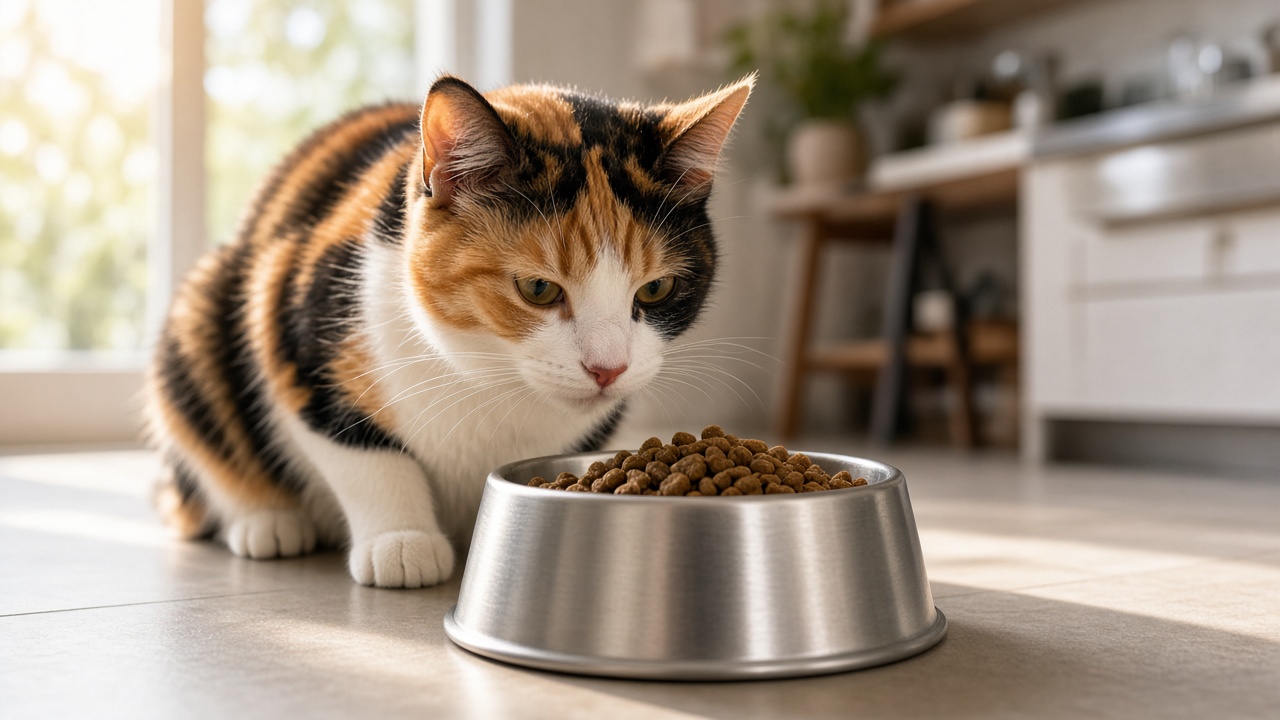
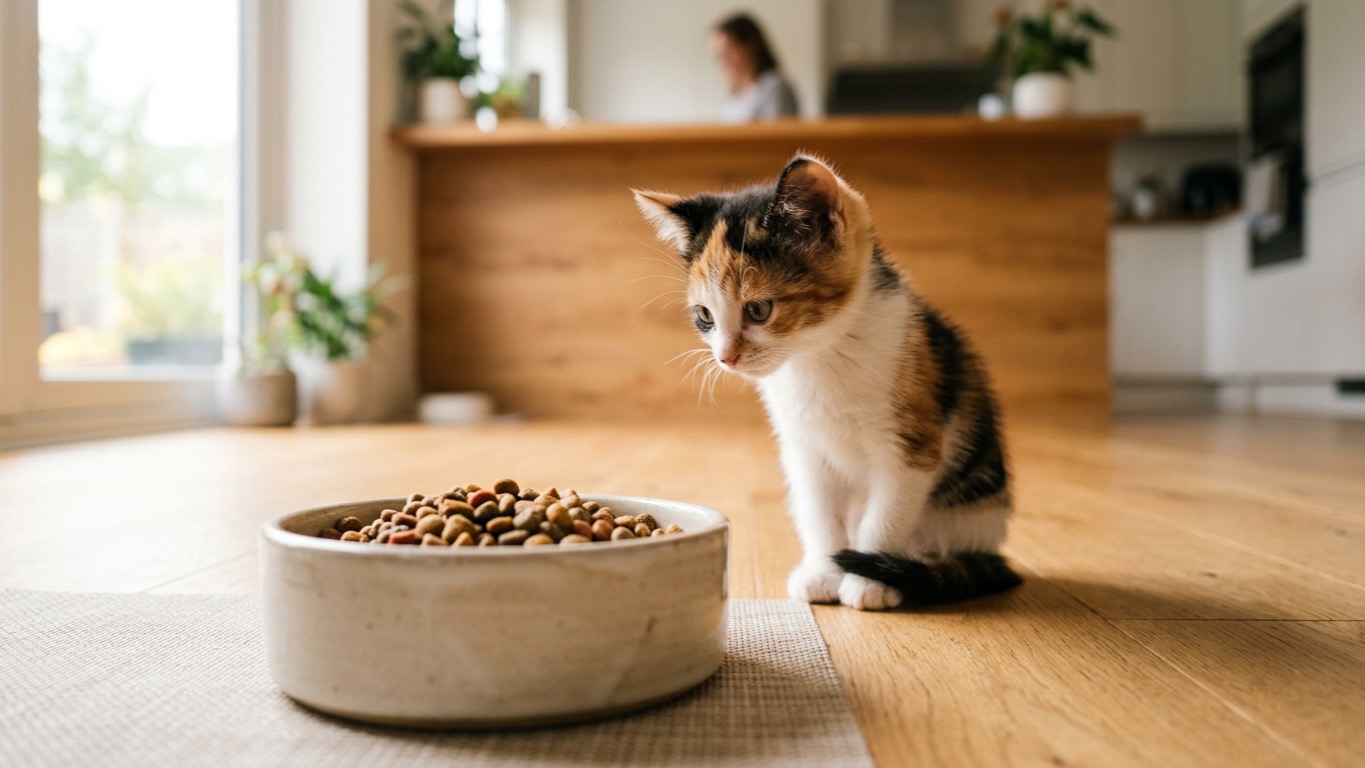
Quick answer: Do not use adult-only cat food as a kitten’s main meals. Feed a complete food labeled for growth or all life stages until about 12 months. One stolen bite from an adult bowl is not an emergency.
A kitten’s main diet should be growth-labeled food, not adult-only food, until 12 months. This page is a label-and-spec briefing from our research desk.
Our inclusion rule is strict: we cover only complete commercial dry and wet foods that print a life-stage statement. We leave out homemade recipes, raw diets, cow’s milk, milk replacers, and prescription foods.
Why adult-only food fails a growing kitten
Adult-maintenance food can meet an adult cat’s needs and still miss a kitten’s growth minimums.
Kittens build bone, muscle, and brain tissue in one fast year, while adult food is built only for upkeep.
The Merck Veterinary Manual reports AAFCO protein floors on a dry-matter basis:
- Growth and reproduction: 30% protein, or 75 grams per 1,000 kcal
- Adult maintenance: 26% protein, or 65 grams per 1,000 kcal
That gap is four percentage points of protein, or 10 grams of protein per 1,000 kcal.
A bag can clear the adult floor and still sit under the growth floor, and that is the core problem.
Our research team compared those published floors with one maker’s growth bag. Nestlé PetCare’s page for Kitten Chow Advanced Nutrition lists 40.0% crude protein, well above the 30% growth floor.
The same page lists other growth-leaning specs:
- Crude fat: 13.5% minimum
- Calcium: 1.2% minimum
- Phosphorus: 1.1% minimum
- DHA: 0.02% minimum
- Taurine: 0.12% minimum
- Calories: 3,705 kcal per kg, or 414 kcal per cup
Those numbers are the maker’s published guarantees, not results from a trial we ran.
Hill’s Pet Nutrition’s kitten feeding page states a simpler rule. Adult cat food is not made with the balance growing kittens need.
If you still need a growth-labeled bag, start with our kitten food buying guide.
How much energy a kitten actually needs
A young kitten can need more than twice the calories per pound that a near-adult kitten needs.
The American Animal Hospital Association’s kitten page reports energy figures from the 2021 AAHA/AAFP Feline Life Stage Guidelines. Those figures are:
- At 10 weeks: 200 kcal per kg of body weight per day
- At 10 months: 80 kcal per kg of body weight per day
Growth slows by 120 kcal per kg, so the 10-week need is 2.5 times the 10-month need. That ratio matches Merck’s 2.5 times rest-energy starting point for kittens.
Worked from those AAHA figures:
- A 1 kg kitten at 10 weeks needs about 200 kcal a day
- A 3 kg kitten at 10 months needs about 240 kcal a day
The smaller, younger kitten can need almost as many calories as the larger, older one.
The Merck Veterinary Manual gives a second starting math. Healthy kittens may be fed at 2.5 times resting energy requirement. Neutered adult cats start at 1.2 times that same rest figure.
Merck also notes that two cats of the same weight may need 30% more or 30% less than the calculated number.
Use the bag’s cup weights, then watch body condition, and do not treat any formula as a fixed dose.
Nestlé PetCare’s Kitten Chow page publishes daily cup ranges:
- Age 3 to 6 weeks: 1/4 to 1/3 cup, 3 to 4 times a day
- Age 7 weeks to 6 months: 1/3 to 3/4 cup, 3 to 4 times a day
- Age 7 months to 1 year: 1/2 to 3/4 cup, 2 times a day
Those cups are based on a standard 8 oz measuring cup, so adjust if your kitten is lean or heavy.
How to read the life-stage line on the bag
The small nutritional adequacy sentence on the bag is the rule that matters, not the word “kitten” in big type.
AAFCO’s Reading Labels page lists four recognized life stages:
- Gestation and lactation
- Growth
- Maintenance
- All life stages
“Complete” means the food holds every required nutrient, and “balanced” means the ratios are in range.
AAFCO shows three standard sentence forms. One cites AAFCO nutrient profiles, and another cites feeding tests or a family match to a tested food.
Read the last phrase in that sentence, and look for “growth,” “growth and reproduction,” or “all life stages.”
“Maintenance” or “adult” means the food was not shown to meet growth needs. Do not use that bag as the kitten’s only food.
AAFCO also says this sentence usually sits on the back or side, in small print, so flip the bag and skip the front panel.
AAFCO’s Reading Labels page notes that most states adopt AAFCO model rules, so the life-stage line is still the buyer’s check.
All-life-stages food is allowed for kittens because it must meet the growth profile. It is a legal fit, not always the leanest adult fit.
What one stolen bite means versus a daily adult diet
A few bites of adult food are not a poison event, but a daily adult-only menu is the risk.
Hill’s Pet Nutrition’s kitten feeding page says a kitten that eats adult food will not be harmed in that moment. It can still slow healthy development if that food stays the main diet.
Keep these two cases apart:
- One raid on an adult bowl: return the kitten to growth food at the next meal
- Days or weeks of adult-only meals: switch back to a growth or all-life-stages food
Watch for loose stool after a sudden swap, which is a diet-change issue, not proof the adult food was “toxic.”
Do not add cow’s milk as a fix, because Hill’s notes that many cats are lactose intolerant and milk can cause diarrhea.
Treats are not a growth diet, and Hill’s says they should stay at or under 10% of daily calories.
If money is why you reached for an adult bag, see our guide to healthy cat food on a budget. Cost is not a reason to drop below the growth life stage.
When to switch, and how to do it
Most cats can move to adult food near the end of the first year, not at weaning.
Hill’s Pet Nutrition’s kitten feeding page says most kittens are fully weaned by 8 to 10 weeks. The American Animal Hospital Association says weaning onto commercial kitten food can start at 3 to 5 weeks.
Nestlé PetCare says kittens often nibble solids at 3 to 4 weeks. It keeps them on Kitten Chow for a full 12 months. After one year, Research suggests to move to a Cat Chow adult formula.
Hill’s says you can begin the adult switch at about 11 to 12 months. Larger breeds such as Maine Coons may stay on kitten food until about 18 months.
Staying on calorie-dense kitten food too long can add extra weight, and Hill’s states that risk in plain terms.
When the age is right, change the mix slowly with this seven-day Hill’s plan:
- Days 1 to 2: 25% adult food and 75% kitten food
- Days 3 to 6: raise the adult share and cut the kitten share
- Day 7: adult food only
Nestlé PetCare uses a 7 to 10 day window for any diet change. Hill’s says some picky cats need up to 40 days.
If stool turns loose, slow the steps and do not jump to 100% adult food in one meal.
Feeding a kitten and an adult cat in one home
Shared free-fed bowls mix the two diets, so timed meals keep each cat on the right life stage.
The American Animal Hospital Association notes that cats prefer to eat alone in a quiet spot, which helps in a two-cat home.
Use this setup:
- Feed the kitten a growth or all-life-stages food on a schedule
- Feed the adult a maintenance food in a separate room or on a high shelf
- Pick up uneaten wet food after the meal
- Do not leave an adult maintenance bag open as a house buffet
An all-life-stages food can feed both cats if the adult stays lean, so watch the adult’s waist. Kitten-density food can add weight to a quiet adult.
An older cat with kidney limits should not share a free-fed bowl with a kitten. See our wet food notes for senior kidney care when those needs conflict.
The Merck Veterinary Manual notes canned foods often hold 60% to more than 87% water, and dry foods hold 3% to 11% water. Wet food spoils faster in a shared bowl.
Nestlé PetCare says not to leave moistened kibble sitting. Mix one part liquid with three parts Kitten Chow, then replace it often.
FAQ
Can kittens eat adult wet food if it is still “complete”?
Only if the can’s life-stage line says growth or all life stages. Adult-maintenance wet food can still miss Merck’s growth protein floor. Wet or dry does not change that label test.
What if my kitten already ate adult food for a week?
Switch back to a growth or all-life-stages food at the next shopping trip. Hill’s says a short stretch of adult food is not an emergency, but it is not a growth plan. Change over several days if stool is soft, and call your clinic if eating stops.
Can one all-life-stages food feed a kitten and an adult?
Yes, if the bag’s AAFCO sentence says all life stages, because AAFCO treats that claim as a growth-level claim. Measure the adult’s cups so the extra calories do not add fat.
When can a Maine Coon eat adult food?
Hill’s Pet Nutrition says large breeds such as Maine Coons may need kitten food until about 18 months. Most other cats can start the switch at 11 to 12 months. Use body condition and the breeder’s growth notes, not the calendar alone.
How many meals should a weaned kitten get?
Nestlé PetCare lists 3 to 4 feedings a day through 6 months, then 2 feedings a day from 7 months to 1 year. Hill’s says kittens need several meals a day because their stomachs are small, and water should stay out at all times.
Can an adult cat eat leftover kitten food?
An adult can eat kitten food for a short time. Hill’s warns that staying on kitten food too long can cause unhealthy weight gain. Move the adult back to a maintenance food after the kitten’s switch.
Is free-feeding adult kibble safe for a kitten?
Free-feeding adult-only kibble makes that food the main diet and fails the 12-month growth rule. Free-feeding a growth food is closer to Purina’s “food at all times” note, but still watch weight after spay or neuter.