One meal of cat food will not poison a healthy dog; a diet of it is not AAFCO-complete for dogs.
This page is a label-and-spec briefing from The Pet Bench research desk.
When someone types “can dogs eat cat food,” they want a yes-or-no they can act on tonight: is the stolen bowl an emergency, or just a calorie mistake? Our research team compared published nutrient floors, manufacturer calorie math, and current shop prices. Adult cat food must hit a 26 percent dry-matter protein floor; adult dog food’s floor is 18 percent. That eight-point gap is why the cat bowl smells like a steak to a dog, and why using it as dinner is a nutrition error, not a toxin event.
The selection rule for this article is the Species-Statement Rule. We cover only commercial dry and wet cat food that already carries a nutritional adequacy statement naming cats — the bags and cans a dog in a mixed household can actually reach. We include stolen kibble, a handed “just this once” scoop, and the night the dog bag is empty.
We do not cover homemade recipes, raw mixes, prescription veterinary diets, snack-labeled cat treats, or any ranked “best food” list. If the principal display panel does not name a species, or if the item is a treat with no adequacy statement, it is outside this briefing.
AAFCO calls the nutritional adequacy statement “perhaps the most important part of a label.” “Complete” means all required nutrients are present; “balanced” means they sit in the correct ratios. A cat food can pass that test for a cat and still fail it for a dog, because the statement names one species. That printed sentence is the rule we used.
What actually happens after a dog eats cat food
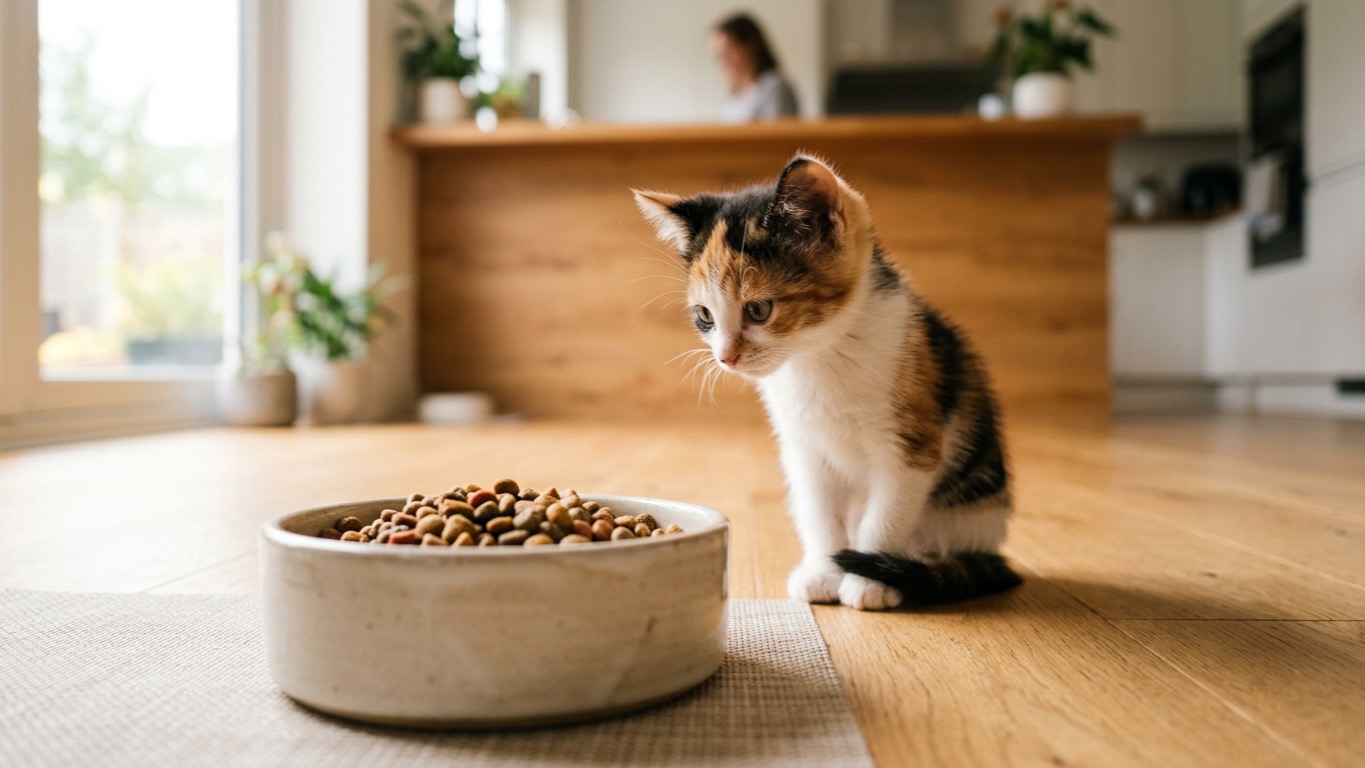
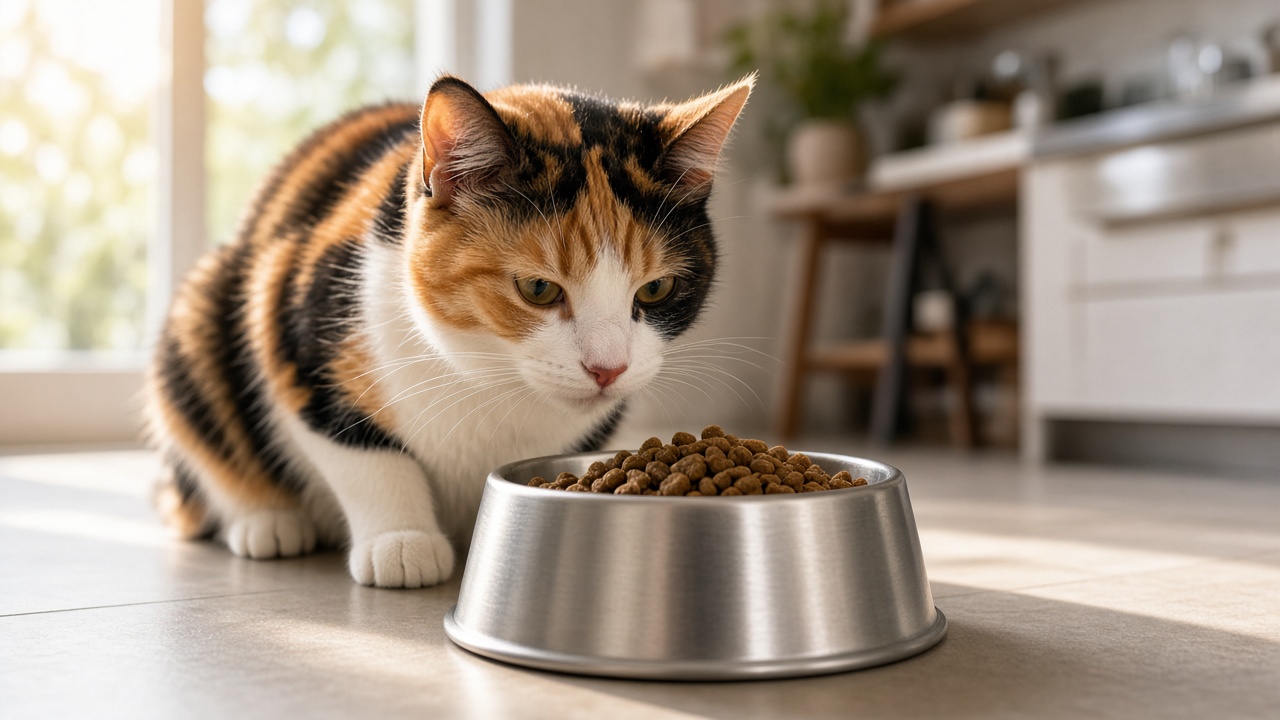
A healthy adult dog that steals a few pieces of cat kibble, or finishes a cat’s wet-food tray, is not eating a poison. Commercial cat food is meat, fat, vitamins, and minerals a dog can digest. The first-day problem is richness, not toxicity.
Cat recipes run denser in protein and fat because cats are obligate carnivores. The Merck Veterinary Manual states that cats require dietary vitamin A, arachidonic acid, and taurine — an extra essential amino acid on top of the ten that are essential for dogs. Those requirements pull more animal tissue and more fat into the formula. A dog used to maintenance dog food can answer that jump with loose stool, gas, or a night of vomiting.
That is the typical stolen-bowl story: messy, not catastrophic. The picture changes when the amount is large, the dog is small, or the dog already has a pancreas, kidney, or weight problem. Repeated vomiting, a hunched stance, a painful belly, skipping the next meal, or diarrhea that lasts past a day are reasons to call the clinic that already knows the dog. This desk cannot rule pancreatitis in or out.
If the dog also ate something from the foods dogs can and cannot eat list — onions, xylitol gum, grapes — treat that as the emergency and the cat food as the side issue. Cat food does not cancel a toxin.
Why cat food is built denser: the 18–26 Split
The 18–26 Split is the cleanest number pair on this page. On its calorie-content explainer, AAFCO sets the adult-maintenance crude-protein floor for dog food at 18.0 percent on a dry-matter basis, and the growth-and-reproduction floor at 22.0 percent. The same association’s cat profiles are not restated on that HTML page. The Merck Veterinary Manual, citing AAFCO guidelines, lists adult cat food at a 26 percent dry-matter protein minimum (65 grams of protein per 1,000 kcal of metabolizable energy) and growth-and-reproduction cat food at 30 percent (75 grams per 1,000 kcal). Adult dog food, on that same Merck table, is 18 percent dry matter or 45 grams per 1,000 kcal.
| Adult floor (dry-matter basis) | Dog food | Cat food |
|---|---|---|
| Crude protein, AAFCO / Merck citing AAFCO | 18% | 26% |
| Protein per 1,000 kcal ME | 45 g | 65 g |
A cat food that merely meets its own floor is already 44 percent higher in protein than a dog food that merely meets its floor (26 divided by 18), and it carries 20 extra grams of protein in every 1,000 kcal. Real bags usually sit above the floor. AAFCO requires protein and fat as legal minimums, and fiber and moisture as legal maximums, so the gap a dog actually eats is often wider than the profile gap.
Fat is the other half. Merck’s nutrition chapter says most commercial adult dog foods typically contain 5–15 percent fat on a dry-matter basis, while cat diets that have been fed successfully span 8–40 percent fat, and “as much as 60 percent of the calories in a cat’s diet may come from fat.”
Dogs do not need the extra taurine that cat food is built to supply. Merck is blunt: taurine deficiency in cats can cause dilated cardiomyopathy and central retinal degeneration. Dogs can synthesize taurine. Extra taurine in a stolen meal is not the harm. The harm is the calorie and fat load that comes with the meat.
[](https://www/articles/cat/feeding/can-cats-eat/can-cats-eat-dog-food/)’s feeding page, updated January 27, 2026, states that cats lack the enzymes to make taurine and arginine, cannot produce vitamin A the way dogs can, and cannot produce arachidonic acid, so dog food “won’t usually be supplemented with arachidonic acid.” A dog living on cat food is an excess problem. A cat living on dog food is a deficiency disease says everyday dog food “can even cause death in certain cases.” Merck adds that nutritional problems occur most commonly with unbalanced homemade diets “and when cats are fed diets formulated for dogs.” Separate the bowls for both animals.
Moisture makes the label easy to misread. Merck puts dry pet foods at 3–11 percent water and canned foods from 60 percent to more than 87 percent water. AAFCO requires those four guarantees on an as-fed basis. A canned cat food that lists 10 percent protein as-fed can still be a high-protein diet once water is removed.
How many extra calories a stolen cup actually adds
AAFCO publishes the modified Atwater factors used on U.S. pet-food labels: 3.5 kcal per gram for protein, 3.5 for carbohydrate (nitrogen-free extract), and 8.5 for fat. Fat is 2.4 times as calorie-dense as protein on that scale. A recipe that leans feline will almost always deliver more kcal per cup than a maintenance dog kibble of the same volume.
AAFCO’s own worked example averages four laboratory batches to 24.80 percent crude protein, 14.58 percent crude fat, and 45.18 percent nitrogen-free extract as-fed, then calculates 3,688 kcal/kg. At 120 grams per cup, that example food is 442.6 kcal per cup. At 10 grams per piece, a single treat from the same math is 36.9 kcal.
Our research team did not weigh a cup of any cat food. We ran AAFCO’s published cup against Merck’s energy formulas. Resting energy requirement is 70 × (body weight in kg)^0.75. For a 25-pound dog (11.3 kg), that is about 433 kcal at rest. Merck’s table then multiplies by 1.6 for a neutered healthy adult dog, about 693 kcal per day, or by 1.4 for an obesity-prone adult, about 606 kcal. One extra 442.6-kcal cup — AAFCO’s example cup, not a cat-food cup we measured — is 64 percent of that neutered dog’s daily maintenance energy. If the dog already ate breakfast, the raid is most of a second day’s calories in one sitting.
That is why a dog will cross a room for the cat bowl. [](https://www/articles/cat/feeding/can-cats-eat/can-cats-eat-dog-food/) states that cats have 470 taste buds and dogs have 1,700, and that cat foods are “formulated to be so highly flavorful.” The attraction is a denser recipe landing on a species with more than three times the taste buds.
Price is not nutrition, but it is a published proxy for how manufacturers position the two recipes. On Hill’s own shop, Science Diet Adult Chicken & Barley dry dog food, 15 lb, listed at $51.99, which is $3.47 per pound. The matching adult chicken dry cat food on the same shop, 7 lb, listed at $34.99, which is $5.00 per pound — 44 percent more per pound. We are not ranking those SKUs. We are noting that the manufacturer’s own store prices the feline recipe as the denser, smaller-bag product.
Which dogs should never share the cat bowl
Some dogs can shrug off one rich meal. Some cannot.
Merck’s energy table flags obesity-prone adult dogs at 1.4 × resting energy requirement, below the 1.6 × used for a typical neutered adult. A dog already living on the lower multiplier cannot absorb a 64-percent calorie spike as “just this once” every time the cat is slow. Repeated raids are a weight plan, whether anyone wrote it down.
Dogs with a pancreatitis history are the other hard no. Cat food is allowed to be, and often is, the higher-fat recipe. If that history is already in the chart, cat food is not a backup dinner.
Older dogs on a renal-support formula are a third group. Extra protein is not automatically a kidney poison in a healthy dog. It is a problem when a veterinarian has already limited protein or phosphorus and the stolen bowl undoes the bag. Our senior kidney-support briefing is about how those diets are labeled. If the current bag exists because of labs, the cat’s bag is not a substitute.
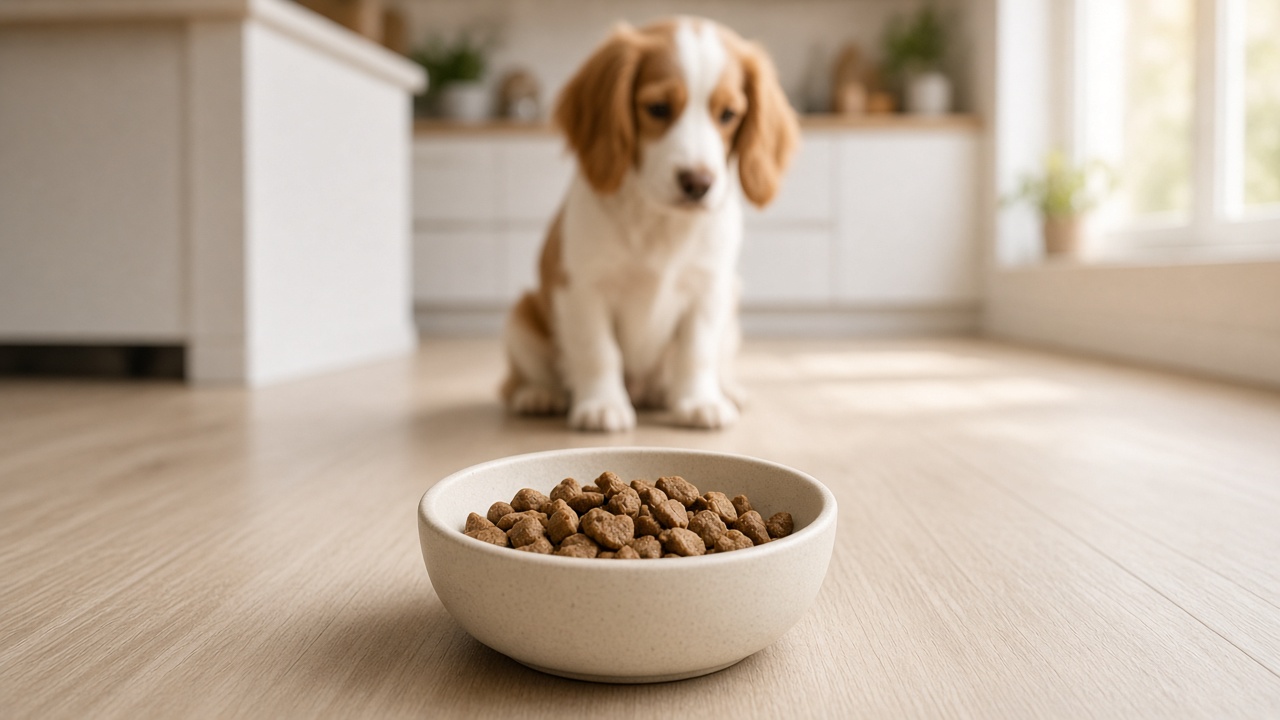
Puppies sit in a different trap. AAFCO’s growth floor for dogs is 22.0 percent dry-matter protein, not 18.0. Cat food will usually clear that protein number. It will not automatically clear calcium, phosphorus, or calorie limits that large-breed puppy foods are built around. A stolen bite is still not a poisoning. A week of kitten food as the only meal is a different diet than the one the puppy bag was sold to provide.
After a raid, and how to stop the next one
Tonight’s job is specific. Pick up both bowls when the meal is over. Do not free-feed the cat in a room the dog can enter. Feed in separate rooms, or put the cat’s dish on a surface the dog cannot use. If the dog already ate a large amount of wet cat food, skip the next dog meal rather than stacking calories, then return to the usual ration. If vomiting or a painful belly shows up, call the clinic.
Do not “balance” the raid with a rich people leftover. If you want a low-calorie chew that is not cat kibble, seedless watermelon flesh is a lighter object than a second protein meal — our watermelon portion guide puts 100 grams of flesh at about 30 kcal. That is a treat rule, not a meal rule.
Keep a closed backup of the dog’s actual food. If that backup is gone, a single meal of cat food is still not a poisoning for a healthy adult dog. It is also not a plan. Resume the dog food at the next meal. If the dog is a puppy, a senior on a renal bag, or a dog with a fat-triggered history, that emergency meal is a phone call.
The Species-Statement Rule does not change after the mess is wiped up. If the nutritional adequacy statement names a cat, the food is the cat’s. Sharing is a misread label.
FAQ
Can dogs eat cat food at all?
Yes, in the narrow sense that commercial cat food is not a toxin to a healthy dog. A few stolen pieces or one unexpected meal is a richness problem, not a poisoning. A diet of cat food is not complete and balanced for dogs, because the adequacy statement names cats.
What should I do if my dog ate a whole bowl of cat food?
Take the remaining food away and note how much disappeared. Skip the next scheduled meal if the dog is otherwise bright, then return to the usual ration. Call a veterinarian if vomiting repeats, the belly seems painful, energy collapses, or diarrhea lasts more than a day.
Can dogs eat wet cat food, or is dry the issue?
Both are cat food. Wet recipes often look lower in protein on the as-fed guarantee because they can be 60 percent to more than 87 percent water, per Merck’s ranges, but they are still built to the feline profile once moisture is removed. Wet food is also easier to gulp, so the calorie spike can be larger even when the can looks small.
Can puppies eat cat food?
A stolen bite is still not a poison. Kitten food is not a substitute for a puppy food that carries an AAFCO growth statement for dogs. Large-breed calcium and calorie limits are the usual reason puppy bags exist as their own products.
Why does my dog like cat food more than dog food?
Cat food is built richer in animal protein and fat, and Research suggests dogs have 1,700 taste buds against a cat’s 470. Preference is not a nutrient requirement. A dog that “only wants the cat food” is asking for the denser bag, not telling you the species floors are wrong.
Is cat food bad for dogs with kidney disease or a pancreatitis history?
If a veterinarian already set a renal or low-fat diet, cat food works against that bag. Extra protein and fat are the two things those plans usually constrain. This desk does not stage kidney disease and does not clear a pancreas. Keep the cat bowl out of reach. Our kidney-support food briefing is about how those bags are labeled, not a stand-in for labs.
Can dogs and cats just share one food to make life easier?
No. Cat food is not an AAFCO-complete dog diet. Dog food is not a safe long-term diet for cats; Research suggests everyday dog food can fail a cat hard enough to kill. Two bowls, two statements, two species. That is the whole method.