Quick answer: Long corkscrew curls mean Texel, and short, dense, wiry curls mean Rex. Long curls plus a forehead crest mean Merino. Check length first, then look for a single crown.
A curly-haired guinea pig is a Texel, Rex, or Merino when judged against British Cavy Council coat rules.
This page is a breed-identification desk note built from published club standards and maker specs. Our research team analyzed those documents. We did not handle live cavies, collect fur, or visit breeders.
The British Cavy Council caps a Rex coat at 1.2 cm. It guides Texel and Merino length at about 2.5 cm per month of age.
The rexoid gate we used
A coat looks curly for one reason. The hair is rexoid. It crimps instead of lying flat.
That is our selection rule. We include a breed only if a named cavy club standard calls the coat rexoid. We exclude straight longhairs, plush Teddies, and rosette breeds.
The British Cavy Council writes the gate in plain language. It calls the Texel the rexoid equivalent of the Sheltie.
It calls the Merino the rexoid equivalent of the Coronet. It calls the Rex a short-coated cavy with a crimped, erect coat.
The American Cavy Breeders Association public roster we reviewed names 13 breeds. Texel is on that list. Rex and Merino are not.
An American show card and a British show card may print different names. The hair on the animal does not change. We skipped regional curls that lack a club standard we read.
How to split Texel, Rex, and Merino
Start with length. Then check the head.
The British Cavy Council Rex standard says coat length must be no more than 1.2 cm, preferably shorter. Anything longer is a listed fault. The coat should look crimped and erect, with no flat patches.
A Rex should feel coarse on the back. The same standard awards 45 of 100 points to coat feel. Only 20 points go to coat look.
The belly may be wavy. A straight belly is not a heavy penalty. Guard hairs are a listed fault.
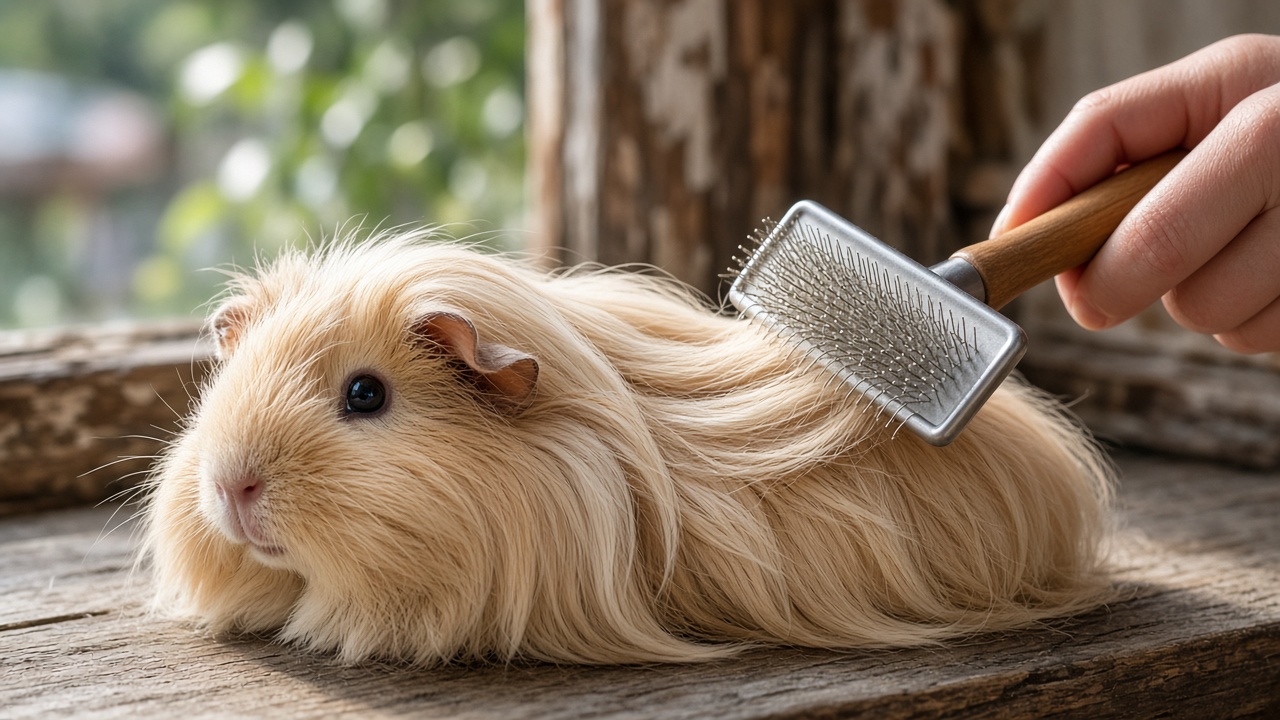
A Texel is the long version of that same crimp. The British Cavy Council Texel standard wants a springy, rexoid coat. The belly should be curly, woolly, and dense.
Hair on the face should point toward the rear. The cavy is shown with a central parting. Length should match age.
The Council’s guideline is about 2.5 cm, or 1 inch, per month. A six-month Texel can carry roughly 15 cm of coat if it has been left to grow.
A Merino uses the same length rule and the same rexoid feel. The difference sits on the forehead. The British Cavy Council Merino standard requires one coronet.
That coronet is a rosette on the front of the head. It radiates from a pinpoint center. The lower edge should sit well down the nose.
Ten of the Merino’s 20 head points belong to that crest. Extra rosettes are a disqualification. A Texel with any rosette is also disqualified.
Those three checks answer most pet-home questions. Short and wiry is Rex. Long ringlets and a smooth head is Texel.
Long ringlets plus one crown is Merino. The British Cavy Council also lists Alpaca, the rexoid partner of the Peruvian. We left that breed out of the walkthrough.
What pet labels get wrong
Pet stores often use “teddy,” “poodle,” or “curly” as nicknames. Those words are not breed names.
A Teddy has short, plush, upright fur. That stuffed-toy feel is not the coarse Rex coat. If the fur feels soft like a plush toy, you likely have a Teddy.
A Silkie, also called a Sheltie, has long hair that sweeps straight back. It is the smooth partner of the Texel. If the locks hang without ringlets, you do not have a curly breed.
A Peruvian has long, straight hair and a front sweep. A Coronet has long, straight hair and a crest. Pair those shapes with curl and you get Alpaca or Merino.
Mixed pet cavies can still grow crimped hair. A pet without papers is not a show Texel. Measure length, then look for one forehead crown.
Coat color does not decide the breed. The British Cavy Council allows Texels and Merinos in any color or mix of colors.
Housing that curly coats actually change
Diet does not change by curl. Floor space and bedding do. Long ringlets trap hay and wet litter.
Humane World for Animals sets a bare minimum of 7.5 square feet for one guinea pig. That is about 30 by 36 inches. For two it still lists 7.5 square feet, and it prefers 10.5 square feet.
Sides must be at least 12 inches high. Humane World for Animals rejects plastic tubs, glass tanks, and wire floors.
The May 2026 Merck Veterinary Manual chapter on housing also cites 7.5 square feet for one animal. It adds about 2 to 4 square feet per extra pig. It wants a solid floor.
MidWest Homes for Pets lists the Guinea Habitat at 8 square feet, with 14-inch sides. The same maker page says a second unit expands the floor to 16 square feet. The bottom is a washable, PVC-lined canvas.
Eight square feet clears the one-pig floor both sources publish. It still sits under the 10.5 square feet Humane World for Animals prefers for a pair. Join a second unit if you keep two.
A roomier floor helps a Texel or Merino stay cleaner. Our guinea pig cage guide walks through floor plans without ranking brands.
Humane World for Animals also wants 2 to 3 inches of paper bedding. It rejects cedar and pine shavings. The Merck Veterinary Manual likewise tells readers to avoid wood shavings and chips.
Kaytee lists Clean & Cozy White Bedding as paper that absorbs up to 6 times its weight in liquid. The same Kaytee page calls it 99.9 percent dust-free and fragrance-free. Bag volumes on that page are 24.6 L, 49.2 L, and 85 L.
Paper sheds fewer long fibers than straw. Our guinea pig bedding guide compares materials by dust and absorbency, not by price tier.
Humane World for Animals places ideal room temperature at about 65 to 75 degrees Fahrenheit. The Merck Veterinary Manual lists 65 to 79 degrees Fahrenheit and 30 to 60 percent humidity. Humane World for Animals notes that guinea pigs often live 5 to 7 years.
Diet numbers that do not change by breed
A Texel still cannot make vitamin C. The Merck Veterinary Manual states that guinea pigs lack L-gulonolactone oxidase. Adults typically need 10 to 25 mg of vitamin C per kilogram of body weight each day.
Growing, pregnant, lactating, or ill animals need 30 mg per kilogram or more. The same Merck page says an adult should eat about its body size in hay. Add 1 to 2 teaspoons of species pellets and 1 to 2 cups of produce daily.
It discourages putting vitamin C in the water. A 2025 study cited by the Merck Veterinary Manual found a produce pattern. Pigs offered 7 to 10 produce types, or more than 10, were less likely to form uroliths.
Oxbow Animal Health lists Essentials Adult Guinea Pig Food at a minimum 14 percent crude protein. Crude fiber is listed at 25 to 28 percent. Ascorbic acid is listed at 250 mg per kg.
The feeding line is 1/8 cup daily for pigs over 6 months, plus unlimited grass hay. Kaytee lists Timothy Complete Guinea Pig Food at a minimum 14 percent crude protein. It lists a maximum 23 percent crude fiber and 200 mg of ascorbic acid per kg.
Kaytee’s feeding line is 1/4 to 1/2 cup. The bag also lists 100,000 CFU per gram of Bacillus species.
Those two pellet lines are not a rank. They are two published labels.
Oxbow Animal Health tells owners to switch over four weeks. Kaytee tells owners to switch over 7 to 10 days. Kaytee also says to use an opened bag within 30 to 45 days.
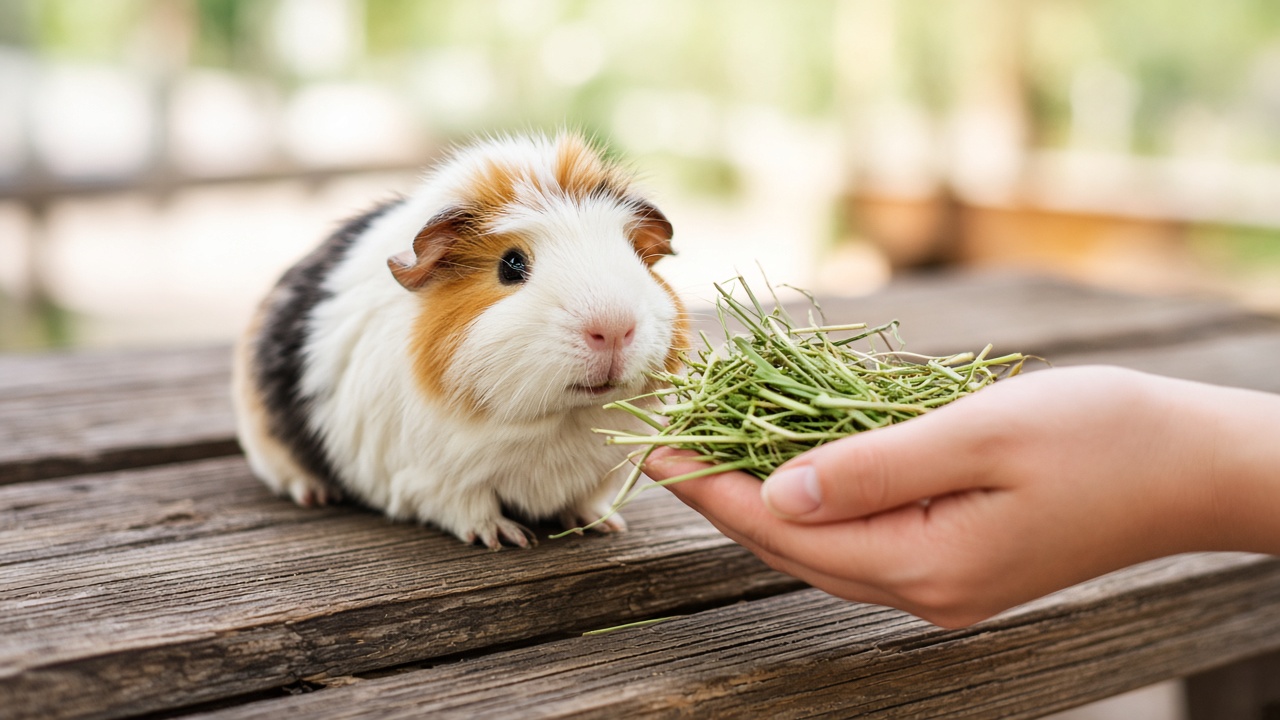
Hay still does the heavy lifting. Curls will collect it. Pick hay out of the coat at each feeding.
Grooming without inventing a test
We did not time grooming sessions or score mats.
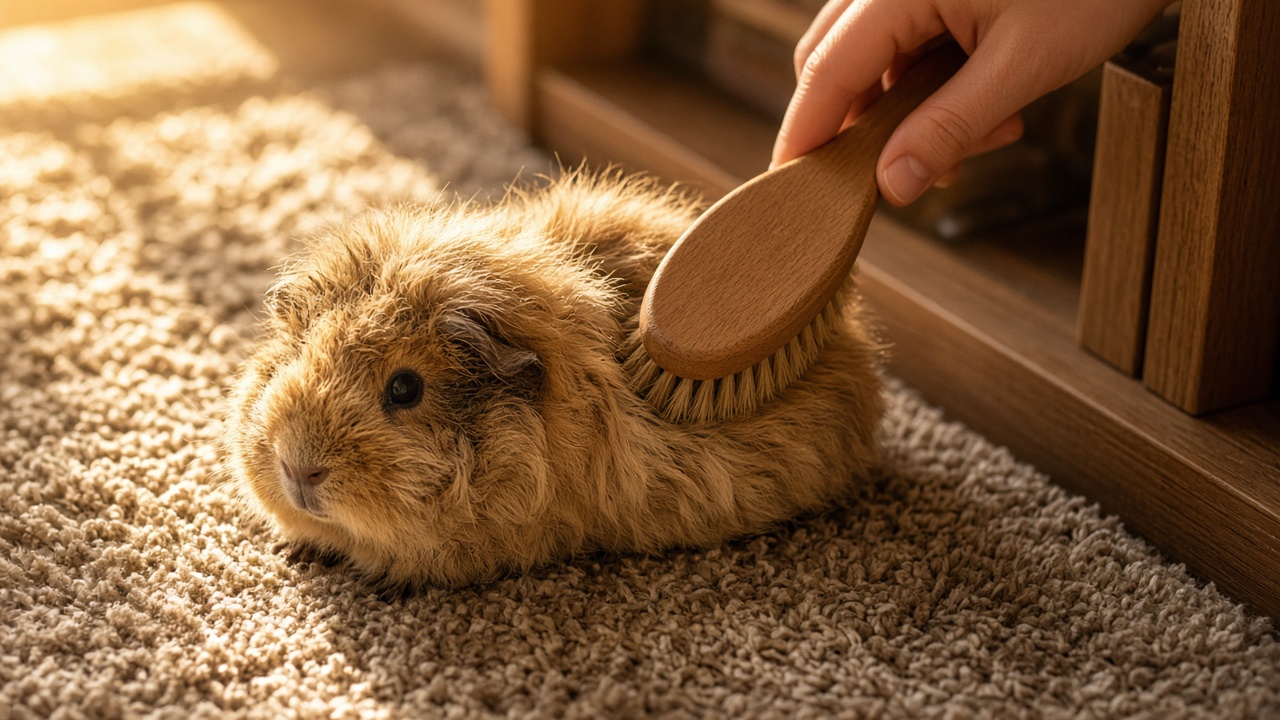
A Rex needs little combing if the coat stays at the 1.2 cm cap. A Texel or Merino needs daily work. The British Cavy Council Texel and Merino standards give 10 points to presentation.
The coat must be clean, free of grease, and unmatted. It must offer no resistance to a comb. If a wide-tooth comb snags, stop and work the tangle with fingers.
A rubber-nub grooming glove built for long-haired cats uses the same contact idea. We did not put that glove on a cavy. Our cat grooming glove review explains how those nubs lift long hair.
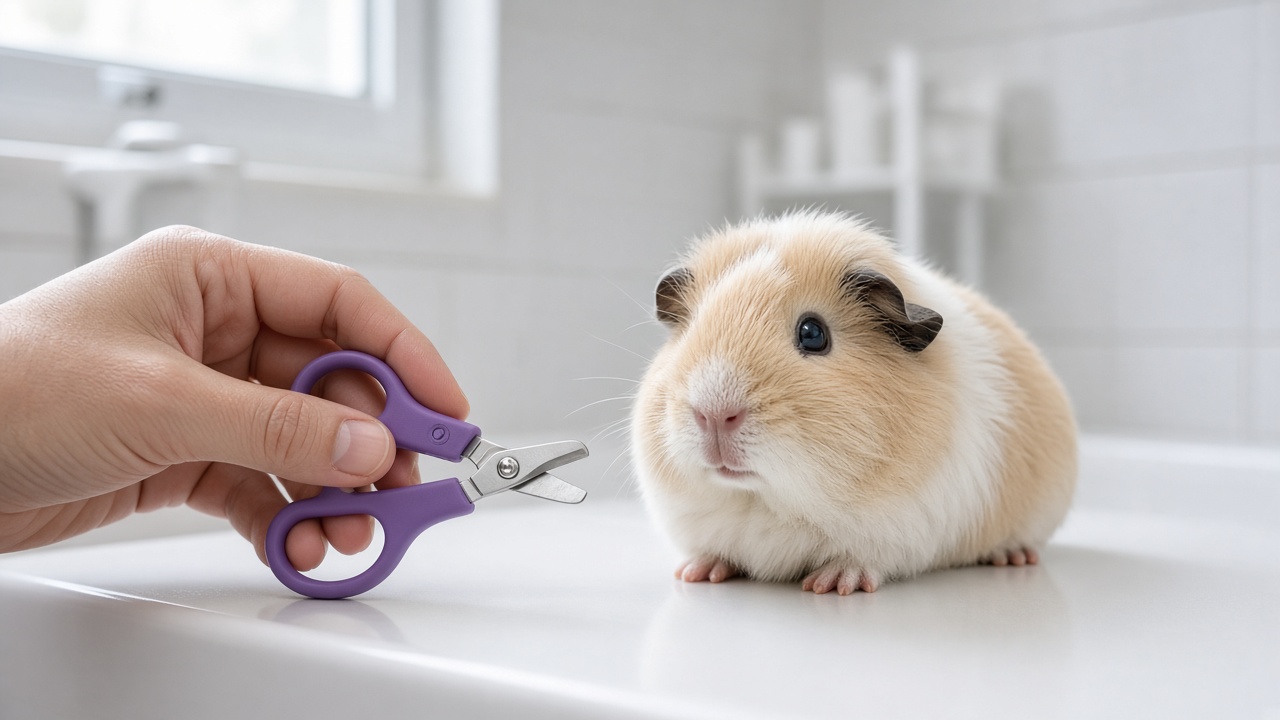
On a guinea pig, keep the stroke light. Stop if the skin lifts with the curl. Trim only the stained skirt around the rear.
Four products we compared by listed attributes
We included a product only if the maker page published a care number. Fiber percent, vitamin C dose, absorbency, dust claim, or floor area counted. Price and rank labels did not.
| Product | Category | Maker-listed spec | Second listed spec |
|---|---|---|---|
| Oxbow Essentials Adult Guinea Pig Food | Adult pellet | Crude fiber 25–28% | Ascorbic acid 250 mg/kg; 1/8 cup daily |
| Kaytee Timothy Complete Guinea Pig Food | Adult pellet | Crude fiber max 23% | Ascorbic acid 200 mg/kg; 1/4–1/2 cup |
| Kaytee Clean & Cozy White Bedding | Paper bedding | Absorbs 6× its weight | 99.9% dust-free; 24.6 L, 49.2 L, or 85 L |
| MidWest Homes for Pets Guinea Habitat | Enclosure | 8 sq ft floor | 14-inch sides; expands to 16 sq ft |
Oxbow Essentials Adult Guinea Pig Food is a uniform pellet with Timothy hay listed first. It is not labeled for growing, pregnant, or nursing pigs.
Kaytee Timothy Complete Guinea Pig Food is also a uniform Timothy pellet. The maker page says the bag holds no loose seeds or sugary fruits.
Kaytee Clean & Cozy White Bedding is paper, not wood. The MidWest Homes for Pets Guinea Habitat is the 171GH line.
Use one unit for a single pig. Join a second unit for the 16 square foot floor the maker lists.
FAQ
Is a Teddy the same breed as a Rex?
No. Both wear short, upright coats, but the feel differs. A Rex should feel coarse and spring back when you brush it with your palm.
If the fur feels plush, you likely have a Teddy.
My curly pig has a swirl on its head. Is that a Texel?
A single, centered forehead crown on long rexoid hair is the Merino marker. The British Cavy Council Merino standard scores that coronet and disqualifies other rosettes. A Texel must have no rosettes at all.
Can a mixed pet guinea pig be curly without being a Texel?
Yes. Curl is a hair trait, not a registration paper. A pet can inherit rexoid hair and still fail every other show point.
Use length and the head check to pick the closest named type.
Does a curly coat change how much I should feed?
No. The Merck Veterinary Manual diet ranges apply to the species, not the hairstyle. Keep hay at body-size volume.
Keep pellets at about 1 to 2 teaspoons, or follow the bag’s cup line. Keep produce near 1 to 2 cups. Stay in the 10 to 25 mg per kg vitamin C band for adults.
How often should I comb a Texel or Merino?
Daily. The British Cavy Council presentation rule is “no resistance to a comb.” Hay wedges into ringlets at every meal.
A Rex at the 1.2 cm cap can go longer between sessions.
Is the MidWest Guinea Habitat large enough for two curly pigs?
MidWest Homes for Pets lists 8 square feet in one unit. It lists 16 square feet if you join a second. Humane World for Animals prefers 10.5 square feet for two pigs.
One unit meets the one-pig floor both sources publish. A pair of long-coated pigs is cleaner on the expanded 16 square foot layout.