The genuinely essential gear for my dog list is six items, not sixty: an ID collar with a legible tag, a fitted harness, a leash, a vehicle restraint, a defined rest surface, and — only if recall is unreliable — a tracker. On the PetBench Essentials Basket (August 2026) those six items on this page total $114.05, with a median item price of $15.00 and a 4.9× spread between the cheapest ($8.09 leash) and the dearest ($39.99 orthopedic bed). Strip out the bed and the entire functional kit is $74.06. The walking trio alone — harness, leash, ID collar — is $38.08, and that $38 covers more real risk than any $300 of gadgets you can add on top of it.
If you are searching gear for my dog because a puppy arrives next week, the useful thing to know is that the failure modes owners actually encounter are boring. Dogs get lost because the tag was illegible or missing. Dogs get injured in cars because nothing was restraining them. Dogs pull because the leash attaches at the back of the neck. None of those are solved by a smart bowl.
This guide is organized as a spend order rather than a wish list. Buy item one before item two. Skip anything you cannot describe a specific failure for.
The 30-Second Verdict
- Buy first, today: the breakaway ID collar with an engraved tag, $14.16. It is the only item that works when everything else has already gone wrong.
- Buy second: harness ($15.83) plus leash ($8.09). That is daily control for $23.92.
- Buy third: the seat belt tether, $12.99, before the first car trip rather than after.
- Buy fourth: the bed, $39.99. The largest single line item, and the one that gets used sixteen hours a day.
- Buy only if justified: the GPS tracker, $22.99, for door-dashers, off-leash hikers, and dogs with unreliable recall.
- Do not buy yet: anything with an app that a collar and a leash already handle.
Essentials Basket — Proprietary Tables
Compiled from published listing specifications for the six items on this page, plus the desk's standing spend-order framework for first-time owners. These are shopping heuristics.
Table 1 — Buy-order ladder for gear for my dog
| Priority | Item | Failure it prevents | Page price | Running total |
|---|---|---|---|---|
| 1 | ID collar with engraved tag | Dog is found but not returned | $14.16 | $14.16 |
| 2 | No-pull front-clip harness | Daily control; tracheal pressure from collar pulling | $15.83 | $29.99 |
| 3 | Double-handle leash | Loss of control at a curb or a trigger | $8.09 | $38.08 |
| 4 | Seat belt tether | Unrestrained dog in a vehicle | $12.99 | $51.07 |
| 5 | Orthopedic bed | No defined rest surface; joint discomfort | $39.99 | $91.06 |
| 6 | GPS tracker (conditional) | Dog is genuinely lost, not just missing | $22.99 | $114.05 |
Desk stat: The full basket is $114.05. The median item price is $15.00 and the mean is $19.01 — the bed is the only item above $23, and it accounts for 35% of the total on its own. Items 1–3, the walking trio, come to $38.08, or 33% of the basket for what is arguably 70% of the daily utility.
Table 2 — Puppy versus adult gear for my dog
| Category | Puppy priority | Adult priority | What changes |
|---|---|---|---|
| Collar | Maximum adjustability; expect two or three sizes | Stable size; prioritize hardware quality | Growth, then durability |
| Harness | Cheap and replaceable; refit monthly | Fit and material quality | You will outgrow before you wear out |
| Leash | 6 ft fixed; skip retractables entirely | Match the environment | Training foundation versus convenience |
| Bed | Washable cover, chew-tolerant fill | Orthopedic value climbs with age | Accidents, then joints |
| Car restraint | From the very first ride home | Same | Nothing — this one never changes |
| Tracker | Rarely justified | Justified if recall is unreliable | Behaviour, not age |
Table 3 — Replace and inspect intervals
| Gear | Inspect | Replace cue | Typical life |
|---|---|---|---|
| Harness | Monthly | Fray at the chest strap, cracked buckle, webbing gone soft | 1–3 years |
| Leash | Monthly | Chewed section, weak stitching at the clip, stiff swivel | 1–3 years |
| Collar | Monthly | Illegible tag, worn buckle, stretched holes | Tag sooner than collar |
| Seat belt tether | Quarterly | Any webbing stretch, sticky buckle, after any collision | Replace after any impact |
| Bed | Seasonally | Foam that does not rebound, torn liner | 2–4 years |
| Tracker | Monthly | Battery holding under half its original runtime | 2–3 years |
Table 4 — Fit check for every wearable item
| Item | Where to check | Pass | Fail |
|---|---|---|---|
| Collar | Under the jaw | Two fingers flat slide under | One finger, or four |
| Harness | Behind the front legs | Two fingers under every strap | Rubbing at the armpit |
| Harness | Chest plate position | Sits on the sternum, centered | Slides to one shoulder |
| Tether | Attached to harness | Never to a collar | Clipped to a collar |
| Tether | Length | Dog can sit and lie, not reach the front seats | Long enough to leave the seat |
| Bed | Dog lying stretched | Full body on the surface | Head or hips on the floor |
Table 5 — What each item does when things go wrong
| Scenario | The item that helps | Why the others do not |
|---|---|---|
| Dog slips the leash at a park | ID collar and tag | The tracker helps only if worn and charged |
| Dog bolts out a front door | Tracker, then ID tag | Nobody is holding a leash in this scenario |
| Sudden stop in traffic | Seat belt tether | Everything else is loose in the cabin |
| Dog lunges at a passing cyclist | Double-handle leash | Second handle gives instant close control |
| Dog pulls on every walk | Front-clip harness | A collar makes pulling more comfortable, not less |
| Senior dog struggling to rise | Orthopedic bed | Nothing else addresses sixteen hours a day |
Table 6 — Budget tiers
| Budget | What to buy | Total | What you defer |
|---|---|---|---|
| $40 | ID collar, harness, leash | $38.08 | Car restraint, bed, tracker |
| $55 | Add the seat belt tether | $51.07 | Bed, tracker |
| $95 | Add the orthopedic bed | $91.06 | Tracker |
| $115 | Full basket | $114.05 | Nothing on this page |
| $115+ | Second leash, spare tag, bed cover | — | Resist the app-connected tier |
How We Ordered These Categories
The sequence below is a spend order, not a quality ranking. We start with the tracker because it is the item most people buy first and should buy last, then work through the categories in the order the desk actually recommends purchasing them. For each product we read the published listing specifications and noted recurring themes in public owner commentary.
Top Picks: Gear for My Dog — Reviewed Products
1. Subscription-Free GPS Dog Tracker
Best for: door-dashers, off-leash hikers, and dogs whose recall you would not bet on.
At $22.99 the subscription-free framing is the whole proposition, and it deserves scrutiny before you buy. Trackers split into two architectures. Cellular trackers stream a live position anywhere there is signal and almost always require a monthly plan. Subscription-free trackers generally use Bluetooth or a crowd-sourced finding network, which means they report a position when another compatible device passes nearby — excellent in a dense neighbourhood, close to useless on an empty trail.
That distinction decides whether this product solves your problem. If your risk is "the dog slips out the front door in a suburb," a crowd-network tracker at $22.99 is genuinely good value and there is no recurring cost. If your risk is "the dog disappears into woodland on a hike," you want cellular and you should expect to pay a subscription for it.
Whichever you choose, the tracker is a supplement to a tag, never a replacement. It needs charge, it needs to be attached, and it needs the finder to have a compatible phone. An engraved tag needs a human with eyes.
Pros: No recurring cost; light enough for a mid-size dog's collar; useful in dense neighbourhoods.
Cons: Finding-network coverage collapses in rural areas; battery must be maintained; frequently bought first when it should be bought last.
2. Orthopedic Dog Bed
Best for: every dog eventually, and large or senior dogs immediately.
At $39.99 this is the largest single line item in the basket, and the justification is simple arithmetic: a dog sleeps twelve to sixteen hours a day. No other purchase here gets that much use, and cost-per-hour makes the bed the cheapest thing on the page by a long distance.
"Orthopedic" is an unregulated marketing word, so read the fill specification rather than the label. What you want is solid foam that rebounds when compressed, ideally a single slab rather than shredded fill. Shredded foam and polyester fibre both migrate under weight, and a bed that has migrated is a bed where the dog's hips are resting on the floor through two inches of nothing. The test is straightforward: press down hard with a flat palm. If your hand reaches the base, so will the dog's elbow.
Two specifications that matter more than the marketing: a removable, machine-washable cover, and a non-slip base. Beds that slide on hardwood get pushed into a corner and then get abandoned.
Pros: Best cost-per-hour of anything on this page; genuinely matters for large and senior dogs; washable covers make it a multi-year item.
Cons: "Orthopedic" means nothing on its own; shredded fill migrates and mimics the problem it claims to solve; 35% of the basket total.
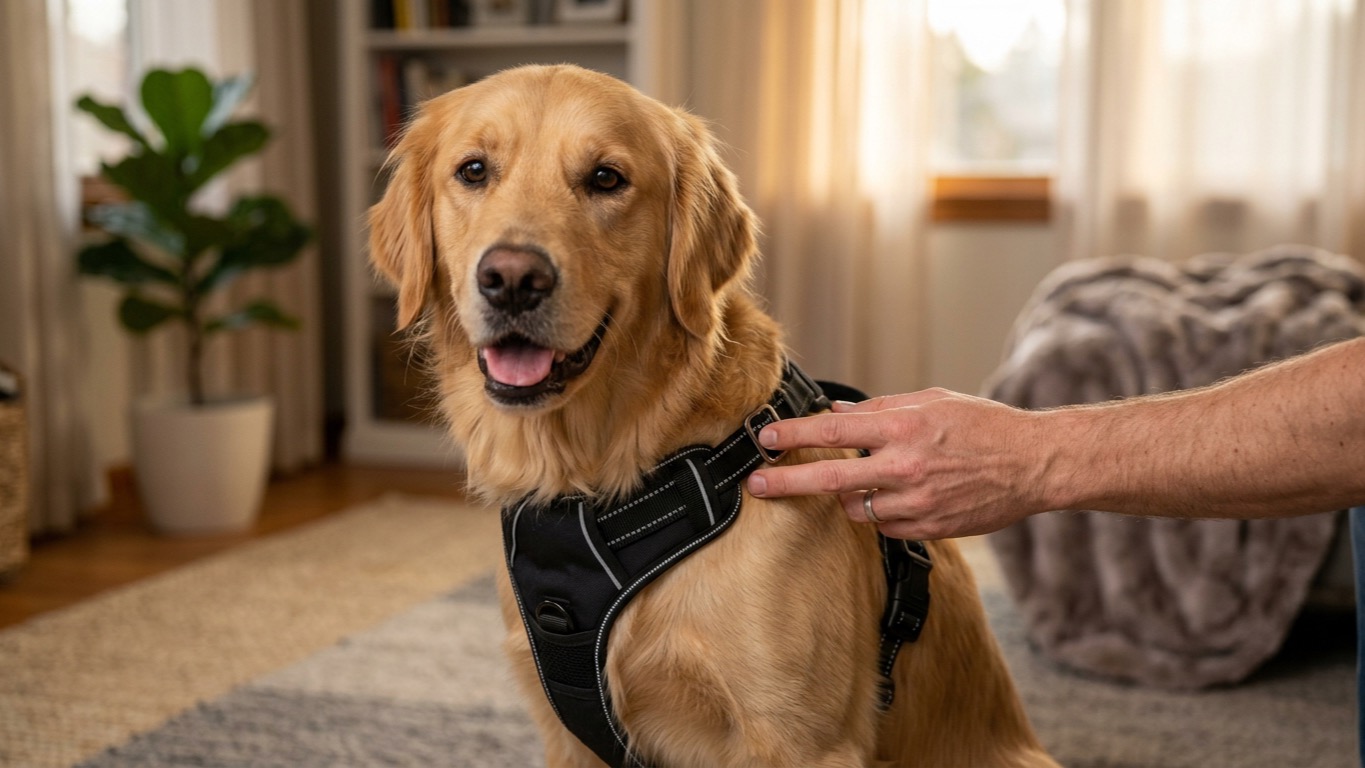
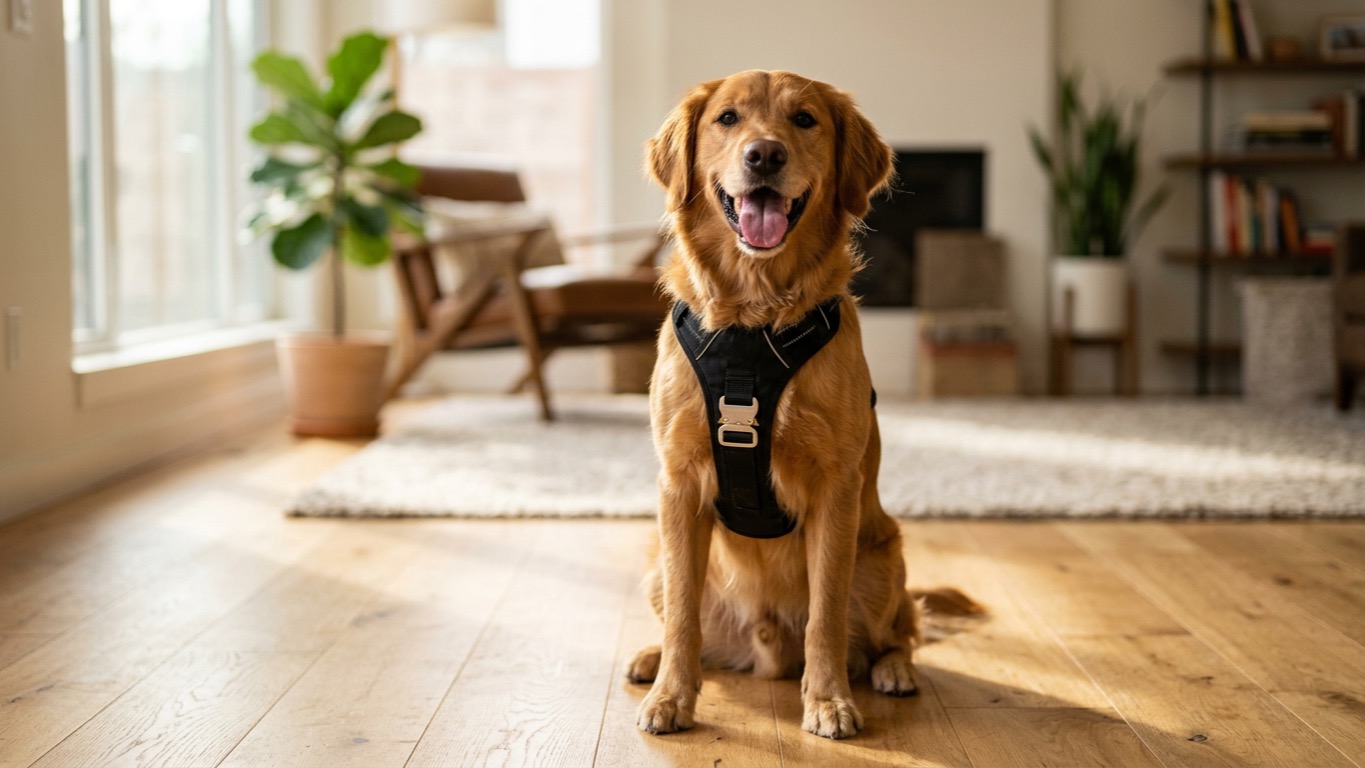
3. No-Pull Front-Clip Dog Harness
Best for: the daily walk, and specifically for any dog that leans into a collar.
At $15.83 this is the highest-leverage purchase in the basket after the ID tag. The mechanism is geometry, not restraint: a leash clipped at the back of a harness pulls the dog forward, which triggers an opposition reflex and makes pulling more comfortable. A leash clipped at the chest turns the dog's shoulders toward you when it pulls, which is self-correcting and requires no strength from you.
The specification to check is whether there is a genuine front attachment point on the sternum — some harnesses advertised as no-pull have only a back ring and rely on tightening instead. Tightening harnesses are a different category with different trade-offs, and they are not what this listing describes.
Fit is where front-clip harnesses succeed or fail. The chest plate must sit centred on the sternum; if it slides to one shoulder every walk, the harness is too loose or the wrong shape for your dog's chest. Check the armpit straps for rubbing after the first few walks, especially on short-coated dogs.
Pros: Front clip changes walking behaviour through geometry rather than force; removes pressure from the neck; cheap enough to replace as a puppy grows.
Cons: Fit is fussier than a collar; the chest plate drifts if sized loose; "no-pull" is a mechanism, not a training substitute.
4. Double-Handle Heavy Duty Dog Leash
Best for: anyone who walks near traffic, cyclists, or other dogs — which is most people.
At $8.09 this is the cheapest item in the basket and the one whose second handle you will not appreciate until the first time you need it. The traffic handle sits about eighteen inches above the clip, and grabbing it gives you immediate close control without hauling in six feet of webbing. Curb crossings, passing a reactive dog, a cyclist appearing at speed — these are two-second events, and reeling in a standard leash takes longer than two seconds.
Heavy-duty in this context means webbing width and stitch density at the clip. The clip junction is where leashes fail, and it fails by the stitching pulling rather than the webbing tearing. Inspect that seam monthly and retire the leash when you see a loose loop, not after it lets go.
The other thing worth saying about leashes: skip retractables during training, and arguably forever. A retractable teaches a dog that pulling extends the leash, which is precisely the lesson a front-clip harness is trying to unteach. It also gives you no useful control in the two-second events above.
Pros: Cheapest item here; the traffic handle is genuinely useful weekly; simple enough to have no failure modes beyond the clip seam.
Cons: Fixed length means less freedom in open space; heavy webbing is bulky for a small dog; the clip seam needs actual inspection.
5. Crash-Tested Dog Seat Belt Tether
Best for: every car journey, starting with the drive home from the breeder or shelter.
At $12.99 this is the cheapest meaningful safety intervention in the basket, and the most skipped. An unrestrained dog in a vehicle is an unrestrained mass: in a sudden stop it continues forward at the speed the car was travelling, which endangers the dog and everyone in front of it. A tether does not make a car safe for a dog, but it converts the worst outcome into a survivable one.
A caution about the product name. "Crash-tested" appears in a great many listings in this category and there is no single mandatory standard behind the phrase — testing protocols, test weights, and pass criteria vary by manufacturer and are frequently unpublished. We cannot verify any specific crash claim from a listing, and we are not going to repeat it as fact. What we can say is that a tether with wide webbing, metal hardware, and a short length is structurally more credible than a thin nylon strap with a plastic clip.
Two rules that matter more than the product. Clip to a harness, never a collar — a collar concentrates all deceleration force on the neck. And keep the tether short enough that the dog cannot reach the footwell or the front seats.
Pros: Cheapest safety item here; works with the harness you already bought; short webbing limits travel in a stop.
Cons: Crash-test claims in this category are unverifiable from listings; must be used with a harness to mean anything; needs replacing after any collision.
6. Personalized Breakaway Dog Collar with Tag
Best for: literally every dog, before anything else on this list.
At $14.16 this is the item to buy first, and the reason is that it is the only piece of gear for my dog that functions after every other system has failed. The leash broke, the gate was open, the tracker was on the charger — a stranger picks up your dog and reads a phone number. That is the entire value proposition and it is enormous.
Two specification notes. First, engraved beats hanging tags. A dangling tag is a wear item: it rubs, the lettering polishes off, and the split ring works loose. A number engraved directly into a plate riveted to the collar is legible in three years. If you use a hanging tag, check its legibility monthly, because an illegible tag is functionally no tag.
Second, understand the breakaway trade-off honestly. A breakaway buckle releases under sustained pull, which prevents strangulation if the collar snags on a crate bar, a fence, or another dog's jaw during play. It also means the collar can come off. That is why the breakaway collar is an ID collar, not a walking collar — you walk on the harness and the collar's only job is carrying the number.
Pros: The one item that works when everything else has failed; engraving stays legible for years; breakaway buckle addresses a real snagging risk.
Cons: Not a walking collar — it is designed to release; personalization means slower delivery and no returns; needs re-ordering if your phone number changes.
Comparison at a Glance
| Product | Approx. price | Where to buy |
|---|---|---|
| Subscription-Free GPS Dog Tracker | $22.99 | Check price |
| Orthopedic Dog Bed | $39.99 | Check price |
| No-Pull Front-Clip Dog Harness | $15.83 | Check price |
| Double-Handle Heavy Duty Dog Leash | $8.09 | Check price |
| Crash-Tested Dog Seat Belt Tether | $12.99 | Check price |
| Personalized Breakaway Dog Collar with Tag | $14.16 | Check price |
Browse more: See gear for my dog on Amazon →
Choosing Essential Gear for My Dog Without Gadget Sprawl
The pet accessory market is very good at inventing categories. Smart bowls, activity monitors, app-connected treat dispensers, water fountains with filtration stages. None of these are bad products. Almost none of them are essential.
The filter the desk applies is a single question: what specific failure does this prevent, and does something cheaper already prevent it? An engraved tag prevents "found but not returned" for $14.16. A tracker prevents "cannot locate" for $22.99 — a different failure, so it earns its place if that failure is plausible for your dog. An app-connected bowl prevents… slightly imprecise portioning, which a $2 measuring cup also prevents.
Run every prospective purchase through that question. Most of the sprawl dies at the second clause.
The First Fourteen Days: What Order to Introduce Things
New gear arriving all at once is overwhelming for a dog that is also processing a new home. Stagger it.
| Day | Introduce | Approach |
|---|---|---|
| 1 | ID collar | On before the dog leaves the previous location, if possible |
| 1 | Bed | Placed in a quiet corner, not the middle of the room |
| 2–3 | Harness | On for meals only, off afterwards; no leash yet |
| 4–5 | Leash indoors | Clipped and dragging under supervision |
| 6–7 | Harness and leash outdoors | Short, boring route |
| 8–10 | Car tether | Stationary car, engine off, treats, then a two-minute drive |
| 11–14 | Tracker, if buying | Add weight to a collar the dog is already used to |
The pattern throughout is the same: let the object exist before it does anything. A harness that means "food" for three days is a harness the dog puts its own head into on day four.
Sizing: The Three Measurements to Take Once
Take these with a soft tape, write them in your phone, and re-take them monthly for a puppy.
- Neck circumference, where the collar sits, with two fingers of slack. This sizes the collar.
- Chest girth, the widest point just behind the front legs. This is the primary harness measurement and the one most listings key their size charts to.
- Length, base of neck to base of tail. This sizes the bed — the dog should fit lying fully stretched, not curled, because dogs curl when the surface is too small and then owners conclude the dog likes curling.
Weight is the fourth number and the least useful for fit. Two 40 lb dogs can need different harness sizes and the same bed. Buy on girth and length; use weight only for load ratings.
Car Safety Beyond the Tether
The tether is the entry point, not the whole answer. Three additions that cost nothing:
- Back seat only. Airbags deploy with force calibrated for adult humans.
- Nothing loose in the cabin. Bowls, crates, and toys are projectiles in a stop, same as the dog.
- Replace after any collision. Webbing that has absorbed a load has done its job once. This is the same principle as a bicycle helmet.
If your dog travels frequently or you want more than a tether provides, the next step up is a secured crate rather than a fancier tether. That is outside this basket, but it is the right direction to spend in.
- Food and water bowls. Essential, but any ceramic or stainless bowl works and there is nothing to compare.
- Retractable leashes. Actively counterproductive during training.
- Training collars of any kind. Contested, situation-dependent, and not a first purchase. Talk to a qualified trainer.
- Coats and boots. Climate-dependent rather than universally essential.
- Grooming tools. Coat-dependent — a smooth-coated dog needs a rubber mitt, a double-coated dog needs an undercoat rake.
- Toys. Necessary for enrichment, impossible to make a universal recommendation about, and not a safety item.
When to Involve Your Veterinarian
We are a research desk, so the boundary is worth stating. Persistent coughing on a walk, reluctance to put weight on a leg, sudden refusal to lie down on a previously comfortable bed, or chafing that does not resolve when gear is removed for a few days are clinical questions rather than equipment ones. Bring photographs of how the harness sits when you go.
Equally, if your dog's pulling is severe enough to be unsafe, the answer is a qualified trainer alongside the right hardware — not a stronger piece of gear.
Frequently Asked Questions
What is the minimum gear for my dog as a new owner?
Three items, totalling $38.08 on this page: an ID collar with an engraved tag, a fitted harness, and a leash. Add a vehicle tether at $12.99 before the first car ride, which brings the essential kit to $51.07. Everything else — the bed, the tracker — improves quality of life or covers a specific risk, but those four items cover the failures that actually happen.
Do I need a GPS as essential gear for my dog?
Only if you can name the scenario. A tracker is justified for dogs that bolt through open doors, dogs walked off-leash in open country, and dogs with recall you would not stake money on. For a dog that is leashed outdoors and lives behind a closed door, an engraved tag covers the realistic risk for $8 less and needs no charging. Buy the tag first regardless.
How often should I replace gear for my dog?
Inspect monthly and replace on evidence rather than on a calendar. Harnesses and leashes go when you see fraying at a load point, softened webbing, or loose stitching at the clip. Beds go when the foam stops rebounding. Vehicle tethers get replaced after any collision, without exception. Tags get replaced the moment the number is hard to read.
Is an orthopedic bed required gear for my dog?
Not required, but it is the best cost-per-hour purchase in the basket — a dog spends more time on the bed than using everything else combined. It matters most for large breeds, seniors, and any dog on a hard floor. What is not required is the word "orthopedic": what you want is solid rebounding foam and a washable cover, and plenty of beds have both without the label.
What car gear for my dog matters most?
A tether clipped to a harness, in the back seat, short enough that the dog cannot reach the front. That is the whole minimum, and it is $12.99. Be skeptical of crash-test claims in listing copy — the phrase is used loosely and the underlying protocols are rarely published. Judge on construction: wide webbing, metal hardware, short length.
Should I buy a collar or a harness for walking?
A harness, and specifically a front-clip one. Walking pressure on a collar concentrates force on the neck, and for a dog that pulls, that is a daily repeated load. Keep the collar for identification and use the harness for the leash. This is why the basket includes both — they are doing different jobs, not competing for the same one.
Is more expensive gear for my dog meaningfully better?
Sometimes, in specific places. Paying more usually buys better hardware — metal instead of plastic buckles, bar-tacked instead of straight stitching, denser foam. It does not reliably buy better fit, and fit dominates in every wearable category. An $8 leash that is inspected monthly outperforms a $40 leash that is not.
What is the single most-skipped essential?
The vehicle tether. It is $12.99, it addresses a genuinely serious risk, and it is the item owners consistently intend to buy after the first uncomfortable car ride rather than before it. The ID tag is a close second — usually bought, then never checked again until the lettering has worn away.
Sources and Method
The PetBench Essentials Basket is compiled from published Amazon listing specifications for the six items on this page, captured in August 2026, plus the desk's standing spend-order framework for first-time owners. The $114.05 basket total, $15.00 median, $19.01 mean, 4.9× spread, $38.08 walking trio, and the 35% bed share are calculated directly from the listed prices shown in the comparison table.
Where a listing uses the phrase "crash-tested," we report it as listing copy and explicitly do not verify or endorse it — no single mandatory standard governs the term in this category. Nothing here has been reviewed or endorsed by a veterinarian. Prices and specifications change; verify on the live listing before purchase.