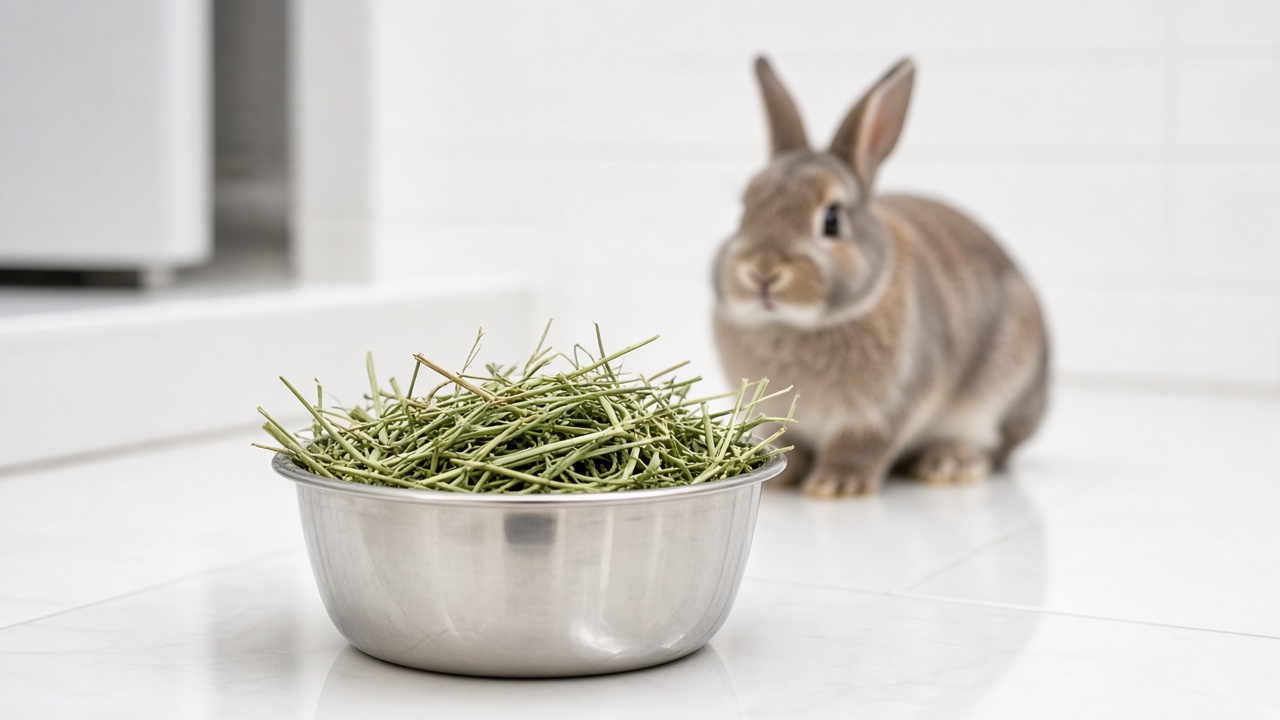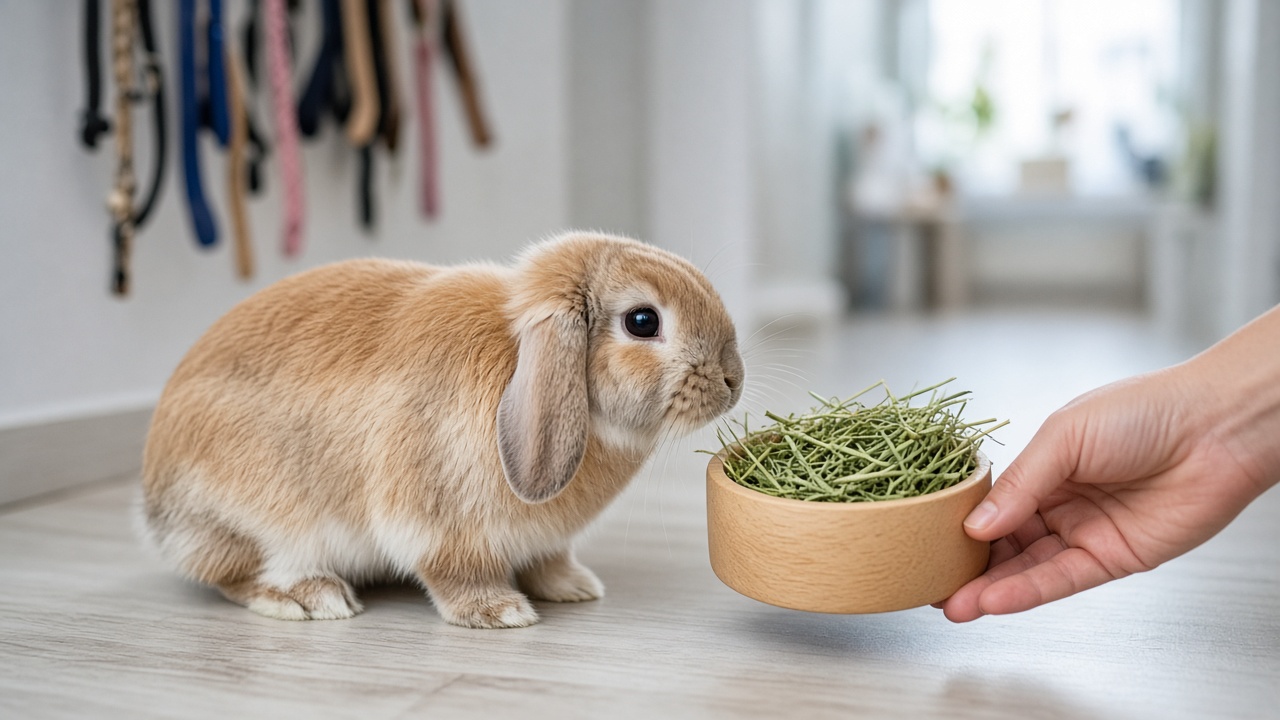

Quick answer: Keep an adult French Angora on unlimited grass hay, a measured timothy pellet, and regular coat work. House the rabbit indoors in a pen large enough to hop, plus daily out-of-pen time. Skip alfalfa-heavy adult diets and long stretches without combing.
A French Angora is a clean-faced commercial wool rabbit that seniors must weigh 7.5 to 10.5 pounds.
This page is a research-desk care brief that compares published breed and feed specs. We did not harvest wool from a live rabbit, run a feeding trial, or score a show string.
Our selection rule is the Adult Indoor Companion Rule. We cover adult companion French Angoras kept indoors on a hay-first diet, and only pellets with a maker-page guaranteed analysis. We leave out breeding programs, outdoor-hutch-only setups, meat strings, and mill fiber barns.
What a French Angora actually is
The National Angora Rabbit Breeders Association describes the French Angora as a commercial-type wool rabbit. The face, head, ears, and front feet stay clean. Ear tufts, if present, sit only at the tips.
That clean face is the breed’s practical marker. You are not trimming facial wool the way English Angora owners must. NARBC still calls the coat a wool coat with guard hair above a crimped underwool.
NARBC lists junior bucks and does from 3.75 pounds to 7.5 pounds. Seniors may weigh 7.5 to 10.5 pounds. Those two bands are the published size check for the breed.
NARBC notes that ARBA recognizes four Angora breeds. French is the commercial body with clean extremities. NARBC says most judging points sit on wool density, texture, and length.
House Rabbit Society says well-cared-for indoor rabbits can live seven to 10-plus years. That is years of combing, not a short novelty phase.
NARBC calls the coat easy-care next to other Angoras. Easy-care does not mean no-care.
Loose wool still enters the gut when a rabbit grooms itself. Hay fiber and a comb are the two controls.
How we chose what belongs here
Our research team analyzed maker pages and two primary rabbit organizations. We compared listed protein, fiber, calcium, and feeding notes. We did not open bags or weigh scoops.
A pellet entered the table only if the maker page listed a guaranteed analysis. We skipped seed-and-fruit mixes. House Rabbit Society warns those mixes raise carbohydrate load and invite selective eating.
We also skipped outdoor-hutch plans as a primary home. House Rabbit Society says a backyard hutch isolates a social animal and exposes it to predators. Domestic rabbits can die from the stress of an approach.
AAFCO treats household rabbits not raised for food or fur as specialty pets. For those species, AAFCO recognizes nutrient recommendations from the National Research Council. That is not an AAFCO dog or cat nutrient profile.
Grooming a clean-faced wool coat
French Angora wool is the daily work. NARBC says the coat should fall free, with guard hair that can take mill processing. Mats start where the rabbit cannot reach well.
Check the belly, inner thighs, and the base of the tail first. House Rabbit Society tells owners to brush regularly with a soft brush. That is the floor, not a show calendar.
A wool breed sheds into its own mouth. Hay fiber is the main defense against blockage. Grooming is the second.
Use a slicker and a wide-tooth comb on dry wool. Work from the ends toward the skin. Do not yank a solid mat.
Feel for skin before you cut anything close. A full session lives on our how to groom a rabbit guide. Tool choices sit in our rabbit grooming kit review.
Keep the housing dry. Damp wool felts. Soiled wool at the rear is a flystrike risk in warm weather.
House Rabbit Society lists flystrike among outdoor hazards. Indoor wool still needs a clean rear. Do not bathe a French Angora as routine care.
Water mats the underwool. Spot-clean with a damp cloth if urine reaches the skirt. Then comb that patch dry.
Diet: hay first, then a measured pellet
House Rabbit Society puts hay at 85 percent of an adult diet. Vegetables take about 10 percent. Pellets take about 5 percent.
Fruit stays under 5 percent and counts as a treat. Hay is not a garnish. House Rabbit Society says it cuts hairball and blockage risk and wears the teeth.
Adult grass choices are timothy, orchard, oat, and similar low-calcium hays. House Rabbit Society reserves alfalfa hay for babies, nursing does, elderly rabbits, and injured rabbits. A healthy adult French Angora does not need alfalfa as the main forage.
The same page notes that long-haired breeds, including Angoras, may need more protein or pellets to grow coat. Pellets should still stay plain and high in fiber. House Rabbit Society wants 18 percent minimum fiber and no nuts, seeds, or grains in the mix.
Susan Brown, quoted by House Rabbit Society, warns against uncontrolled pellet feeding. She lists obesity, heart and liver disease, chronic diarrhea, and kidney disease as risks. Measure the scoop.
House Rabbit Society suggests 1 to 2 cups of leafy vegetables per 4 pounds of body weight. Pick at least three greens. Add one new green at a time.
Our research team compared four currently sold adult pellets. Three list a 25 percent fiber figure on the maker page. Kaytee Timothy Complete Rabbit Food lists a 22.0 percent minimum.
A senior French Angora often sits in the 8 to 10 pound band. Oxbow Animal Health feeds Essentials Adult Rabbit Food at 1/3 to 1/2 cup daily in that band. Unlimited grass hay sits beside that scoop.
| Product | Protein min | Fiber | Calcium | First listed plant | Maker feeding note |
|---|---|---|---|---|---|
| Oxbow Essentials Adult Rabbit Food | 14.00% | 25.00–29.00% | 0.35–0.75% | Timothy grass meal | 8–10 lb: 1/3–1/2 cup daily |
| Small Pet Select Rabbit Food Pellets | 14% | 25–29% | 0.4–0.6% | Timothy hay | Ages 1–5 yr: 1/4–1/2 cup per 6 lb |
| Kaytee Timothy Complete Rabbit Food | 13.0% | 22.0–27.0% | 0.25–0.75% | Sun-cured timothy grass hay | Large breed: 2/3–1 1/2 cups |
| Science Selective Adult Rabbit Food | 14.0% | 25.0% | 0.6% | Alfalfa meal | 60–70 g/day for a 2.5 kg adult |
Oxbow lists calcium at 0.35 to 0.75 percent. Small Pet Select lists 0.4 to 0.6 percent. Kaytee lists 0.25 to 0.75 percent, and Supreme Petfoods lists 0.6 percent calcium with 0.4 percent phosphorus.
Science Selective Adult Rabbit Food names alfalfa meal first. Supreme Petfoods writes the food for adults from 20 weeks of age. A hay-first house plan still needs loose grass hay beside those nuggets.
Kaytee’s large-breed scoop is the outlier. The maker page says 2/3 to 1 1/2 cups for a large breed. That sits above Oxbow’s 8 to 10 pound cup range.
Match the scoop to body condition. Do not default to the biggest printed cup. Oxbow runs a four-week switch: mix 3:1, then 2:2, then 1:3, then full new food.
Kaytee uses a 7 to 10 day mix. Small Pet Select says hay should be available 24 hours a day. Keep fiber high during any change.
Kaytee tells owners to use an opened bag within 30 to 45 days. The same page lists Total Bacillus species at 100,000 CFU per gram. Oxbow lists vitamin A at 10,000 IU per kilogram minimum.
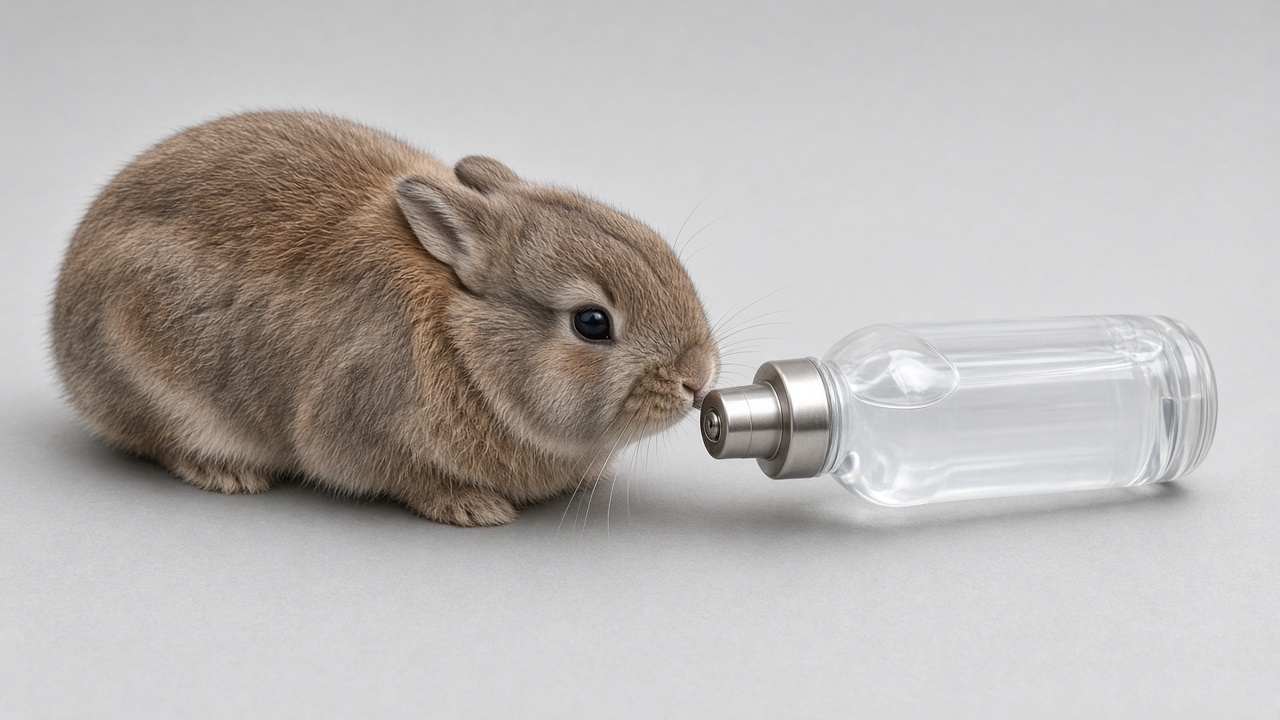
Water is not optional. House Rabbit Society wants fresh water daily. A heavy crock usually invites more drinking than a bottle.
If you use a bottle, check the ball every refill. For a wider pellet field, see our best rabbit pellets guide. This table stays on four adult formulas with published analyses.
Housing that fits a 10-pound wool rabbit
House Rabbit Society’s primer sets a minimum cage at 2 by 2 by 4 feet for a single rabbit. That is a bedroom, not a life. The same page prefers a pen and several hours of exercise each day.
House Rabbit Society’s living-space guide says a resting cage should be three to four times the stretched-out adult body length. A senior French Angora is a long commercial body. A starter kitten cage fails that test.
Keep the rabbit indoors. House Rabbit Society says indoor housing is essential. Outdoor time needs a full enclosure and a person present.
The group lists cats, dogs, and birds as outdoor threats. It also lists fleas, ticks, RHDV2, raccoon roundworm, and flystrike. Wool plus weather is a poor pair.
Cover any wire floor. House Rabbit Society says wire can ulcerate feet. Use a solid rest board or a pen with a solid base.
Place the pen away from extreme heat. House Rabbit Society says to keep rabbits off top-tier stacks in summer. A wool rabbit holds heat.
Give a hide box and a litter box. House Rabbit Society says most rabbits pick a corner. Line the box with newspaper and grass hay, then dump it daily.
Skip pine and cedar chips. The same page says aromatic phenols can affect liver enzymes. Skip clay cat litter as well.
House Rabbit Society ties clay litters to respiratory and gut trouble. Paper pellets or hay-in-box setups stay simpler for wool. Bunny-proof cords, because a bored French Angora will chew.
Intact males and females must live apart. House Rabbit Society says a doe can kindle every 30 days. She can conceive again within 30 minutes of giving birth.
A simple daily watch list
Look at the coat before you look at the toys. Run a hand from rump to belly. Loose tufts belong in the comb, not in the stomach.
Look at the hay pile. A French Angora that ignores hay is already in trouble. House Rabbit Society says to seek expert care if eating or stool stops for 12 hours.
Watery diarrhea is the same emergency flag. Look at the rear the same day. Soiled wool in heat is not a cosmetic delay.
Look at weight against the NARBC bands. A senior under 7.5 pounds or over 10.5 pounds sits outside the published show range. Companion rabbits still need a stable adult weight.
House Rabbit Society reports uterine cancer rates of 50 to 80 percent in intact aging does. Spay and neuter decisions belong with a clinician who already works on rabbits. This desk does not perform those surgeries.
FAQ
How big is a French Angora rabbit?
The National Angora Rabbit Breeders Association lists juniors from 3.75 to 7.5 pounds. Seniors may weigh 7.5 to 10.5 pounds. A companion rabbit can sit near either edge and still need the same hay-first plan.
Do French Angoras need more pellets than short-haired rabbits?
House Rabbit Society says long-haired breeds such as Angoras may need more protein or pellets to support coat growth. That is a maybe, not a free-choice bowl. Start from the maker’s adult scoop and the 85 percent hay split.
How often should I groom a French Angora?
House Rabbit Society says to brush regularly. NARBC describes a wool coat with protruding guard hair. Check the belly and rear every day you handle the rabbit. Run a full comb-out on a fixed weekly rhythm at minimum.
Can I keep a French Angora in an outdoor hutch?
House Rabbit Society argues against the backyard hutch as a primary home. Predators, weather, and isolation all sit on that list. Wool also felts when it stays damp, so an indoor pen with daily run time matches the sources we used.
What should I feed besides pellets?
Unlimited grass hay is the core. House Rabbit Society adds 1 to 2 cups of leafy greens per 4 pounds of body weight. Keep fruit rare, and skip bread, cereal, chocolate, and yogurt drops.
Which pellet from the table fits a hay-first adult?
Oxbow Essentials Adult Rabbit Food lists timothy first and 25 percent minimum fiber. Small Pet Select Rabbit Food Pellets lists the same pair. Kaytee Timothy Complete Rabbit Food also leads with timothy and lists 22.0 percent minimum fiber. Science Selective Adult Rabbit Food lists 25.0 percent fiber but names alfalfa meal first.
How do I switch pellets without upsetting the gut?
Oxbow Animal Health publishes a four-week mix. Kaytee publishes a 7 to 10 day mix. Keep hay unlimited during the change so fiber stays high.