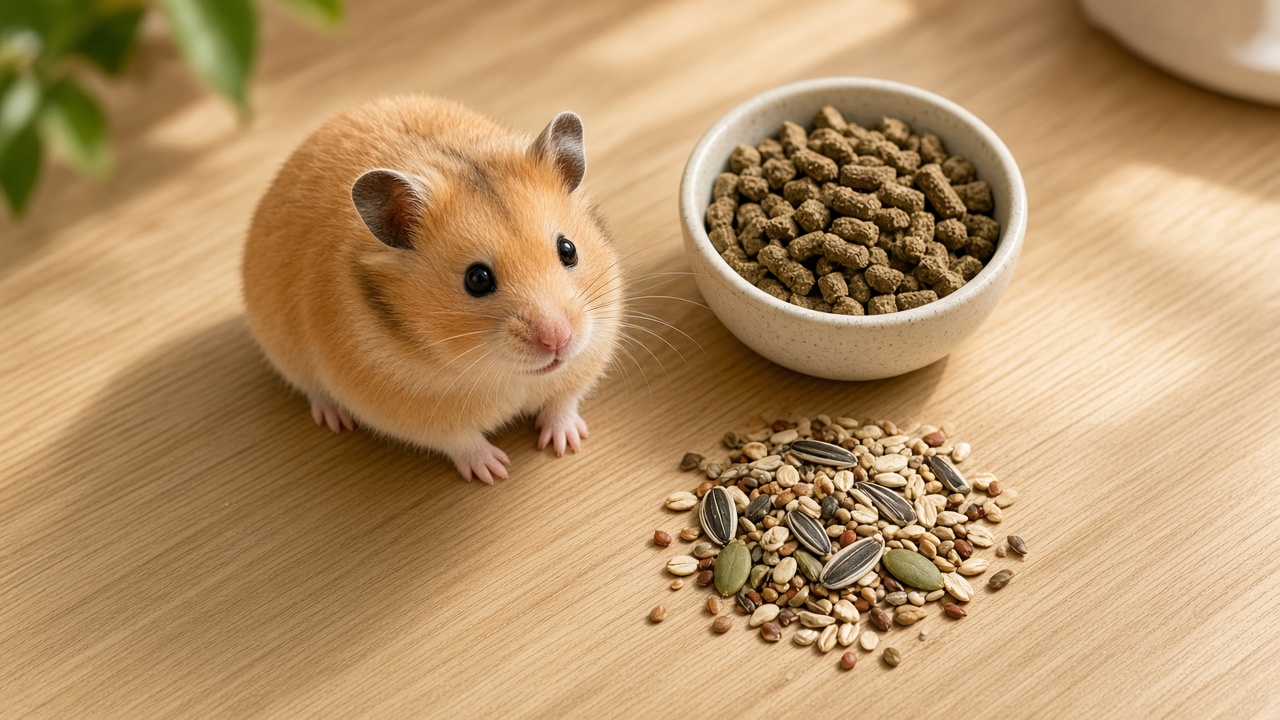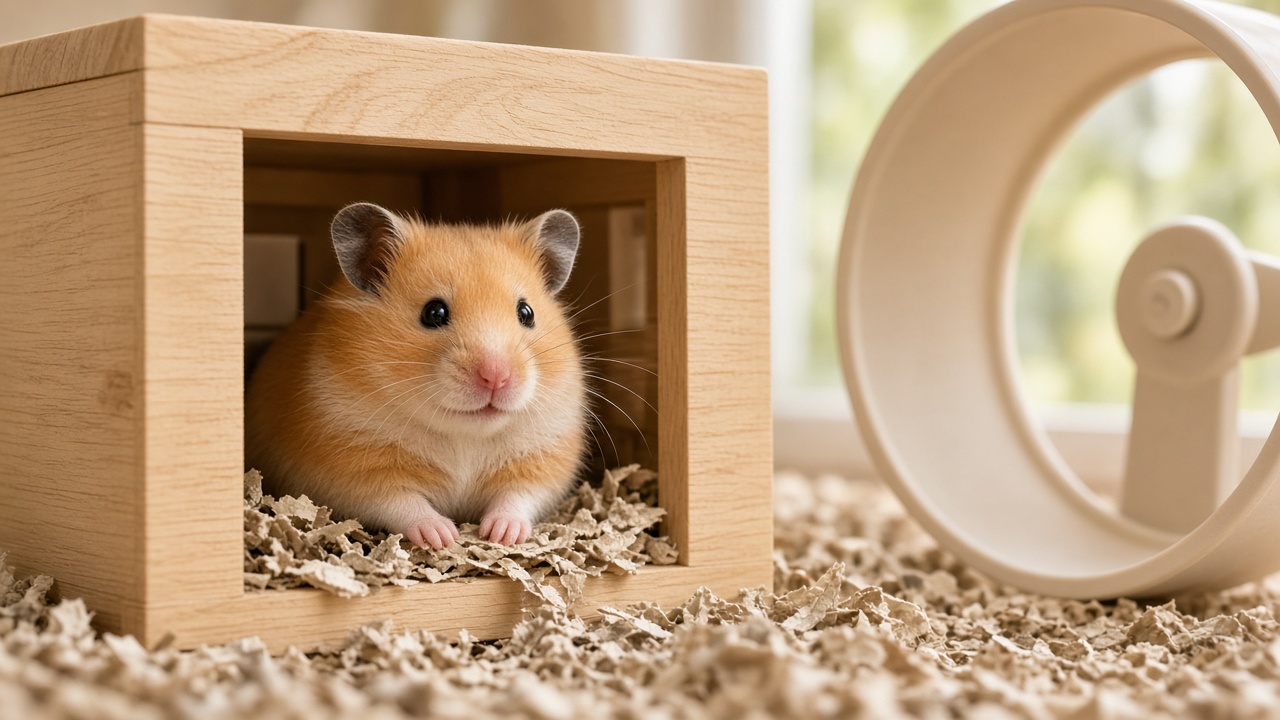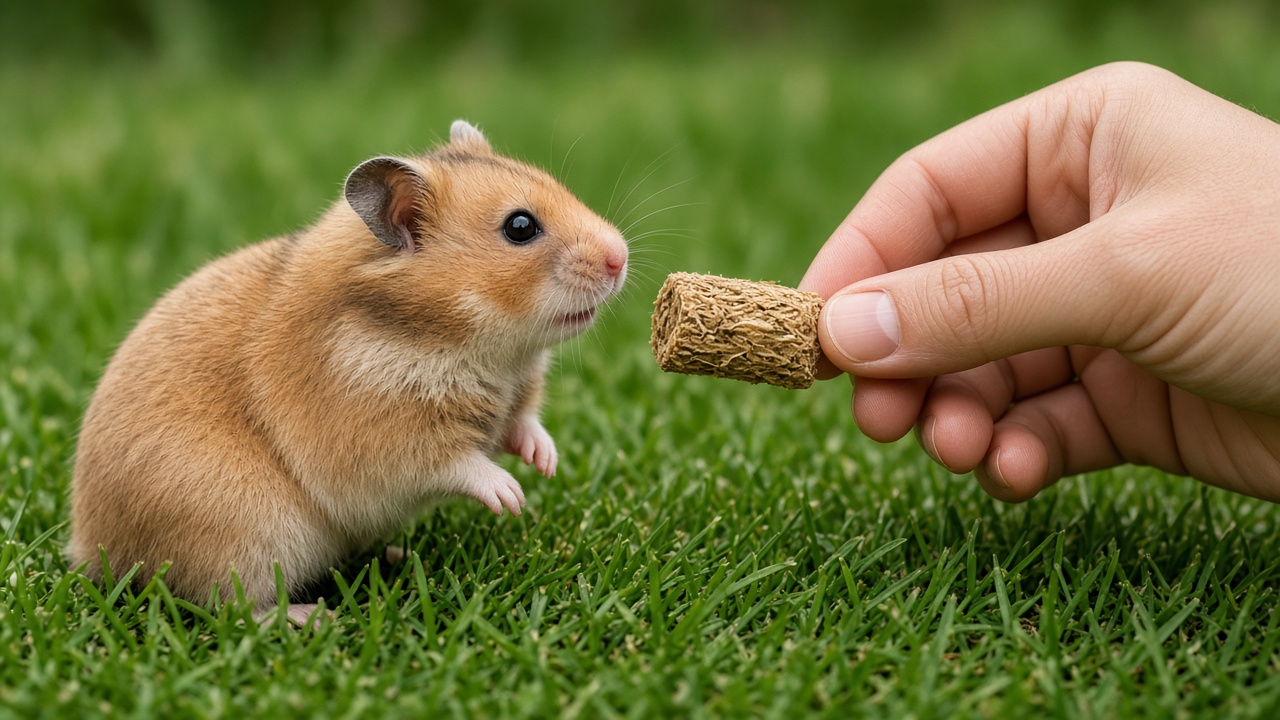
Quick answer: Keep one golden hamster alone in a large, solid-floor home with deep bedding and a solid wheel at least 11 inches across. Feed a uniform fortified pellet, not a pick-and-choose seed mix. Expect a two-to-three-year, night-active companion.
A golden hamster is a solitary Syrian hamster that needs a 100-by-50-centimeter floor and a 27-to-32-centimeter solid wheel.
This page is a Pet Bench research brief on one adult golden hamster. We did not breed a pair, keep a colony, or run feeding trials.
Selection rule. We included currently sold U.S. maker listings that name hamsters and publish a size or guaranteed analysis. We left out dwarf-only wheels under 10 inches, scented bedding, and colony kits.
Our research team analyzed published specs and compared them with Blue Cross and PDSA care sheets. We did not measure cages in a lab.
What a golden hamster actually is
Blue Cross states that the Syrian hamster is the most common and largest pet hamster. It also calls that animal the golden hamster.
PDSA places typical hamster life at about two to three years. Blue Cross says they are naturally nocturnal and most active in the evening.
They are not a pair pet. PDSA says Syrian hamsters live alone in the wild and fight if they meet.
Blue Cross says most species will fight if kept together. Do not mix sexes or species.
Blue Cross states that hamsters can reach sexual maturity at just one month. It says they should not be rehomed before six weeks old.
A breeding pair, per Blue Cross, can produce a litter every three to four weeks. The average litter is eight to ten young.
That is why this brief covers one hamster. A second hamster is a second complete home.
The 100-by-50 floor rule
We use one named rule for housing. Call it the 100-by-50 floor rule.
Blue Cross wants a floor no smaller than 100 cm by 50 cm. Height should be at least 50 cm.
PDSA cites the German Veterinary Association for Animal Welfare for a 100-by-50-centimeter minimum.
Our research team converted that floor to square inches. One hundred centimeters by 50 centimeters is about 775 square inches of continuous floor.
Tubes and extra stories do not replace that floor. PDSA prefers one large level because hamsters have poor eyesight and can fall.
Blue Cross says tanks help hold deep bedding and cut bar escapes. A mesh lid is still required for air.
Blue Cross wants bar or mesh gaps under 1 cm. Prevue Pet Products lists 3/8-inch spacing on the 528 Universal Small Animal Home.
Prevue lists 1/2-inch spacing on the Hamster Haven Large SP2005GRAY. That is the maker’s published gap, not a welfare grade.
PDSA wants a home that can hold at least 25 cm, or 10 inches, of bedding. Blue Cross states a minimum of 20 cm of digging bedding.
PDSA also wants a steady 18–21°C room, away from drafts and direct sun. That is about 64–70°F.
If the room drops, PDSA says Syrian hamsters may enter torpor. Check that the room has not fallen below 20°C, about 68°F.
PDSA names an extra-large cage, a glass tank, or a homemade enclosure. A DIY hamster cage can meet the 100-by-50 floor when a listed product cannot.
Starter gear we compared
The table below is an attribute list from maker pages. It is not a ranking.
We compared listed footprints with the 775-square-inch Blue Cross floor. We did not open boxes or time animals on wheels.
Niteangel’s Stacker Series page titles the enclosure at about 558 square inches. That listed floor is about 28 percent short of 775 square inches.
Prevue lists the 528 at 32 1/2 inches long by 19 inches wide by 17 1/2 inches high. That overall footprint is 617.5 square inches, about 20 percent short of 775.
Prevue lists the Hamster Haven Large at 21 5/8 by 13 3/8 by 14 1/4 inches. That overall footprint is about 289 square inches, about 37 percent of the Blue Cross floor.
The Haven still appears here because it is a current hamster-named listing with published sizes. The selection rule shows the gap.
Niteangel lists Super-Silent wheel sizes of 8.2, 10, 11, and 12.6 inches. The stand height adjusts from 1 to 4 inches.
Blue Cross gives Syrian wheels a 27–32 cm range. An 11-inch drum is about 28 cm. The 12.6-inch drum is about 32 cm.
PDSA asks for at least 30 cm, or 12 inches, for a Syrian wheel. The 12.6-inch Niteangel size is the listing that clears 30 cm.
| Product | Category | Maker-listed size or analysis | Material or form | Maker-listed note |
|---|---|---|---|---|
| Niteangel Stacker Series Hamster Cage | Enclosure | About 558 sq in | Glass, optional acrylic front door | Stackable; holders sold separately |
| Prevue Pet Products 528 Universal Small Animal Home | Enclosure | 32 1/2 in L × 19 in W × 17 1/2 in H | Powder-coated steel and plastic | 6 1/4 in deep base; 3/8 in wire spacing |
| Prevue Pet Products Hamster Haven Large SP2005GRAY | Enclosure | 21 5/8 in L × 13 3/8 in W × 14 1/4 in H | Powder-coated steel mesh and plastic tray | Includes platform, ramp, dome, and a wheel |
| Niteangel Super-Silent Hamster Exercise Wheel, XL 12.6-inch | Wheel | 12.6 in drum; 1–4 in stand height | PS plastic drum, acrylic base | Dual ball bearings; solid running surface |
| Oxbow Essentials Hamster & Gerbil Food | Daily food | Crude protein 15.00% min; fat 4.50% min | Uniform kibble | Adult large hamster: 1/3 cup |
| Kaytee Forti-Diet Pro Health Nourish+Protect Hamster and Gerbil Food | Daily food | Crude protein 12.0% min; fat 6.0% min | Pellet and seed blend | 2 tablespoons, about 20 g |
Prevue’s Haven page lists an included exercise wheel. It does not publish that wheel’s diameter.
Do not treat a bundled wheel as a 27–32 cm Syrian wheel unless the maker prints the size. Swap it if the hamster runs with a bent back or a lifted head.
Food from published labels
AAFCO states that it does not approve, certify, or endorse pet foods. There is no AAFCO-approved hamster food.
AAFCO’s consumer FAQ points label readers to Dog or Cat Food Nutrient Profiles. It does not publish a hamster nutrient profile on that page.
Oxbow lists crude protein at 15.00% minimum and crude fat at 4.50% minimum. Fiber is 10.00% minimum and 15.00% maximum. Vitamin A is 10,000 IU/kg minimum.
For an adult large hamster over six months, Oxbow’s serving is 1/3 cup. A small adult hamster is 1/8 cup.
Oxbow warns that hamsters hoard, so check stashes and adjust the daily ration. Its switch plan runs four weeks, with week four as the new food alone.
Kaytee lists crude protein at 12.0% minimum and crude fat at 6.0% minimum. Fiber is 12.0% maximum.
Kaytee lists total Bacillus species at 80,000 CFU/g. Its serving is 2 tablespoons, about 20 g, with a 7-to-10-day switch.
Those two labels do not match. Our research team did not pick a winner by taste.
A uniform kibble blocks selective eating. PDSA prefers pellets and treats muesli-style mixes as a small add-on.
PDSA allows a teaspoon or two a day of washed fruit, vegetables, and herbs. Blue Cross says a fresh portion should be as small as the hamster’s ear.
Scatter the dry ration. Remove uneaten wet food so a hoard does not rot.
Give constant fresh water. PDSA specifies a bottle with a metal spout. Blue Cross allows a bottle or a small bowl and a daily water change.
Bedding, wheels, and a nightly layout
Deep bedding is not décor. It is the burrow.
PDSA wants no less than 25 cm, or 10 inches. Blue Cross wants at least 20 cm.
Paper-based bedding is the shared safe core. PDSA also allows aspen, spruce, or hemp if mixed with paper so tunnels hold.
PDSA rejects wood shavings, sawdust, cotton wool, kapok, bamboo fluff, scented bedding, and shredded newspaper.
A solid wheel sits on the floor. Niteangel’s 1-to-4-inch stand is meant to clear bedding, not to shrink the drum.
Blue Cross bans exercise balls and mesh or spoke wheels. Feet catch in gaps, and a ball traps the hamster.
Blue Cross prefers a multi-chamber hide so the sleep spot is not the doorway. Add a sand bath and keep the layout stable after each clean.
Cleaning, handling, and household rhythm
Spot-clean wet bedding and uneaten fresh food every day. PDSA also wants bottles and bowls cleaned daily.
Full-clean timing depends on cage size. PDSA says small cages often need a weekly full clean.
Blue Cross says a full clean is usually once or twice a month. It still wants a spot clean every few days.
Both sheets want some dry, unsoiled bedding put back. Blue Cross names about one-third of the old bedding.
Use our how to clean a hamster cage guide for the wash steps.
Use how often to clean a hamster cage for the calendar.
Handle only when the hamster is already awake. A sleeping hamster may bite.
Scoop with two cupped hands. Sit low so a jump is a short fall.
Wash hands after cage work. Keep wild mice out of the room.
Health flags you can see at home
This desk does not diagnose. The flags below are the ones Blue Cross and PDSA name in public sheets.
Wet tail is diarrhea with a soiled tail, low appetite, and low energy. PDSA lists stress, a sudden diet change, bacteria, and gut parasites among causes.
Blue Cross links wet tail with stress in newly weaned young. It advises a ready cage and two or three quiet days after arrival.
Impacted cheek pouches look like cheeks that never empty.
A bent back on the wheel is a gear problem you can see. Change the drum before you blame the hamster.
Syrian scent glands sit on the flanks. Blue Cross describes them as small, dark, symmetrical patches that do not itch or grow.
If the animal is cold and still, and the room is under 20°C, PDSA says check for torpor. Warm the room slowly.
Teeth never stop growing. Overgrown teeth mean missed food and a drooling face.
FAQ
Are golden hamsters the same as Syrian hamsters?
Yes. Blue Cross treats “Syrian hamster” and “golden hamster” as the same animal. Coat color does not change the care rule.
Can two golden hamsters live together if the cage is huge?
No. PDSA says Syrians fight when they meet, with injury or death as the outcome. A second hamster needs a second 100-by-50 home.
How big should a golden hamster cage be?
Blue Cross wants at least 100 cm by 50 cm of floor and 50 cm of height. PDSA cites the same 100-by-50-centimeter floor from the German Veterinary Association for Animal Welfare. Our spec comparison put that floor at about 775 square inches.
What wheel size does a golden hamster need?
Blue Cross lists 27–32 cm for Syrians. PDSA lists at least 30 cm, or 12 inches. Niteangel’s published 12.6-inch Super-Silent size is the listing in our table that meets both sheets.
How much should I feed an adult golden hamster?
Oxbow’s page says 1/3 cup a day for an adult large hamster over six months. Kaytee’s page says 2 tablespoons, about 20 g. Follow one product’s line. Do not average two labels.
How often should I clean the cage?
Spot-clean wet spots and leftover fresh food daily. PDSA leans toward a weekly full clean in small cages. Blue Cross leans toward once or twice a month in a large setup, with old dry bedding put back.
Do golden hamsters hibernate?
PDSA says Syrian hamsters may enter short torpor in the cold, lasting hours to a few days. Blue Cross says domestic hamsters can enter torpor if they get cold or short on food. Keep the room near PDSA’s 18–21°C band.