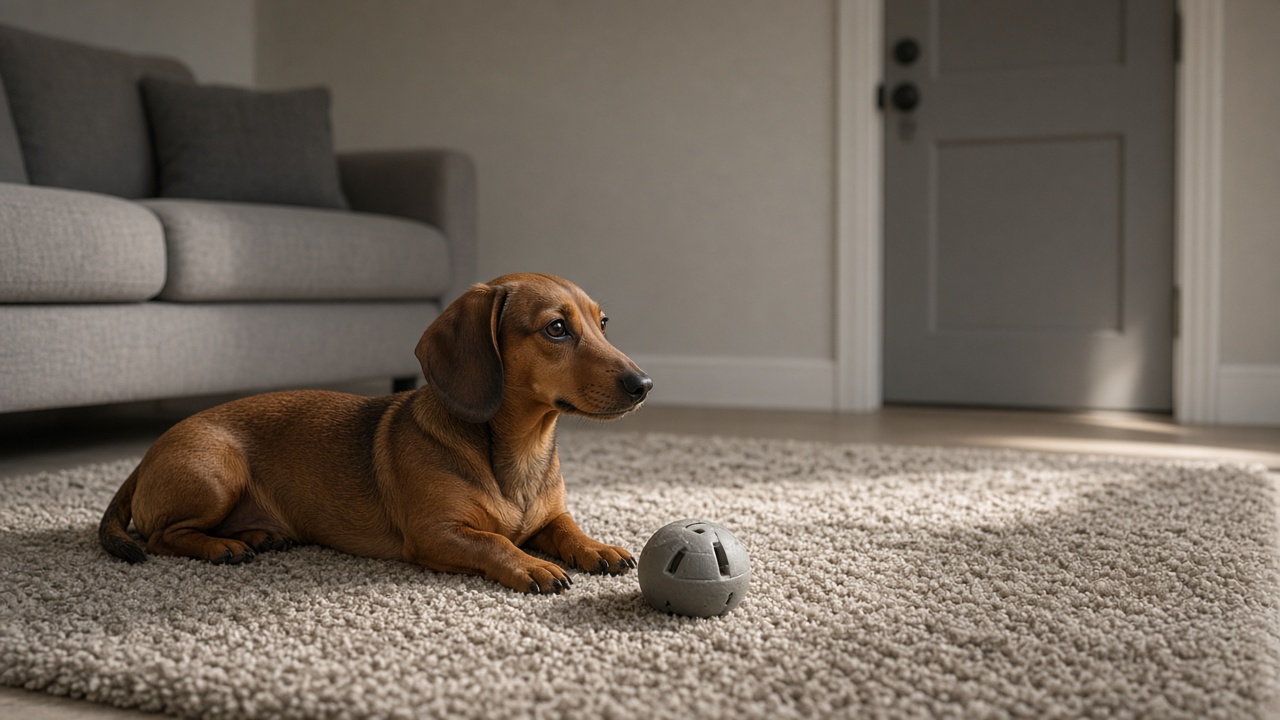
Quick answer: Keep adult dogs under four hours alone. Give puppies shorter windows that rise with age. Book a walker or sitter if you will be out longer.
A healthy adult dog should not be left alone longer than four hours.
This page is an age-cap briefing from published welfare texts and maker spec sheets. We did not film departures, time bladder holds, or run overnight crate trials.
Selection rule: we covered household pet dogs by life stage. We also compared currently sold home tools that makers list for monitoring, scheduled feeding, or stuffed chew time. We left out boarding kennels, shock-based gadgets, livestock working dogs, and overnight crate-hold experiments.
Our research team analyzed those published caps as the Age Cap Grid. The grid is a reading aid, not a diagnosis.
The Four-Hour Desk Rule
Dogs Trust tells owners to avoid leaving a relaxed adult dog for more than four hours. The RSPCA gives the same four-hour cap. Both groups want toilet breaks, exercise, and human company inside that window.
The American Kennel Club page on alone time quotes veterinary behaviorist Vint Virga. He sets a different ceiling. He says dogs should spend no more than six to eight hours alone without a chance to relieve themselves.
Those two clocks answer different questions. Four hours is a welfare-and-company cap. Six to eight hours is a bladder-hold ceiling on that AKC page.
A full workday plus a commute exceeds both clocks. Plan a visitor if you will miss the four-hour mark.
Limits by Age on the Age Cap Grid
Age changes the hold, not the need for company. A puppy can hit a bladder limit long before four hours.
The American Kennel Club’s potty-training timeline states a month-plus-one rule. Add one to the puppy’s age in months. That sum is the maximum hours between potty breaks.
A 3-month-old puppy plus one equals 4 hours in a crate, on that AKC page.
That 4-hour crate figure is a mess-avoidance ceiling. It is not a comfort target for a 12-week-old.
The same AKC timeline says most growing puppies eat three to four meals a day. It also says to take a puppy out 5 to 30 minutes after a meal. A skipped midday visit collides with both numbers.
| Life stage | Published hold cue | Organization that named it |
|---|---|---|
| Puppy, age in months plus one | Maximum hours between potty breaks | American Kennel Club |
| 3-month-old example | 4 hours in a crate | American Kennel Club |
| Relaxed adult | No more than 4 hours alone | Dogs Trust and RSPCA |
| Adult without a toilet chance | No more than 6 to 8 hours | American Kennel Club |
| Any age, daily social time | At least 2 hours with people or dogs | American Kennel Club |
A senior often needs the puppy side of this grid. Joint pain and weaker bladder control shrink the window. Do not treat a 12-year-old like a 4-year-old on a four-hour clock.
An adolescent between 6 and 12 months may hold urine longer than a baby. Energy and chewing still rise. A longer hold is not a license for an empty afternoon.
Dogs Trust notes that newly adopted adults often follow you from room to room. Those dogs still need a slow build.
Start with a few minutes. Increase only while the dog stays relaxed.
Why a Full Workday Fails the Clock
The RSPCA reports that eight out of 10 dogs struggle when left alone. That sentence stands on its own.
The same RSPCA page says half of those dogs show no obvious signs. Owners can miss the distress for that reason.
The RSPCA tells owners to video the dog from time to time. Hidden signs include trembling, pacing, and whining.
Dogs Trust lists more signs on its separation page. Those include barking, indoor toileting, chewing doorways, and ignoring food you left.
The American Kennel Club page says dogs need a minimum of two hours of dedicated social time each day. You can split that time into chunks.
Two hours of people time and four hours of absence are different ledgers. A dog can greet you with joy and still have spent the day in distress.
What Published Surveys Actually Count
The 2024 PDSA Animal Wellbeing Report found a clear weekday pattern. Owners leave 19 percent of dogs alone for five or more hours on a typical weekday.
That share rose from 15 percent in the 2022 PDSA report. It matches the 2019 figure. It sits below the 24 percent the PDSA recorded in 2018.
The same 2024 PDSA report says 26 percent of dogs are never left alone on a typical weekday. That share fell from 32 percent in 2022.
The 2024 PDSA report also states that 11 percent of dogs show signs of distress when left alone.
PDSA found a gap by training method. Eighteen percent of owners who used aversive methods reported distress when the dog was left alone. Twelve percent of owners who used food or treat rewards reported the same sign.
The 2024 PDSA report cites evidence that dogs should get over twelve to sixteen hours of sleep. The same report then counted sleep. Twenty-seven percent of dogs, or 2.9 million, sleep ten hours or less in a day.
A long absence can steal rest as well as company. A noisy hallway does not count as a nap.
Tools That Fill a Gap, Not a Workday
A camera or feeder does not reset the four-hour cap. It can show you what the RSPCA asked you to record.
Our research team compared published specs on five currently sold products. We picked tools that makers list for watching, talking, tossing a treat, scheduling kibble, or stuffing a chew. We skipped shock collars and boarding packages.
| Product | Role while you are out | Listed spec from the maker | Power or form |
|---|---|---|---|
| Furbo 360° Dog Camera | Watch, talk, toss treats | 1080p rotating 360° view, 4x digital zoom, 100-treat hopper, 8.8 x 4.9 x 4.9 in, 1.7 lb | 2-meter USB-C cable |
| Petcube Bites 2 | Watch, talk, dispense treats | 160° wide-angle view, 1080p HD, 4x digital zoom, two-way audio | 10 ft USB-C cable, no internal battery |
| Wyze Cam Pan v3 | Watch a room or yard | 1920 x 1080, 360° pan, 180° tilt, IP65, 20 fps day and 15 fps night | 1.8 m USB cable, 2.4 GHz Wi-Fi only |
| PetSafe Smart Feed Automatic Dog and Cat Feeder, 2nd Generation | Timed dry or semi-moist meals | 24-cup hopper, up to 12 meals a day, 1/8 cup to 4 cups per meal, 20.3 x 9.4 x 12.6 in | Plug-in, optional 4 D-cell backup |
| KONG Classic | Stuffed chew for short absences | Natural red rubber; Medium size listed for dogs 15–35 lb | Stuff with kibble; maker marks it for supervised use |
Furbo’s comparison page lists a 100-piece treat capacity on the Furbo 360° Dog Camera. That hopper can empty a day’s snack budget in one sitting.
Petcube’s Bites 2 support page says the device has no internal battery. You must plug it in. Plan the outlet before you plan the view.
Wyze lists IP65 weather resistance on the Cam Pan v3. That rating covers outdoor mounting with the maker’s listed outdoor power adapter. It does not add hours to the dog’s clock.
The PetSafe Smart Feed page lets you schedule up to 12 meals. Meal size runs from 1/8 cup to 4 cups.
A feeder can hit lunch. It cannot walk a bladder.
KONG’s product page lists the Classic Medium for dogs between 15 and 35 pounds. The same page tells you to supervise use and to stop if you find damage.
Food, Water, and Empty Bowls While You Are Out
The RSPCA tells owners to feed a small meal shortly before leaving. It also says to walk the dog and return home half an hour before you go.
Take treats for stuffed toys out of the day’s food allowance. The RSPCA states that point to limit weight gain.
AAFCO’s treats-and-chews page says snack and treat labels mark products that are not complete and balanced. AAFCO tells owners to give those products sparingly. Extra tosses from a Furbo hopper still count.
Match the leftover kibble to how much food you should feed your dog. Do not stack a feeder meal on a full breakfast bowl.
A delayed meal is not the same as a planned fast. If the hopper jams, read how long a dog can go without food. Then fix the schedule.
Wet food left in a bowl is a spoilage problem, not a comfort tool. Our desk covers that clock for cats in how long wet cat food can sit out. The same habit is a poor plan for a dog you will not see for hours.
Leave fresh water. A full bowl does not replace a toilet break.
Signs the Window Is Too Long
Dogs Trust says a dog that ignores a usually loved chew may be worried. The RSPCA makes the same point about a stuffed toy left untouched.
Neighbors may report barking that you never hear. The RSPCA lists neighbor complaints as a common first clue.
The American Kennel Club page lists destruction, indoor urination, drooling, pacing, and crate escape attempts. Those signs that appear every time you leave are not a “phase.”
Shorten the next absence. Ask a person to visit.
Do not add a louder toy. Cut the time away instead.
FAQ
How long can a healthy adult dog be left alone?
Dogs Trust and the RSPCA both cap a typical adult at four hours. The American Kennel Club page cites a six-to-eight-hour bladder ceiling without a toilet chance. Use the shorter welfare cap for daily plans.
How long can a puppy be left alone?
Use the American Kennel Club month-plus-one rule as a crate ceiling, not a goal. A 3-month-old puppy plus one equals 4 hours. Many 8-to-12-week puppies need far shorter gaps because they eat three to four meals a day.
Can I leave my dog alone for an eight-hour workday?
An eight-hour shift plus a commute exceeds the four-hour Dogs Trust and RSPCA caps. The 2024 PDSA report found owners already leave 19 percent of dogs for five or more hours on a weekday. Book a walker, sitter, or daycare for the middle of that day.
Do cameras and treat tossers buy more hours?
No. A Furbo 360° Dog Camera or Petcube Bites 2 can show hidden distress the RSPCA asked you to record. They do not replace a toilet break or a person.
What if my dog looks guilty when I come home?
The RSPCA says dogs do not take revenge. The same page says a “guilty” look often follows past scolding at the door. Dogs Trust says the dog is reading your body, not confessing.
How much social time does a dog need if I work from home?
The American Kennel Club page sets a minimum of two hours of dedicated social time a day. The 2024 PDSA report also found that 26 percent of dogs are never left alone on a weekday. Teach short, calm separations even if you work in the next room.
Can I leave wet food down for the whole absence?
A wet bowl sitting out is a food-safety problem. It does not meet company or toilet needs. Keep meals on a schedule, and treat leftovers like any other perishable pet food.