Quick answer: Match crate time to age. A puppy usually needs a break after as many hours as its age in months, plus one. Most adult dogs should get out by six to eight hours.
A healthy adult dog should leave the crate by hour eight; a puppy should leave by age-in-months plus one. This page is a research-desk hour map built from published kennel tables and maker spec sheets. We did not crate dogs, log overnight watches, or pull clinic case files.
Our research team compared three named hour tables and five currently sold crates. We applied published size formulas to those interiors. We found no FDA hour table.
Selection rule: We kept only daytime crate-hour limits that a named kennel club or shelter group published, plus crates with maker-listed interiors. We left out overnight folklore, hotel boarding, and crates with no maker dimension sheet.
Hour limits by age, from named tables
The American Kennel Club publishes a clean age ladder for time alone. Under 10 weeks, the listed cap is 1 hour. At 10 to 12 weeks, the listed cap is 2 hours.
At 3 months the listed cap is 3 hours. At 4 months it is 4 hours. At 5 months it is 5 hours.
At 6 months the listed cap is 6 hours. Over 6 months, the American Kennel Club lists a maximum of 6 to 8 hours. The same page says adult dogs should not stay home alone much longer without a break.
ASPCA Pet Health Insurance publishes a tighter puppy ladder. At 9 to 10 weeks, the listed crate window is 30 to 60 minutes. At 11 to 14 weeks, it is 1 to 3 hours.
At 15 to 16 weeks, that page lists 3 to 4 hours. At 17 or more weeks, it lists 4 to 6 hours. It also repeats the one-hour-per-month-of-age rule.
The Animal Humane Society uses one math line for puppies. Use the puppy’s age in months plus one to set crate hours. A 2-month-old lands at 3 hours.
A 4-month-old lands at 5 hours on that line. The same shelter page says young dogs cannot hold for a full workday.
We treat those three tables as the Bench Hour Split. Daytime crate time is the shorter of the named table for that age and a fit check. The dog must stand, turn, and lie in the crate you own.
Where the published hour tables split
Our research team lined those three tables up side by side. The gap is the late-puppy window, not the newborn window.
For a 4-month-old, the American Kennel Club lists 4 hours. The Animal Humane Society months-plus-one line lists 5 hours. ASPCA Pet Health Insurance’s 17-week row lists 4 to 6 hours.
That is a two-hour published spread for the same birthday. For most 4-month-olds, use the 4-hour low end.
For a dog past 6 months, the American Kennel Club lists 6 to 8 hours. ASPCA Pet Health Insurance still lists 4 to 6 hours at 17 or more weeks. That page tells owners on an 8-hour workday to go home at midday or hire a walker.
Those two adult-leaning numbers do not match. We report both, then take the lower number when the dog is still under a year.
The Animal Humane Society does not publish a separate adult ceiling. Months-plus-one is a puppy bladder rule, not a 13-hour adult plan.
Crate size is a limit, not a luxury
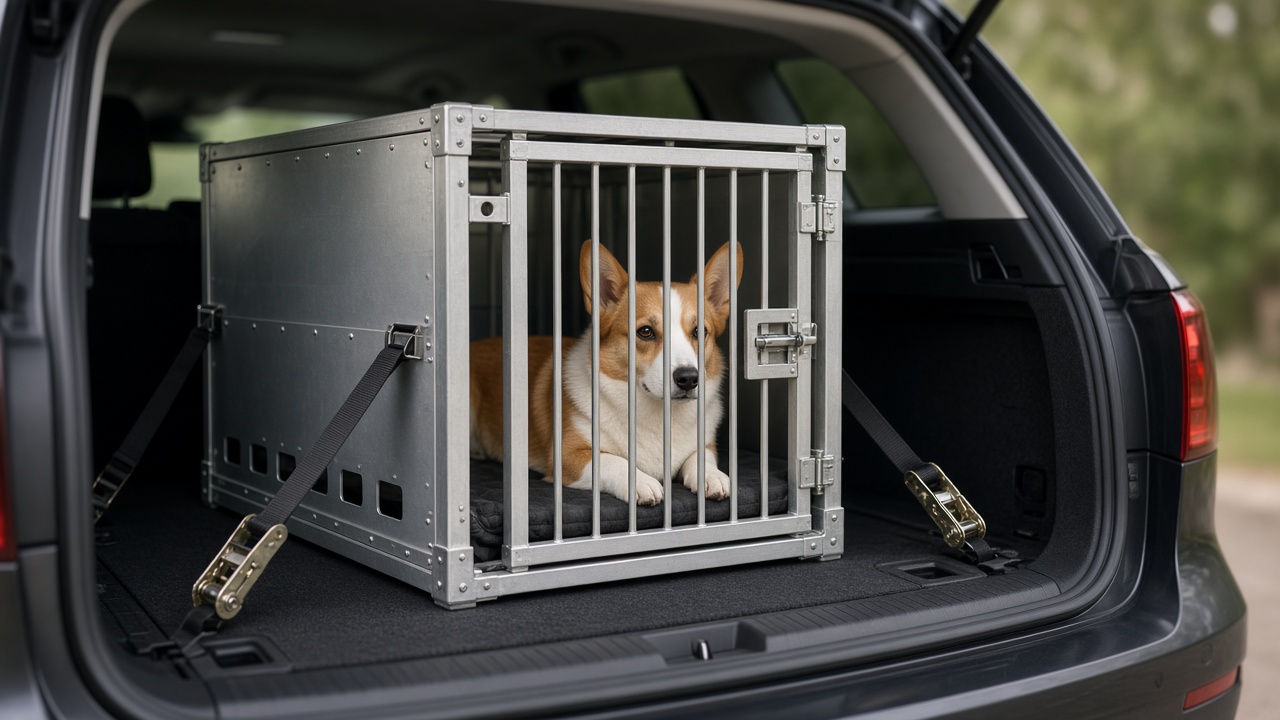
Hour tables assume the dog can stand, turn, and lie down. A short crate turns that hour cap into a cramped hold.
The USDA Animal and Plant Health Inspection Service states the commercial primary-enclosure formula in 9 CFR 3.6. Measure the dog from nose tip to tail base, add 6 inches, then square that number. Divide by 144 to get minimum floor space in square feet.
That rule governs licensed dealers, exhibitors, and research housing. It is not a home-crate statute. We still used it as a published yardstick.
For a 28-inch-long dog, the formula is 34 × 34 ÷ 144, or 8.03 square feet. The American Veterinary Medical Association’s December 2025 model bill copies the same floor math for high-volume breeders.
The International Air Transport Association’s Live Animals Regulations, Edition 52, January 2026, set a different air-travel test. The dog must stand, sit erect, lie naturally, and turn about while standing.
That IATA sheet also says snub-nosed breeds need a container 10% larger. Ventilation must cover at least 16% of the four sides. Openings for dogs may be no larger than 25 mm by 25 mm.
Dogs over 14 kg must be crated individually on that sheet. MidWest Homes for Pets tells owners to measure nose-to-tail-base, then add a few inches. Its iCrate page lists seven lengths, from 18 inch through 48 inch, with a divider panel.
Petmate’s Sky Kennel page says the kennel should be 3 to 4 inches taller and longer than the dog. Diggs tells owners to add 2 inches to standing height and 2 to 4 inches to body length.
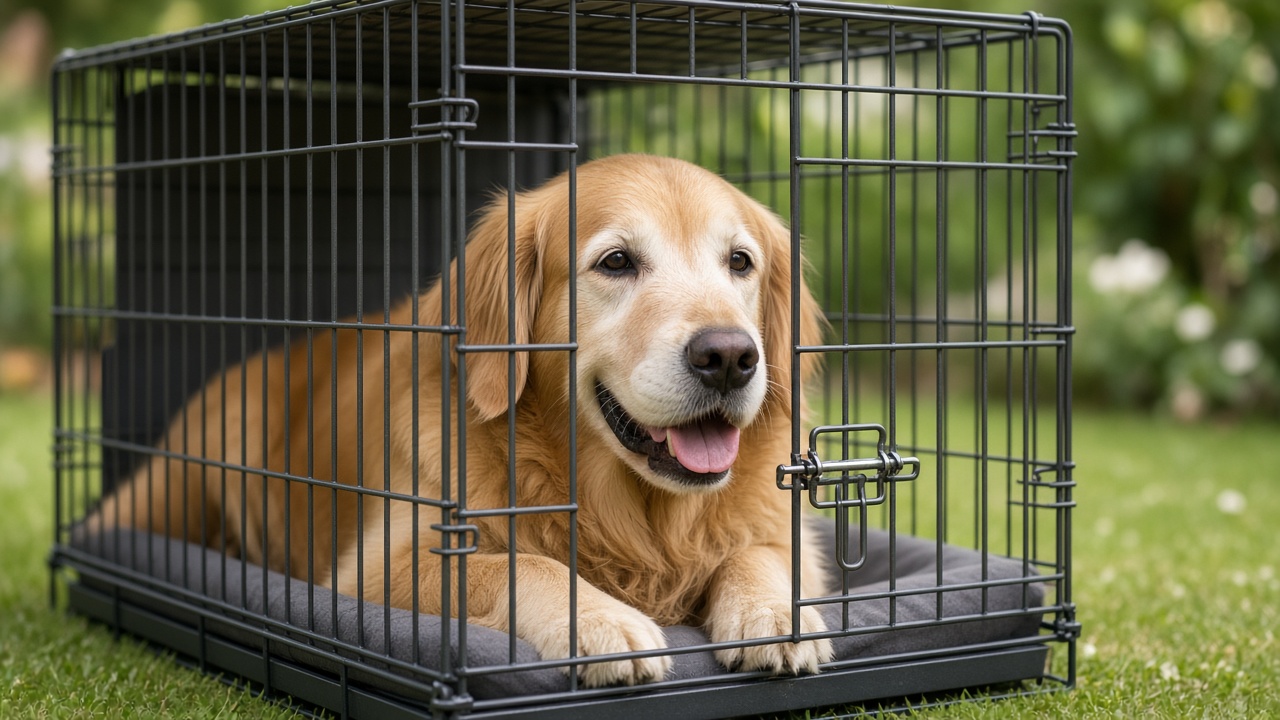
A large dog that fills a 48-inch wire crate still needs those extra inches of headroom. If you are sizing up from a 36-inch box, start with our guide to crates for large dogs.
Five current crates, compared by published specs
We compared five crates listed for sale on their maker pages. We used one mid-to-large size from each line. This is not a ranking.
| Model | Listed interior (L × W × H) | Empty weight | Maker size cue | Build |
|---|---|---|---|---|
| MidWest Homes for Pets iCrate | Seven listed lengths, 18–48 in | Not listed on the product page | Divider panel included; single or double door | Folding wire |
| Petmate Sky Kennel, 36 in | 32.5 × 22 × 26 in | 20.75 lb | Dogs 50–70 lb | Rigid plastic; 90% pre-consumer recycled |
| Diggs Evolv, Large | 41.5 × 27.9 × 30.1 in | 48 lb | Dogs 70–90 lb, or 22–28 in tall | Steel frame, diamond mesh |
| Impact Collapsible Dog Crate, 34 in Intermediate | 34.5 × 23 × 29 in | 35 lb | Listed for Labrador-size breeds | Aluminum; 0.817 in vents |
| GUNNER G1, Intermediate | 30 × 18 × 25 in floor | 48 lb | Dogs up to 70 lb | Double-wall; 5 Star crash-test claim on the maker page |
Our research team then ran the USDA floor formula against those interiors. The GUNNER G1 Intermediate floor is 30 × 18 inches, or 3.75 square feet. That is less than the 8.03 square feet the 28-inch dog example needs under 9 CFR 3.6.
The Petmate Sky Kennel 36-inch interior is 32.5 × 22 inches, or 4.97 square feet. The Impact 34-inch Intermediate floor is 34.5 × 23 inches, or 5.51 square feet. Neither row meets that 8.03-square-foot yardstick.
The Diggs Evolv Large floor is 41.5 × 27.9 inches, or 8.04 square feet. That is the only row that meets the 28-inch-dog USDA yardstick. That yardstick is a commercial housing formula, not a home-law test.
Impact lists ventilation holes at 0.817 inches. That is about 20.8 mm, under the IATA 25 mm maximum for dogs. Petmate’s Sky Kennel page still cites the 51st edition (2025) of the IATA Live Animals Regulation.
The IATA public container sheet we read is Edition 52, January 2026. GUNNER lists the Intermediate kennel at 48 pounds empty. MidWest’s iCrate divider shrinks a 36-inch or 42-inch crate as a puppy grows.
Workdays, nights, and flights
An 8-hour workday is longer than every puppy row we quoted. It also sits at the top of the American Kennel Club adult range. ASPCA Pet Health Insurance tells owners on that schedule to add a midday visit or a walker.
Do not stack a commute, a full shift, and an evening errand into one crate block. The hour cap is per closed-door stretch, not per calendar day.
Night is a different problem. Many adult dogs sleep 8 hours without a yard trip. That is rest, not a workday hold.
The Animal Humane Society still says to keep the crate near the bedroom. A young dog can then ask for a night potty trip. It also says you can crate a dog 2 to 20 minutes before you leave.
Do not load the crate an hour early and count that hour as free. Air travel is not a home hour table. IATA Edition 52 says animals do not normally need extra food for 12 hours after dispatch.
Water must be offered if total journey time exceeds 12 hours. IATA also says weaned puppies younger than 8 weeks must not be shipped.
A wet walk can ruin a rest block. Water on the pad makes the crate a drip tray. Dog rain boots keep bedding dry so the hour cap stays about bladder time.
Yard time also brings coat hitchhikers. Check the coat before a long closed-door stretch. A flea collar is outdoor gear, not extra crate hours.
When a listed hour cap is already too long
A published hour number is a ceiling, not a target. Cut the stretch if the dog soils the crate, chews the door, or will not settle.
The Animal Humane Society says distress can look like forcing the door. If that happens, open the crate. Restart the intro in shorter blocks.
The American Kennel Club notes that senior dogs may need more outings than a healthy adult. A 6-to-8-hour window can shrink with age.
A crate that is too large can also fail housetraining. ASPCA Pet Health Insurance says extra floor lets a puppy potty at one end and sleep at the other. MidWest’s divider exists for that reason.
Heat shortens every number on this page. GUNNER’s own G1 page says surface color can still hit a temperature ceiling in sun. If the dog cannot stand without hitting the roof, stop the clock.
FAQ
How long can a dog stay in a crate during the day?
Use the named table for the dog’s age. Take the low end if two tables disagree. The American Kennel Club lists 6 to 8 hours for dogs over 6 months.
ASPCA Pet Health Insurance still lists 4 to 6 hours at 17 or more weeks. It also calls for a midday break on an 8-hour workday.
How long can a 3-month-old puppy stay in a crate?
The American Kennel Club lists 3 hours at 3 months. The Animal Humane Society months-plus-one line lists 4 hours. Start at 3 hours, then watch for restlessness or a soiled pad.
Can an adult dog stay in a crate for 8 hours while I work?
Eight hours is the top of the American Kennel Club adult range, not the middle. ASPCA Pet Health Insurance tells workday owners to go home at midday or hire a walker. Split the day if the dog is under a year, a senior, or new to the crate.
Is overnight crate time the same as daytime crate time?
No. Night is sleep. Day is a hold while you are gone.
The Animal Humane Society still wants night potty trips for young dogs. Do not treat a 10-hour night as proof that a 10-hour workday is fine.
Does a bigger crate let me leave a dog longer?
Not by the hour tables we compared. Extra floor can even slow housetraining, which is why MidWest ships a divider with the iCrate. Size must still let the dog stand, turn, and lie down.
How long can a dog stay in a crate on a flight?
IATA Edition 52 says extra food is not normally needed for 12 hours after dispatch. Water is required if the total journey exceeds 12 hours. Puppies under 8 weeks must not be shipped.
What if my puppy cries before the hour cap?
The Animal Humane Society says first check food, water, potty, and exercise. If the dog is trying to force the door, end the session. If it is testing you, wait for quiet, then open.