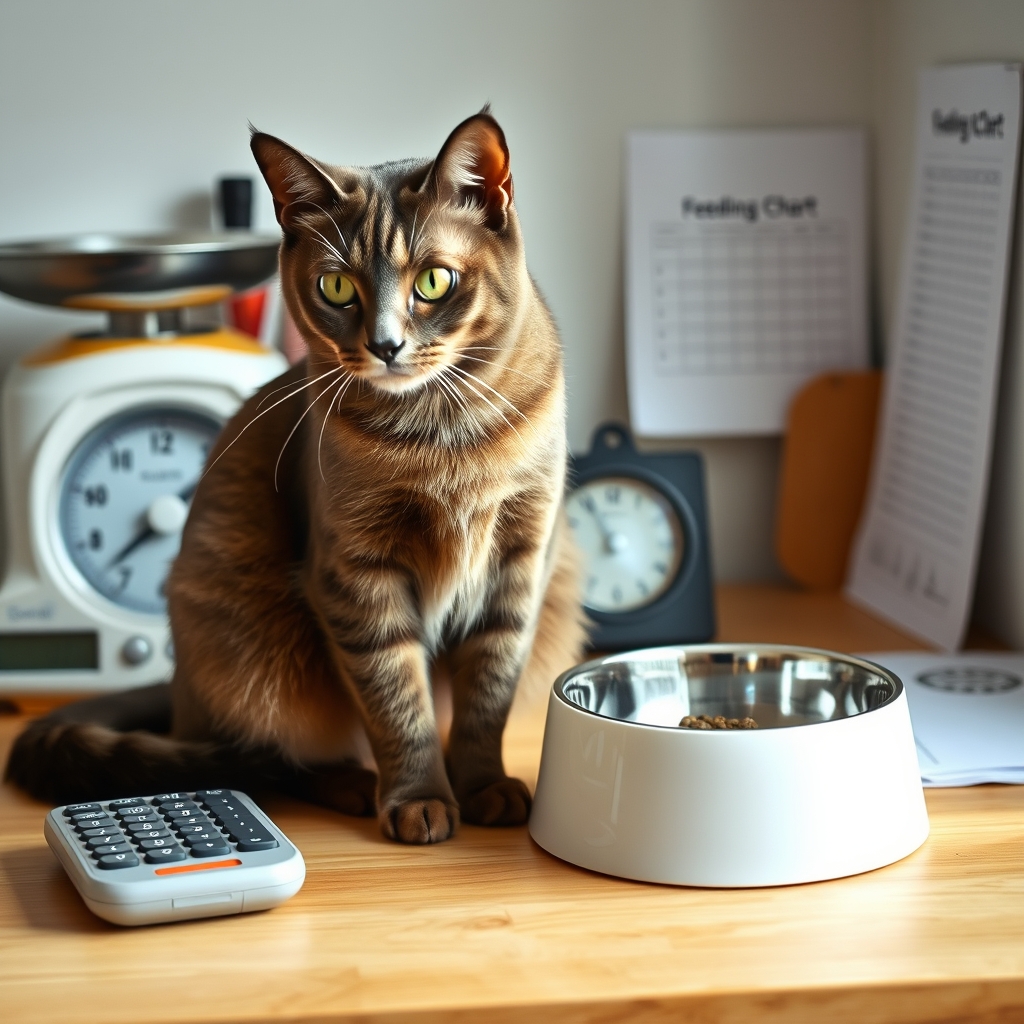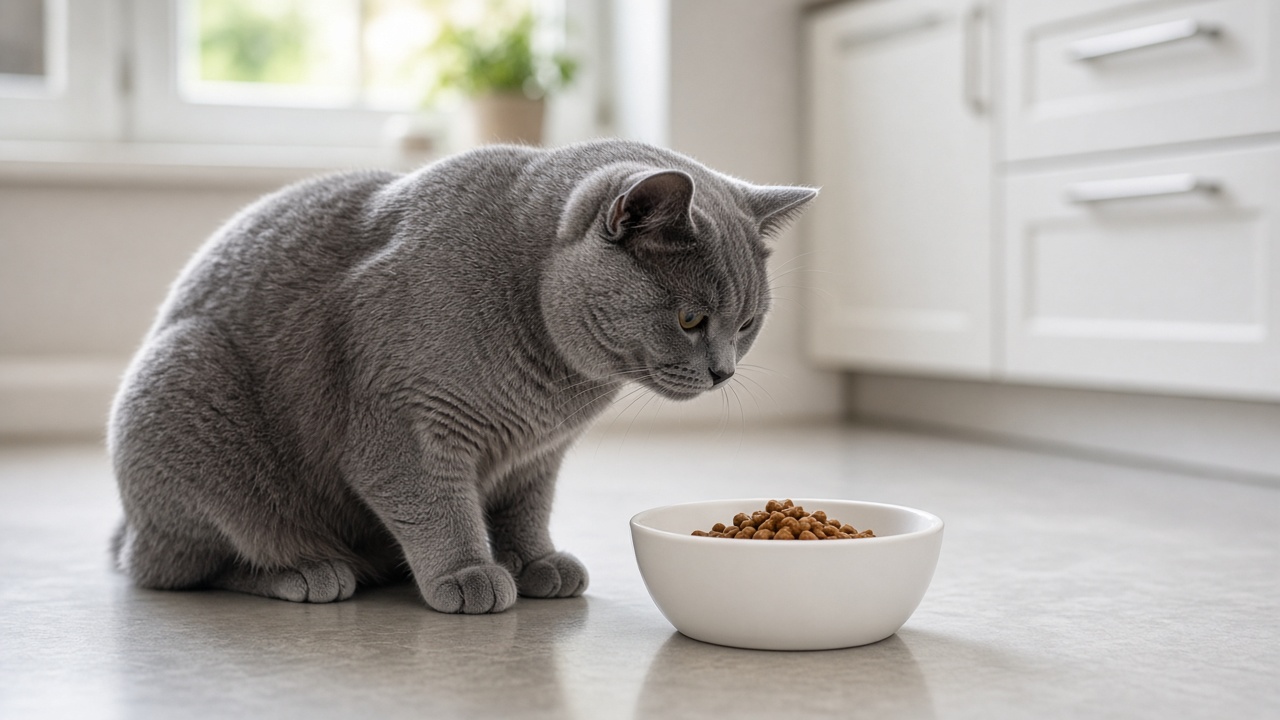
Quick answer: Kittens under six months need three meals a day. From six months on, most cats do well on two measured meals. Keep that twice-daily split through the senior years unless a clinic changes the plan.
Most healthy adult cats should eat two measured meals a day, not free-feed. This page is an age-based meal-count schedule drawn from association pages and current maker feeding tables. We did not weigh household cats, time bowls in homes, or run feeding trials.
What this schedule includes, and what it leaves out
Our selection rule is narrow. We cover complete-and-balanced foods that publish a calorie figure and a weight-based daily amount on the current maker page.
We leave out puzzle feeders, raw diets, prescription renal foods, and snack treats. Those items do not give a full-day meal count for a healthy cat.
Our research team compared published specs on five current foods. We used those labels to show how a day’s ration can be split.
For grams by body weight, use our cat feeding chart by weight.
A meal-count schedule by age
We call this the Age-Split Meal Rule. Three meals a day until six months. Two measured meals after that.
Keep the same two-meal clock after age 10 unless a clinic resets it.
Cornell’s feline health center updated its feeding-frequency page in 2024. Cornell says kittens usually do best on three meals a day until six months.
From six months to one year, Cornell says twice-daily feeding is generally best. Cornell puts adulthood at about one year. Then Cornell says once or twice a day is appropriate in most cases.
We take the twice-daily half of that range for healthy adults on a measured ration. Cornell defines senior cats as 10 years and older, and keeps them on the same regimen unless a clinic instructs otherwise.
Birth to six months
Kittens have small stomachs and high energy needs. The Purina Institute says kittens need about twice the calories per unit of body weight as adults during the first six months.
The Purina Institute also says to provide up to four small meals a day until six months. Cornell’s three-meal plan sits inside that range. Use four meals if the kitten finishes early and cries.
Hill’s Pet Nutrition lists Hill’s Science Diet Kitten Chicken Recipe from weaning until 1 year. Hill’s lists 407 kcal per cup for that dry food. Hill’s also lists a 7-day mix-in when you change formulas.
Six months to one year
Growth slows. The Purina Institute says two meals per day are adequate by six months of age. Cornell says the same for the six-month to one-year window.
Keep kitten food until skeletal maturity. The Purina Institute puts that point at about 1 year. Do not jump to adult food just because meal count drops.
Split the daily cup or can amount into morning and evening bowls. Keep the two times stable.
Adult years
Two meals about 12 hours apart cover most healthy adults. VCA Animal Hospitals, citing a 2025 LifeLearn briefing, says an empty stomach starts sending hunger signals after 8 to 10 hours.
That gap is why one meal leaves a long empty stretch. Cornell still allows once-daily feeding for some adults. Use one meal only if the cat finishes a measured ration, keeps a waist, and does not vomit bile at dawn.
Royal Canin tells owners that treats should represent no more than 10% of total daily calorie intake. Count those calories inside the day’s total. Do not add a third snack meal on top of a full label ration.
Age 10 and older
Do not add meals just because the cat is old. Cornell keeps seniors on the adult schedule unless a clinic changes it. Extra bowls often mean extra calories.
Watch leftovers. A senior that skips a usual meal is giving you data. A timed bowl makes that skip obvious.
Indoor seniors live next to the box all day. A steady meal clock makes stool timing easier to read. Pair that habit with how often to change cat litter.
Why two meals fit an adult cat’s stomach
VCA Animal Hospitals describes a simple stomach that empties within a few hours. Hunger rises again after 8 to 10 hours with nothing in the stomach.
Two meals break that cycle. Breakfast and dinner avoid a 16-hour fast. Cats that beg at noon often need a smaller third meal, not a larger morning scoop.
One large meal can overflow a small stomach. VCA notes that over-eating at any meal can cause discomfort and slower digestion. Split the day’s grams.
Dogs do not share this clock. Keep separate bowls if both species eat in one kitchen. See how much food should I feed my dog.
How labels encode “how often”
The Association of American Feed Control Officials (AAFCO) requires feeding directions on most complete-and-balanced pet foods. AAFCO’s consumer label guide says those directions must specify food weight per animal weight per unit of time.
AAFCO also requires a calorie statement under the heading “Calorie Content.” That line must show kilocalories per kilogram as fed. It must also show kilocalories per familiar unit, such as a cup or a can.
AAFCO lists 44 required nutrient specifications in the AAFCO Cat Food Nutrient Profiles. Those profiles set what “complete and balanced” means.
The U.S. Food and Drug Administration (FDA) requires pet food labels to identify the product, state net quantity, and name the maker or distributor. FDA also requires ingredients listed from most to least by weight.
Canned pet foods must meet the low-acid canned food rules in Title 21 CFR Part 113. Read the life-stage line before you copy a meal count.
What current foods list for a day’s ration
Labels give a daily total. They rarely print “7 a.m. and 7 p.m.” Our research team split those daily totals using the Age-Split Meal Rule.
Across the four dry formulas below, listed calorie density runs from 325 kcal per cup to 494 kcal per cup. That is a 169 kcal gap in one measuring cup.
| Product | Form | Life stage on the maker page | Calories listed | Example daily amount | Maker’s stated feeding style |
|---|---|---|---|---|---|
| Hill’s Science Diet Kitten Chicken Recipe | Dry | Weaning to 1 year; also pregnant or nursing cats | 407 kcal/cup | 5/8 cup (85 g) for a 4 lb kitten under 4 months | Daily total; 7-day switch |
| Hill’s Science Diet Adult Chicken Recipe | Dry | Adults 1–6 years | 483 kcal/cup | 1/2 cup (65 g) for a 10 lb cat | Daily total |
| Royal Canin Indoor Adult | Dry | Indoor cats 1–7 years | 325 kcal/cup; 3,534 kcal/kg | 5/8 cup (56 g) for an 8.8 lb cat at medium activity | Daily total by activity band |
| Purina Pro Plan Adult Complete Essentials Chicken & Rice Formula | Dry | Adult maintenance | 494 kcal/cup; 4,358 kcal/kg | 1/4–1/2 cup for a 5–9 lb cat | Maker text says feed free choice through the day |
| Fancy Feast Classic Paté Tender Beef & Liver Feast | Wet, 3 oz can | Adult | 98 kcal/can; 1,157 kcal/kg | 1 can per 3-1/2 lb of body weight daily | Daily can count |
Hill’s Science Diet Adult Chicken Recipe lists 483 kcal in one 8-fluid-ounce cup. A 10 lb cat at Hill’s 1/2 cup a day is about 242 kcal from that food. Split that into two 1/4-cup meals under the Age-Split Meal Rule.
Royal Canin Indoor Adult is the leanest cup in this set at 325 kcal. Royal Canin’s medium-activity line for an 8.8 lb cat is 5/8 cup, or 56 g. That is about 203 kcal at Royal Canin’s 325 kcal-per-cup figure.
Purina Pro Plan Adult Complete Essentials Chicken & Rice Formula sits at 494 kcal per cup. Purina’s 10–14 lb band is 1/2 to 3/4 cup. That band spans about 247 to 371 kcal.
Purina’s adult Pro Plan page tells owners to feed that formula “free choice” through the day. We still split the daily cup into two measured offerings. The day’s grams stay the same.
Fancy Feast Classic Paté Tender Beef & Liver Feast lists 98 kcal per 3 oz can. Fancy Feast says to feed an average adult 1 can per 3-1/2 lb of body weight daily. A 10.5 lb cat on that line is three cans a day.
Serve those cans as two or three timed meals. Do not leave pâté out for hours.
Cornell notes that wet cat food is typically about 70 to 80 percent water. That water fills the bowl faster than dry food. It also spoils faster.
Free feeding, leftovers, and multi-cat homes
Free feeding means the bowl never hits empty. Cornell says that pattern may work for some cats. Cornell also says it can cause overeating and weight gain in others.
The Association for Pet Obesity Prevention (APOP) ran a 2025 opinion survey of 265 screened respondents across 45 states. That group included 174 pet owners and 84 veterinary professionals.
APOP reports that 43% of cat owners described their cat as above ideal weight. That share was 33% in 2024. APOP also reports that only 3% of cat owners weigh food.
Among cat owners who tried to cut weight, APOP says 53% made an attempt. Only 19% of those cats reached a healthy target weight. A measured two-meal clock is one control you already own.
In a multi-cat home, one bowl is not a schedule. The fast eater empties it. The shy eater waits.
Feed cats in separate rooms or use timed lids. Keep each cat on its own age rule. Wet leftovers are not a grazing tray.
Pick up uneaten pâté after the meal, not hours later. Dry leftovers can wait until the next timed meal if the day’s grams were already measured.
Royal Canin says not to top up a bowl just because it is empty before the next meal.
Refill at the next clock time. If the cat is still hungry, shrink the gap to three meals. Do not pour a second daily ration.
FAQ
Can I feed my healthy adult cat once a day?
Cornell allows once-daily feeding for some adults. VCA says at least two meals are best because hunger rises after 8 to 10 empty hours. Try two meals first.
Should I leave dry food out all day?
Only if you measured the day’s full ration and will not refill it. Purina’s Pro Plan adult label prefers free choice. Cornell warns that free feeding can drive weight gain.
How often should I feed a kitten wet food?
Use the same Age-Split Meal Rule. Three or four small meals until six months. Two meals after that.
The Purina Institute says to serve wet food at room temperature and not leave it out long.
Do senior cats need more meals than adults?
Not by default. Cornell keeps cats 10 years and older on the same regimen unless a clinic changes it. Extra meals help only when a senior cannot finish a normal bowl in one sitting.
Then split the same daily calories. Do not enlarge the pile.
How do I split wet food and dry food in one day?
Pick the day’s calorie total from the dry bag or the wet label. Assign one meal to wet food and one to dry, or split both.
Fancy Feast’s beef-and-liver pâté is 98 kcal per can. Hill’s adult chicken dry is 483 kcal per cup. Do the arithmetic before you mix bowls.
What if I have a kitten and an adult in the same house?
Feed them apart. Kitten food is denser in calories per pound of cat. The Purina Institute wants growth food until about 1 year.
An adult that steals kitten kibble will blow its calorie cap.
When should I change the number of meals?
Change the count when age crosses six months or one year. Change it if a clinic sets a medical meal time. Change it if the cat leaves food, or finishes in minutes and begs.