Quick answer: Take your puppy outside on a leash after every wake-up, meal, drink, and play session. Use the American Kennel Club month-plus-one rule as the longest crate wait, not the daytime target. Reward the instant they finish outdoors, and confine them when you cannot watch.
Take the puppy outside after sleep, meals, and play, never waiting longer than age-in-months plus one hour.
This page is a schedule-and-method brief from our research desk. We compared published house-training counts. We did not run a kennel trial, film overnight holds, or time any puppy’s bladder on a clock.
What we included, and the rule that kept products out
Selection rule: we cover outdoor-first house training for healthy puppies from eight to twenty weeks in typical US homes.
A crate, pad, cleaner, or door bell makes this brief only if the maker lists a house-training use. We skip adult-dog retraining and ranked kit bundles.
Our research team analyzed two published clocks. The UC Davis Clinical Animal Behavior Service lists daily outing counts by age. The American Kennel Club states a month-plus-one crate maximum.
We treat those as different tools. UC Davis counts set the workday plan. The American Kennel Club figure is a ceiling, not a target gap.
That split is the Pet Bench Split-Rule. Follow the higher daily count while the puppy is awake. Never crate past the American Kennel Club hold limit for its age.
Age-by-age outing schedule
The UC Davis Clinical Animal Behavior Service ties delay time to age. Its housetraining handout lists 8 to 10 breaks a day from 6 to 14 weeks.
From 14 to 20 weeks, that same UC Davis handout lists 6 to 8 breaks a day. From 20 to 30 weeks, it lists 4 to 6 breaks. From 30 weeks on, it lists 3 to 4 breaks.
The American Kennel Club gives a different number for crate time. Take age in months, add one, and that is the maximum hours a puppy should hold it. A 3-month-old plus one equals 4 hours.
On its pad-training page, the American Kennel Club writes that a puppy cannot control the bladder until 16 weeks. A 4-month-old, it says, can hold it about 5 hours, including at night.
ASPCA Pet Health Insurance, in a 2023 house-training explainer, sets a tighter awake gap. It says two hours is the maximum between outdoor trips. A break every half hour to an hour is best when the puppy is active.
Plan the day on those awake counts. Use the American Kennel Club month-plus-one figure only as the longest crate stay.
A sample day for a 10-week-old looks busy. First trip is at wake-up. Meals, naps, and play each trigger another walk to the same spot.
Step by step: the Four-Trigger Outing
The Merck Veterinary Manual, in its July 2025 puppy-care review, lists the natural potty times. Those include morning, night, meals, drinks, naps, play, and overnight for the youngest pups.
We group those into four triggers you can run without a chart: wake, meal, nap, and play. That set is the Four-Trigger Outing.
1. Pick one door and one outdoor spot
The American Kennel Club says to head out the same door to the same area every time. Keep the puppy on a leash, even in a fenced yard.
The ASPCA says dogs show pre-potty signs. Watch for sniffing, circling, and stiff-legged walking. Those signs mean move now.
2. Wait quietly, then mark the finish
Stand still at the spot. Give a short cue as they start. The American Veterinary Society of Animal Behavior says the reward must be immediate.
Do not walk back to the kitchen first. The American Veterinary Society of Animal Behavior notes that a jar treat rewards the return, not the outdoor pee.
ASPCA Pet Health Insurance adds a timing warning. If you praise while they are still going, they may stop early. Wait until they finish, then treat.
3. If they do not go, reset in the crate
The American Kennel Club pad-training page gives a reset. Put the puppy back in the crate for 10 to 15 minutes. Then try the spot again.
Repeat until they go. For the youngest pups, that same American Kennel Club page says trips can come every 15 minutes.
4. Confine when you cannot watch
The ASPCA says to limit the house to the one or two rooms you can see. Widen the map only after the habit holds.
The American Veterinary Society of Animal Behavior calls a crate useful because dogs avoid soiling a den. MidWest Homes for Pets sells the iCrate Dog Crate for that job.
Its product page lists seven lengths, from 18 inches to 48 inches, and includes a divider panel. Size the living space so the puppy can stand, turn, and lie down.
MidWest Homes for Pets says the divider should sit snug across the crate width, not the length. Extra floor invites a toilet corner.
Crate work does not end at 20 weeks. For a later adult routine, use our crate guide for older dogs.
Meals and water set the clock
Free feeding hides the next poop. The American Kennel Club says most growing puppies eat three to four meals a day.
After a meal, wait only 5 to 30 minutes, then go out. Younger pups go sooner.
The Merck Veterinary Manual gives a meal-count table. From 6 to 12 weeks, it lists 4 daily meals of a puppy diet.
From 3 to 6 months, it lists 3 meals. From 6 to 12 months, it lists 2 meals.
That Merck table also notes puppies can leave their mother at about 7 to 8 weeks. House training starts in that same window.
Match the food to growth. The Association of American Feed Control Officials calls the nutritional adequacy statement the key label line. Its consumer label page also notes 37 required nutrient specifications in the Dog Food Nutrient Profiles.
For week-by-week bowls, use our puppy nutrition guide. For a wet timed meal, see our wet puppy food brief.
Water has its own clock. The American Kennel Club says young puppies need about one-half cup of water every two hours.
Older weaned puppies need about one-half ounce to one ounce of water per pound of body weight per day. A 20-pound puppy, it says, needs 10 to 20 ounces a day.
The American Kennel Club also says to lift food and water about two to three hours before bedtime. If lights-out is 11 pm, that means no bowl after about 8 pm.
Keep full daytime access. The same page warns that daytime water cuts can lead to dehydration and resource guarding.
ASPCA Pet Health Insurance uses a similar night cut. It says to place the water bowl out of reach about two and a half hours before bed.
Pads, cleaners, and a door bell: published attributes only
Pads are a backup, not the end goal of this brief. The American Kennel Club says outdoor toilet training is the ideal.
Pads can help in apartments or with very young pups. We compared maker-listed sizes. We did not soak pads or spray carpets in a lab.
| Product | Format | Maker-listed size or volume | House-training attribute from the maker page |
|---|---|---|---|
| MidWest iCrate Dog Crate | Wire crate | Seven lengths, 18 in to 48 in | Divider panel included to shrink the den |
| Four Paws Wee-Wee Superior Performance Dog Pee Pads | Disposable pad | 22 in x 23 in; 14-pad pack | Six-layer Floor Armor; 25% more absorbent than Four Paws original 5-layer pad; 24-hour protection |
| Simple Solution Extreme Stain and Odor Remover | Enzymatic spray | 32 oz or 1 gal | 3x stronger than the brand’s regular formula; cover 2x the carpet mess; wait 5+ minutes |
| Nature’s Miracle Stain & Odor Remover for Dogs | Enzymatic spray | 1/2 oz for a 1–2 in soft spot; 32 oz for 3x3 ft | Wait 10 minutes, then blot; 24-hour dry time; 25% post-consumer recycled bottles |
| PoochieBells Classic Design | Indoor door bells | 26 in long x 3 in wide | Two bell sets; Poochie-Pets states a 2–15 day training window |
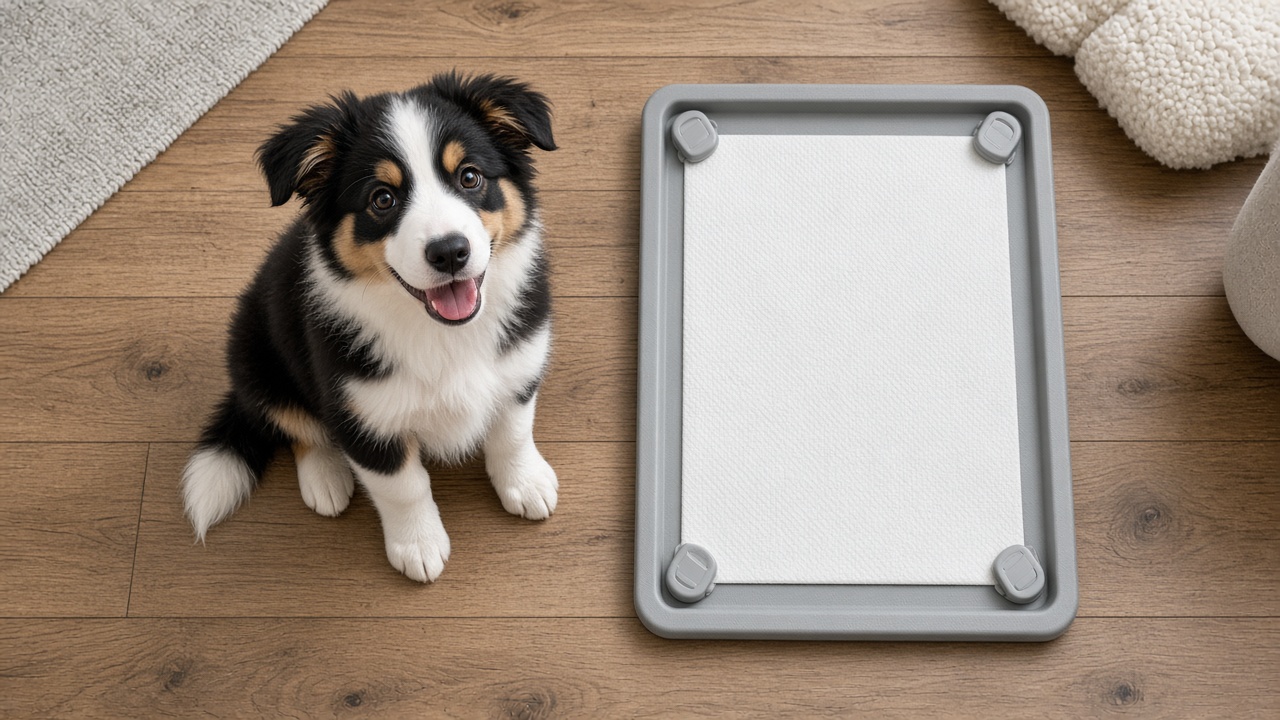
Place a Four Paws Wee-Wee Superior Performance pad away from beds and bowls. Four Paws lists a built-in attractant.
Clean every indoor miss with an enzymatic product. The UC Davis housetraining handout says residual smell can pull the puppy back to the same tile.
Simple Solution Extreme Stain and Odor Remover says to soak carpet backing and padding. Cover twice the mess, then wait at least 5 minutes.
Nature’s Miracle Stain & Odor Remover for Dogs doses a 1- to 2-inch soft spot at 1/2 ounce. A 3-by-3-foot soft area gets 32 ounces.
Wait 10 minutes, then blot. For old odor, Nature’s Miracle says to leave a wet towel on the spot for 1 to 2 hours.
PoochieBells Classic Design snaps to an indoor knob. Teach the ring after the outdoor habit is already clear. A bell is a request tool, not a bladder.
Accidents, nights, and when to open more rooms
Expect misses. The UC Davis handout says accidents will happen and should be expected.
The American Veterinary Society of Animal Behavior says do not punish a mess you find later. Puppies cannot connect a scold delivered minutes after the act.
If you catch them mid-stream, clap once and carry them out. Praise the finish outdoors, then clean with the enzymatic product you already chose.
Night holds run longer than day holds because the puppy is still. The American Kennel Club says the last act before bed is one more trip.
Keep the crate near your bed so a whimper wakes you. The American Kennel Club notes a small puppy may pee on the floor during a sleepy walk to the door.
The American Kennel Club quotes Jerry Klein, its chief veterinarian, on the finish line. If training starts early, a 6-month-old is usually dependable most of the time outdoors.
If you see no progress, that same page says to have the puppy checked for infection or another medical delay.
Widen the house one room at a time. The ASPCA says enlarge territory only as the training takes hold. Two clean weeks is a fair gate before the next room.
FAQ
How often should I take a puppy outside during the day?
Follow the UC Davis counts first. Use 8 to 10 trips a day from 6 to 14 weeks, then 6 to 8 trips through 20 weeks. ASPCA Pet Health Insurance caps the awake gap at two hours.
How long can a puppy hold it overnight?
The American Kennel Club says sleep stretches the hold, but month-plus-one still applies. Its pad-training page says a 4-month-old can hold about 5 hours, including night. Plan one night trip until those holds stay dry.
Should I start on pads or go straight outside?
This brief is outdoor-first. The American Kennel Club calls outdoor toilet training the ideal. If you use Four Paws Wee-Wee Superior Performance pads, keep one spot.
What if the puppy pees in the crate?
The crate is too big, the stay ran past the hold limit, or the puppy cannot yet hold it. MidWest Homes for Pets says to move the iCrate divider so the pup can only stand, turn, and lie down. The American Kennel Club says control may not arrive until 16 weeks.
When is a puppy reliably house-trained?
The American Kennel Club, citing our editorial team says a 6-month-old is usually dependable outdoors if training started early. The Merck Veterinary Manual says the first weeks of outdoor praise often produce a working habit. Those are not the same mark.
Do I take water away to speed training?
Not during the day. The American Kennel Club says young pups need about one-half cup every two hours. Lift the bowl two to three hours before bed.
What if I work a full day and cannot hit 8 to 10 trips?
Do not crate past the American Kennel Club month-plus-one limit. ASPCA Pet Health Insurance says to arrange a sitter if the puppy will be alone all day. For a longer gap, use a pen with a sleep end and a Four Paws pad end.