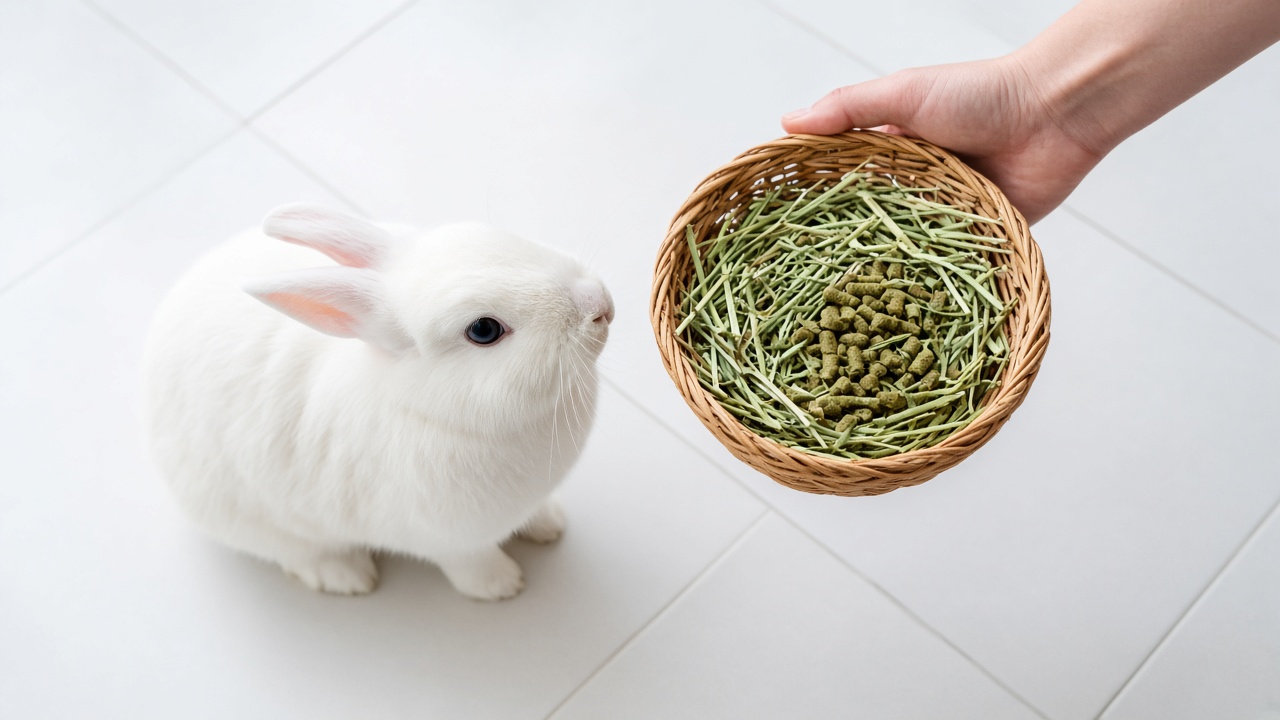
Quick answer: A New Zealand rabbit is a large American show breed with a 12-pound ARBA maximum. Plan indoor floor space, unlimited grass hay, and a measured timothy pellet. This body size eats more and needs more room than a dwarf.
The American Rabbit Breeders Association lists the New Zealand at a 12-pound maximum and five show colors. This page is a desk brief on companion New Zealand rabbits, not a live-animal trial, temperament study, or fryer-growth log.
Selection rule: we covered adult house-rabbit care we could pin to named primary pages. Those pages were ARBA, the House Rabbit Society, the Merck Veterinary Manual, and current maker labels. We left out meat-yield charts, laboratory cage protocols, and seed-and-corn muesli mixes.
What ARBA actually lists for this breed
The New Zealand rabbit is American, not a New Zealand import. The American Rabbit Breeders Association says the breed was developed in the United States and recognized in 1916.
ARBA’s own breed page sets a maximum weight of 12 pounds. That single number is the size fact most searchers need.
The ARBA Official Breed ID Guide updated in January 2026 lists five varieties: black, blue, broken, red, and white. Broken entries are shown as Broken Black, Broken Blue, and Broken Red.
ARBA classifies the breed as Six Class. That means juniors, intermediates, and seniors are shown as separate age groups.
A 2021–2024 ARBA Standard of Perfection correction sets the New Zealand junior minimum at 6 pounds. Some older hobby pages still print a lower junior floor. The correction is the number we used.
ARBA also claims this breed has more Best in Show wins than any other ARBA breed. That is a registry boast, not a pet-quality score.
Temperament and who should handle one
Our research team did not score temperament in homes. We will not invent a calmness percentage.
The House Rabbit Society describes companion rabbits as inquisitive, intelligent, sociable, and affectionate. Those traits belong to the species, not a unique New Zealand test.
A 10- to 12-pound body is heavy to lift wrong. Support the chest and the hindquarters at the same time.
The House Rabbit Society warns that children often want to cuddle in ways that scare rabbits. An adult should be the primary caretaker when kids share the house.
Intact pairs breed fast. The House Rabbit Society notes a doe can kindle every 30 days and can conceive within 30 minutes of giving birth.
The same House Rabbit Society primer says uterine cancer can reach 50–80% as unspayed does age. That is a health planning number, not a temperament note.
New Zealands were bred for meat type and show type. A muscular frame does not guarantee a mellow pet. Ask the rescue or breeder how that rabbit behaves on the floor, not in a photo.
Lifespan and the health facts we could source
The House Rabbit Society says well-cared-for indoor rabbits can live seven to 10-plus years. We did not compile a New Zealand-only death table.
Outdoor hutches add predator stress, weather, and parasites. The House Rabbit Society lists fleas, ticks, RHDV2, raccoon roundworm, and flystrike among outdoor risks.
If a rabbit stops eating or stops passing feces for 12 hours, the House Rabbit Society says to seek expert care at once. Watery diarrhea is the other emergency it flags.
The Merck Veterinary Manual states a rabbit drinks about 120 mL of water per kilogram of body weight each day. A 5 kilogram adult, near the ARBA cap, needs about 600 mL by that math.
The same manual says rabbits drink more from an open bowl than from a sipper bottle. Use a heavy crock so a large rabbit cannot flip it.
Space for a 12-pound body
The House Rabbit Society primer still prints a minimum cage of 2 feet by 2 feet by 4 feet for one rabbit. That is 8 square feet of floor if you read it as a 2-by-4 footprint.
The same organization’s later living-space page says a cage is a bedroom, not a home. Resting space should be three to four times the stretched-out adult body length.
A New Zealand at the 12-pound ARBA cap needs more runway than a 3-pound dwarf. Pet-store starter cages fail that body-length rule for this breed.
Wire floors can ulcerate hocks. The House Rabbit Society says to cover wire with wood or cardboard, or to skip wire pens.
The House Rabbit Society wants several hours of exercise in a safe area each day. Indoor housing is its default, not a backyard hutch.
Rabbit-proof cords and houseplants before free-roam time. A large rabbit reaches tabletops and chewable trim that a dwarf cannot.
Hay, greens, and four adult pellet labels
The House Rabbit Society puts hay at 85% of an adult diet. Grass hay should sit in the feeder at all times.
It assigns about 10% of the diet to vegetables. The rule of thumb is 1–2 cups of leafy greens per 4 pounds of body weight.
At 12 pounds, that vegetable math is 3–6 cups a day if you scale the same rule. Add one new green at a time.
Pellets are the remaining 5%. The House Rabbit Society wants a plain timothy pellet with at least 18% crude fiber and no seeds or colored bits.
The Merck Veterinary Manual’s maintenance table lists 12% total protein and 14–20% fiber. It also tells keepers to restrict adult pet pellets to 1/4 cup per 5 pounds of body weight.
For an 11-pound New Zealand, that Merck dose is about 1/2 cup of pellets a day. Hay still has no cap.
The same manual advises cutting dietary calcium to 0.4–0.5% for nonlactating adults. It links long alfalfa-meal diets to urinary sludge risk.
Our research team compared published specs on four adult bags sold in September 2026. We used maker pages only. We did not run feeding trials.
| Product | First listed ingredient | Crude protein (min) | Crude fiber | Calcium on label | Maker feeding note for large adults |
|---|---|---|---|---|---|
| Oxbow Garden Select Adult Rabbit Food | Timothy Grass | 12.00% | 22.00–26.00% | 0.35–0.75% | 3/4 cup daily at 10+ lb, plus unlimited grass hay |
| Oxbow Essentials Adult Rabbit Food | Timothy Grass Meal | 14.00% | 25.00–29.00% | 0.35–0.75% | 3/4 cup daily at 10+ lb, plus unlimited grass hay |
| Kaytee Forti-Diet Pro Health Nourish+Protect Adult Rabbit Food | Sun-cured Timothy Grass Hay | 12.0% | 21.0% max; min not listed | Not listed on the maker page | 1/2–1 cup (60–120 g) for a large breed |
| Small Pet Select Rabbit Food Pellets | Timothy hay | 14% | 25–29% | 0.4–0.6% | 1/4–1/2 cup per 6 lb of body weight from ages 1–5 years |
Three of those four labels publish a fiber minimum at or above 22%. That sits above the House Rabbit Society’s 18% floor.
Kaytee’s official page lists a 21.0% fiber maximum and no fiber minimum. It does list 120,000 CFU/g of Bacillus species.
Oxbow Garden Select and Oxbow Essentials both print 3/4 cup at 10 pounds and up. That is more pellet than the Merck 1/4-cup-per-5-pound line.
Small Pet Select’s chart at 12 pounds is 1/2–1 cup, depending on metabolism. Kaytee’s large-breed band is the same cup range.
Comparing those published charts, a 10- to 12-pound adult is told to eat about 1/2–1 cup of pellets a day. Hay volume still matters more than which of these four bags you pick.
For a wider pellet shortlist, see our best rabbit pellets guide. Match the bag to adult timothy formulas, not alfalfa grower rations.
Oxbow Garden Select prints a four-week switch: 1/4 new, then 1/2, then 3/4, then all new. Kaytee uses a 7- to 10-day mix of old and new food.
Coat care and shedding
New Zealand rabbits wear a short, dense commercial coat. Short hair still sheds, and a 12-pound body sheds more volume than a dwarf.
A weekly brush handles most months. Daily passes help during a heavy molt so swallowed fur does not mat in the gut.
The House Rabbit Society says teeth wear down on the silicate and lignin in grass hay, not on salt licks or hard blocks. Hay is dental care, not a side dish.
Use a soft brush and support the rabbit on a non-slip mat. Our step-by-step rabbit grooming guide walks through the order of work.
If you need tool names and coat-safe options, read the rabbit grooming kit review. Skip slicker styles meant for dogs.
Check nails when you groom. A large rabbit’s dewclaws catch on carpet and pen mesh.
Daily care that this size actually changes
Food and litter scale with body mass. A New Zealand soils a box faster than a 4-pound mix.
The House Rabbit Society prefers a newspaper-lined box filled with grass hay. It rejects pine and cedar shavings and clay cat litter.
Change the box daily. A 12-pound rabbit can fill a small pan before supper.
Keep the water crock full. The Merck 600 mL figure for a 5 kilogram rabbit is a planning number, not a one-bowl limit.
Offer cardboard boxes and tunnels it can move. The House Rabbit Society calls these “projects,” and a meat-type body needs room to shove them.
Do not house two rabbits together until both are altered and introduced on neutral ground. The House Rabbit Society says introductions can fail and cause injury.
FAQ
How big do New Zealand rabbits get?
The American Rabbit Breeders Association lists a 12-pound maximum on its New Zealand breed page. Juniors must reach at least 6 pounds under the 2021–2024 ARBA Standard of Perfection correction. Pet rabbits that are not shown can sit under or over a show ideal, but 12 pounds is the registry cap we can cite.
Are New Zealand rabbits good pets?
They can be, if you have floor space and an adult handler. The House Rabbit Society wants indoor housing, several hours of exercise, and an adult as the primary caretaker around children. Our desk did not run a breed-wide temperament survey, so we will not call this breed uniquely “easy.”
How long do New Zealand rabbits live?
The House Rabbit Society gives indoor companions a span of seven to 10-plus years. We found no ARBA lifespan table for this breed alone. Outdoor hutch life is shorter in that group’s risk list, which includes predators and RHDV2.
How much should I feed a New Zealand rabbit?
Keep grass hay in front of the rabbit all day. The House Rabbit Society keeps pellets near 5% of the diet and wants at least 18% fiber in the bag. The Merck Veterinary Manual’s adult pet line is 1/4 cup of pellets per 5 pounds. Maker charts for 10- to 12-pound rabbits often print 1/2–1 cup.
What colors does ARBA recognize?
The January 2026 ARBA Official Breed ID Guide lists black, blue, broken, red, and white. Broken classes are Broken Black, Broken Blue, and Broken Red. Other colors from crossbreeding are not on that ARBA list.
Do New Zealand rabbits need a big cage?
Yes, relative to dwarf breeds. The House Rabbit Society primer lists a 2-by-2-by-4-foot cage as a minimum for one rabbit. Its later page wants resting space three to four times stretched-out body length. Treat any cage as a bedroom and attach a pen or a bunny-proofed room.
Should I choose an alfalfa pellet or a timothy pellet?
For a healthy adult, use a timothy-based pellet. The House Rabbit Society reserves alfalfa hay for babies, nursing does, and some elderly or injured rabbits. The Merck Veterinary Manual links long alfalfa-meal maintenance diets to kidney and bladder mineral problems.