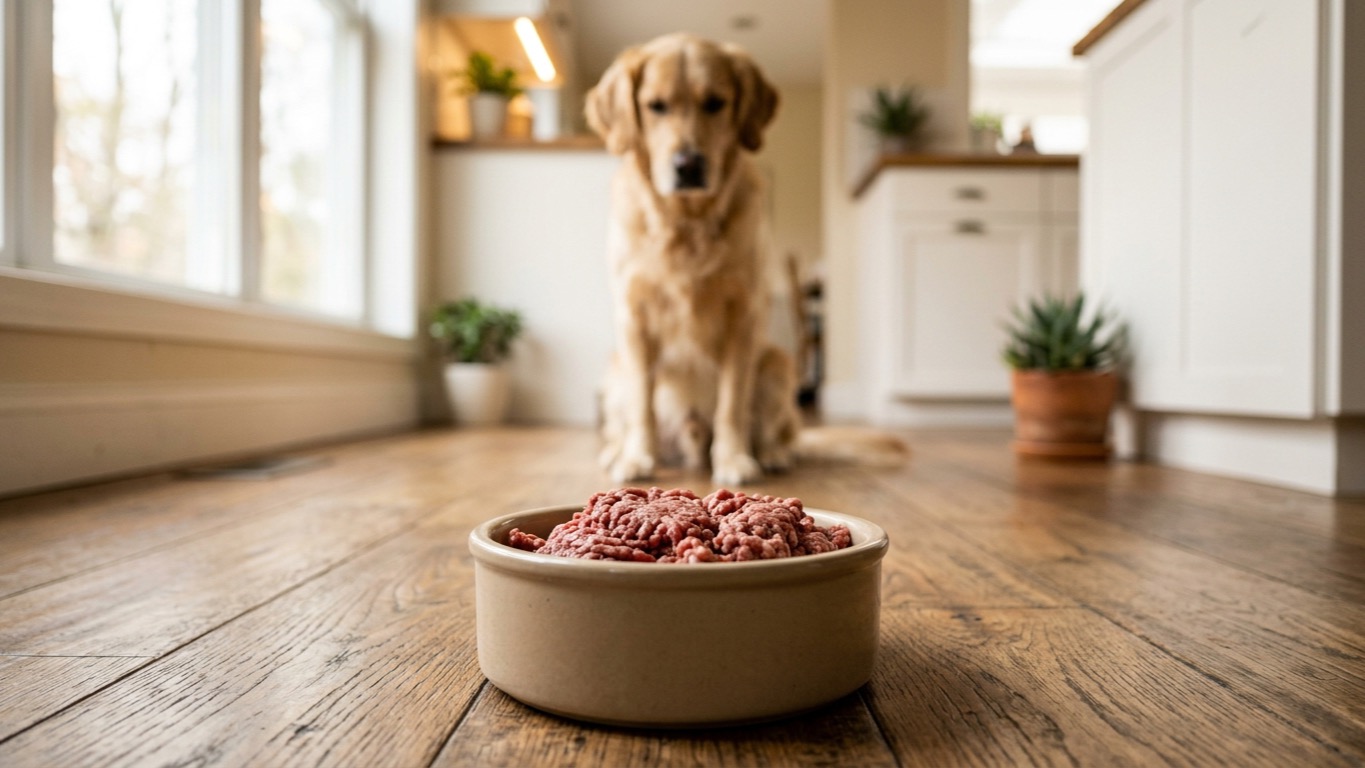

Quick answer: Most short-term dog diarrhea starts after scavenged food, a rushed diet change, parasites, or infection. Watch a bright, eating adult for 48 hours. Call a clinic sooner for blood, vomiting, puppies, or a dog that will not eat.
Dietary indiscretion, parasites, infection, toxins, or organ disease can cause a dog’s diarrhea. This page is a research-desk briefing that compares published trigger lists and over-the-counter digestive-support labels.
Cornell University College of Veterinary Medicine’s Riney Canine Health Center lists dietary indiscretion, a too-fast food switch, stress, and internal parasites as transient causes. The same page lists viruses, foreign bodies, toxins, and organ disease as more serious causes. Our research team analyzed those lists against five current labels.
Meredith Miller, associate clinical professor of small animal medicine at Cornell, says many cases are mild and self-limiting. She also names the 48–72 hour mark as the point to seek care if stool stays loose. That window is a published threshold, not a home diagnosis.
What this desk included, and what it left out
We used one selection rule. A scenario entered this article only if Cornell or the Merck Veterinary Manual names it as a diarrhea trigger. A product entered only if its current maker page lists a stool-quality, microbiome, or digestive-support claim and sells it without a prescription note.
We left out prescription gastrointestinal diets. We left out human antidiarrheal tablets. We left out any brand whose current maker page
That is the PetBench Trigger-and-Threshold Rule. Cover the trigger if a primary desk published it. Cover the product if the maker published a digestive claim we could read.
Our research team compared published specs on five products: three complete adult kibbles and two single-serve probiotic supplements. Among the kibbles, maker-listed calories run from 368 to 485 kcal per cup. That spread is a label fact, not a feeding order.
Everyday diet triggers
Dietary indiscretion is the plain name for a dog that ate garbage, spoiled leftovers, or a fatty scrap. Cornell lists it first among transient causes. Merck’s dog-owner digestive chapter lists overeating and indigestible food in the same noninfectious group.
A rushed kibble switch is a separate trigger. Cornell’s three-day swap example (75 percent, then 50 percent, then 25 percent old food) is the pattern it tells owners to slow down. Hill’s Pet Nutrition, on its Adult Perfect Digestion Chicken & Barley Recipe page, tells owners to mix the new food in over a 7-day period.
Nestlé Purina PetCare, on its Pro Plan Adult Sensitive Skin & Stomach Salmon & Rice Formula page, asks for 7–10 days. Those maker windows sit inside Cornell’s “week or two” advice. Our research team did not time stools during a switch.
Rich extras can start the same problem. A handful of freeze-dried strawberries is still a new sugar-and-fiber load. A few figs can do the same.
Cornell’s bland-diet note names boiled chicken or low-fat hamburger with white rice. That is why some owners ask whether dogs can have ground beef during a short upset. Cornell also says those home plates are not balanced for long-term feeding.
AAFCO’s consumer label guide says snacks, treats, and supplements are exempt from the usual complete-and-balanced statement. Extra treats are not a mild add-on when the gut is already moving too fast. Cornell also names a clinic visit or boarding as a transient trigger.
Parasites, viruses, and other infections
Internal parasites are on Cornell’s short transient list. Merck’s owner chapter says parasites are a frequent cause of digestive disease. Some of those parasites also infect people.
The Companion Animal Parasite Council’s hookworm guideline, updated February 28, 2025, asks for fecal testing at least four times in the first year of life. It asks for at least two tests per year in adults, adjusted for lifestyle. CAPC also notes that hookworm larvae can develop in about 2 to 9 days.
Adult hookworms, CAPC writes, may live 4 to 24 months in the small intestine. CAPC also flags milk-borne passage of Ancylostoma caninum to nursing pups.
Viruses sit on Cornell’s more serious list. Merck names canine parvovirus, coronavirus, and rotavirus as causes of malabsorption. Large-volume watery diarrhea, Merck says, often tracks with hypersecretion from bacterial infection.
Salmonella, Campylobacter, Clostridium, and Giardia appear on Merck’s infection table. Our research team did not rank those organisms by U.S. clinic frequency.
Toxins, objects, and disease outside the gut
Cornell lists toxicity and foreign bodies among the serious causes. Merck groups chemicals and swallowed objects with the noninfectious diseases. In that group, Merck says, usually only one animal in a household is sick.
The U.S. Food and Drug Administration’s chocolate page states that chocolate is toxic to dogs. Cocoa contains theobromine and caffeine. FDA lists vomiting and diarrhea among the early signs, and notes that the fat and sugar can trigger pancreatitis.
Grapes, raisins, and xylitol gum belong in the same emergency bucket.
If you saw the dog swallow one, call a clinic or a poison line. Do not wait for the 48-hour stool clock.
Merck reminds owners that kidney, liver, or adrenal disease can show up as vomiting or diarrhea. Cornell adds pancreatic disorders and Addison’s disease to that list.
Black, tarry stool has a specific published meaning. Cornell calls it melena and attributes it to partially digested blood. Fresh red blood is a different picture, and either one ends the wait-and-see plan.
When loose stool is a reason to call
Use the PetBench 48-Hour Threshold as a sorting rule, not a treatment. Cornell’s Miller quote sets care at 48–72 hours if diarrhea does not resolve. Cornell’s owner checklist also says to go in when a bland diet fails after 2–3 days.
Go sooner for black or bloody stool, vomiting, or a lost appetite. Puppies, seniors, and dogs with another disease do not get that full window. A puppy that will not drink is a same-day problem.
Dehydration is the reason the clock matters. Cornell explains that water is normally absorbed in the gut. Diarrhea dumps that water, and vomiting speeds the loss.
Bring a stool sample if you can. Cornell and Merck both ask for one. Cornell lists fecal parasite tests, x-rays when a blockage is suspected, and bloodwork when systemic illness is the concern.
Have fresh water out, and take the dog out often. Cornell states both as owner tasks.
Cornell tells owners not to give human bismuth or loperamide tablets unless a veterinarian directs it. Those medicines can harm some dogs. Cornell’s bland plate of boiled chicken or low-fat hamburger with white rice is not a long-term diet.
If stool is not firmer after 2–3 days on that plate, Cornell says to schedule an appointment. Do not add a new probiotic, a new kibble, and a new treat on the same day. That stack is three variables.
OTC digestive-support products we compared
These five products are currently sold. Each maker page we opened lists a digestive, stool, or microbiome claim. The table is an attribute comparison, not a ranking.
| Product | Form | Maker-listed digestive note | Published spec | Use note on the maker page |
|---|---|---|---|---|
| Purina Pro Plan Veterinary Supplements FortiFlora Canine | 1 g powder sachet | Live cultures; stool-quality support | 1×10⁸ CFU Enterococcus faecium SF68 per sachet | 1 sachet daily for dogs of all sizes; 30 sachets per box |
| Nutramax Proviable-DC | Sprinkle capsule | Diet change, travel, or indiscretion | 5 billion CFU; 7 named strains | 1 capsule daily; store at or below 77°F |
| Hill’s Science Diet Adult Perfect Digestion Chicken & Barley | Dry kibble | ActivBiome+ prebiotic blend | 3607 kcal/kg; 368 kcal/cup; 25.1% protein (dry matter) | Adults 1–6 years; not for puppies or dogs 7+ |
| Purina Pro Plan Sensitive Skin & Stomach Salmon & Rice | Dry kibble | Oatmeal and prebiotic fiber | 26.0% crude protein (min); 3903 kcal/kg; 449 kcal/cup | Adult maintenance; AAFCO feeding-test statement |
| Royal Canin Small Digestive Care | Dry kibble | Prebiotics, fibers, highly digestible protein | 28.0% crude protein (min); 4044 kcal/kg; 485 kcal/cup | Small dogs 10 months and older, up to 22 lb |
The CFU gap is the first label contrast. Nestlé Purina lists 100 million colony-forming units of one named strain in each FortiFlora sachet. Nutramax Laboratories Veterinary Sciences lists 5 billion CFU across seven strains in each Proviable-DC capsule.
Those are different formulas, not a head-to-head outcome score. Our research team did not culture either product.
Calorie density is the second contrast. Hill’s lists 368 kcal per cup, Purina lists 449 kcal per cup, and Royal Canin lists 485 kcal per cup. A cup-for-cup swap among those bags is a calorie jump that can loosen stool.
Life-stage limits matter as much as the fiber claim. Hill’s page says Perfect Digestion Chicken & Barley is for adults 1–6 years. It is not recommended for puppies, dogs 7 and older, or pregnant or nursing dogs.
Royal Canin’s Small Digestive Care page limits the bag to dogs 10 months and older that weigh up to 22 lb. AAFCO recognizes four life stages: growth, maintenance, gestation/lactation, and all life stages. The adequacy statement on the bag has to match the dog in front of you.
Royal Canin’s page states that 92 percent of small dogs fed Digestive Care had optimal stool quality, citing a 2017 internal study. That is the maker’s published figure. It is not a clinic trial we ran.
Purina’s Sensitive Skin & Stomach page states that animal feeding tests using AAFCO procedures substantiate adult-maintenance nutrition. AAFCO describes that feeding-test sentence as one of three allowed adequacy formats. Keep the current bag if the only change was a rushed transition, then restart the swap slowly.
FortiFlora’s maker page lists a 30 × 1 g sachet box. Proviable-DC’s maker page tells owners to keep capsules at or below 77°F. AAFCO warns that a disease-treatment claim without an approved drug misbrands the product.
FAQ
What is the most common reason a dog suddenly has diarrhea?
Cornell lists dietary indiscretion first among transient causes. Scavenged food, a fatty scrap, or a too-fast kibble switch sit in that group. Parasites and infection are next on the same published lists.
How long can I watch a healthy adult before I call a clinic?
Cornell’s Miller quote uses 48–72 hours if the dog is otherwise well. Cornell’s checklist also sends you in at 2–3 days if a bland diet fails. Skip that wait for blood, black stool, vomiting, or a dog that stops eating.
Can a new treat cause diarrhea even if the kibble stayed the same?
Cornell names a too-fast diet change and extra rich food as triggers. A freeze-dried fruit, a fig, or a fatty chew is still a diet change. Merck’s noninfectious list includes indigestible food.
Do intestinal parasites still cause diarrhea if my dog looks fine some days?
Merck says signs of parasite infection overlap with other illnesses. CAPC wants fecal tests four times in year one and at least twice a year in adults. Hookworm adults may live 4 to 24 months.
Are over-the-counter probiotics a treatment for diarrhea?
Maker pages describe support for stool quality or microflora after diet change, travel, or indiscretion. AAFCO says a disease-treatment claim without an approved drug misbrands the product. FortiFlora lists 1×10⁸ CFU per 1 g sachet, and Proviable-DC lists 5 billion CFU per capsule.
When is diarrhea an emergency instead of a waiting game?
Go now for black or bloody stool, repeated vomiting, a swollen hard belly, collapse, or a puppy that will not drink. Cornell ties black stool to digested blood. FDA lists diarrhea among chocolate-toxicity signs.
Can I keep feeding a sensitive-stomach kibble during a flare?
Only if that bag is already the dog’s food and the dog is still eating. A sudden swap to Hill’s Perfect Digestion, Purina Sensitive Skin & Stomach, or Royal Canin Small Digestive Care is still a diet change. Hill’s asks for 7 days, and Purina asks for 7–10 days.