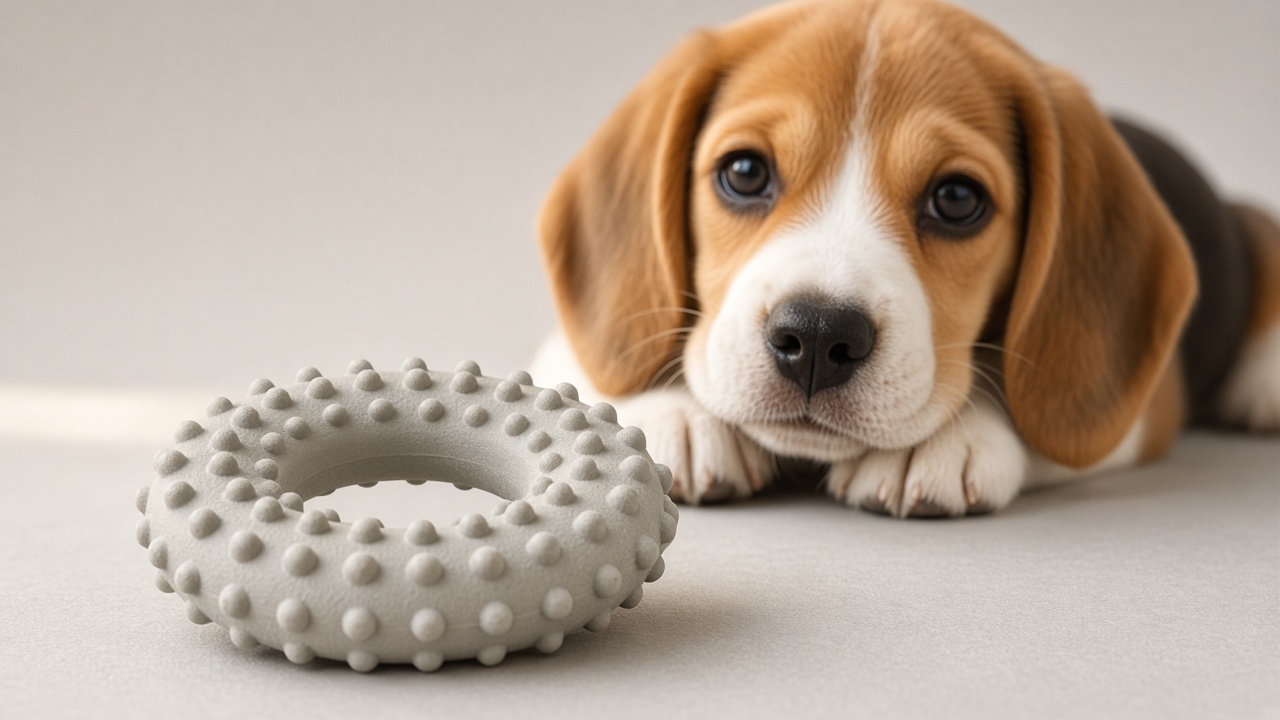
Quick answer: Most puppies start losing baby teeth at 12 to 16 weeks. The last ones are usually gone by 6 to 7 months. Offer soft, size-matched chews and have a clinic check any baby tooth that stays beside an adult tooth.
Most puppies start shedding baby teeth at 12 to 16 weeks and finish by 6 to 7 months.
This page is a week-by-week desk comparison of published eruption windows, and we did not examine live litters, run a feeding trial, or score chew toys in a lab.
The Shed-Window rule we used
Our research team lined up three published calendars. Those calendars come from the Merck Veterinary Manual, VCA Animal Hospitals, and the American Kennel Club.
A week appears below only if at least one of those three names it for eruption or shedding. That is the first cut.
A chew enters the comparison table only if its maker page lists a puppy age or a puppy weight band. That is the second cut.
We left out adult-only power chews, rawhide, hooves, antlers, and clinic extraction plans. We also left out ranked “best of” lists.
That pair of cuts is the Shed-Window rule. It is a calendar filter plus a label filter. It is not a ranking.
Week-by-week shedding timeline
Puppies are born without visible teeth. VCA Animal Hospitals states that fact on its puppy-teeth page.
The Merck Veterinary Manual says most dogs grow 28 deciduous teeth and 42 permanent teeth. Those two counts are the backbone of this timeline.
Weeks 0 to 2
The mouth is still closed to chewing work. The American Kennel Club says baby teeth can appear as early as 2 weeks.
You will not see shedding yet. You should still plan for later mouth checks.
Weeks 3 to 6
The Merck Veterinary Manual places deciduous eruption at 3 to 5 weeks of age. VCA Animal Hospitals says eruption starts around 3 weeks.
VCA Animal Hospitals says the full baby set is usually in by about 6 weeks. Those 28 teeth are pointed and sharp.
This is also when many litters move toward solid food. Choose a food whose label names the growth life stage. The Association of American Feed Control Officials lists growth as one of four recognized life stages.
Our puppy nutrition guide walks through how to read that growth statement.
Weeks 7 to 11
The baby set is in. Shedding has not started on the VCA Animal Hospitals calendar.
Chewing will rise. Redirect it to a soft, oversized toy. Do not wait for the first loose tooth.
Weeks 12 to 16
VCA Animal Hospitals says deciduous teeth begin to fall out around 12 weeks. The American Kennel Club places the start at about 3 to 4 months.
Those two windows overlap at weeks 13 to 16. That overlap is the first reliable shed band in this desk comparison.
You may find a hollow crown on the floor. VCA Animal Hospitals says many puppies swallow the crowns while they eat.
Weeks 17 to 26
The Merck Veterinary Manual says permanent teeth usually begin to appear around 4 to 5 months. That is weeks 17 to 22.
VCA Animal Hospitals and the American Kennel Club both say most mouths are finished by 6 months. That is about week 26.
Our research team counted the weeks all three calendars treat as an active swap. That shared band runs 10 weeks, from week 16 through week 26.
We call that band the 10-Week Overlap. It is an arithmetic overlay of those three published windows. It is not a clinic finding.
Weeks 27 to 32
The Merck Veterinary Manual says all permanent teeth are present by 7 months. That is about week 30.
VCA Animal Hospitals, on its persistent-tooth page, tells owners to check the mouth every week until about 7 to 8 months. Keep that habit through week 32.
If a baby tooth still sits beside its adult partner, stop waiting. Book a clinic exam.
Which teeth leave first
VCA Animal Hospitals says incisors and canines erupt first in the baby set. Premolars follow. Dogs do not have baby molars.
VCA Animal Hospitals, on its persistent-tooth page, says teething starts at about 3.5 to 4 months. The first swap is the incisors.
Adult dogs add teeth the puppy never had as babies. Subtract Merck’s 28 from Merck’s 42. That leaves 14 permanent teeth with no baby counterpart.
Those extras are why the adult mouth looks crowded after a clean shed. The count is not a breed quirk. It is the published species count.
The American Kennel Club notes that 42 adult teeth is about 10 more than people have. That extra set includes the grinding molars.
What shedding looks like at home
Loose teeth, extra drool, and light red marks on a toy are common. VCA Animal Hospitals calls the bleeding minuscule.
The American Kennel Club also flags drool and small blood spots on toys. It says unusual signs should go to a veterinarian.
You may never see a tooth. The American Kennel Club’s our editorial team says puppies often swallow most of them.
A leftover tooth is a different problem. VCA Animal Hospitals says no two teeth should occupy the same place at the same time.
Set a weekly mouth check. A dog grooming table gives you a stable height for that look.
Watch for a baby fang beside a new adult fang. VCA Animal Hospitals says upper canines are the most common leftover teeth.
Small breeds and short-nosed breeds show this more often on that VCA page. Book the clinic if you see a double tooth.
Chews that match a shedding mouth
Hard nylon, hooves, and ice cubes can crack teeth. VCA Animal Hospitals warns against those hard objects during teething.
The table below is not a ranking. It lists five currently sold items whose maker pages name a puppy age or weight band.
We compared published specs only. We did not chew-test any item.
| Product | Maker-listed puppy band | Material on the maker page | Maker-listed size or pack | Edible? | Freeze note on the maker page |
|---|---|---|---|---|---|
| Nylabone Puppy Chew Teething Bone | Small size for puppies up to 25 pounds; not for puppies with adult teeth | Soft, chicken-flavor chew | 4.5 inches long, 1 inch wide, 1.75 inches high | No | Maker says freeze it for extra soothing |
| KONG Puppy | Pink or blue rubber for puppies 9 months and younger | Natural rubber sized to 28 baby teeth | XS up to 5 pounds; S up to 20 pounds; six KONG sizes in all | No | Maker says stuff and freeze |
| Petstages Cool Teething Stick | Labeled for teething puppies and inflamed gums | Cotton-poly fabric with a stuffed interior | Sold as one stick; UPC 871864001263 | No | Soak, freeze, and remove once thawed |
| Benebone Puppy Dental Chew | Tiny size listed for dogs under 15 pounds | Nylon, made in the USA | Tiny, Small, Medium, and Large weight bands | No | No freeze claim on the product page |
| Greenies Dental Puppy Treats Teenie | Not for dogs under 6 months or under 5 pounds | Edible, rawhide-free dental treat with DHA | 6.0 ounce or 12.0 ounce packs; one treat per day | Yes | No freeze claim; subtract 26 kcal from the meal |
Nylabone’s page also lists a Medium/Wolf size up to 35 pounds. Use the Small size only while the puppy still has baby teeth.
KONG’s size page says the largest ring should be bigger than the back of the mouth. If the puppy sits between sizes, that page says to size up.
Petstages tells you to pull the Cool Teething Stick once it thaws. The same page says to replace the toy if pieces larger than a grain of rice come off.
Benebone’s nylon body is harder than the rubber and fabric items. Hold it against VCA Animal Hospitals’ warning on hard nylon.
Greenies Dental Puppy Treats Teenie start after most shedding. The feeding line is one treat per day for dogs 5 to 15 pounds.
That 26-kcal subtraction is a label math step, not a feeding plan we invented. Treats are not a complete food.
The Association of American Feed Control Officials says treats are for intermittent or supplemental feeding. Keep the main bowl on a growth formula.
Food, brushing, and the household mess
Sore gums can slow eating for a few days. Soften kibble with warm water if the puppy backs off dry food.
Do not switch to an adult formula during the swap. The Association of American Feed Control Officials says a growing puppy needs different nutrient ratios than a mature dog.
Its consumer page also gives a sample adult direction: a 10- to 15-pound dog may be fed ½ cup twice a day. Use your puppy bag’s own growth table instead.
The American Kennel Club says to start mouth handling early. Buy a dog toothbrush and dog toothpaste.
Do not use human paste. The American Kennel Club warns that human paste can contain xylitol, which is toxic to dogs.
Lost baby teeth and loose puppy coat often travel together. After car rides, check the same seams you would clear of fur.
Our guide on how to get pet hair out of car seats covers those seams. A rice-sized tooth can hide in the same crease.
Keep a small bag for any crown you find. Note the date. That note helps you see whether the 10-Week Overlap is on track.
If week 26 arrives and a baby tooth remains, treat that as a missed window. Call the clinic.
FAQ
When do puppy teeth fall out?
Most puppies start shedding at 12 to 16 weeks. VCA Animal Hospitals uses the 12-week mark. The American Kennel Club uses 3 to 4 months. The last baby teeth are usually gone by 6 months on those two calendars, or by 7 months on the Merck Veterinary Manual calendar.
How many teeth does a puppy lose?
The Merck Veterinary Manual counts 28 deciduous teeth. All 28 are meant to leave. The adult set is 42, so 14 permanent teeth have no baby twin. You may find far fewer than 28 crowns on the floor because many are swallowed.
Is it normal if I never find a baby tooth?
Yes. VCA Animal Hospitals says puppies often swallow the hollow crowns while eating. The American Kennel Club’s Jerry Klein makes the same point. Finding zero teeth is not, by itself, a problem if the adult set is coming in cleanly.
What if a baby tooth stays next to an adult tooth?
That is a persistent deciduous tooth. VCA Animal Hospitals says the leftover crown steals the adult tooth’s seat and can crowd the bite. Upper canines are the most common leftover teeth on that page. Schedule a clinic visit as soon as you see two teeth in one slot.
Can I pull a loose puppy tooth at home?
Do not pull it. You can tear gum tissue or leave a root fragment. VCA Animal Hospitals describes extraction as a clinic procedure under anesthesia when a tooth will not leave. Your job is the weekly look, not the removal.
When should I start brushing a puppy’s teeth?
VCA Animal Hospitals says the ideal time is as soon as the puppy comes home. Go gently while gums are sore. Use dog toothpaste only. Keep the weekly check going until 7 to 8 months, as that same VCA page advises.
Which chews belong in the shedding months?
Stay inside the Shed-Window rule and pick an item whose maker page names a puppy age or weight band. Stay on the soft side of VCA Animal Hospitals’ hardness warning. Nylabone Puppy Chew Teething Bone, KONG Puppy, and Petstages Cool Teething Stick fit that early window. Save Greenies Dental Puppy Treats Teenie for puppies at least 6 months old.