Quick answer: Watch what your dog licks and when it happens. See a clinician if licking is new, frantic, or paired with vomiting, sores, or weight loss. Use a sized lick mat or stuffable toy only after pain and gut trouble are ruled out.
A dog that licks floors, furniture, and skin in one day is showing nausea, itch, or understimulation—not affection. This page is a research-desk map of eight licking causes and maker-listed tongue tools. We did not examine clinic cases, run a feeding trial, or rank brands.
Dogs lick to taste, soothe, and scan a room. That is normal in short bursts. The problem starts when the tongue hops from one class of object to another.
Our research team analyzed published clinic papers and maker spec sheets. We compared those numbers. We did not put toys in dogs’ mouths.
The Two-Class Rule: what this page covers
A reason enters this article only if it can explain licking that crosses two object classes in 24 hours. The classes are body, household surfaces, air, people, and nonfood objects.
Single-spot sores on one limb stay out as a standalone skin essay. They appear here only when the same dog also licks floors, people, or air.
A product enters only if the maker lists a lick surface or stuffable cavity plus a published size. Chew-only bones, scent sprays, and supplements stay out.
That rule is why you will not see a ranked “top toys” list. You will see attribute rows from maker pages.
Four medical reasons dogs lick many things
1. Nausea and gut discomfort
A queasy dog often licks floors, lips, and air. Extra saliva tastes bad. The tongue tries to clear it.
Watch for drool and grass eating. Our page on why a dog throws up undigested food covers that same gut cluster.
The Journal of the American Veterinary Medical Association published a 2025 review. It covered 133 dogs and cats sent for endoscopic foreign-body removal.
Of animals with usable records, 66 percent (70 of 106) had chronic gut signs. Half of that group (53 of 106) had pica.
The same paper defined chronic enteropathy as gut signs lasting more than 3 weeks. Every biopsied animal (41 of 41) showed histologic chronic enteritis. Twenty percent (8 of 41) had duodenal inflammation without matching stomach changes.
Those figures do not prove your dog has enteropathy. They do show that object-mouthing can sit on top of a long gut problem.
2. Itch, pain, and skin disease
Itchy skin sends the tongue to paws, belly, and then nearby rugs. Pain in a joint can do the same hop.
The University of Minnesota Small and Large Animal Dermatology Handbook covers acral lick dermatitis. One practice study found it in 2.9 percent of 559 dermatology cases.
The same handbook notes an estimate that up to 70 percent of those dogs may have anxiety-related conditions.
A firm, hairless plaque on a lower leg is not “just a habit.” The handbook describes how licking can release endorphins and keep the loop going after the first trigger fades.
3. Mouth pain
Dental pain can look like random licking. The dog licks air, bedding, or your hand after meals.
The American Journal of Veterinary Research calls periodontal disease the most widespread oral disease of dogs. It reports a range of 44 percent to 80 percent. Age, breed, and diagnostic rules change that range.
Halitosis, drooling, and dropping kibble raise the odds that the mouth, not the carpet, is the real target.
4. Nutrient gaps and pica-adjacent licking
A complete diet will not stop every lick. An incomplete one can add a hunt for taste and minerals.
The AAFCO Dog Food Nutrient Profiles set adult-maintenance floors on a dry-matter basis. Those floors are 18.0 percent crude protein and 5.5 percent crude fat.
Growth and reproduction minimums sit at 22.5 percent protein and 8.5 percent fat. Label math matters more than bag art.
AAFCO’s Reading Labels guide says a “lite” dry dog food cannot exceed 3,100 kilocalories per kilogram. The Nutrient Profiles assume 4,000 kcal of metabolizable energy per kilogram of dry matter when they convert nutrient tables.
If the bag skips a nutritional adequacy statement, do not guess. Read what chicken meal means on a dog-food label and compare the life-stage line to those AAFCO floors.
Four behavioral reasons dogs lick many things
5. Boredom and understimulation
A bored dog licks tile because the tile is there. The same dog may then chew a shoe.
Licking burns minutes. It is cheap entertainment. Pair it with short walks and a job for the mouth.
If the tongue and the teeth both hunt objects, treat the understimulation as one problem. Our guide to stopping shoe chewing covers the chew half of that pair.
6. Anxiety and self-soothing
Repetitive licking can calm a stressed dog. Thunder, departures, and crate time are common starts.
The University of Minnesota handbook flags boredom, crate confinement, and low social contact as risks around acral lick lesions. The lick itself can become the reward.
Do not punish the tongue. Change the trigger and give a legal lick target.
7. Attention
Many dogs lick people because a person looks back. That is training, not romance.
If every lick earns talk or a shove, the behavior pays. Walk away. Reward a sit on a mat instead.
8. Taste and leftover residue
Sweat, crumbs, and spilled broth taste like a snack. Furniture holds those traces for hours.
This reason still has to pass the Two-Class Rule. A dog that only licks the sofa after pizza night is tasting. A dog that then licks your arms and the floor is doing more than snack patrol.
When the licking pattern needs a clinic visit
Book a visit if licking is new, lasts most of the day, or leaves sores. Book sooner if you see vomiting, diarrhea, weight loss, or collapse.
Air licking and “fly snapping” belong in that same pile. Those patterns can track mouth pain or a neurologic problem. Do not wait them out.
Bring a 24-hour list of surfaces and times. That log is more useful than a guess about “dominance” or “love.”
AAFCO notes that FDA labeling rules apply to animal food that crosses state lines. A clinician still has to judge the dog. A label cannot.
Tongue tools compared by published specs
These five products stay on the page because each maker lists a lick surface or cavity and a size. Our research team compared those published specs. We did not score “best.”
| Product | Maker-listed job | Published size or capacity | Material (maker page) | Care note (maker page) |
|---|---|---|---|---|
| LickiMat Buddy Classic | Cross-maze lick surface for wet food and spreads | 8 in × 8 in (20 cm × 20 cm) | Food-grade TPR; no BPA, PVC, phthalates, or silicone | Freezer and microwave safe; hand wash |
| KONG Classic, Medium (SKU T2) | Stuffable cavity for kibble or paste | 2.25 × 2.25 × 3.5 in; 0.25 lb | 100% natural rubber | Supervised use; stop if damaged |
| West Paw Tux, Large | Shallow treat cavity; fill and freeze | 5 in / 13 cm | Recyclable Zogoflex; no BPA, latex, phthalates, or silicone | Top-rack dishwasher safe |
| Outward Hound Fun Feeder Slo Bowl, Medium | Maze slow bowl | 2 cups dry or wet food | BPA, PVC, lead, and phthalate free | Top-rack dishwasher; non-slip base |
| Nina Ottosson Lickin’ Layers | Level 2 three-layer lick puzzle | Over 100 treat compartments | Food-safe; no BPA, PVC, or phthalates | Supervise; do not leave the dog alone with it |
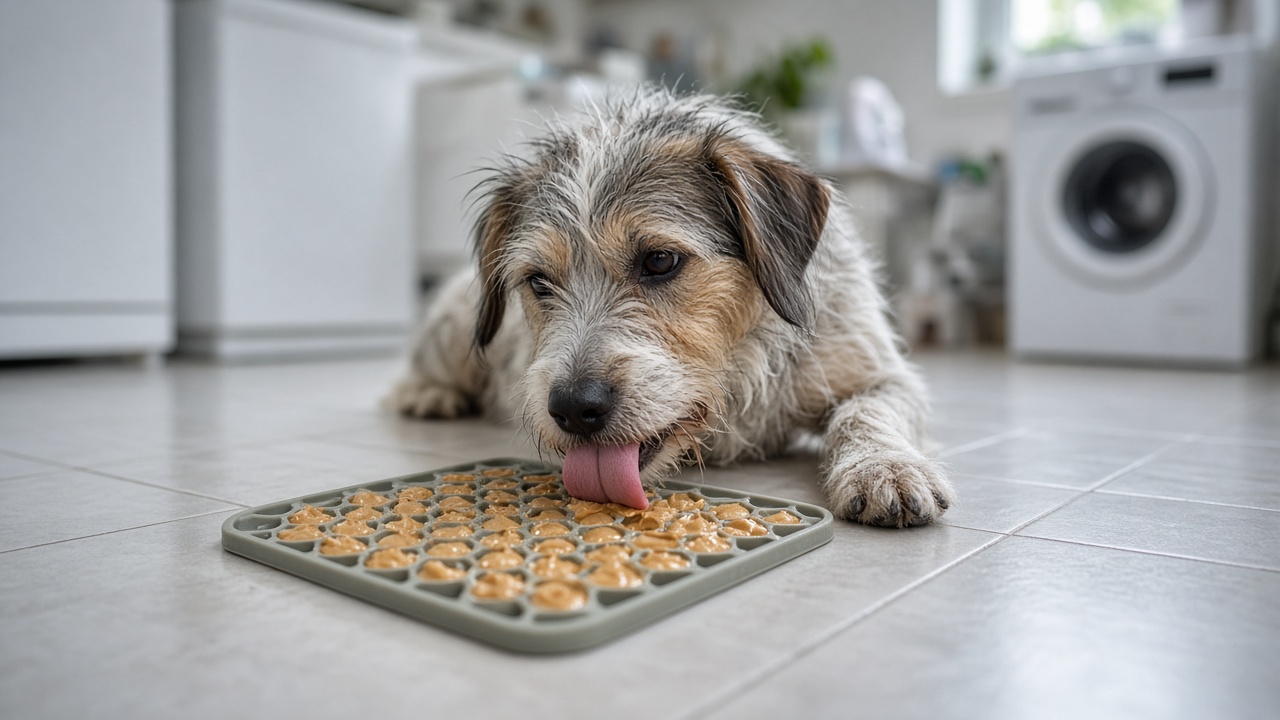
LickiMat USA lists the Buddy Classic as an 8-inch square. The cross maze is built to hold wet food, soaked kibble, and spreads. The company says it is not a chew toy.
KONG Company lists the Medium Classic at 2.25 by 2.25 by 3.5 inches and 0.25 pounds. The red rubber line is sold for average chewers. Size up for power chewers, per that page.
West Paw lists the Large Tux at 5 inches, or 13 centimeters. The cavity is shallow on purpose for short snouts. The page says the toy is made with Zogoflex in Bozeman, Montana.
Outward Hound lists Fun Feeder Slo Bowl sizes as three-quarter cup, 2 cups, and 3 to 4 cups. The company claims meals can last up to 10 times longer. Treat that 10-times line as a maker claim, not a measured trial by us.
Nina Ottosson by Outward Hound lists Lickin’ Layers as a Level 2 game with three spinning layers. The page states more than 100 treat compartments. It also says to freeze only xylitol-free peanut butter.
Pick the tool by snout shape and chew strength. A flat lick mat fails if the dog shreds rubber. A stuffable toy fails if the opening is wider than the jaw is safe for.
Spreads and foods that do not belong on a lick mat
Keep human toothpaste and sugar-free gum away from every lick session. Many of those products use xylitol.
Nina Ottosson’s Lickin’ Layers page already warns to use xylitol-free peanut butter. Follow that maker note. Read the jar before you smear.
Stay inside the daily calorie budget. AAFCO’s calorie example uses modified Atwater factors of 3.5 for protein and carbohydrate. Fat counts as 8.5, and the sum is multiplied by 10 to reach kcal per kilogram.
Frozen broth is enough for most dogs. Thick frosting is not a training plan.
Wash the tool after each use. A dirty maze is just another floor.
FAQ
Why does my dog lick the floor only at night?
Night licking often tracks an empty stomach, reflux, or a quiet house with no other job. Note whether the dog also licks lips or air. If the pattern is new, or food comes back up, book a clinic visit the same week.
Why does my dog lick me and then the couch?
That hop crosses two object classes. It fits nausea, leftover taste, or a bid for attention. Wipe the couch crumbs. Then ignore body licking and reward a sit on a mat.
Can a diet change stop the licking?
Only if a diet gap or a food sensitivity is part of the cause. Check the life-stage statement against AAFCO’s 18.0 percent adult protein floor on a dry-matter basis. Do not swap foods to treat sores or vomiting on your own.
Is licking the air different from licking objects?
Yes. Air licking and fly snapping need a clinic exam first. Object licking can still be boredom. Air licking is a poorer match for a lick mat alone.
How long should a legal lick session last?
Ten to twenty minutes of supervised work is enough for most adults. Longer frozen sessions add calories fast. Stop the session if the dog starts chewing the tool.
When is licking an emergency?
Go in now for collapse, repeated vomiting, a swollen belly, or a dog that cannot stand. Go the same day for open sores, blood, or a swallowed nonfood object. A 24-hour surface log still helps the clinician after you arrive.