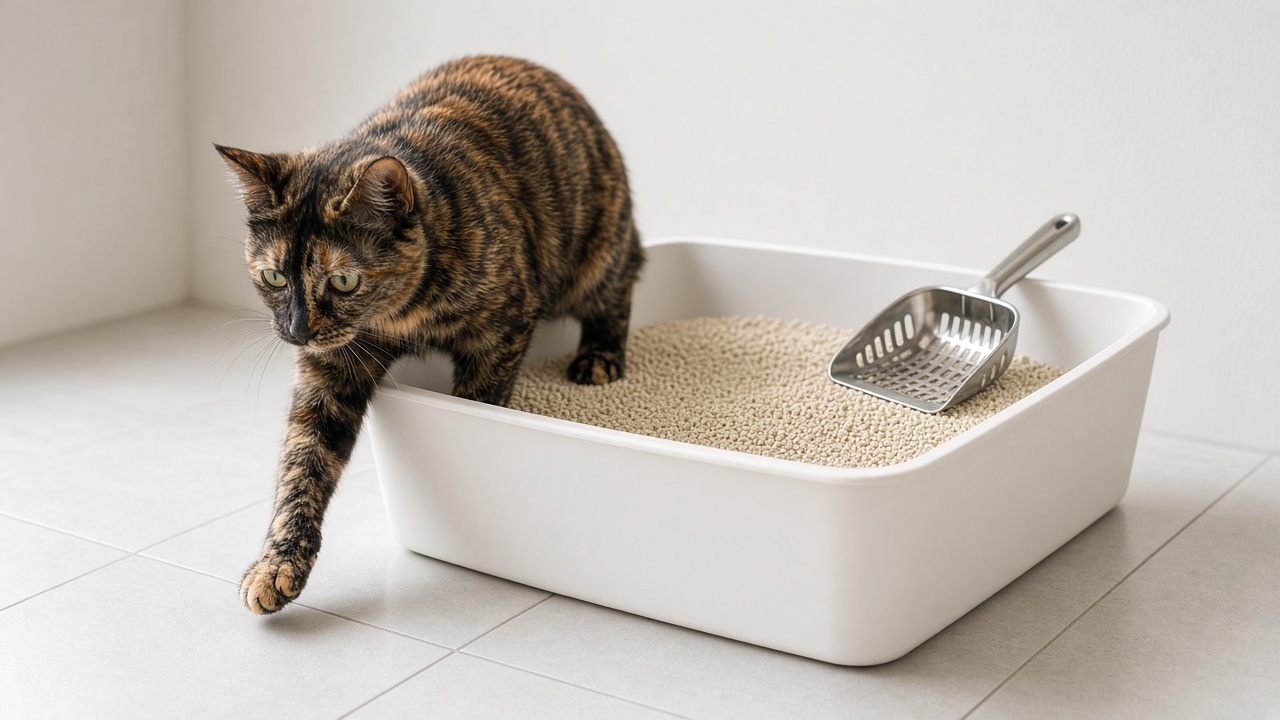
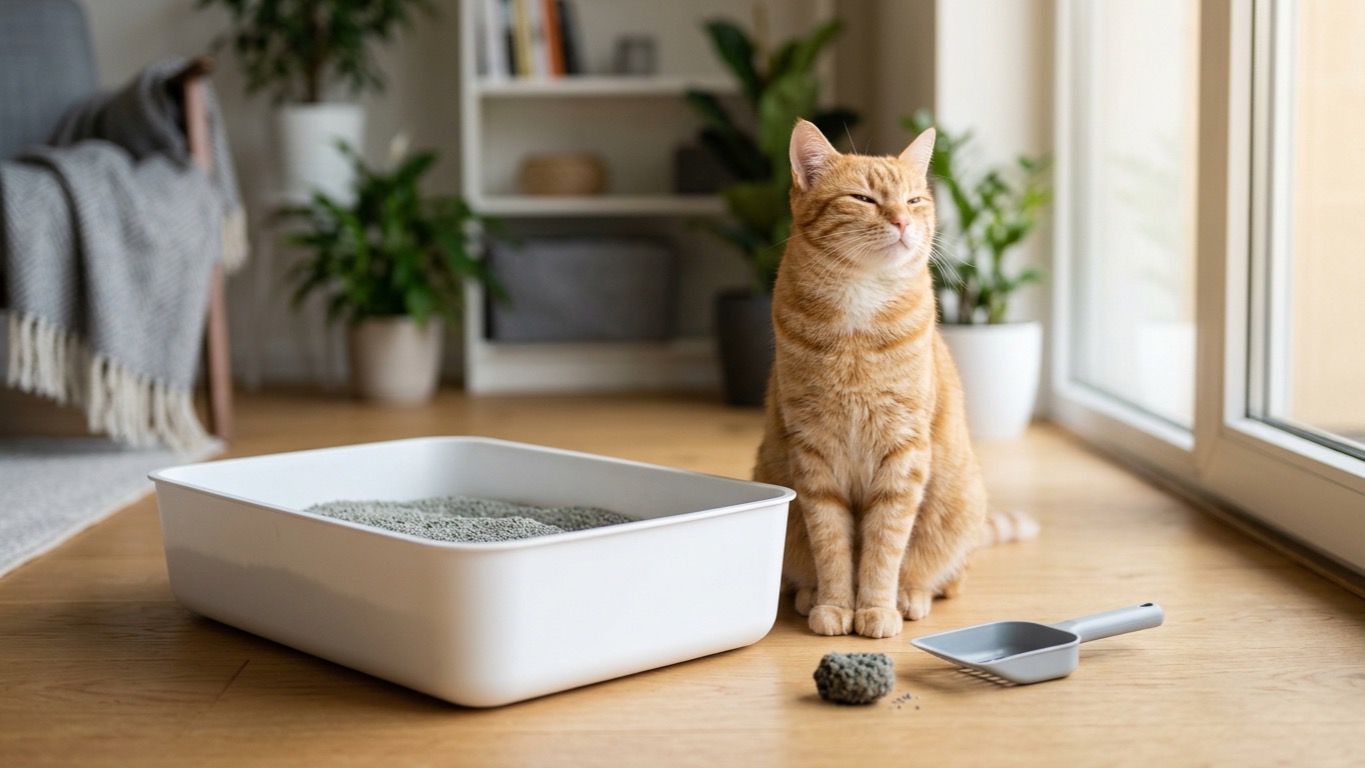
Quick answer: The best cat litter for picky cats is unscented, fine-to-medium, clumping litter in enough large, clean, open boxes — after a veterinarian has ruled out pain. That is the Cornell / ASPCA / AAFP/ISFM / AAHA starting place. There is no champion SKU on this desk.
Our guides are reader-supported. This article may contain affiliate links. As an Amazon Associate we earn from qualifying purchases at no extra cost to you. That does not change the sourcing.
What picky-cat litter listings emphasize on labels
This URL does not carry product cards. The SKUs below are real, currently sold examples this desk mapped to the institutional default — or to a deliberate violation of it. Prices are listing-class snapshots compiled August 2026 from sibling PetBench tiles and public Amazon search cards. They move.
Table 1 — Named SKUs vs the institutional default
| SKU | Listing-class snapshot | Substrate | Matches AAFP/ISFM unscented clumping default? |
|---|---|---|---|
| Dr. Elsey’s Ultra unscented, 40 lb | $22.99 (sibling multi-cat tile) | Bentonite clay | Yes — closest default on this page |
| Dr. Elsey’s Cat Attract | $18–$24 / 20 lb class | Clay + herb attractant | Partial — herbs are a scent, even if marketed for “problem cats” |
| Fresh Step Simply Unscented | $13–$16 grocery clay class | Clay + carbon | Yes on fragrance; carbon is still an additive |
| ARM & HAMMER Multi-Cat Strength Unscented | $15–$20 unscented clay class | Clay + baking soda | Yes on fragrance; baking soda is odor chemistry, not perfume |
| Boxie unscented clumping clay | $20–$28 class | Clay or plant unscented lines | Yes if you buy the unscented SKU, not a scented sibling |
| World’s Best Comfort Care Unscented | $32 / 28 lb class (sibling corn tile) | Corn | Texture change — plant, not clay; still unscented |
| PrettyLitter silica | $23–$28 / 8 lb class | Silica gel | No — crunchy, non-clumping; color change is not a diagnosis |
Desk stat: 4 of 7 examples are unscented clumping clay. 1 of 7 (Cat Attract) adds herbs. 1 of 7 is plant corn. 1 of 7 is silica. Ultra at $22.99 for 40 lb is about $0.57/lb. World’s Best at $32 for 28 lb is about $1.14/lb — 2.0× the Ultra unit price for a texture change, not a ranking.
Table 3 — Box math before you buy another bag
| Cats in the home | Boxes Cornell / ASPCA / AAHA / AVMA start with | Spend first | Spend second |
|---|---|---|---|
| 1 | 2 | Second open box + daily scoop | Ultra-type unscented clay if the substrate is the question |
| 2 | 3 | Third box in a second room | One texture trial in the extra box only |
| 3 | 4 | Fourth box; split rooms | Do not line four boxes with four scented clays |
Table 4 — Depth conflict this desk will not paper over
| Source | Depth they print | Desk note |
|---|---|---|
| ASPCA | 1–2 in, not 3–4 | If the cat perches on the rim, start here |
| AAFP/ISFM | At least 1.25 in (3 cm) | Floor, then vary |
| Dr. Elsey’s / Fresh Step | 3–4 in | Maker fill; can read as too deep to a picky cat |
| World’s Best | 2–3 in | Plant-litter fill |
Those four numbers cannot all be “the” depth. The cat’s use of the box is the vote.
What the best cat litter for picky cats actually is
If a cat is “picky” about litter, start with the box, not a brand ranking. Named feline-medicine sources converge on the same first moves.
Cornell Feline Health Center, ASPCA, AAFP/ISFM, AAHA, and AVMA are the named sources on this page. They are not a PetBench panel.
Five first moves, in order
- Rule out pain. House soiling can be medical — urinary tract disease, FLUTD, constipation, arthritis, kidney disease, diabetes. Cornell and ASPCA both say take the cat to a veterinarian before treating this as a preference problem.
- Clean the box. ASPCA: scoop at least once a day; rinse the box weekly with baking soda or unscented soap. AVMA (FLUTD page): ideally scoop twice a day and change litter about once a week, or more often as needed.
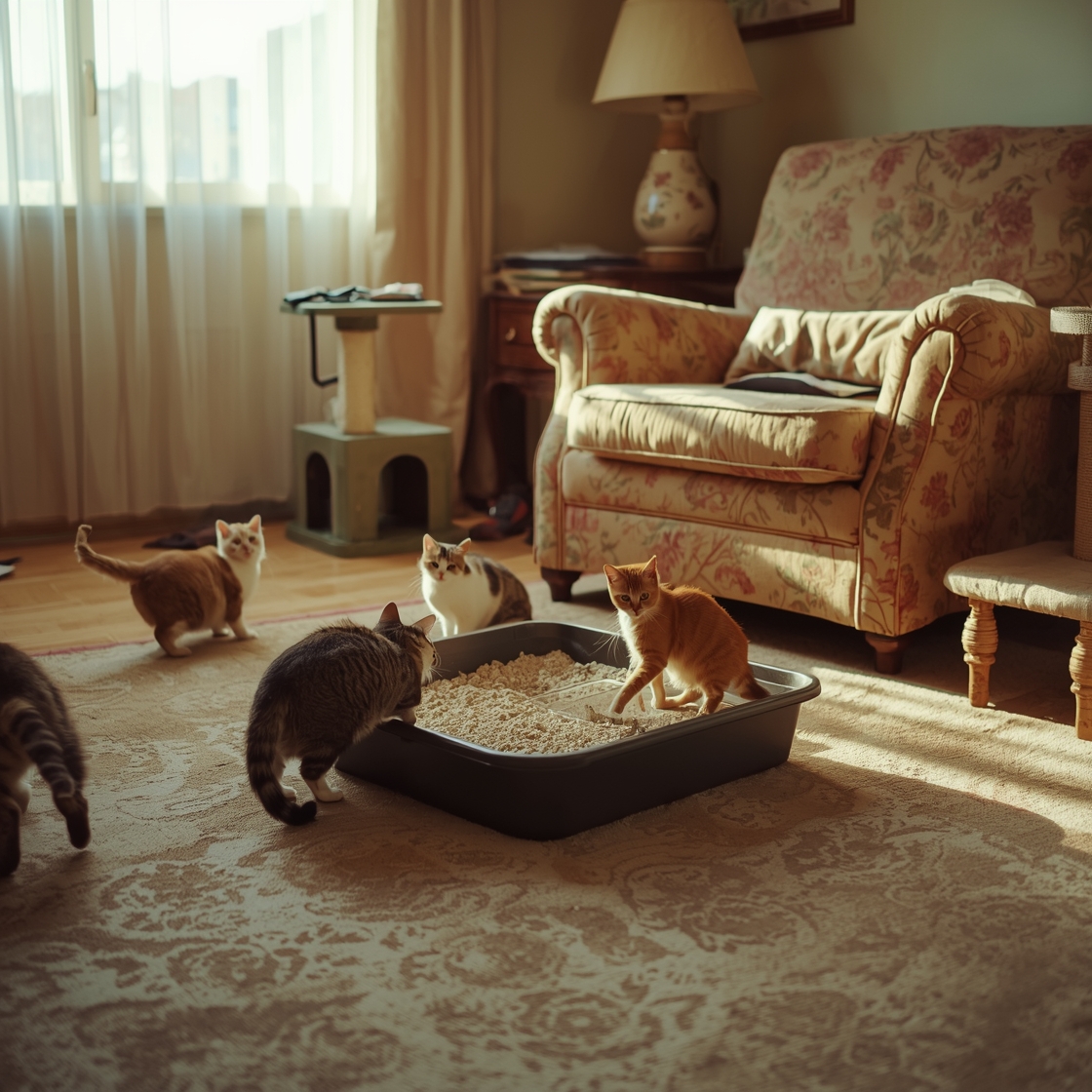
- Use enough boxes. Cornell, ASPCA, AAHA, and AVMA all use some version of one box per cat, plus one extra, in separate quiet locations.
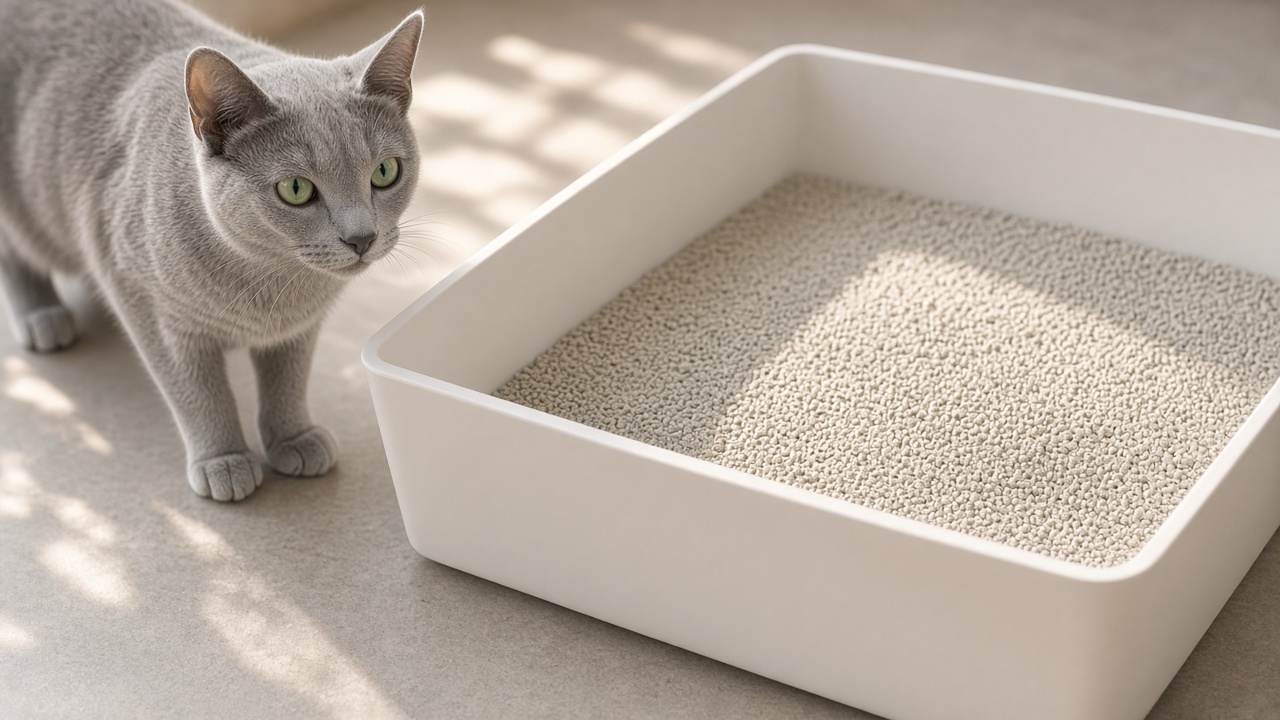
- Default substrate. AAFP/ISFM: a fine, sand-like, non-scented, clumping litter. ASPCA: most cats prefer clumping, unscented litter with a medium-to-fine texture. Cornell: most cats prefer unscented litter; switch brands gradually.
- If you still do not know what the cat wants. Put different litters in separate boxes and let the cat vote (ASPCA, AAFP/ISFM, AAHA).
A scented “odor control” clay, a pine pellet, or a silica crystal can work for some cats. They are not the institutional default for a cat that is already avoiding the box.
Terms a newcomer should know
Bentonite is the clay that clumps when wet. It is the usual grocery clumping litter.
Substrate is the stuff in the box — clay, corn, silica, wood pellets. Cats vote with their paws on texture and scent.
FLUTD is feline lower urinary tract disease. Urinating outside the box is a major sign (AVMA). A new bag will not treat a blockage.
House soiling is Cornell’s word for elimination outside the box. Cornell is explicit: cats probably do not soil to punish you. The problem is medical, aversion, preference, or marking.
What ”
Institutional default vs listing job
| Job | Named source | Typical listing title | Desk note |
|---|---|---|---|
| Medical rule-out first | Cornell, ASPCA, AVMA | “Cat Attract,” “picky cat” | A bag is not a urinalysis |
| Unscented clumping default | AAFP/ISFM, ASPCA, Cornell | “Odor control,” “fresh scent” | Perfume is a human-nose job |
| One box per cat, plus one | Cornell, ASPCA, AAHA, AVMA | Multi-cat jumbo tub | Adjacent boxes can read as one |
| Scoop daily / twice daily | ASPCA / AVMA | “30-day odor” | Hygiene beats a fragrance additive |
| Household preference check | ASPCA, AAFP/ISFM, AAHA | “#1 picky cat litter” | The cat votes in your house |
First: is this picky, or is this medical?
“Picky” is a marketing word. Cornell’s house-soiling page treats elimination outside the box as a medical, aversion, preference, or marking problem — not spite.
See a veterinarian first if any of the following are true (AVMA FLUTD; Cornell LUTD; ASPCA):
- Straining in the box, crying out, or producing only small amounts of urine.
- Blood in the urine, or licking the genital area more than usual.
- Going to the box often and leaving little or nothing.
- A male cat that is distressed and passing little or no urine. Urethral obstruction is an emergency. AVMA and Cornell both say so.
- A sudden change in a cat that previously used the box reliably.
- Difficulty climbing into a high-sided box (arthritis, age, injury).
AVMA lists urinating outside the litter box as a major sign of FLUTD. Cornell notes that inflammation can make urination painful. The cat may then associate the box with pain and keep avoiding it after the medical episode is over. ASPCA describes the same “negative litter-box association.”
A new bag of litter will not treat a blockage, a urinary tract infection, idiopathic cystitis, stones, constipation, or cognitive decline. If the exam is clear, then litter type, scent, texture, depth, box size, location, and cleanliness are the right levers.
For multi-cat conflict and extra boxes, see our guide to litter in multi-cat homes. For scooping cadence, see how often to change cat litter.
What picky cats actually reject
AAFP and ISFM put it bluntly: cat litter is marketed to people, not to cats. Labels that say “less tracking,” “multi-cat,” “scented,” “organic,” or “natural” are aimed at the person holding the debit card. Cats often find aromatic litter and deodorizers offensive. No product removes the need to clean the box.
Scent, perfume, and deodorizing powder
AAFP/ISFM: aromatic litter and deodorizers are often offensive; use non-scented clumping material. ASPCA and Cornell: most cats prefer unscented litter. AAHA/AAFP: some cats find scented litters significantly aversive; unscented clumping may be preferred after urinary problems.
Try first: switch to unscented. Do not add powders or scented beads.
Texture — too coarse, pellet, crystal, or suddenly different
ASPCA: cats generally prefer clumping litter with a medium-to-fine texture. AAFP/ISFM: fine, sand-like clumping litter. ISFM/AAFP hospital guidance: wood or recycled-paper pellets can have a strong scent; some cats (especially with degenerative joint disease) find pellets painful to stand on.
Try first: offer a fine unscented clumping clay and one alternative in separate boxes.
A dirty box
ASPCA: virtually all cats like a clean box; scoop at least daily. AVMA: ideally scoop twice daily. AAFP/ISFM: no product replaces regular cleaning. Balancing on the rim with only one or two feet in the box can mean aversion to the substrate or to soiled litter. Cornell: some cats refuse a box that contains any urine or feces.
Try first: scoop daily (twice if you can). Full wash weekly with unscented soap or baking soda (ASPCA).
Box too small, covered, or lined
ASPCA: most cats do not like lids or liners; they want a large, easy-entry box. AAHA/AAFP: the box should be at least 1.5× the cat’s length from nose to tail tip; most manufactured boxes are too small. Cornell: covers hold odor in; large cats need bigger boxes; kittens and elderly cats need low sides.
Try first: open box, no liner, bigger than you think. Storage totes are the institutional workaround.
Litter too deep — or too shallow
ASPCA: most cats like 1–2 inches, not 3–4. AAFP/ISFM: at least 1.25 inches (3 cm); cats vary; test depths. Several clay makers (Dr. Elsey’s, Fresh Step) instruct 3–4 inches. Those instructions conflict.
Try first: if the cat perches on the rim, try a shallower bed. If waste is not covered, try a bit deeper.
Location, ambush, and no escape route
ASPCA: quiet but not cornered; multiple escape routes; not next to food, laundry machines, or a dog bowl. Cornell: another animal that terrorizes the cat at the box is a reason to add boxes and open sight lines. AVMA: safe access in quiet areas.
Try first: one box per floor if the home has stairs. Food bowls elsewhere.
Not enough boxes, or social blocking
Cornell, ASPCA, AAHA, AVMA: n + 1 (one box per cat, plus one). AAHA also allows one box per social group plus one, if you know the groups.
Try first: add a box in a second room before you swap brands again.
A sudden brand change
Cornell: dislike is common after a sudden brand switch; add small amounts of new litter to the old. World’s Best’s own transition copy: start at one-third new, then two-thirds.
Try first: mix gradually over days, not overnight.
That list is the decision framework. A ranked “top 7” cannot substitute for it.
How to let the cat vote
Do not force the cat into the box (ASPCA: that can increase dislike). Do not rub a nose in waste (Cornell and ASPCA both say this is useless and harmful).
A household preference check (yours, not ours)
Do this only after the veterinary visit if soiling is new, painful-looking, or a male cat is straining.
- Keep the old box exactly as it was — same litter, same place — so the cat does not lose the only station that still works.
- Add a second identical open box beside the first with the candidate litter. Same size class. Unscented if you are following the institutional default.
- Keep depth similar at first. If needed, vary depth in a second round (AAFP/ISFM).
- Scoop both on the same cadence (AVMA: ideally twice daily).
- Count which box has waste for several days. One clump is not a verdict. A week of one box going unused is a signal.
Do not mix the two substrates in one pan if you are trying to read a preference. Mixing is a transition tool (Cornell), not a preference tool.
If the cat is eliminating on a soft surface (carpet, laundry), Cornell says you may need a finer, softer litter. If the preference is tile or a bathtub, a smoother surface with less litter may be the bridge. Move a used box only a few inches a day, and stop if use drops (Cornell).
If both boxes are ignored, you are probably not in a litter-brand problem. You are in a pain, box-count, box-location, or social-conflict problem. Buy another box before you buy another brand.
Material trade-offs (facts, not scores)
| Material | What it typically is | Trade-off that matters for a picky cat | What we can source |
|---|---|---|---|
| Clumping clay (bentonite) | Fine-to-medium granules that bind when wet | Closest to the sand-like texture AAFP/ISFM describe; can be dusty or heavy; not flushable (Dr. Elsey’s: do not flush) | Institutional default is unscented clumping. Dust claims are manufacturer labels, not our lab results. |
| Scented clay | Same clay plus perfume / “freshness” | Often better for the human nose; AAFP/ISFM say cats often find aromatic litter offensive | Use only if this cat still uses the scented box when an unscented box sits in the same room as a second station. |
| Corn (plant clumping) | Compressed whole-kernel corn (World’s Best) | [Different feel than clay; maker says 99% dust-free, no clay dust, no artificial perfumes; plant litters can attract pantry pests if stored open (a common owner report amazon.com/s?k=Different+feel+than+clay%3B+maker+says+99%25+dust-free%2C+no+clay&tag=) | — |
| Silica crystals | Amorphous silica gel | Crunchy, non-clumping; some cats refuse the feel; PrettyLitter markets color change as a health flag, not a diagnosis | PrettyLitter: silica gel absorbs urine in pores; color reacts to pH and visible blood. A color change is a reason to call a vet, not a lab result. |
| Wood / paper pellets | Large pellets, often non-clumping | Lower tracking for many homes; ISFM/AAFP: pellets can smell strong and can be painful to stand on, especially with joint disease | Texture change is a common reason a “picky” cat walks away. See pellet litter. |
| Fine clay vs low-tracking large granules | Smaller grains feel more like sand; larger grains stay in the box | Fine grains are what most cats prefer to dig in; they also track more | Tracking and preference pull in opposite directions. See low-tracking litter. |
Clumping vs non-clumping for odor is a different question. If odor is the human problem after the cat is using the box, start with clumping litter for odor control.
Common SKUs when shopping the best cat litter for picky cats
Dr. Elsey’s Cat Attract® (clumping clay + herbs)
Dr. Elsey’s Cat Attract calls this a “problem cat training litter,” blended with a natural herb attractant, 99% dust-free, hard-clumping, with chlorophyll odor control. Ingredients listed: natural clay and herbs. Directions: fill 3–4 inches; scoop twice daily; do not flush.
Honest frame: this is one of the few mass-market clays marketed for box non-use. The herb blend is a scent, even if the bag is sold as unscented-to-perfume. AAFP/ISFM say cats often dislike aromatic litter. If you try Cat Attract, treat it as a trial in one extra box, not a guarantee. Dr. Elsey’s “guaranteed to bring cats back” is a manufacturer promise, not a Cornell finding. Non-use can still be medical.
Dr. Elsey’s Ultra (unscented clumping clay)
Dr. Elsey’s Ultra is the same maker’s unscented clay: no perfumes or deodorants, hard-clumping, 99% dust-free on the label, mixed heavy and medium granules, aimed at multi-cat homes and sifting/mechanical boxes. Same 3–4 inch fill; scoop twice daily; do not flush.
Trade-off: closer to the AAFP/ISFM “non-scented clumping” default than a Febreze clay. It is still mined clay: heavy to pour, and “99% dust-free” is the maker’s figure, not a measurement we ran. Some cats still track medium clay. If Cat Attract’s herbs seem to put a cat off, Ultra is the fragrance-free sibling to try in the next box over.
World’s Best Cat Litter® Comfort Care™ Unscented (corn)
World’s Best Comfort Care Unscented states this formula is made from U.S.-grown whole-kernel corn: tight-clumping, soft texture, no artificial perfumes, no clay dust, 99% dust-free, lightweight, marketed as flushable and septic-safe. Their transition copy: start with one-third new litter, then two-thirds. They ask for a 2–3 inch depth and daily scooping.
Trade-off: this is not wood-pellet litter. The live article said it was. Corn feels different from bentonite. That can be the point (softer, no clay dust) or the problem (a clay-raised cat may refuse it). Flushability is the manufacturer’s claim; Elsey’s, Fresh Step). Store plant litter sealed.
Fresh Step™ Simply Unscented (clay + carbon)
Fresh Step Simply Unscented describes a fragrance-free, dye-free clumping clay with odor-fighting carbon and “Ammonia Block Technology,” a 15-day odor-control guarantee, and a low-dust formula. Fill 3–4 inches; scoop daily; do not flush. The same brand also sells heavily scented lines (Febreze, Gain, Heavy Duty). Those are a different product.
Trade-off: if the old article pushed “Fresh Step Advanced Heavy Duty” at picky cats, that was the wrong lever. Heavy Duty is an odor-block, often scented, pitch. Simply Unscented is the SKU that matches institutional “no added fragrance” advice. Carbon is not perfume, but some cats still object to any additive.
ARM & HAMMER™ Multi-Cat Strength, Unscented (clay + baking soda)
Trade-off: baking soda is an odor strategy without a floral perfume. It is still clay. Slide-style “easy clean-up” formulas that include fragrance belong in a different conversation.
Boxie unscented clumping clay
Boxie unscented litter sells unscented natural clumping clay and an unscented plant-based lightweight litter, marketed as no perfumes or masking agents, low-dust, for scent-sensitive cats. Older Boxie copy advertised 30-day odor control on clay. Treat long odor windows as marketing, not a reason to skip daily scooping (AAFP/ISFM: no product removes that job).
Trade-off: a straightforward unscented clay alternative. Elsey’s or Fresh Step.
PrettyLitter (silica gel, color-change)
PrettyLitter is amorphous silica gel. The maker says pores absorb urine and trap odor, crystals stay dry as moisture evaporates, and a proprietary indicator changes color with urine pH and visible blood. PrettyLitter’s own safety page says only licensed medical professionals can determine what is best for the cat.
Trade-off: crystals are a texture many cats refuse (AAFP default is sand-like clumping). Color change is not a urinalysis, not a diagnosis of FLUTD, and not a substitute for the AVMA workup (physical exam, urine specific gravity, sediment, and, if needed, culture or imaging). If crystals turn blue, orange, or red, call the vet. Do not wait for a “retest” bag.
A practical sequence (one week, then a vet if needed)
Use this only after a veterinary exam if the change was sudden, painful, or bloody.
Day 0. Count boxes. If you have two cats and one box, add a second and a third before you buy a new formula (n + 1). Uncover hooded boxes. Pull liners. Move food away from the box.
Days 1–2. Scoop every box at least once a day (twice if you can). Wash one box with unscented soap or baking soda (ASPCA). Put the current litter back so the only change is cleanliness.
Days 3–7. If use is still poor, add a second open box beside the first with an unscented fine clumping clay (Ultra-type or another unscented clay). Do not mix types in the same pan yet.
If the cat uses the new box: you have a preference signal. Transition the old box slowly (Cornell; World’s Best’s one-third / two-thirds steps are a reasonable manufacturer version of the same idea).
If the cat uses neither: change location or box size next, not brand. AAHA/AAFP: most store-bought boxes are too small. Cornell: low sides for seniors and kittens.
If the cat perches on the rim or eliminates just beside the box: AAFP/ISFM read that as possible substrate or soil aversion. Try a shallower bed (ASPCA’s 1–2 inches) even if the bag says 3–4.
If nothing moves in a few days, or signs of pain appear: stop shopping. Go back to the veterinarian. Ask about urine testing and, in older cats, bloodwork. Cornell: cats with medical conditions may not “act sick.”
When a vet is the right answer (not a different bag)
Call or go in now for a male cat straining with little or no urine (AVMA, Cornell: obstruction can kill in 24–48 hours).
Book promptly for blood in urine, crying in the box, genital licking, frequent tiny clumps, or a senior who started missing the box. Cornell lists kidney disease, hyperthyroidism, and diabetes as reasons a cat drinks and urinates more and cannot always reach the box in time. Arthritis is a reason the box is now too tall.
Ask for behavior help (veterinary behaviorist or a CAAB working with your vet) if medical workup is clean, boxes are plentiful and clean, unscented clumping litter is on offer, and soiling continues. ASPCA: medication is unlikely to help if the problem is litter type, location, or a dirty box; it may help when anxiety is the driver, and only under veterinary direction.
Cornell: never hit, kick, or scream at a house-soiling cat. Punishment increases anxiety and can make soiling worse.
Dr. Elsey’s Cat Attract is a commercial product that sells herbal attractant for cats that have already left the box. It can be a useful example of that job class. It is not a diagnosis and it is not a replacement for the Cornell/ASPCA medical-first step. PrettyLitter’s color change is a prompt to call a clinic, not a urinalysis.
If a brand name on a card contains the word “vet” or “attract,” that is the brand’s wording. It is not a review we commissioned.
We still have no dust-chamber number, no clump-score, and no 30-day acceptance trial. Manufacturer “99% dust-free” lines stay their lines.
Scented clay can win the human-nose contest and lose the cat. That is why this desk will not crown an “odor control” perfume as the picky-cat winner.
Frequently Asked Questions
What is the best cat litter for picky cats?
There is no lab-ranked best. AAFP/ISFM, ASPCA, Cornell, and AAHA/AAFP point to the same starting place: unscented, fine-to-medium, clumping litter in enough large, clean, open boxes. The “best” bag is the one this cat actually uses when two household boxes offer different substrates after medical causes are ruled out. That check is the owner’s, in that home — not a field trial notes.
What should I prioritize when shopping for best cat litter for picky cats?
Start with a veterinary rule-out if soiling is new or painful. Then: unscented, sand-like, clumping substrate; n + 1 open boxes; daily scoop. Manufacturer specs and owner consensus are shopping cues. They are not hands-on lab testing by this desk.
Should I buy scented litter so the box smells better to me?
Not as the first move for a cat that is already avoiding the box. AAFP/ISFM say cats often find aromatic litter and deodorizers offensive. ASPCA and Cornell say most cats prefer unscented. Control odor by scooping (AVMA: ideally twice daily) and by using a clumping unscented base, not by adding perfume.
How many litter boxes do I need?
One per cat, plus one extra. Cornell, ASPCA, AAHA, and AVMA all teach that rule of thumb. Three cats → four boxes, preferably in more than one room, not lined up as one giant station (AAFP/ISFM: adjacent boxes can read as one box).
How deep should the litter be?
Sources disagree, and we will not pretend they do not. ASPCA: most cats prefer 1–2 inches, not 3–4. AAFP/ISFM: at least 1.25 inches (3 cm), and cats vary. Dr. Elsey’s and Fresh Step instruct 3–4 inches. World’s Best: 2–3 inches. If the cat stands on the rim, try shallower. If waste is not buried, try deeper. That is a preference check, not a universal number.
Can I mix two litters?
You can mix during a transition (Cornell: add small amounts of new to old). Fresh Step tells customers it is best not to mix types for performance. Those two instructions are doing different jobs. For a picky cat, separate boxes are cleaner data than a blend. If you must switch one box, change the ratio over several days, not overnight.
Are crystals or PrettyLitter a good picky-cat litter?
Only if the cat accepts the crunch and the non-clumping feel. The institutional default is sand-like clumping litter. PrettyLitter’s color change can prompt a vet visit; it does not diagnose FLUTD, infection, or kidney disease. AVMA’s diagnostic list still starts with an exam and a urine sample.
What about pellet litter for sensitive paws?
Pellets track less and are often low-dust, which is why owners like them. ISFM/AAFP hospital guidance warns that wood or paper pellets can smell strong and can hurt to stand on, especially for cats with degenerative joint disease. If a senior suddenly “gets picky,” check pain and box height before you assume the cat wants a forest-scented pellet. Details: pellet cat litter.
Is clumping clay safe for kittens?
Dr. Elsey’s clay pages do not carve out a kitten ban; they say do not flush. PrettyLitter and some plant-litter makers warn against clumping clay in very young kittens because of mouthing. If a kitten is still eating litter, ask your veterinarian before using any clumping formula. Low-dust and unscented still matter.
How often should I scoop and fully change the box?
ASPCA: scoop at least daily; wash the box weekly. AVMA (urinary-health page): waste ideally removed twice a day, litter changed about once a week or more often as needed. Manufacturer “15-day” or “30-day” odor windows do not override that hygiene baseline. More in how often to change cat litter.
My cat used the box for years and stopped. Is the litter suddenly wrong?
Maybe — but sudden change is a medical flag first (Cornell, ASPCA, AVMA). After the exam: a recent brand switch, a new cover, a dirtier multi-cat box, a new dog, or a new baby gate in the hallway are the usual non-medical suspects. Fix those before you buy a “Cat Attract” bag and call it done.
How do I transition my pet to a new litter safely?
Introduce changes over several days when possible. Keep a familiar box in place. Watch appetite, stool, and whether the cat still uses a station. Stop the change and call the veterinarian if you see straining, blood, sudden refusal, or lethargy.
Bottom line
Picky-cat litter is not a secret champion SKU. It is a clean, large enough, unscented, sand-like clumping box — plus a spare — after a veterinarian has ruled out pain. Brands on this page are examples of products that exist and match (or deliberately violate) that brief. If the cat is straining, crying, or passing blood, skip the aisle and go to the clinic.
Sources
- Cornell Feline Health Center — Feline Behavior Problems: House Soiling
- Cornell Feline Health Center — Feline Lower Urinary Tract Disease
- ASPCA — Litter Box Problems
- AVMA — Feline lower urinary tract disease (FLUTD)
- AAFP and ISFM Guidelines for Diagnosing and Solving House-Soiling Behavior in Cats (PMC)
- 2021 AAHA/AAFP Feline Life Stage Guidelines (Journal of Feline Medicine and Surgery)
- AAHA — General Litter Box Considerations
- 2022 ISFM/AAFP Cat Friendly Veterinary Environment Guidelines
- Dr. Elsey’s — Cat Attract® Litter
- Dr. Elsey’s — Ultra Litter
- Dr. Elsey’s — FAQ
- World’s Best Cat Litter — Comfort Care™ Unscented
- Fresh Step — Simply Unscented
- ARM & HAMMER — Unscented cat litter
- Church & Dwight — Slide Platinum ingredient disclosure
- Boxie — Unscented litter collection
- PrettyLitter — How it works
- PrettyLitter — Silica safety