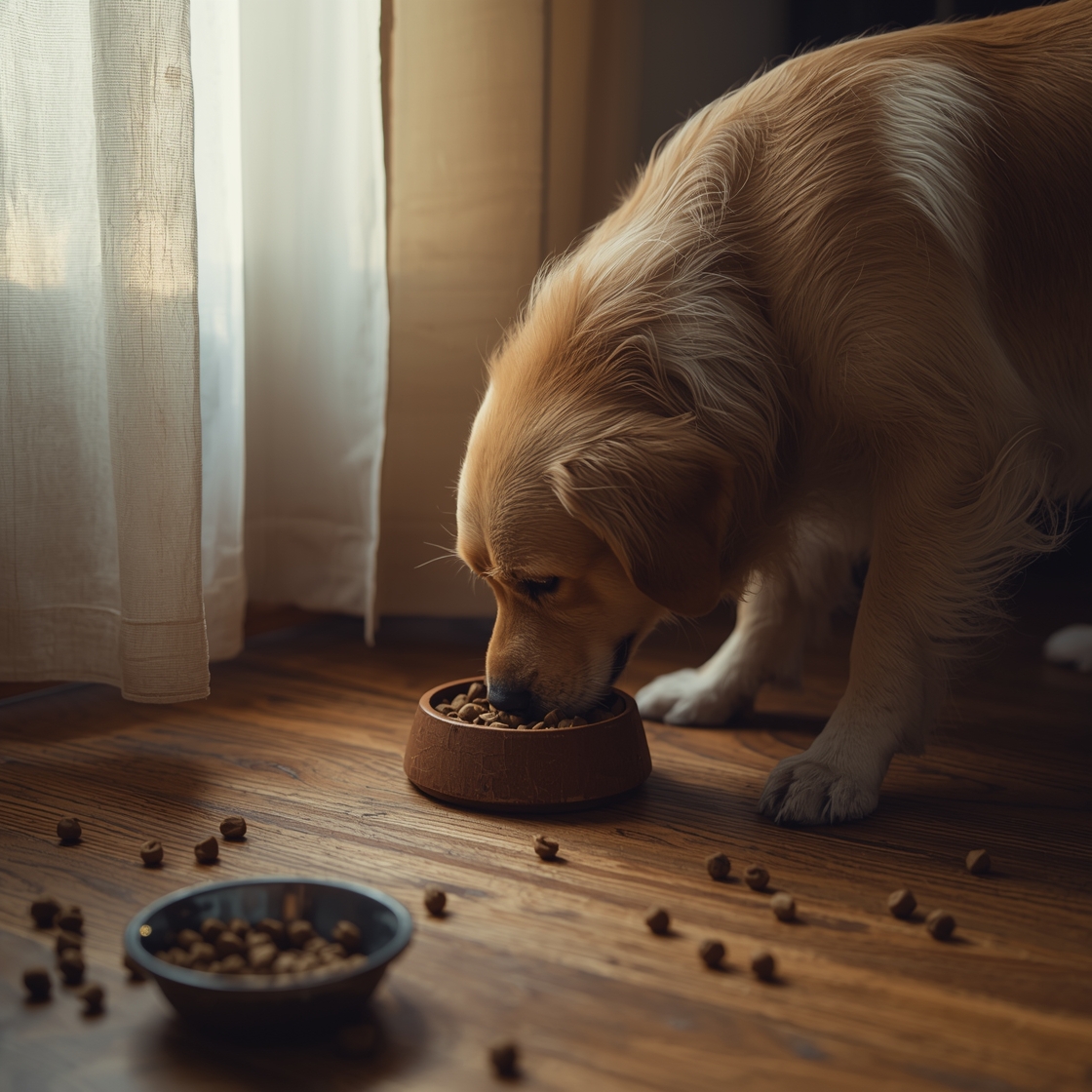

The best dog food for Cocker Spaniels is a complete-and-balanced adult (or growth) formula whose maker’s weight range actually fits this dog — often 22–35 lb — with a printed kcal/cup you can feed to a lean body, not a “small breed” bag capped at 20–25 lb. The We read the titles and descriptions of 4 SKUs. Published kcal/cup on maker pages ran 304–369. Royal Canin Cocker Adult is the one breed-named dry: 3,661 kcal/kg, 304 kcal/cup, formulated-to-meet AAFCO adult maintenance. Hill’s Small & Mini Adult is a feeding-trial food not recommended above 25 lb. AVMA: Cocker Spaniels are over-represented for otitis externa. Food does not replace an ear exam. Cornell and PennGen document PRA and PFK as inherited disease — not kibble jobs.
Our guides are reader-supported. This article may contain affiliate links. As an Amazon Associate we may earn a commission if you buy through links, at no extra cost to you.
General sequence first: how to choose the right dog food. Label walkthrough: dog food label cheat sheet. Puppy calories: puppy nutrition guide. Seniors: choosing senior dog food.
Quick picks at a glance
- Best breed-named example: Royal Canin Cocker Spaniel Adult — formulated AAFCO maintenance, 304 kcal/cup, chart starts ~22 lb. Optional geometry, not a medical seal.
- Best feeding-trial small-and-mini (if the dog is actually ≤25 lb): Hill’s Science Diet Adult Small & Mini Chicken & Brown Rice — 357 kcal/cup. Wrong bag for a 30 lb English Cocker.
- Best mid-weight shredded adult example: Pro Plan Complete Essentials Shredded Blend Chicken & Rice — feeding-test language on many lots; read the bag. Charts often include the 21–35 lb row Cockers actually occupy.
- Best grocery lamb-and-rice example: ONE Lamb & Rice — feeding-test adult maintenance on labels we read; ~369 kcal/cup. Not “less complete” because it costs less.
- Not a pick: grain-free “prey model” rankings, 9.9/10 scores, or any claim that a bag treats ears, PRA, or PFK.
There are no product cards on this URL. Examples below are real formulas with manufacturer AAFCO sentences we could read. They are not a feeding-trial ranking.
30-second size check (plain English)
- Weigh the Cocker.
- If under 22 lb, a small-breed or Small & Mini adult may fit the maker’s chart — still read the lid.
- If 22–25 lb, Hill’s Small & Mini and Royal Canin Cocker Adult can both be on-label. Compare 304 vs 357 kcal/cup. Same cups are not the same calories.
- If over 25 lb, skip Small & Mini and most “under 20 lb” small-breed bags. Use a regular adult complete (Pro Plan shredded or ONE Lamb & Rice are examples) or confirm Royal Canin’s chart still includes this weight.
- If the ears smell, the gums are pale, or the dog bumps into furniture at night — stop. That is a clinic, not a size check.
| This dog’s scale | First bag question | Common miss |
|---|---|---|
| ≤20 lb adult | Small-breed chart OK? | Using a giant cup |
| 22–25 lb | 304 vs 357 kcal/cup | Pouring 2 cups of both |
| 26–35 lb | Not Small & Mini | “But they’re both Cockers” |
| Puppy | Growth / all-life-stages | Adult Cocker breed bag |
What should I prioritize when shopping for best dog food for cocker spaniels?
Safety and life stage first. Then the maker’s weight range. Then kcal/cup you can feed to a visible waist. Ears, PRA, and PFK are clinic jobs. A pretty breed lid is optional.
Three jobs. A 28 lb Cocker in a 20 lb “small breed” bag is a chart miss before you argue protein.
| Job | What actually works | Bag role | Fails if you skip the real job |
|---|---|---|---|
| Life stage | Growth vs adult maintenance vs all-life-stages (AAFCO) | Match the sentence on this lot | Fail — puppy on adult, or adult on a 10-week pup |
| Size fit | Maker’s published weight range | Hill’s Small & Mini ≤25 lb; RC Cocker chart from 22 lb | Fail — “small breed” as a Cocker default |
| Medical ears / eyes / PFK | Clinic + genetics pages (AVMA, Cornell, PennGen) | Complete diet only | Fail — shopping as treatment |
| Example (not a rank) | AAFCO path (maker) | kcal/cup (published) | Size / age cue | Desk fit |
|---|---|---|---|---|
| Royal Canin Cocker Spaniel Adult | Formulated to meet adult maintenance | 304 (3,661 kcal/kg) | Purebred Cockers 12 months+; chart from 22 lb | Breed-named option |
| Hill’s Science Diet Small & Mini Adult | Feeding tests, adult maintenance | 357 (3,699 kcal/kg) | 1–6 years, ≤25 lb full grown | Fail if the dog is 28–35 lb |
| Pro Plan Shredded Blend Chicken & Rice | Feeding tests (confirm life stage on lot) | Read the bag | Charts often include 21–35 lb | Many Cockers live here |
| ONE Lamb & Rice | Feeding tests, adult maintenance | ~369 (about 3,862 kcal/kg on panels we saw) | Adult grocery | Baseline if lamb-and-rice is fine |
Before you shop: (1) the AAFCO sentence matches life stage, (2) the maker’s weight range includes this dog, (3) ears/eyes/collapse are a clinic first, (4) you will re-weigh in 2–4 weeks. Fail gate 2 and this checklist is decorative.
What the best dog food for Cocker Spaniels actually needs to say on the bag
The useful job is not “pick the winner of seven.” It is:
- Buy a complete-and-balanced food for this dog’s life stage. AAFCO: “complete” means all required nutrients are present; “balanced” means they are in the correct ratios. FDA and AAFCO describe two legal paths: formulated to meet an AAFCO Dog Food Nutrient Profile, or animal feeding tests using AAFCO procedures. Read the nutritional adequacy statement. Other groups’ seals are not a substitute (FDA’s complete-and-balanced explainer).
- Match life stage, then the size of the actual dog. AAFCO life stages are growth, gestation/lactation, adult maintenance, or all life stages. “All life stages” is built to the growth/reproduction profile (WSAVA; AAFCO). A “small breed” bag is not automatically the Cocker bag.
- Treat breed-specific kibble as one option, not a prescription. Royal Canin Cocker Spaniel Adult exists. Coat, heart, and weight language on that bag is the manufacturer’s.
- Do not use food as treatment for ears, eyes, or PFK deficiency. Named sources below. None of those pages say a grocery kibble treats the disease.
- Ask the company WSAVA’s questions. If they will not answer, WSAVA says be cautious.
First: is this a food problem, or a medical problem?
AAHA’s 2019 Canine Life Stage Guidelines tell owners to seek veterinary advice for gastrointestinal or dermatological abnormalities before changing food types on their own.
See a veterinarian promptly if any of the following are true:
- Recurrent or smelly ear infections, head shaking, or pain when the ear is touched (AVMA: Cocker Spaniels are over-represented for otitis externa; food does not replace an ear exam)
- Pale gums, dark urine after excitement or heat, exercise intolerance (PennGen / Penn Vet work on PFK deficiency — a genetic enzyme defect, not a “wrong protein” issue)
- Night blindness, bumping into furniture, or a family history of PRA (Cornell)
- Rapid weight gain or loss, vomiting, diarrhea, or a sudden refusal to eat
- A puppy growing too fast or too slow (puppy nutrition guide)
A new “joint support” kibble will not treat end-stage ear disease. A grain-free bag will not treat PRA. Glucosamine on a guaranteed analysis is often marked “not recognized as an essential nutrient by the AAFCO Dog Food Nutrient Profiles” — marketing add-on, not a diagnosis.
Claim vs source
For table scraps and toxins, see foods dogs can and cannot eat. Treats are usually not complete and balanced (AAFCO: snacks are exempt if labeled as such).
How to read the label (the part that is actually regulated)
AAFCO’s consumer page on reading labels is the map. Almost all of the useful text is on the back or side.
1. Nutritional adequacy statement. Three common complete-and-balanced formats:
- “\[Name\] is formulated to meet the nutritional levels established by the AAFCO Dog Food Nutrient Profiles for \[life stage\].”
- “Animal feeding tests using AAFCO procedures substantiate that \[Name\] provides complete and balanced nutrition for \[life stage\].”
- A less common “family” statement: the food is comparable to one that passed a feeding test.
WSAVA notes that formulated foods hit nutrient numbers without a feeding trial, and that a feeding trial still does not guarantee the food is adequate in every household. Both paths are legal. Neither is a “vet-approved” stamp.
2. Life stage. Adult maintenance is the usual target for a healthy grown Cocker. Growth / all-life-stages is the puppy and breeding target. AAFCO does not define a “senior” nutrient profile. Senior bags are a marketing life stage; AAHA still wants a nutritional assessment and a conversation about comorbidities. Details: choosing senior dog food.
3. Guaranteed analysis. Required: minimum crude protein, minimum crude fat, maximum crude fiber, maximum moisture. “Crude” is the lab method, not a quality grade (AAFCO). Extra lines (omega-6, glucosamine, taurine) are often voluntary.
4. Calories. Required on US pet-food labels (WSAVA; AAFCO). The four examples above differ by 65 kcal/cup at the extremes (304 vs 369). That gap is a waistline. AAHA: 56% of US dogs are overweight; feeding directions are a starting point, not a prescription (AAFCO says the same).
5. Feeding directions. Amount per weight, plus frequency. Adjust to the rib-and-waist picture your veterinarian wants.
6. Ingredient list. Descending order by weight, AAFCO-defined names. “Chicken dinner” vs “with chicken” are different name rules (25% vs 3%). WSAVA: the ingredient list does not tell you whether a qualified nutritionist built the recipe.
Ask the company what WSAVA asks
WSAVA’s 2021 Guidelines on Selecting Pet Foods tells teams to look past “holistic” and “premium” — those words are unregulated. Ask:
- Do they employ a nutritionist with a PhD in animal nutrition or board certification (ACVN or ECVCN)? Name, staff vs consultant.
- Who formulates the recipe?
- How do they confirm AAFCO or FEDIAF — database or chemical analysis of the finished food?
- What quality control exists (validation, nutrient analysis, toxicology, bacteriology, shelf life)?
- What product research exists in peer-reviewed journals?
- Calories per cup or can, and a typical analysis for nutrients not on the label.
- Who actually makes the food, and can you reach a person?
If the company will not answer, WSAVA says be cautious. That is a better filter than a star rating we invented.
Life stage, then body condition
Puppy. Use a food with an AAFCO growth or all-life-stages statement. Cocker puppies are not giant-breed puppies, but they still need a growth profile. See the puppy nutrition guide.
Adult. Maintenance — or all-life-stages if that is what you and your veterinarian choose. Hill’s Small & Mini Adult is not recommended by Hill’s for puppies, for dogs over 6 years on that SKU, or for pregnancy/nursing. Royal Canin Cocker Spaniel Adult is aimed at purebred Cockers 12 months and older (English or American, per the maker).
Senior. No AAFCO senior profile. AAHA: comorbidities drive the plan; muscle condition matters. Wet food can help some older dogs that chew poorly — best wet dog food for senior dogs after choosing senior dog food.
Weight. Royal Canin’s Cocker page says excess weight can affect overall health; the formula is marketed to “help maintain an ideal weight.” Manufacturer copy. AAHA’s 56% figure is the institutional reason to use the calorie line and a body-condition score instead of free-feeding the cup chart.
Transition. Hill’s instructs a 7-day mix. Pro Plan and ONE feeding copy commonly uses 7–10 days. If the dog is already sick, AAHA’s rule applies: call the veterinarian before you swap.
Grain-free, raw, and homemade — without the folklore
Grain-free. Not a Cocker default. FDA’s Center for Veterinary Medicine investigated reports of dilated cardiomyopathy in dogs eating certain diets. In single-primary-diet reports, about 90% were labeled grain-free; many formulas listed peas and/or lentils among the first ten ingredients. FDA has said the issue looks multifactorial and has not told owners of dogs without signs to change diets on their own. It has asked people to work with their veterinarians. Taste of the Wild and Orijen appeared on FDA’s April 2019 brand-frequency table. We are not repeating that list as a shopping ranking.
Raw. FDA has documented Salmonella, Listeria monocytogenes, and Shiga toxin–producing E. coli in commercial raw pet foods and has stated that raw feeding carries risk to animals and people. We will not print an unsourced 70/10/10 recipe. If you want raw or home-cooked, that is a veterinary-nutritionist job (ACVN / ECVCN).
Table food as the diet. FDA’s complete-and-balanced explainer exists because table scraps unbalance the ration. Occasional shared food is a different question from making dinner the meal.
Example foods that actually exist (not a ranking)
Royal Canin Cocker Spaniel Adult (dry)
Royal Canin states this kibble is for purebred Cocker Spaniels 12 months and older, English or American. US guaranteed analysis (as published): crude protein min. 23.0%, crude fat min. 12.0%, crude fiber max. 3.3%, moisture max. 10.0%, EPA min. 0.17%, DHA min. 0.07%, vitamin A min. 18,900 IU/kg; taurine, glucosamine, and chondroitin carry the AAFCO “not recognized as essential” star. Calories: 3,661 kcal ME/kg, 304 kcal/cup (calculated). Feeding chart on the US page starts at 22 lb (10 kg).
AAFCO statement (manufacturer): “Breed Health Nutrition Cocker Spaniel Adult is formulated to meet the nutritional levels established by the AAFCO Dog Food Nutrient Profiles for maintenance.”
Royal Canin’s own benefits: exclusive kibble shape for a broad muzzle and square jaw; taurine plus EPA/DHA “to help support healthy cardiac function”; EPA, DHA, and vitamin A for skin and coat; a formula that “helps maintain an ideal weight.” Manufacturer claims. Not a Cornell or AVMA treatment protocol for PRA, otitis, or PFK.
Check Royal Canin Cocker listings →
Honest frame: the one mass-market dry food named for the breed. Useful if you want that kibble geometry and you accept a formulated-to-meet adult-maintenance bag. Still a complete-and-balanced specialty SKU, not a veterinary therapeutic diet. Wrong life stage for a puppy.
Hill’s Science Diet Adult Small & Mini Chicken & Brown Rice
Hill’s recommends this dry food for adult dogs 1–6 years that weigh up to 25 pounds when full grown. Hill’s says it is not for puppies, for mature adults 6+, or for pregnancy/nursing. Published calories: 3,699 kcal/kg, 357 kcal/cup. Hill’s feeding table on the same line goes up to 25 lb (2 cups).
AAFCO statement (manufacturer): “Animal feeding tests using AAFCO procedures substantiate that Hill’s Science Diet Adult Small & Mini Chicken & Brown Rice Recipe Dog Food provides complete and balanced nutrition for maintenance of adult dogs.”
That is the feeding-trial path. Hill’s markets itself as “U.S. veterinarians’ #1 recommended brand.” That is Hill’s advertising, not an AAHA or WSAVA product endorsement, and it is not a Cocker-specific approval.
Check Hill's Small & Mini listings →
Honest frame: a grain-inclusive adult-maintenance food from a company WSAVA-style questions usually can answer. The hard limit is size and age. A 28–35 lb English Cocker, or an American Cocker that finished above 25 lb, is outside Hill’s own “recommended for” line. Use an adult (not small-and-mini) Science Diet bag, or another adult-maintenance food, and confirm the AAFCO sentence on that SKU.
Pro Plan Complete Essentials Shredded Blend Chicken & Rice
This is the regular (not “small breed”) shredded-blend adult line. Published product sheets have used feeding-test language for all life stages, including growth of large sized dogs, while some retail listings for current Complete Essentials adult bags show an adult-maintenance feeding-test sentence. Read the bag in your hand. Both are AAFCO feeding-test language; they are not the same life-stage claim.
Feeding tables for this style of bag include the 21–35 lb row many Cockers occupy (about 1⅔–2⅓ cups on published adult charts — a starting point, not a target we measured). Chicken is listed first on product copy. Chicken by-product meal is an AAFCO-defined ingredient, not a secret defect.
Check Pro Plan shredded blend listings →
Honest frame: a widely sold, grain-inclusive shredded kibble with an AAFCO feeding-test statement (confirm which life stage is on your lot). Texture is a palatability choice, not a medical one. Do not confuse this bag with Pro Plan Small Breed Shredded Blend, which markets for adults under 20 pounds — too small for a lot of Cockers.
ONE Lamb & Rice Formula
A grocery-aisle adult food with lamb as the named protein. Labels we read quote feeding-test language for maintenance of adult dogs. Still read this bag.
Check ONE Lamb & Rice listings →
Honest frame: an adult-maintenance feeding-test food that does not pretend to be breed-specific. Useful as a complete-and-balanced baseline if your veterinarian is fine with lamb-and-rice and the dog keeps a lean body condition. It is not a limited-ingredient veterinary elimination diet.
How these products compare on labels and price
| Example | kcal/cup | vs RC Cocker (304) | 2-cup day (desk math) | Size gate |
|---|---|---|---|---|
| Royal Canin Cocker Adult | 304 | baseline | 608 kcal | Chart from 22 lb |
| Hill’s Small & Mini Adult | 357 | +53 kcal/cup | 714 kcal | ≤25 lb, 1–6 yr |
| ONE Lamb & Rice | ~369 | +65 kcal/cup | ~738 kcal | Adult grocery |
| Pro Plan shredded | Read bag | Unknown until you read it | Unknown | Confirm 21–35 lb row |
Desk math, not a feeding trial: swapping 2 cups of RC Cocker (608 kcal) for 2 cups of Hill’s Small & Mini (714 kcal) is about +106 kcal/day if the cup is honest. That is a waist. AAHA wants the weight trend, not a screenshot of a table.
At 24 lb, Royal Canin’s published Cocker chart is about 1¾ cups (low activity) to 2⅜ cups (high activity). Hill’s Small & Mini table at 25 lb is 2 cups. Those are starting charts on two different calorie densities. Adjust to body condition.
A practical sequence (desk research, not a feeding trial)
- Weigh the dog and score the body. Ribs easy to feel, waist visible from above — AAHA’s push to trend BCS and weight.
- Read the AAFCO sentence for the life stage you need. Puppy → puppy nutrition guide. Senior with other diseases → choosing senior dog food and the veterinarian.
- Check the maker’s weight range. Small-and-mini / small-breed bags often cap at 20–25 lb. Royal Canin’s Cocker adult chart starts at 22 lb. Those two facts already sort a lot of SKUs.
- Call the company with WSAVA’s list if the brand is new. No answer → walk away.
- Transition over 7–10 days unless your veterinarian says otherwise.
- Re-check weight in two to four weeks. AAFCO: feeding directions may need modification.
- Do not treat ears, eyes, or collapse with a new protein. Those are clinic problems.
Check current Cocker-related listings →
Ears, coat, and the best dog food for Cocker Spaniels
Pendulous ears are conformation. AVMA: most hanging-eared dogs never get infections. Humidity under the flap can contribute; allergic skin disease and other medical causes are the drivers clinicians name. Food may matter if a veterinarian diagnoses a food-responsive allergy. That is an 8-week exclusive trial — see best dog food for allergies — not a “Cocker ear kibble.”
Coat shine is a complete-diet plus parasite-and-endocrine story. EPA/DHA on the Royal Canin panel is a manufacturer skin/coat line. It is not a Cornell eye protocol.
Worked example: two Cockers, two bags
Dog A, American Cocker, 24 lb, 3 years, lean, ears clean, last exam normal. Job = complete adult that fits 24 lb. Royal Canin Cocker Adult is on-label (12 months+, chart includes this weight). Hill’s Small & Mini is also inside the 25 lb cap. Compare 304 vs 357 kcal/cup and pick the one this dog will eat. Re-weigh in 3 weeks.
Dog B, English Cocker, 32 lb, 7 years, recurrent smelly ears, BCS 7/9. Job = clinic first (ears + weight). Hill’s Small & Mini is outside the maker’s 25 lb line. A “small breed” bag is the wrong chart. A grain-free upgrade is not an ear treatment. After the veterinarian names a plan, pick an adult-maintenance food whose calorie line you can feed down to a leaner BCS. ONE Lamb & Rice or a standard adult Pro Plan are examples, not a rank.
Those two dogs can live in the same house. They cannot share a “Cocker bag” rule. This checklist is a size-and-job list.
How to choose the best dog food for Cocker Spaniels this month
Write the job on a sticky note.
- If the job is a healthy adult inside 22–28 lb, a breed-named RC Cocker bag or another complete adult with a matching chart is the shopping problem.
- If the job is a 30+ lb Cocker, skip Small & Mini / under-20-lb small-breed bags.
- If the job is a puppy, stop and use a growth or all-life-stages statement.
- If the job is ears, eyes, pale gums, or collapse, close Amazon.
- If the job is weight, use kcal/cup and a scale, not a “weight management” banner.
That sticky note is the these cocker size-bag listings.
Keep a log: date, cups, kcal/cup from the bag, weight, ear events, stool. Bring the log to the clinic.
Re-read the label when a new bag arrives. Formulas change. If you switch from RC Cocker to Hill’s because the lid was on sale, write the switch date. Two calorie densities in one month is two variables.
Frequently Asked Questions
What is the best dog food for Cocker Spaniels?
There is no lab-ranked best, and we will not invent one. AAFCO complete-and-balanced for the right life stage, a company that will answer WSAVA’s questions, a calorie density you can feed to a lean body, and a veterinarian who knows this dog. Royal Canin Cocker Adult is the breed-named example. It is not a medical seal.
Do Cocker Spaniels need a breed-specific diet?
No named veterinary institution requires one. Breed bags are a product category. A well-made adult food that fits the dog’s weight and life stage is the institutional baseline (AAFCO + WSAVA + AAHA).
Are Cocker Spaniels prone to ear infections, and can food fix that?
AVMA: otitis externa is especially prevalent in Cocker Spaniels; the breed also has a described predisposition to ceruminous-gland hyperplasia. AVMA also says most hanging-eared dogs never get infections. Food does not replace an ear exam. If a veterinarian diagnoses a food-responsive allergy, that veterinarian chooses the diet.
What about PFK deficiency and eye disease?
PennGen (Penn Vet) lists phosphofructokinase deficiency in American and English Cocker Spaniels (and English Springer Spaniels, Whippets, Wachtelhund). It is an inherited enzyme defect that can cause hemolytic crises. Cornell lists English and American Cocker Spaniels among breeds with genetic variants that raise PRA risk. UC Davis VGL lists both Cocker types among breeds appropriate for PRA-prcd testing. None of those pages recommend a grocery kibble as treatment.
Is grain-free better for Cockers?
Not as a breed rule. If your dog is on a pulse-heavy diet and you are worried, talk to your veterinarian. FDA has not issued a recall of “all grain-free food.”
How often should I switch the best dog food for Cocker Spaniels?
You should not switch for sport. AAHA: get veterinary advice before changing foods if the dog already has GI or skin signs. When you do switch a healthy dog, Hill’s publishes a 7-day mix; others commonly print 7–10 days.
Can Cocker Spaniels eat raw food?
Some owners do. FDA has found Salmonella and Listeria in commercial raw pet foods and has said raw feeding is a human and animal health risk. We will not print an unsourced 70/10/10 recipe. Use a board-certified veterinary nutritionist if you want raw or home-cooked.
How much should I feed a 25-pound Cocker Spaniel?
There is no honest single cup number. Royal Canin’s Cocker adult chart at 24 lb is about 1¾–2⅜ cups depending on activity. Hill’s Small & Mini table at 25 lb is 2 cups. Those are starting charts on 304 vs 357 kcal/cup. Adjust to body condition.
Is “vet-approved” on this URL a certification?
No. We cannot change the URL. We can refuse to pretend a named college of veterinary medicine signed this article.
Bottom line
A Cocker Spaniel needs a complete-and-balanced food for its life stage, fed to a lean body, from a company that will answer WSAVA’s questions. Breed-shaped kibble is optional. Ears, PRA, and PFK deficiency are real, institution-documented risks; they are reasons to see a veterinarian, not reasons to buy a red-meat kibble.
Multi-dog houses, children, and ear-goo calendars
Do not share one “Cocker bag” across a 24 lb American and a 32 lb English if the calorie densities differ and only one dog is on a weight plan. Separate scoops. Write cups on the lid.
Children love sharing toast. Toast is a protein-and-calorie variable. If Dog B is in an ear-and-food workup, toast is how week three resets. See best dog food for allergies for exclusive-trial rules.
Keep an ear log: date, smell (0–5), head shake, last clean, last clinic cytology. A new bag without that log is how households say “food didn’t work” when the ear was never cultured.
Open bags oxidize. A 30 lb bag on a 24 lb Cocker can sit too long. Buy a size you will finish in about six weeks. The “deal” bag that goes rancid is a new GI variable.
Grooming, swimming, and the food-as-ear-cure myth
Cockers get wet ears from bowls, grass, and baths. Moisture under a flap is a humidity story. AVMA already said ear shape is not the proven primary cause. Drying ears as your veterinarian directs is a mechanic. A “skin and coat” kibble is not a towel.
Swimmer’s-ear weeks are not a reason to jump from ONE Lamb & Rice to a grain-free ranking. Keep the complete diet still. Treat the ear. Re-score the body after steroids or antibiotics change appetite.
Dental pain looks like “picky Cocker.” A shredded blend can help some dogs pick up kibble. It can also hide a tooth that needs a clinic. If chewing dropped overnight, do not only buy a softer bag.
We will not tell you a grocery bag “prevents PFK crises” or “stops PRA.” Those sentences are not on Cornell or PennGen pages.
The prose refuses the claim.
Cost desk (not a price we locked)
Royal Canin breed bags often sit in a premium sticker band. Hill’s Small & Mini is a mid-premium clinic-aisle feel. Pro Plan shredded and ONE Lamb & Rice are easier grocery/specialty finds. Cost per day is kcal needed ÷ kcal/cup × price per cup, not bag sticker. A cheaper 369 kcal/cup bag can cost more per day than a 304 kcal/cup bag if you keep pouring the same cups. Check the live listing.
How we researched this guide
Desk research. The We read the titles and descriptions of four currently sold adult examples on AAFCO path, published kcal/cup, and maker weight/age gates. We read AAFCO label rules, WSAVA’s 2021 selecting-pet-foods toolkit, AAHA’s 2019 canine life-stage nutrition section, FDA’s diet-associated DCM and raw-food pages, AVMA’s otitis FAQ, Cornell’s PRA page, PennGen’s PFK page, and current manufacturer pages for the foods named above. Nothing here is a diagnosis or a treatment plan.
SOURCES:
- AAFCO — Reading Labels
- WSAVA Nutrition Committee
- WSAVA Global Nutrition Committee — Guidelines on Selecting Pet Foods (2021 PDF)
- 2019 AAHA Canine Life Stage Guidelines
- FDA — Diet and canine heart disease Q&A
- AVMA — Ear cropping and canine otitis externa FAQ
- Cornell — Progressive retinal atrophy
- UC Davis VGL — PRA-prcd
- PennGen — PFK Deficiency
- Royal Canin US — Cocker Spaniel Adult
Open, infected, or rapidly worsening ears or eyes are a clinic.
If you are still scrolling “Cocker food” listings after you wrote the job, you are shopping as avoidance. Close the tab. Open the scale. Open the clinic portal if the ear is worse at week two.
Night head-shaking that wakes the household is a severity flag. A breed bag that “might help the coat by week six” is the wrong clock. Same for pale gums after a hard play session. Those are not Amazon problems. The best dog food for Cocker Spaniels assumes a dog that can wait for a measured cup. If your dog cannot wait, you already know which building to drive to.
Keep used bags until you photograph the AAFCO sentence and the kcal/cup line. If a weight creep returns in February, you will want last October’s panel, not your memory of the lid color. Brands recycle packaging faster than they recycle formulas.
English and American Cockers are not the same finished weight. Do not copy a neighbor’s Hill’s Small & Mini scoop onto a 33 lb field-bred dog because both are “Cockers.” The size bag listing review is a tape measure. A shared Facebook recipe is not.
Show dogs and field dogs can live in the same breed club and still need different cup counts. The complete-and-balanced sentence does not change. The activity line on the feeding chart does. Start at the maker’s low-activity number if the dog is a couch Cocker. Start higher only if the waist says so. Re-weigh. That is the whole experiment a household can run without a clinic. Everything after a month of rising weight is a smaller cup, not a third brand.
Last reviewed: August 2026. If something looks stale, let us know.