
Quick answer: A dwarf hamster is a small Phodopus pet that needs a large solid-floor home, a uniform pellet diet, and a quiet night routine. Plan for about two to three years. House most adults alone.
A dwarf hamster is a tiny nocturnal rodent sold as a first small pet. Dwarf hamsters are Phodopus pets under 100 g; most live two to three years in homes of at least 100×50 cm.
This page is a research-desk briefing that compares published species, housing, and diet specs.
Selection rule: we cover currently sold cages and foods with maker-listed dimensions or a guaranteed analysis. We also cover species named by Merck Veterinary Manual or Veterinary Record. We exclude Syrian-only gear, unsized starter kits, and figures
Our Floor-Area Gate is simple. Listed length times width must reach the 100 by 50 cm floor PDSA cites from Germany’s Veterinary Association for Animal Welfare. That gate is about 775 square inches.
Comparing published L × W on five current homes, only two listed footprints meet it.
Which animals count as dwarf hamsters
Merck Veterinary Manual names the Djungarian hamster, Phodopus sungorus, and the Roborovski hamster, Phodopus roborovskii, as dwarf pets. Merck groups those animals by body size under 100 g.
Veterinary Record’s 2023 owner survey also names Campbell’s Russian dwarf, Phodopus campbelli. That paper treats Campbell’s, Winter White, and Roborovski hamsters as the usual dwarf set. It lists the Chinese hamster, Cricetulus griseus, as a separate common pet.
Shop labels often blur those names. Winter White and Djungarian are the same species, and hybrids of Campbell’s and Winter White appear in trade.
Veterinary Record notes that novice owners may not tell those two Russian dwarfs apart. Chinese hamsters are often sold beside dwarfs, but they are not Phodopus.
Merck’s hamster chapter focuses on the Syrian hamster, Mesocricetus auratus. Syrian adults weigh 110 to 140 g and measure 170 to 180 mm. That is the contrast class, not a dwarf.
How long dwarf hamsters live
PDSA’s hamster guide, published December 2024, says hamsters typically live about two to three years. Lifespan varies by species. Larger Syrians tend to outlive smaller Russian dwarfs.
Merck Veterinary Manual gives Syrian hamsters a lifespan of two to three years. Merck does not publish a separate dwarf number on that page. We do not invent one.
A two-year plan is realistic. A three-year plan is optimistic, not guaranteed.
Merck notes that hamsters often hibernate below 5°C, or 41°F. PDSA sets a steady room range of 18 to 21°C, or about 64 to 70°F. Keep the cage off drafts and out of direct sun.
PDSA warns that a cold cage can push a hamster into torpor, a state that looks like deep sleep or death. Warm the room slowly if the temperature has dropped.
Cage size and why floor area matters
PDSA says most shop cages fail basic needs. It cites the Veterinary Association for Animal Welfare minimum of 100 by 50 cm. Bigger is better.
That floor is 5,000 square centimeters, or about 39.4 by 19.7 inches. That is 775 square inches. Stacked shelves do not count as extra floor.
Veterinary Record analyzed 248 dwarf-hamster surveys from 8 May to 7 July 2020. Enclosures ranged from 30 × 36 × 30 cm to 152 × 121 × 90 cm. Thirty of 248 homes, or 12.1 percent, were shorter than 75 cm.
Oxbow’s care page lists 360 to 450 square inches as a range many pets “will do.” That is Oxbow’s figure, not the PDSA-cited floor.
PDSA also asks for at least 25 cm, or 10 inches, of bedding. Merck’s Syrian note goes further and cites 40 to 80 cm, or about 15 to 30 inches.
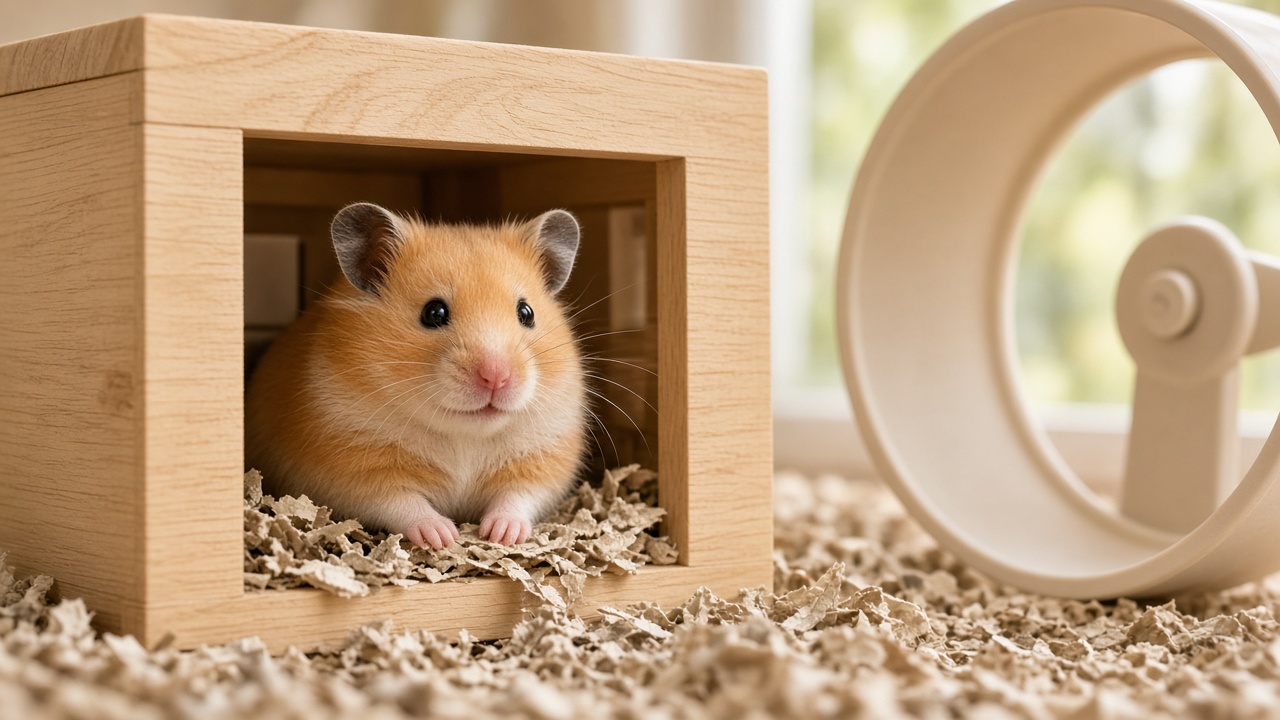
PDSA wants a solid-surface wheel of at least 20 cm, or 8 inches, for dwarfs. Syrian wheels start at 30 cm, or 12 inches. A slatted wheel can catch a foot.
A DIY hamster cage can beat a small wire starter. The unbroken floor still has to meet the 100 by 50 cm gate. Measure the interior, not the box art.
Habitat products compared by listed specs
Our research team analyzed maker-listed length and width. We multiplied those figures for floor area.
The Prevue Pet Products Hamster Haven Large, model SP2005GRAY, lists 21 5/8 by 13 3/8 by 14 1/4 inches. That floor is about 289 square inches, with 1/2 inch wire spacing.
The listed Haven height cannot hold 10 inches of bedding and a full-size wheel. Under our gate, it is a temporary box, not a finished home.
The Prevue Pet Products Universal Small Animal Home, model 528, lists 32 1/2 by 19 by 17 1/2 inches. That floor is about 618 square inches. Wire spacing is 3/8 inch, and the tubby base is 6 1/4 inches deep.
Niteangel lists three Bigger World sizes with inner and outer measures. Small inner size is 30 by 15 by 17.7 inches, or 450 square inches. Medium inner size is 39.4 by 19.7 by 19.7 inches, or about 776 square inches.
Large inner size is 47.2 by 19.7 by 23.6 inches, or about 930 square inches. Only the Medium and Large listed floors meet the 775-square-inch gate. The Small matches Oxbow’s upper 450 figure and still misses PDSA’s cited floor.
Kaytee lists the Comfort Exercise Wheel Large at 8.5 inches in diameter. That is about 21.6 cm. It clears PDSA’s 20 cm dwarf minimum on paper.
| Product | Listed size (L × W × H) | Floor from listed L × W | Build | Extra listed spec |
|---|---|---|---|---|
| Prevue Hamster Haven Large SP2005GRAY | 21 5/8 × 13 3/8 × 14 1/4 in overall | 289 sq in | Steel mesh, plastic tray | 1/2 in wire |
| Prevue Universal Small Animal Home 528 | 32 1/2 × 19 × 17 1/2 in overall | 618 sq in | Steel mesh, plastic tub | 6 1/4 in base; 3/8 in wire |
| Niteangel Bigger World Small | 30 × 15 × 17.7 in inner | 450 sq in | MDF frame, PVC panels | 17.7 in listed height |
| Niteangel Bigger World Medium | 39.4 × 19.7 × 19.7 in inner | 776 sq in | MDF frame, PVC panels | Closest to 100 × 50 cm |
| Niteangel Bigger World Large | 47.2 × 19.7 × 23.6 in inner | 930 sq in | MDF frame, PVC panels | Tallest inner height here |
Niteangel’s page says the line is recommended for dwarf hamsters and most Syrians. It also says the cage is not suitable for destructive rodents that chew out.
Prevue lists the Haven for x-small and small animals. It lists the 528 for many species, including Syrian hamsters. A dwarf can live in a 528, but the 6 1/4 inch base still misses PDSA’s 10 inch bedding depth.
Diet: pellets, portions, and treats
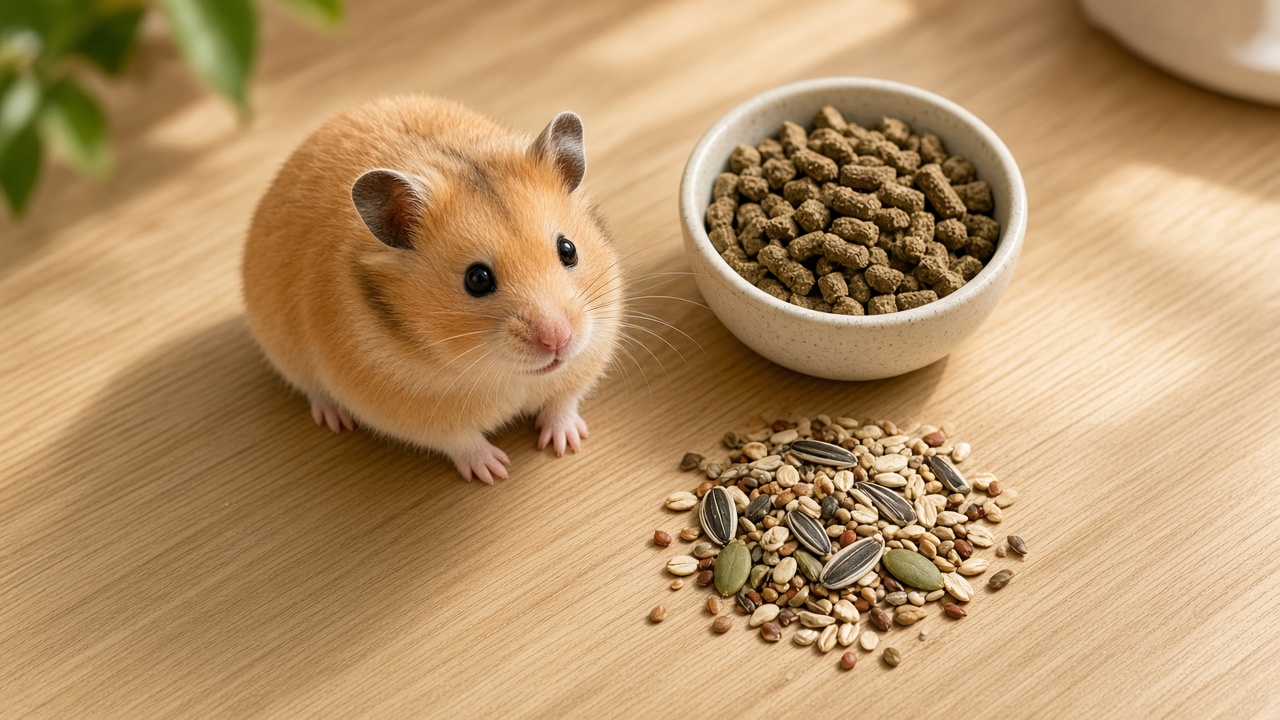
Merck says captive hamsters should eat a complete pelleted diet made for hamsters. Merck says to avoid generic seed mixes. Animals pick seeds and leave pellets.
Oxbow’s care page sets a 75 / 20 / 5 split. Fortified uniform food is about 75 percent of the daily diet. Produce is about 20 percent, and treats stay at 5 percent or less.
Oxbow Essentials Hamster and Gerbil Food lists crude protein at 15.00 percent minimum and crude fat at 4.50 percent minimum. Crude fiber is 10.00 to 15.00 percent. Moisture is 10.00 percent maximum.
Oxbow’s feeding line for an adult small hamster over six months is 1/8 cup per day. Young, pregnant, or nursing small hamsters get unlimited food on that label. Check hoards, because females hide extra pellets.
Oxbow’s four-week switch is written on the same page. Mix one-quarter, then half, then three-quarters new food. Week four is the new food only.
PDSA says a teaspoon or two of washed fruit, vegetables, and herbs is enough each day. PDSA flags Russian dwarf hamsters as prone to diabetes. Keep sugary fruit small.
Oxbow’s offer list includes romaine, kale, seedless apple, and squash. Avoid leeks, chives, and onions. PDSA still treats citrus as unsettled.
AAFCO states that it does not regulate, test, approve, or certify pet food. AAFCO writes model label language that states may adopt. Hamster bags are specialty pet food, not dog or cat nutrient-profile food.
Daily care, cleaning, and handling
Dwarf hamsters are night-active. Handle them after they wake. PDSA says children should be supervised, and a cup-handed scoop is safer than a scruff.
PDSA’s housing note is blunt. Syrian and Chinese hamsters live alone in the wild and will fight. PDSA also says domesticated Russian dwarfs should not share a home because dominance fights often occur.
Veterinary Record found that 148 of 248 hamsters, or 59.6 percent, had always lived alone. Sixty-five animals were later split after agonistic behavior. Hamsters older than six months were 4.75 times more likely to have a co-housing failure.
Of pair- or group-housed hamsters in that survey, 48 percent had fewer food bowls than animals. Sixty percent had fewer water sources, and 60 percent had fewer wheels. If you ever try a pair, give one of each resource per animal, then watch.
PDSA’s clean plan is a daily spot clean plus a fuller reset. Small cages often need a weekly full clean. Larger setups may wait a few weeks.
Our how often to clean a hamster cage guide walks through that timing. For the reset itself, save a handful of dry, clean nest material. Put hides back in the same spots.
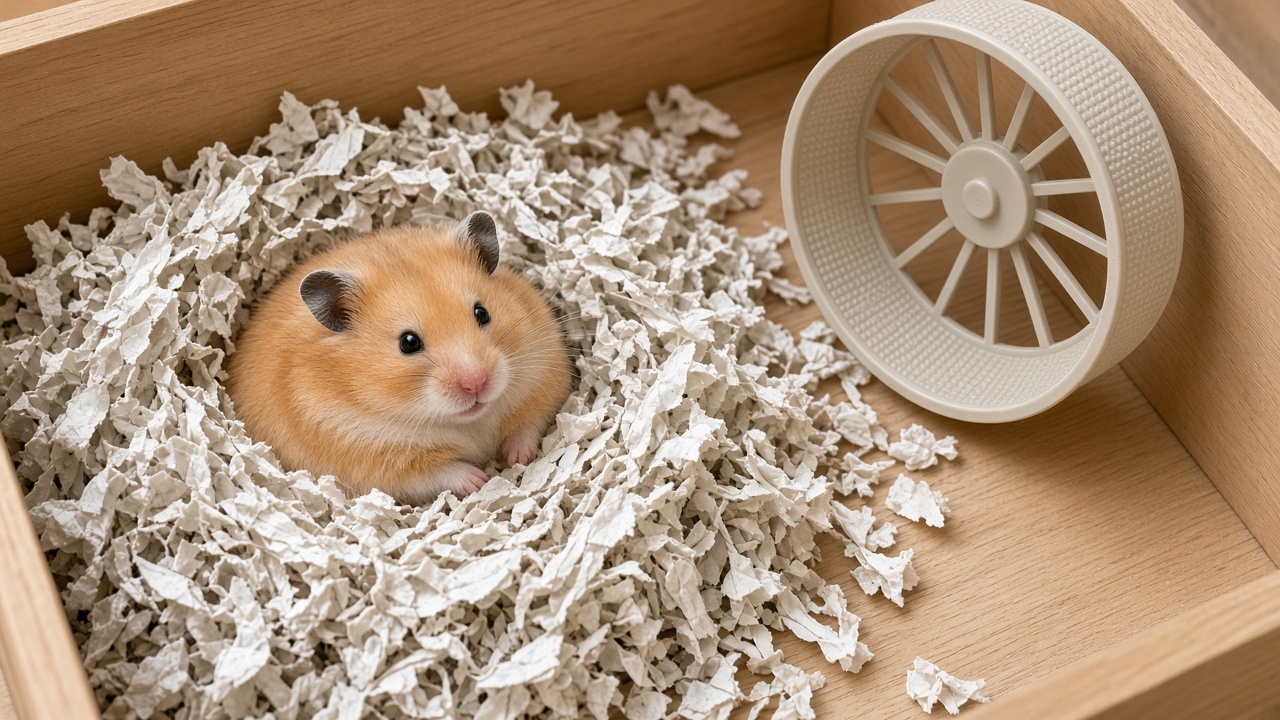
The step-by-step is in how to clean a hamster cage. PDSA lists paper-based bedding as a safe base. It warns against cotton wool, fluffy bedding, scent, and inked newspaper.
Watch for wet tail, overgrown teeth, eye swellings, and sudden lumps. PDSA treats those as clinic problems. This desk does not diagnose.
FAQ
How long do dwarf hamsters live?
PDSA says hamsters typically live two to three years. Russian dwarfs often sit on the shorter side of that range. Merck’s two-to-three-year figure is written for Syrians. Treat two years as the planning baseline.
Can two dwarf hamsters share a cage?
PDSA says most species should live alone. Domesticated Russian dwarfs often fight. Veterinary Record’s 248-owner sample found frequent later splits, especially after six months. Same-sex litter mates are not a guarantee.
What cage size does a dwarf hamster need?
PDSA cites a 100 by 50 cm minimum floor from the Veterinary Association for Animal Welfare. That is about 775 square inches of unbroken floor. Our Floor-Area Gate uses that number, not a stacked tube set.
What should I feed a dwarf hamster?
Merck calls for a complete hamster pellet, not a seed mix. Oxbow sets fortified food at about 75 percent of the diet. Essentials lists 1/8 cup daily for an adult small hamster. Add a teaspoon or two of washed produce, per PDSA.
How often should I clean the cage?
PDSA asks for a daily spot clean of wet bedding and leftover food. Small cages often get a weekly full clean. Larger floors can go longer. Match the interval to smell, urine spots, and cage size.
What wheel size does a dwarf hamster need?
PDSA sets a solid-surface dwarf wheel at 20 cm, or 8 inches. Syrian wheels start at 30 cm, or 12 inches. Kaytee lists the Comfort Exercise Wheel Large at 8.5 inches. Skip barred rims.
Is a Chinese hamster a dwarf hamster?
Veterinary Record lists Chinese hamsters as a common pet species. They are not one of the three Phodopus dwarfs. House them alone. Use the same large floor and deep bedding rules.
A dwarf hamster is a short-lived, night-running Phodopus pet. Match the published record: a 100 by 50 cm floor, a uniform pellet, and a solo adult home. Shop cages that miss the Floor-Area Gate are starter boxes, not finished habitats.