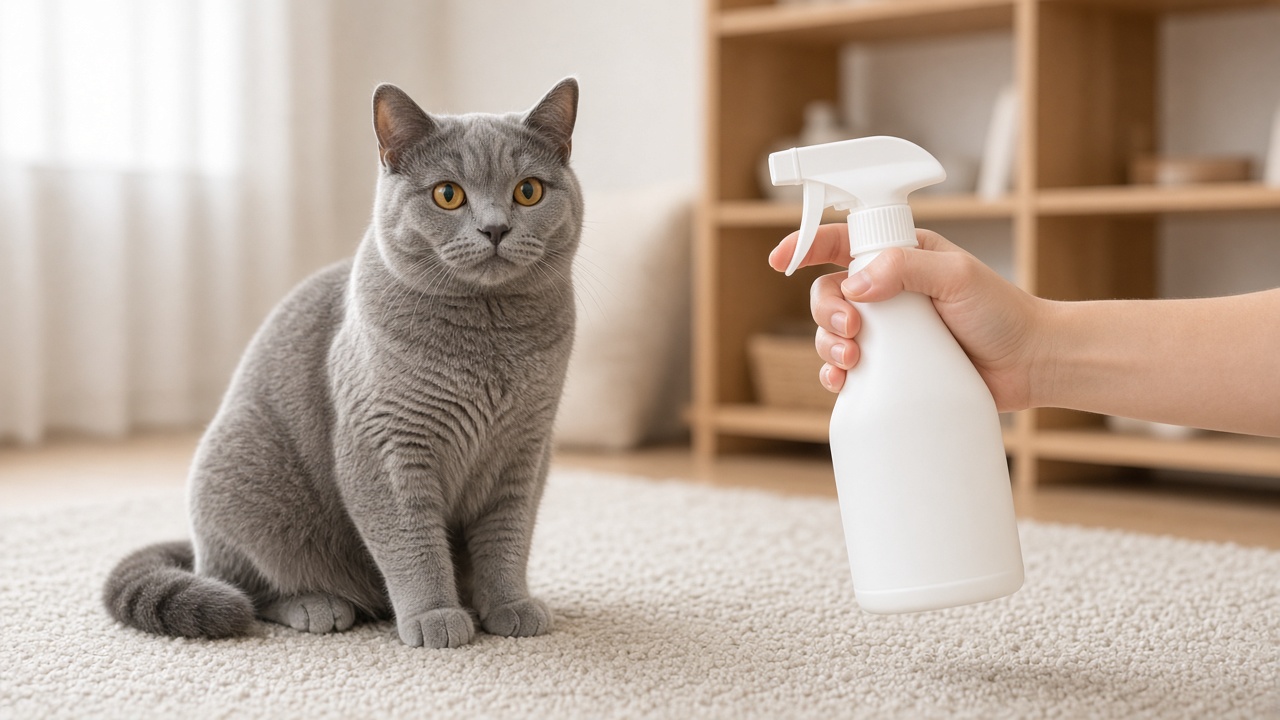
Quick answer: Skip Lysol for fleas. Reckitt sells it as a germ disinfectant, not an insecticide. Use a household spray whose maker page names fleas, treat every pet, and wash bedding.
No current U.S. Lysol disinfectant label names fleas as a target pest. That sentence is the whole answer.
This page is a label-and-spec comparison.
Our research team compared Reckitt’s published Lysol claims with five household sprays sold now. We also read flea-life numbers from the Companion Animal Parasite Council.
What Reckitt’s Lysol label actually claims
Reckitt’s Lysol Disinfectant Spray page says the product kills 99.9% of germs. It lists bathrooms, kitchens, doorknobs, and pet beds as use sites. Those are germ jobs, not insect jobs.
The same Reckitt page lists a 15-second SARS-CoV-2 claim. It also lists a 30-second claim for Rhinovirus Type 39 and Influenza A virus H1N1. Both claims sit on hard, non-porous surfaces.
The U.S. Environmental Protection Agency accepted label for Reckitt’s Brace formula, EPA Registration Number 777-99, lists two actives. Ethanol is 58.00%, and the quaternary ammonium salt is 0.10%.
Other ingredients on that EPA label are 41.90%. The organism list names bacteria, viruses, and fungi, not Ctenocephalides or “fleas.”
Reckitt’s consumer page matches that scope. It sells disinfection, not flea knockdown.
The EPA’s selected-disinfectant page is blunt about missing organisms. If a disinfectant label lacks directions for a pest, the EPA has not reviewed data for that use.
Fleas are not on the Lysol disinfectant organism list. Hartz prints the related federal rule on its home-spray page. Using a pesticide in a way that disagrees with its labeling violates federal law.
Why disinfectant chemistry is the wrong job
Ethanol and a quaternary ammonium salt can dry a small insect on contact. That is a chemistry guess, not a Reckitt claim. Reckitt does not publish a flea-kill rate, a residual window, or an egg claim.
Adult fleas are only the visible slice of an infestation. The Companion Animal Parasite Council says a female can produce 40 to 50 eggs per day. Egg laying starts within 20 to 24 hours of the first blood meal.
CAPC lists flea eggs at 0.5 mm. Those eggs drop off the host within a few hours. They land in carpet, cracks, and bedding.
A wipe across a hard counter never reaches that pile.
CAPC also says adults usually live 2 to 3 months. In temperate homes, 90 to 95% of adults emerge within 21 to 35 days. A one-time Lysol mist cannot cover that calendar.
Pupae last even longer. CAPC says an adult may stay quiet in the cocoon for up to 30 weeks. The stated conditions are 11°C and 75% relative humidity.
The U.S. Food and Drug Administration tells owners how to read a flea product. An EPA pesticide shows an EPA Registration Number. An FDA animal drug shows a six-digit NADA or ANADA number.
Lysol’s EPA number is a disinfectant number. It is not a flea-drug number.
The American Veterinary Medical Association tells owners to buy EPA-registered pesticides or FDA-approved medicines for fleas. It also tells owners to read the full label and match species and weight. Lysol fails that first filter.
How fleas persist after you spray a couch
The Companion Animal Parasite Council flea guideline still publishes the life-cycle sizes used here. Eggs are oval and 0.5 mm long. Larvae and pupal cocoons are each about 0.5 cm long.
CAPC says adults can start emerging about 8 days after pupal development begins. The stated conditions are 24°C and 78% relative humidity. Most have emerged by day 13.
Newly emerged cat fleas die within 1 to 2 weeks without a host, per CAPC. In a house with a dog or cat, they feed at once, and the egg clock starts again.
CAPC lists Ctenocephalides felis as the usual flea on North American dogs. It also names Bartonella henselae and Dipylidium caninum as agents fleas can move. A disinfectant bottle does not interrupt that chain.
The 2011 AAHA-AVMA Preventive Healthcare Guidelines call for year-round flea control on every dog. The same line appears for every cat. A kitchen disinfectant is not that plan.
Our selection rule for this page
We used one rule. A household spray had to be sold now in the United States. Its maker page had to name fleas as a target pest.
The same page had to publish at least one number. That number could be coverage, residual days, reapply hours, or an active percent.
That rule kept Lysol out. Reckitt names germs, not fleas.
The rule also kept foggers, collars, and oral tablets out. Those are different jobs and different labels.
We compared only attributes the maker published.
Wondercide lists plant oils. Hartz, PetArmor, and Zodiac sell conventional home sprays. Vet’s Best lists peppermint oil and eugenol.
Different chemistries. Same entry ticket: the word “fleas” on the maker page.
Household sprays that name fleas on the maker page
These five products met the rule. Attributes below come from each maker’s current product page.
| Product | Listed size | Flea stages named | Residual or reapply interval | Coverage listed | Use on pets |
|---|---|---|---|---|---|
| Hartz UltraGuard Plus Flea & Tick Home Spray | 16 oz | Fleas and flea eggs | 7 months against pre-adult fleas | Up to 500 sq ft | Do not spray on pets or humans |
| PetArmor Home & Carpet Spray | 16 oz | Fleas, eggs, larvae, pupae | 210 days on immature stages; 14–30 days on adults | 500 sq ft | Do not apply directly to pets |
| Zodiac Carpet & Upholstery Aerosol Spray | 16 oz | Fleas, eggs, larvae | Up to 7 months | Up to 2,000 sq ft | Not stated on the maker page |
| Vet’s Best Flea & Tick Home Spray, Peppermint | 32 oz | Fleas, eggs, larvae | 2–4 hours between uses; twice in 24 hours max | Not listed | Dogs 12 weeks or older |
| Wondercide Flea & Tick Spray for Pets + Home | 16 oz | Adults, eggs, larvae | Reapply every 24 hours | Not listed for 16 oz | Dogs and cats, all ages, as directed |
Hartz’s page repeats the 500-square-foot coverage and a one-hour wait. It also names brown dog ticks and limits use to indoor spaces.
PetArmor splits residual time with unusual candor. Immature fleas last up to 210 days. Adult fleas and ticks last about 14 to 30 days.
Zodiac’s aerosol page claims fleas, eggs, larvae, and ticks for up to 7 months. It lists 2,000 square feet for 16 ounces. It does not publish pet-on-animal directions there.
Vet’s Best lists peppermint oil at 0.3%, eugenol at 0.7%, and sodium lauryl sulfate at 2.7%. Use is for dogs 12 weeks or older, at most twice in 24 hours.
Wondercide’s cedarwood formula lists cedarwood oil at 5.7%. Sodium lauryl sulfate is 2.2%, and sesame oil is 0.1%. Its 32-ounce bottle note lists 400 square feet.
Our research team lined those numbers up. Coverage claims run from 400 to 2,000 square feet. Residual claims run from a daily reapply to 210 days on immature fleas.
That spread is why we refuse a “top” list. A 2,000-square-foot aerosol is not the same tool as a daily pet-and-home mist. Pick the row that matches the room and the species in the house.
A three-job plan that matches the labels
Call this the Label-First Flea Plan. Job one is the pet. Job two is the room, and job three is the wash.
Lysol does none of those jobs on purpose.
Job one needs a product labeled for that species and weight. The AVMA says cats are not small dogs. Never put a dog-only product on a cat.
Wondercide’s page allows dogs and cats of all ages when used as directed. Vet’s Best’s peppermint home spray is written for dogs 12 weeks or older.
Job two needs a product that names fleas on carpets or upholstery. Hartz, PetArmor, and Zodiac do that. Hartz and PetArmor say do not spray the bottle on the animal.
Vacuum first, as PetArmor directs. Seal the bag and take it outside.
Job three is heat and removal. PetArmor tells users not to spray bed linens. Wash the linens, spray the bare mattress, and wait at least 2 hours.
CAPC says moderate to severe infestations may take several months to control. That matches PetArmor’s 14-to-30-day adult window. New adults keep hatching after the first spray day.
The AVMA also says to follow the weight range on the label. A dose written for a larger dog can harm a smaller one. A household spray that says “not for pets” is not a backup on-animal dose.
If two products might overlap on one animal, stop and read both labels. Vet’s Best says it does not test mixes with other flea products. Hartz says using more than one on-animal product at once can cause illness.
Do not stack bottles to “speed it up.”
What this page cannot replace
This desk compared published pages. It did not examine your carpet, your pet, or your yard. A clinic visit is still the place for a sick, very young, very old, pregnant, or nursing animal.
The FDA says side effects can occur even when a flea product is used as directed. Keep the box. The lot number matters if you need to report a problem.
CAPC says every pet in the home must be treated, or the infestation holds. One untreated cat can refill the carpet. That is a household rule, not a brand claim.
Outdoor shade pockets still matter. CAPC says larvae fail in long, direct sun. They do fine in cool, shady rest spots.
A living-room spray does not treat the porch cushion.
If people in the house are being bitten, CAPC treats that as a public-health issue. Newly emerged fleas bite humans.
A can of Lysol does not change that emergence clock. Use Lysol on hard, frequently touched surfaces after you read Reckitt’s germ directions. Keep it off the flea plan.
FAQ
Does Lysol kill fleas on contact?
Reckitt does not publish a flea-kill claim for Lysol Disinfectant Spray. The EPA 777-99 label lists microbes, not fleas. Any on-contact death would be off-label and unmeasured by Reckitt.
Use a spray whose maker page names fleas.
Can I spray Lysol on my dog or cat to kill fleas?
No. Reckitt’s page is written for household surfaces, including pet beds, not for animal skin. The AVMA tells owners to use only EPA-registered pesticides or FDA-approved medicines on pets.
Lysol is neither of those flea products.
Will Lysol kill flea eggs in carpet?
Reckitt does not list flea eggs on the Lysol Disinfectant Spray page. CAPC puts eggs at 0.5 mm and says they fall into carpet within hours. PetArmor’s home spray, by contrast, claims immature stages for up to 210 days.
That is a flea-label claim, not a disinfectant claim.
How is a disinfectant different from a flea spray?
The EPA reviews disinfectant labels for named microbes and contact times. Reckitt lists 99.9% germ kill and a 15-second SARS-CoV-2 claim. A flea spray is reviewed, or at least marketed, against insects.
Hartz and PetArmor name fleas, eggs, and a residual window.
Which household spray covers the most floor, on paper?
Zodiac’s 16-ounce aerosol page lists up to 2,000 square feet. Hartz and PetArmor each list 500 square feet for a 16-ounce can. Wondercide lists 400 square feet for its 32-ounce bottle, not the 16-ounce size.
Coverage is a label number, not a ranking.
How long should I keep pets off a treated carpet?
Follow the product you used. Hartz says leave treated areas for at least one hour. PetArmor says drying takes about 2 hours.
Do not borrow one brand’s clock for another.
Do I still need a product on the pet if I spray the house?
Yes, if you want the infestation to end. CAPC says treat every pet and expect months of work in a bad case. The AAHA-AVMA guidelines call for year-round flea control on every dog and every cat.
A room spray is job two, not job one.