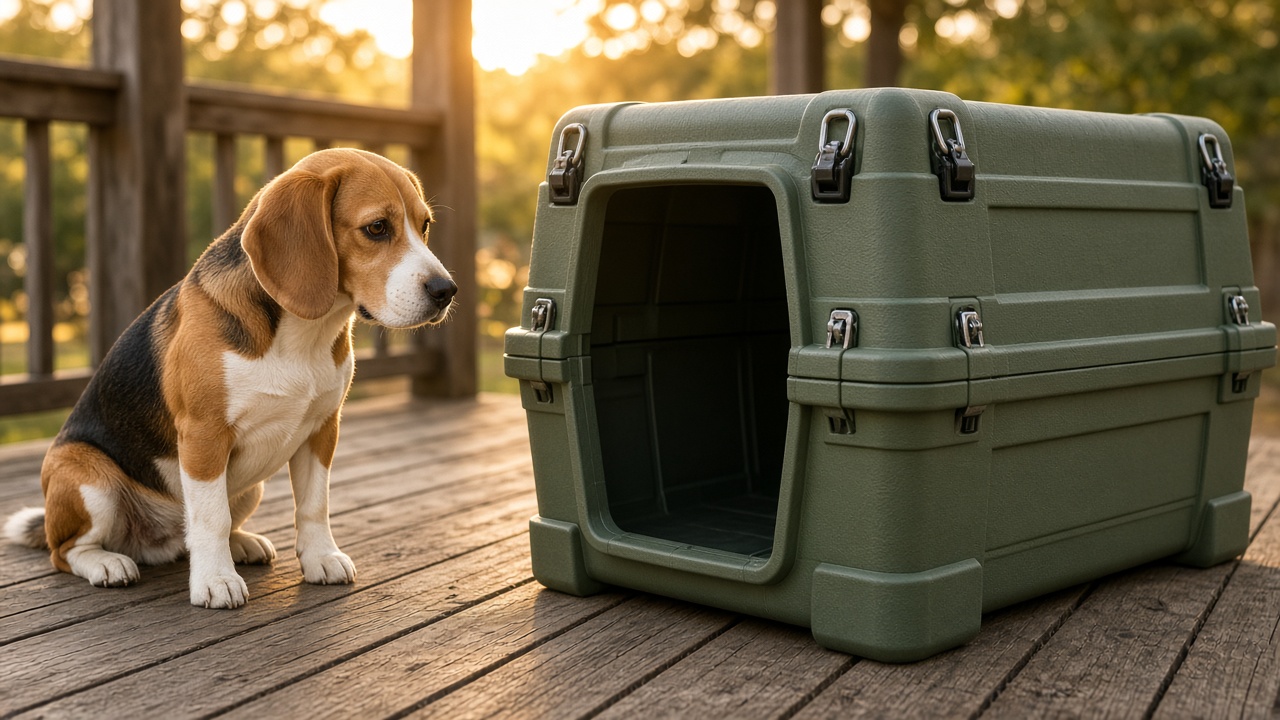
Quick answer: Rule out a sudden medical change first. Then shrink the crate, shorten holds, and wipe urine scent with an enzyme cleaner. Most dogs stop soiling once they cannot sleep away from a wet corner.
Crate peeing stops if you shrink the floor, cap holds at one hour per month of age, and enzyme-clean leftover urine. This page is a research brief on crate soiling. We did not run overnight crate trials, did not swab pans in a lab, and did not film household dogs.
Our research team compared published crate specs and house-soiling studies.
Selection rule: We included only products whose maker pages list housetraining, kennels, crates, or urine-enzyme use. We left out indoor potty pads, belly bands, and crates with no published divider or leak-proof pan.
Why a dog pees in a crate
Crate peeing is common. It is not a moral failure.
Today’s Veterinary Practice reports house soiling in about 20% of pet dogs. The Journal of Shelter Medicine and Community Animal Health surveyed more than 22,000 adopters in 2026.
That study covered 112 shelters in 40 states. It found house soiling in 32% of dog homes and separation distress in 24%.
Four paths show up again and again. The crate is too big, so the dog pees in one corner and sleeps in another.
The hold is too long for a young bladder. Urine scent remains, so the crate reads as a toilet.
Or the dog learned to soil a kennel. The American Kennel Club notes this in rescued dogs.
A fifth path is medical. Sudden crate peeing in a once-clean adult is a clinic question.
The American Veterinary Society of Animal Behavior says most dogs avoid crate peeing during short stays. Space, time, or scent can still beat that instinct.
The Floor-Clock-Scent Rule
This rule has three locks.
Lock the floor. The dog can stand, turn, and lie down. The dog cannot walk away from a wet patch.
Lock the clock. Daytime holds follow age in months, in hours. Younger puppies often need a shorter crate stretch.
Lock the scent. Enzyme cleaners stay on the urine until the label’s wait time ends.
If one lock is open, the other two usually fail. A tight crate still fails if you leave a 10-week-old for four hours.
A 2007 Journal of the American Veterinary Medical Association study followed 113 shelter adopters. Owners who got a 5-minute briefing more often called the dog house-trained at one month.
The split was 98.1% versus 86.4%. Those briefed owners used enzymatic cleaners at 59.3%. The control group used them at 13.6%.
Crate training was common in both groups, 40 of 54 briefed owners and 40 of 59 controls.
How long to leave a dog in a crate
The American Kennel Club’s common guide is simple. A puppy can often hold urine for about as many hours as its age in months.
That guide runs up to about 9 months to 1 year. A 6-month-old may manage about 6 hours. The Club still calls 10 to 12 hours too long for anyone.
ASPCA Pet Health lists shorter crate-time caps for young puppies. At 9 to 10 weeks, it lists 30 to 60 minutes. At 11 to 14 weeks, it lists 1 to 3 hours.
At 15 to 16 weeks, it lists 3 to 4 hours. At 17 weeks and older, it lists 4 to 6 hours.
Use the tighter number when the two guides disagree. A 9-week-old is about 2 months old.
The hour-per-month rule would allow about 2 hours. The ASPCA Pet Health crate table allows 30 to 60 minutes. If that puppy already pees in the crate, start at 30 to 60 minutes.
Today’s Veterinary Practice tells new owners to go out every 2 to 3 hours at first. It also says to go out after waking and before confinement.
It adds a window of 10 to 15 minutes after meals and play. That meal window matters. Food in, urine and stool out.
Do not treat overnight like a workday. Sleeping dogs produce less urine. Night still needs a last outdoor trip.
Young puppies still need a night break. Cold weather also breaks the clock. People skip the yard.
Then the crate becomes the toilet. Keep winter trips short enough that you still go. See our best dog coat for winter guide.
Adult dogs are not a free pass. ASPCA Pet Health says to avoid long crate days even in adults. If work is 8 hours or more, plan a midday walk or a walker.
Size the crate so there is no wet corner
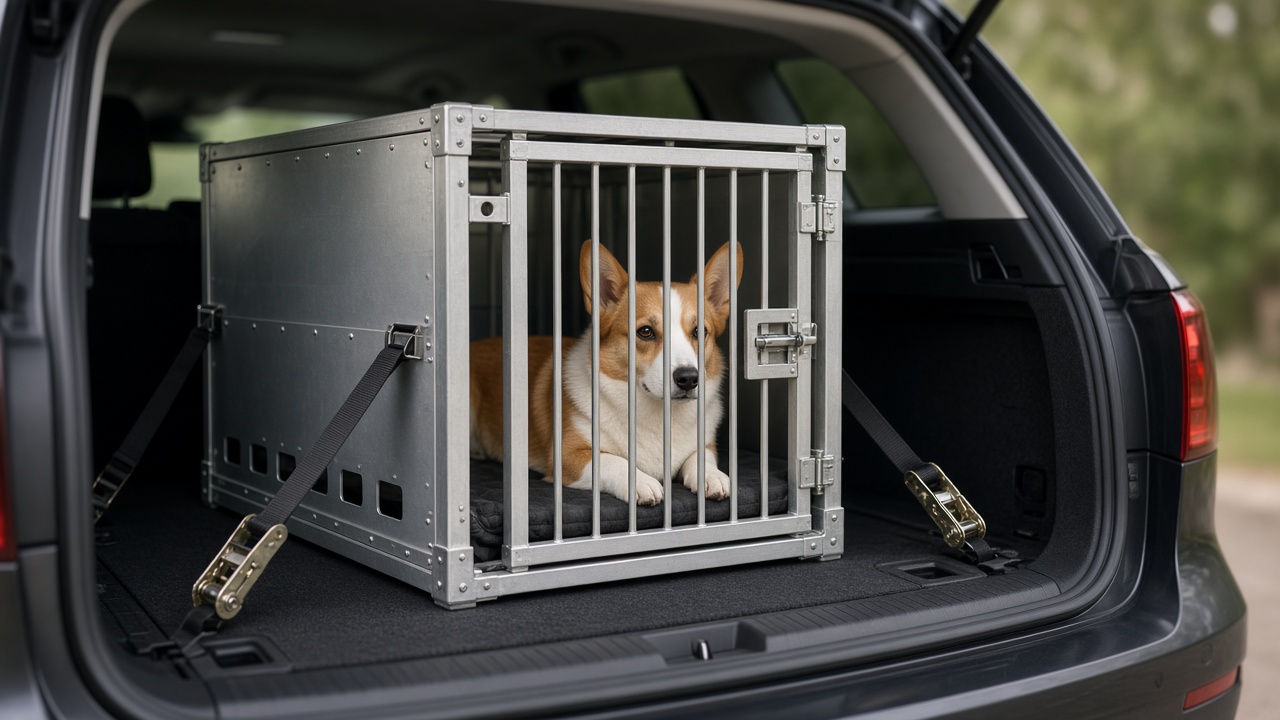
The American Kennel Club says the crate should be just large enough to stand, turn, and lie down. Extra floor is the wet-corner problem.
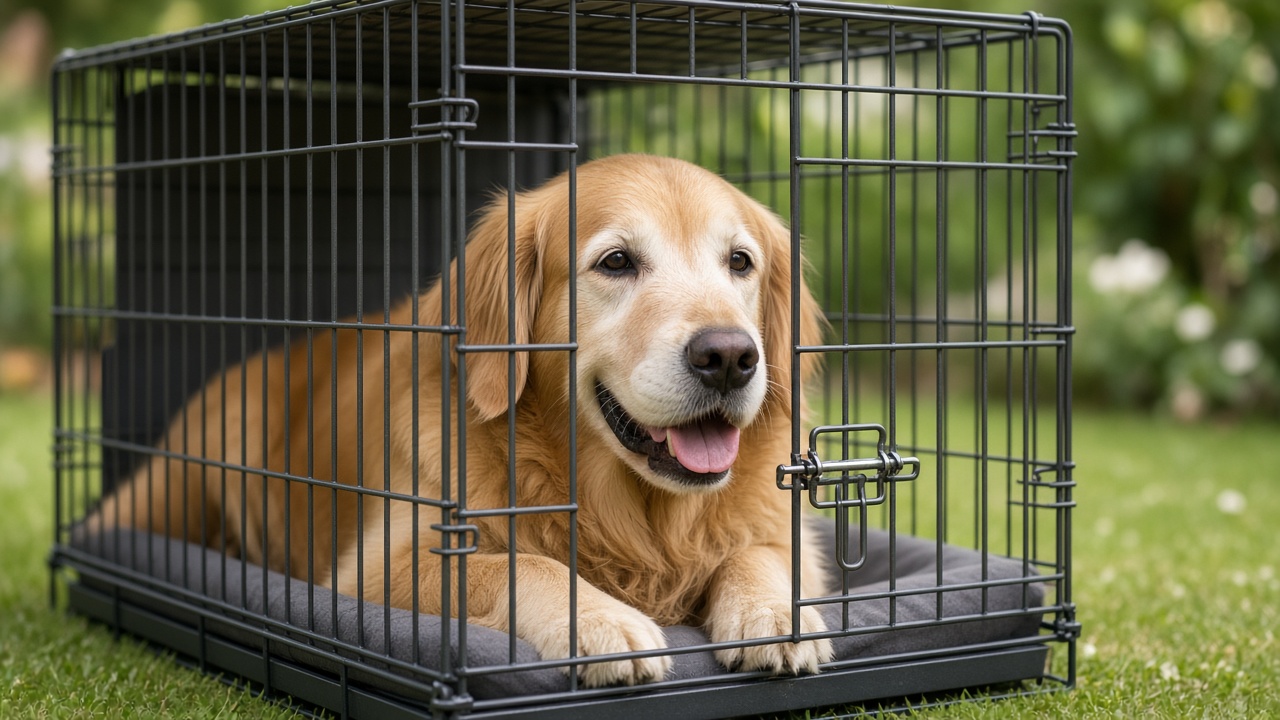
MidWest Homes for Pets lists the iCrate Dog Crate in 7 sizes, from 18-inch to 48-inch. The maker page says it includes a divider panel to adjust living space. It also lists a removable leak-proof plastic pan.
That divider is the housetraining part. Buy the adult length. Close the unused end until the dog fills the remaining floor.
For a growing puppy, start with a divider and a crate sized for puppies. Do not give the full adult floor yet.
Large breeds outgrow a 36-inch body fast. For 42-inch or 48-inch length, see our large-dog crate guide. Still install the divider until house training holds.
A plastic airline kennel can feel more den-like. It also hides messes. Wire crates show wet spots sooner.
Measure the dog standing. Nose to rump is length. Floor to head or ear tip is height.
Pick the smallest listed crate that still allows a turn. If accidents continue, do not add floor. Add outdoor trips.
Clean leftover urine so the crate stops smelling like a toilet
Dogs return to urine they can still smell. The American Kennel Club says lingering odor pulls a puppy back to the same spot. Today’s Veterinary Practice says residual odor may encourage resoiling.
Ordinary dish soap is not enough. Enzyme formulas need contact time.
Our research team analyzed four current maker pages. Listed wait times for new stains run from 5 minutes to 60 minutes. The table lists only attributes the makers publish.
Nature’s Miracle Stain & Odor Remover for Dogs says to soak, wait 10 minutes, then blot, and to dry 24 hours. Its chart lists 4 ounces for a 9 to 12 inch soft stain.
Simple Solution Extreme Stain and Odor Remover lists 32 oz and 1 gal sizes. Wait 5 or more minutes. On carpet, cover 2 times the mess, including the pad.
Rocco & Roxie Professional Strength Stain and Odor Eliminator lists 32 oz and gallon sizes. New stains sit 30 to 60 minutes. Deep odor sits at least 1 hour.
OUT! PetCare Advanced Stain & Odor Remover is a 32 oz bottle. It lists a 3X Pro-Bacteria formula, 2 times the carpet area, and at least 5 minutes.
| Product | Maker-listed size | Wait time on the label | Surfaces or crate use listed | Extra listed spec |
|---|---|---|---|---|
| Nature’s Miracle Stain & Odor Remover for Dogs | Dose chart from ½ oz to 32 oz by stain size | 10 minutes, then blot; 24 hours to dry | Carpets, hard floors, furniture, fabrics | 4 oz for a 9–12 inch soft stain |
| Simple Solution Extreme Stain and Odor Remover | 32 oz or 1 gal | 5 or more minutes | Carpet, upholstery, bedding, clothing | Cover 2× the mess, including pad |
| Rocco & Roxie Professional Strength Stain and Odor Eliminator | 32 oz or gallon | 30–60 minutes for new stains | Carpets, kennels, carriers, crates | CRI Seal of Approval |
| OUT! PetCare Advanced Stain & Odor Remover | 32 oz | At least 5 minutes | Carpet and padding; old and new spots | 3X Pro-Bacteria and enzyme |
| MidWest iCrate Dog Crate | 7 sizes, 18-inch to 48-inch | Divider sets the usable floor | Housetraining crate with leak-proof pan | Single or double door; Paw Block latch |
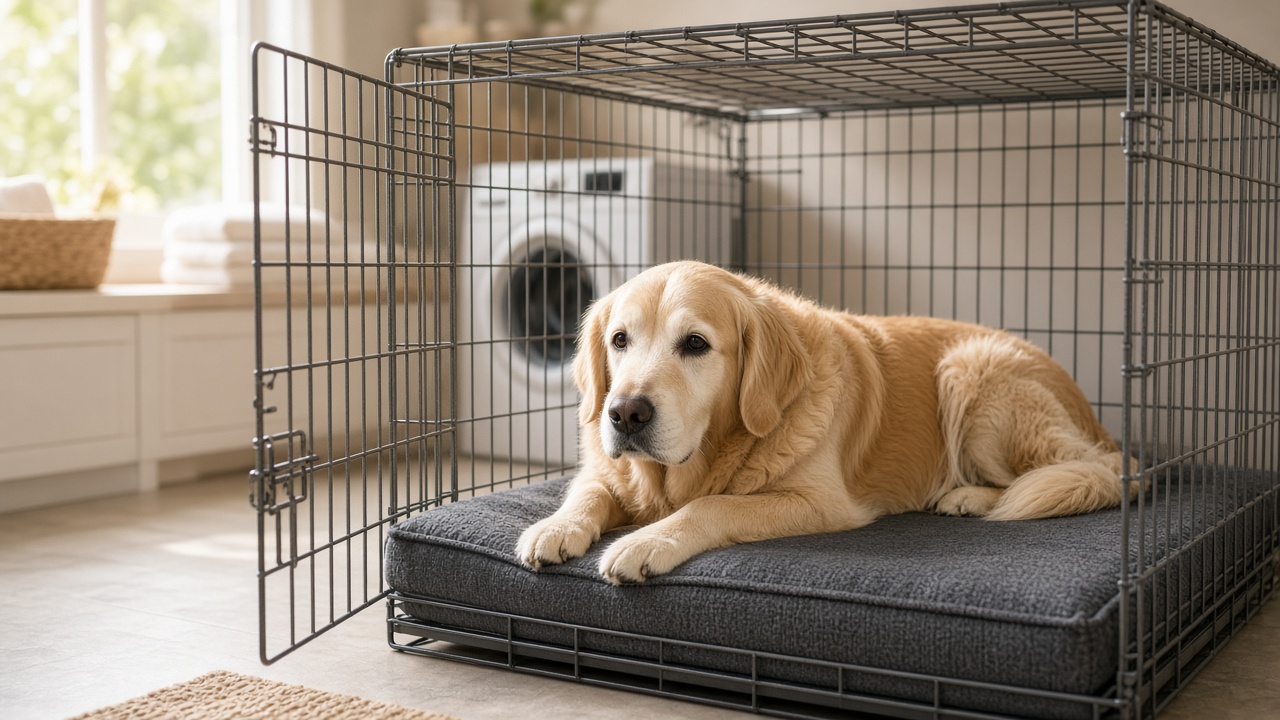
Pull the pan. Wash hard plastic with the enzyme, not bleach first. Bleach can mask odor for you and leave scent for the dog.
Wash washable pads on hot after a pre-soak in enzyme. If a pad still smells, remove it for a week.
Do not put puppy pads inside the crate. A pad teaches “this box is a toilet.”
Bedding, fear, and a seven-day reset
Soft bedding is a comfort, not a right, during a soiling streak. Some dogs pee on anything absorbent, then shove it aside.
The American Kennel Club says some puppies prefer to pee on something soft. Take the bed out until the crate stays dry for several days.
Fear peeing is different. The Journal of Shelter Medicine survey put separation distress at 24% of dog homes. A dog who only soils when you leave is not asking for a bigger crate.
Do not punish that dog. The American Veterinary Society of Animal Behavior says later punishment teaches hiding, not outdoor peeing.
The 2007 Journal of the American Veterinary Medical Association study found briefed owners used verbal punishment less often. The split was 27.8% versus 49.2%.
Old kennel habits need a reset, not a scolding. Go back to puppy timing. Outdoor trip, then a short crate nap, then another trip.
Reward the outdoor pee at the spot, not in the kitchen. Today’s Veterinary Practice says complete house training is not established until 8 weeks pass with no indoor soiling.
If crate panic is the main event, stop stretching alone time. Work with a trainer who uses food and short absences.
Day 1 is measurement and cleaning. Time the last outdoor pee to the next crate accident.
That number is your new maximum hold, minus 30 minutes. Empty the pan. Soak every wet corner with an enzyme product from the table.
Days 2 to 4 shrink the floor. Set the MidWest iCrate divider so the dog cannot leave a wet corner. Go out after sleep, meals, play, and before every crate period.
Days 5 to 7 add 15 minutes only if the crate stayed dry. If it did not, cut 15 minutes.
If the dog is still flooding the crate after a week of short holds, ask a clinic to check urine. We compared labels and studies. We did not examine your dog.
FAQ
Why does a house-trained dog suddenly pee in the crate?
A new medical problem is the first split. Today’s Veterinary Practice puts medical causes at the top for sudden soiling in adults.
A longer workday, more water, or fewer walks can overflow a bladder that used to cope. Scent from one missed accident can restart the habit.
Should I put puppy pads in the crate?
No. A pad tells the dog the crate is an approved toilet. That fights the den instinct the American Veterinary Society of Animal Behavior describes, so never use pads as crate flooring.
How do I clean a crate after urine?
Lift the pan. Soak urine lines with an enzyme cleaner and wait the time on that bottle.
Nature’s Miracle lists 10 minutes before blotting. Simple Solution Extreme and OUT! Advanced list about 5 minutes.
Rocco & Roxie lists 30 to 60 minutes for new stains.
Is the crate too big if my dog pees in one end?
Often yes. Extra floor lets the dog keep a wet room and a dry room.
MidWest Homes for Pets ships the iCrate with a divider for that reason. Close the unused length until the dog only has stand-turn-lie space.
How long can an adult dog stay in a crate overnight?
Overnight is usually longer than a daytime hold. The dog is asleep and drinks less.
It is still not a 12-hour lock-in. The American Kennel Club flags 10 to 12 hours as too long.
Will yelling stop crate peeing?
It usually makes the next accident secret. The American Veterinary Society of Animal Behavior says delayed punishment does not connect to the pee.
Reward the outdoor pee. Clean the crate. Shorten the hold.
When should I call a clinic instead of changing the crate?
Call when crate peeing is new in an adult. Also call if you see straining, blood, huge thirst, or accidents in other rooms.
Call when a puppy never stays dry despite 30 to 60 minute holds. Training cannot fix an infection.